
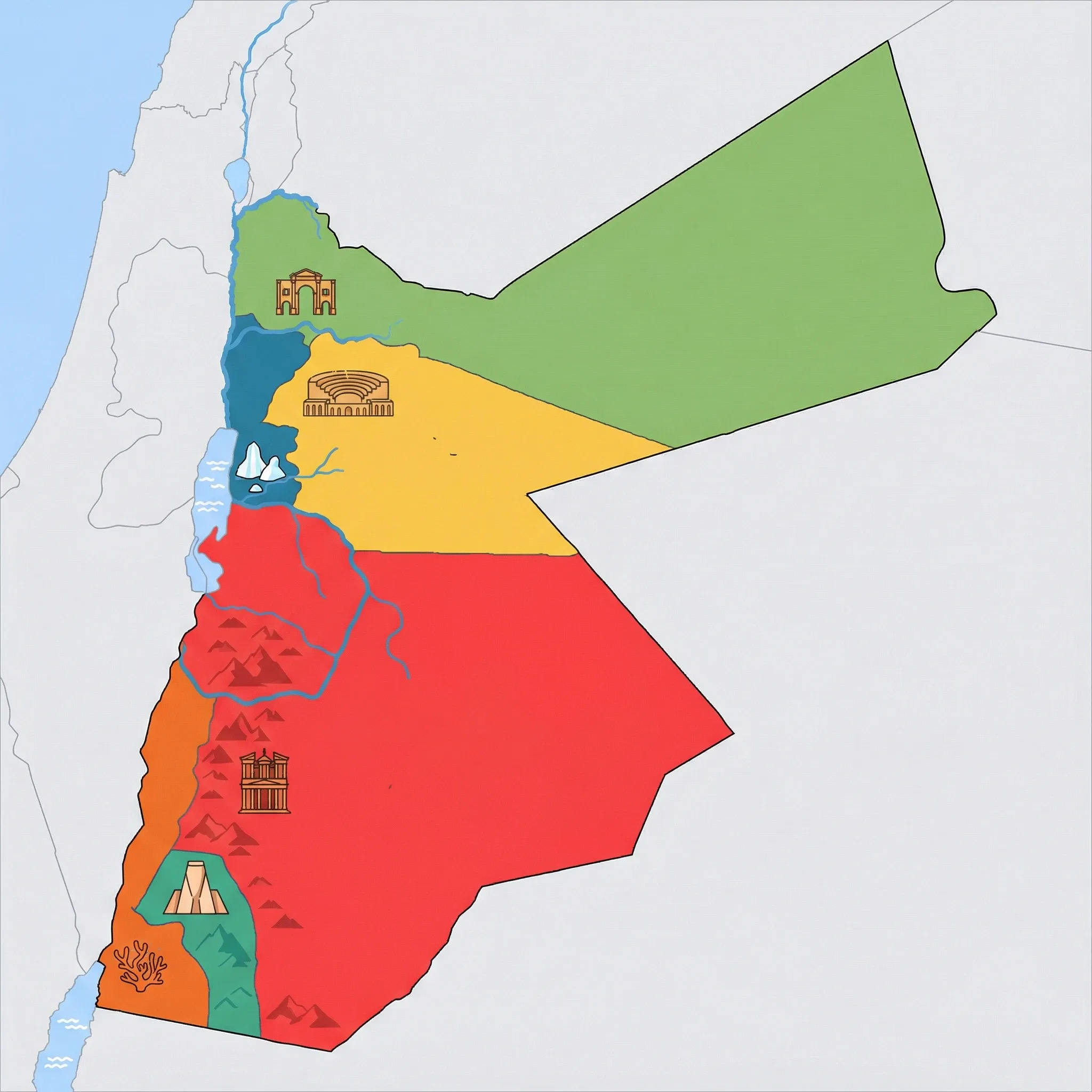
Click a region to explore
Overview
Northern Jordan offers a surprising contrast to the arid landscapes usually associated with the country. Here, the rolling hills of Gilead are blanketed in olive groves, pine forests, and wildflowers in the spring. For families, the crown jewel is the Jerash Archaeological Site, one of the best-preserved Roman provincial cities in the world. Unlike museums where items are behind glass, Jerash is a tactile experience. Children can walk on the original chariot tracks in the stone streets, whisper messages across the vast amphitheaters to test the acoustics, and touch the cool limestone of the towering columns. It is history on a grand, walkable scale.
Beyond the Romans, the north offers medieval adventure at Ajloun Castle. Perched high on a hill, this 12th-century fortress was built to defend against Crusaders. Its maze of vaulted passages, dark chambers, and spiral staircases is perfect for young explorers. The region is also cooler than the rest of the country, making it a pleasant escape during warmer months. The relaxed, rural atmosphere allows for picnics in the Ajloun Forest Reserve, where families can enjoy easy hiking trails and spot local wildlife like the roe deer.
Key Attractions
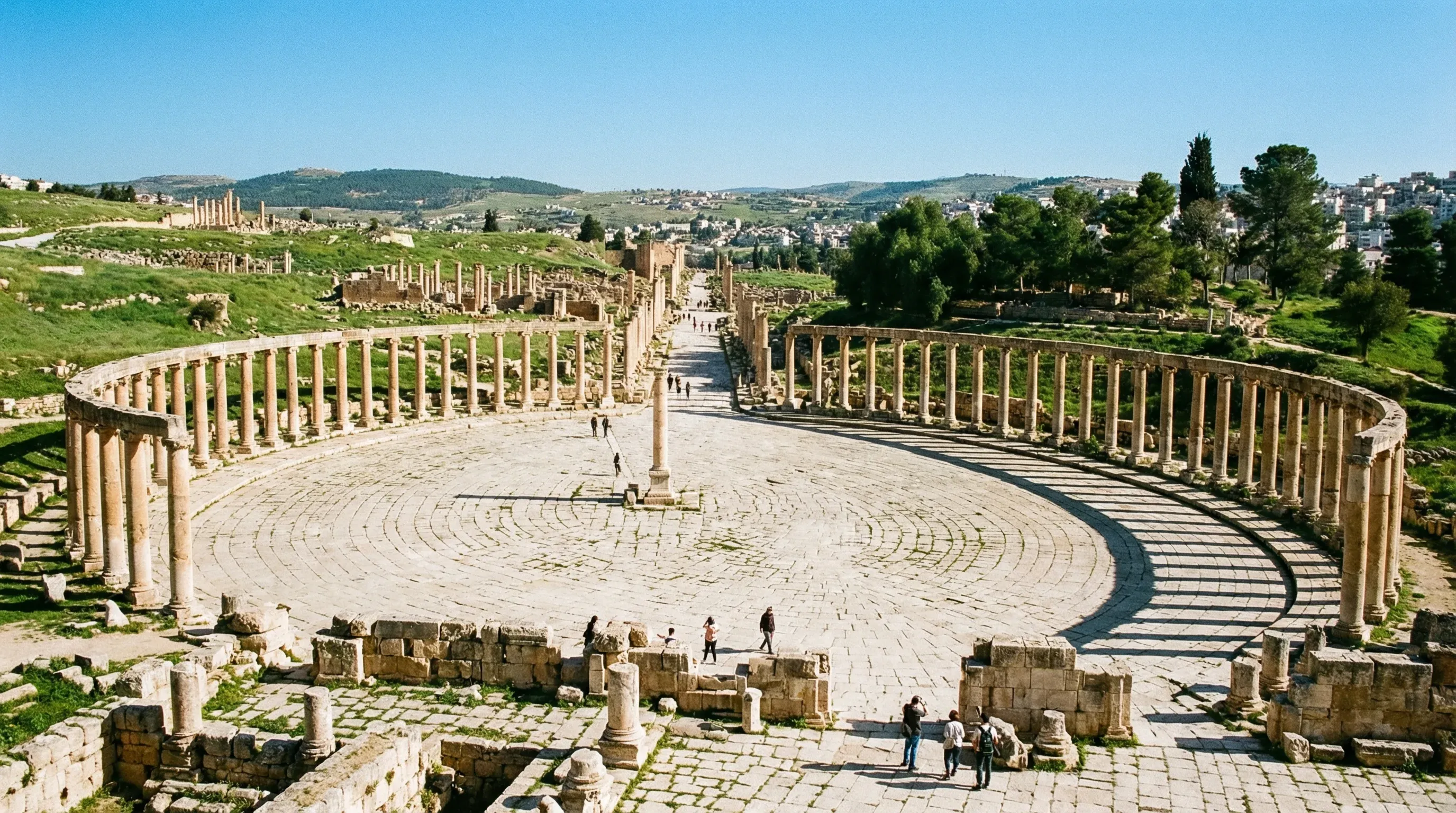
The Jerash Archaeological Site requires at least half a day. Enter through the imposing Arch of Hadrian and make your way to The Oval Plaza, a magnificent asymmetrical plaza surrounded by 56 Ionic columns. It is a fantastic spot for family photos. Don't miss the demonstration of Roman Army tactics and chariot racing at the hippodrome (check seasonal schedules), which brings the ruins to roaring life for kids.
Further north, near the border, lies the Umm Qais Archaeological Site (Gadara). Constructed from striking black basalt stone, it offers breathtaking views over the Sea of Galilee and the Golan Heights. It is quieter than Jerash and offers a poignant geography lesson about the region's borders. Back near Ajloun, the Ajloun Forest Reserve provides a nature break with eco-cabins and trails specifically designed for educational walks.
Practical Advice
Spring (March–May) is the absolute best time to visit, as the ruins are surrounded by green grass and wildflowers. Summer can be hot and exposed at Jerash, so bring hats and plenty of water. There is very little shade in the ruins. Good walking shoes are non-negotiable; flip-flops are dangerous on the uneven ancient stones.
Food & Drink
Typical meal times: Lunch is typically 1:00 pm to 3:00 pm. In this agricultural region, farm-to-table style dining is common.
Typical meal costs: Very affordable. A large meal in a local restaurant costs 10–20 JOD (approx. $14–28 USD / €13–26 EUR) for a family.
Dietary requirements: This is olive country. Dishes are rich in olive oil and fresh vegetables. Vegan options are plentiful (salads, dips, vine leaves).
Signature dishes:
- Gallayet Bandora – A simple but delicious stew of tomatoes, garlic, olive oil, and hot peppers (can be requested mild), often scooped up with bread.
- Makmoura – A traditional northern Jordanian dish meaning "buried." It consists of layers of dough, chicken, onions, and lots of olive oil, baked until golden.
- Fresh Olive Oil & Za'atar – The region produces the country’s best oil. Dipping fresh bread into oil and thyme (za'atar) is a staple breakfast or snack.
Why this score?
The region features the greenest terrain in Jordan, with hiking opportunities in the Ajloun Forest Reserve. Exploring the expansive archaeological sites involves significant walking, but the infrastructure remains relatively accessible and family-friendly.
Why this score?
Northern cities like Irbid and Jerash have decent public and private hospitals that serve the local population. While functional for basic needs, these facilities lack the specialized international patient services found in the capital city of Amman.
Why this score?
Jerash is home to some of the world's best-preserved Roman ruins and is a staple of almost every Jordanian tour itinerary. However, it functions primarily as a day-trip destination from Amman, leading to lower overnight international stay numbers compared to the south.

The North is generally cheaper than Amman or Petra. Entry to Jerash is included in the Jordan Pass (or 10 JOD without). Local dining is excellent value. Accommodation is limited compared to other regions, but guesthouses and eco-lodges in Ajloun offer unique stays for 40–80 JOD (approx. $55–110 USD / €52–105 EUR).

Getting Here & Around
Getting Here
- Driving – Jerash is a 50-minute drive north of Amman on a well-paved highway. Ajloun is another 20 minutes west of Jerash.
- Bus – Public buses leave from Amman's North Bus Station (Tabarbour) when full. They are cheap but can be confusing for non-Arabic speakers.
- Tours – Most families opt for a private driver or organized day tour from Amman, which allows for visiting both Jerash and Ajloun in one day.
Getting Around
- Walking – Inside the archaeological sites, you must walk. Jerash is vast; expect to walk several kilometers. Strollers are difficult to use due to the original Roman paving stones and stairs.
- Car – Necessary to travel between Jerash, Ajloun Castle, and Umm Qais as they are spread out across the governorates.
No airports in this region. See the country flight map for nearby connections.
Official Links

Packing List
Jerash has almost no shade and the white stone reflects the sun intensely.
Standard strollers will fail on Roman cobblestones; a carrier is best for babies.
The pine forests around Ajloun are perfect for a family picnic, a popular local weekend activity.
The north gets significantly more rain than the rest of Jordan, especially Dec-Feb.
The Dead Sea bed is covered in sharp salt crystals that can cut feet; standard flip-flops may get ruined by the brine.
Essential for shielding your face from sand and dust during 4x4 jeep tours in Wadi Rum.
The combination of dry desert air and intense salinity at the Dead Sea dehydrates skin very quickly.
Flies can be surprisingly persistent and annoying in Petra and Wadi Rum, especially near animals.
Many Bedouin camps in Wadi Rum have limited electricity or turn generators off at night.
Desert temperatures drop drastically at night; it can be freezing in Wadi Rum even after a hot day.

Activities & Best Times

Urban tourism, museums, historical sites, architecture
Jerash is one of the world's best-preserved Roman Decapolis cities, offering an authentic, world-class archaeological experience. Spring and autumn provide ideal walking temperatures; summer is classified as off-peak due to intense, direct sun exposure with minimal shade at the ruins.

Hiking, wildlife, outdoor exploration, ecotourism
Home to the rare evergreen oak forests of Ajloun and Dibbeen, offering high-quality hiking on the Jordan Trail. Spring (March-May) is peak for spectacular wildflower blooms and lush greenery, while summer heat and winter rains make those periods less hospitable.

Sport tourism, fitness activities, active recreation
The region features world-class infrastructure for endurance sports, specifically the Northern Jordan Trail and Jordan Bike Trail. Optimal conditions for these high-exertion activities are restricted to the mild transition months, avoiding the extreme summer heat and winter mud.

Spa retreats, wellness centers, peaceful getaways
Features authentic Roman-era thermal baths and natural hot springs like Al-Himma, which offer a unique historical wellness experience. These are most popular and effective during the cooler winter months; the summer heat makes thermal bathing unappealing.

Scenic drives, countryside tours, route-based travel
The Yarmouk Valley and northern stretches of the King's Highway provide scenic driving through Mediterranean-style landscapes and dramatic ridges. Peak visibility and the most beautiful green scenery occur in spring, while winter rain can make mountain driving less predictable.

Learning experiences, scientific sites, historical education
The Jordan Natural History Museum offers notable scientific engagement, though it remains a secondary draw compared to the region's archaeological sites. Best visited during the primary tourism windows when the surrounding educational context of the ruins is most accessible.

Events, celebrations, seasonal attractions
The Jerash Festival of Culture and Arts is a major international event that transforms the ancient city into a living theater. While high-quality and unique, the event is strictly limited to the mid-summer period, which dictates the narrow peak window.

Attractions (13 total)



Public Holidays & Calendar Next 12 months
Public holidays, festivals, cultural celebrations, and seasonal natural phenomena coming up in Jerash & North over the next 12 months.
Loading holidays and events...

Travel Advisory
All major agencies have recently elevated their warnings to the second-highest level due to a severe escalation in regional military conflict. Travelers are advised to defer non-essential trips as security conditions are volatile and could worsen without notice. This consensus is driven by risks of military activity, terrorism, and potential airspace closures.
Safety Topics
Traveller Advice (3 groups)

Respect local cultural standards by dressing modestly and avoiding traveling alone after dark, particularly in less tourist-heavy areas.

While private acts are not legally prohibited, public displays of affection are not socially accepted and may lead to harassment or legal scrutiny under public morality laws.

Ensure you have an emergency supply of food, water, and medication. Register your presence with your national embassy to receive urgent updates and be prepared to follow shelter-in-place orders during security incidents.
Agency Summaries
Regional escalation has created significant security risks and potential for travel disruption. Extremist attacks are considered very likely and could be indiscriminate. The government specifically advises against any travel within 3km of the Syrian border.
Heightened potential for neighboring conflicts in Syria and Israel to impact Jordan's safety. New Zealanders should maintain high personal security awareness and avoid large public gatherings which can turn violent quickly.
Citizens are advised to limit travel to essential trips only as the regional security situation is closely monitored. Those currently in the country should monitor local media and be prepared to shelter in place if instructed by authorities.
The risk level was raised due to the volatile regional security environment and the threat of retaliatory strikes. Australians are urged to avoid potential targets like diplomatic missions, military sites, and energy infrastructure.
The Department of State has ordered the departure of non-emergency government personnel and their families due to safety concerns. Travelers should reconsider visits because of terrorism risks and potential armed conflict. Certain areas, including border regions and specific neighborhoods like Baqa'a, are under 'Do Not Travel' warnings.
The security situation has deteriorated due to regional hostilities, resulting in an increased risk of military debris from intercepted projectiles and sudden airspace closures. Highly dangerous conditions exist near the borders with Syria and Iraq.
Information is provided for general guidance only and does not constitute travel, safety, medical, or legal advice. Conditions may change. Users are responsible for independently verifying information before travel.