
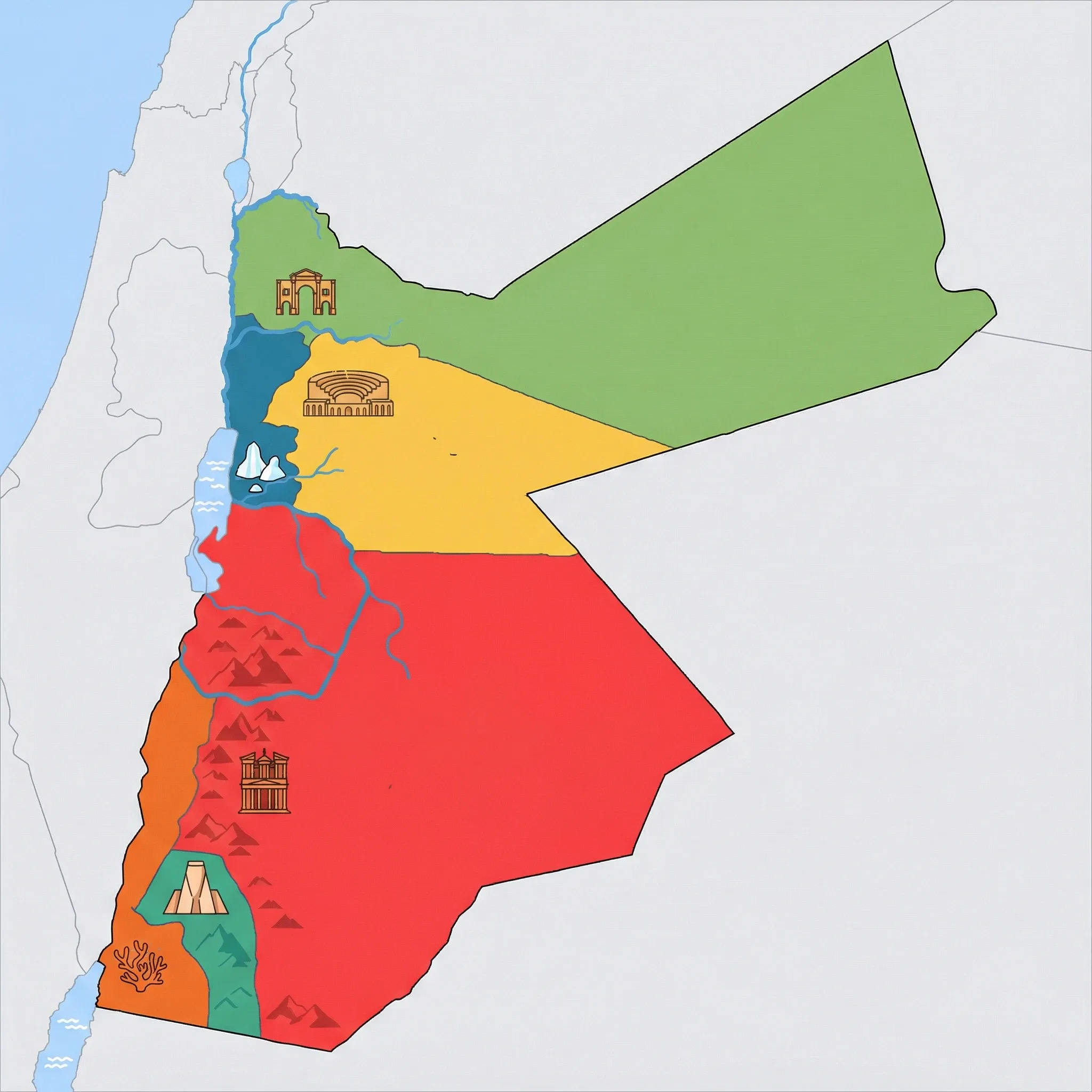
Click a region to explore
Overview
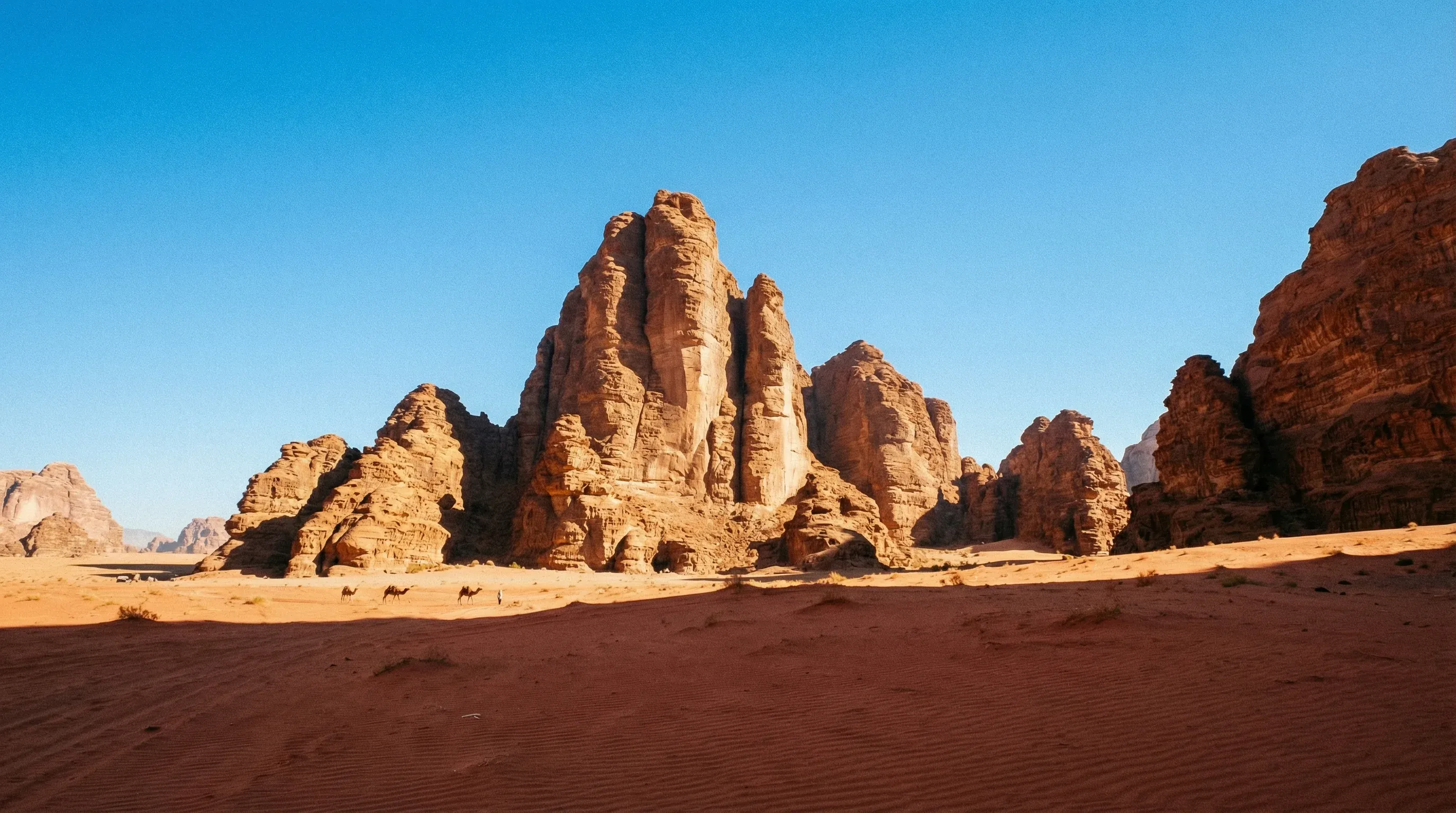
Wadi Rum is a place of silence, scale, and stunning beauty. For families, it is often the highlight of a Jordan trip because it offers pure adventure. The landscape is surreal—vast stretches of red ochre sand interrupted by abrupt, towering sandstone mountains that look like melting wax. It has served as the filming location for The Martian, Star Wars, and Aladdin, facts that instantly engage children's interest. Unlike a typical desert of endless flat sand, Rum is a maze of canyons and rock bridges that invite exploration.
The experience centers on Bedouin hospitality. Families typically stay in camps ranging from basic goat-hair tents to luxury "Martian domes" with private bathrooms and air conditioning. The lack of light pollution makes for some of the best stargazing in the world; kids can see the Milky Way with the naked eye. Days are spent bouncing around in the back of 4x4 pickup trucks (a thrill in itself), running down massive sand dunes, and sitting around campfires drinking sweet tea while listening to local stories. It is a digital detox where nature provides the entertainment.
Key Attractions
The Wadi Rum Protected Area is the zone where all the major sites are located. Tours are essential. The most popular stops for families include the sand dunes (great for rolling down), the Khazali Canyon (where you can see ancient petroglyphs and Thamudic inscriptions on the rock walls), and the Um Fruth Rock Bridge (scramble up for a photo). The sheer experience of driving through the desert, stopping to watch the sunset turn the mountains a burning red, is the main attraction. Taking the scenic The King's Highway (Highway 35) to reach the general area is also part of the journey's appeal, offering dramatic views before you even hit the sand.
Practical Advice
Spring (March–May) and Autumn (Oct–Nov) are ideal. Winters can be freezing at night (literally below zero), and summers are blistering. Important: Most camps run on solar power. Electricity might be limited to evenings. There is no cell signal in the deep desert. Bring cash, as camps often don't have card machines for extras like camel rides.
Food & Drink
Typical meal times: Breakfast is served 7:00 am to 9:00 am. Dinner is the main event, served after sunset (around 7:30 pm to 9:00 pm).
Typical meal costs: Meals are almost always included in your camp accommodation price (half-board). Lunch during jeep tours is usually a simple box meal or Bedouin cookout costing 5–10 JOD per person.
Dietary requirements: Camps serve buffet style. Vegetarians are easily catered for with rice, salads, and vegetable stews.
Signature dishes:
- Zarb – The quintessential Wadi Rum experience. Layers of meat (chicken/lamb) and vegetables are placed on a tiered rack and lowered into an underground pit filled with hot coals. It is covered with sand and left to slow cook for hours. The "unearthing" of the Zarb is a ceremony the kids will love watching.
- Bedouin Tea – Sweet, black tea brewed with sage (maramia) or thyme, offered as a sign of welcome everywhere you go.
Why this score?
This is a vast, remote desert wilderness where visitors travel by 4x4 or camel across deep sand and rocky canyons. The extreme temperatures, lack of paved roads, and off-grid camping make it a high-adventure environment that requires careful preparation.
Why this score?
Medical facilities in the protected area are virtually non-existent, with only a basic clinic at the visitor center. Any serious injury in the deep desert requires a difficult evacuation to Aqaba, and emergency response times can be very slow due to the terrain.
Why this score?
Famous as a filming location for Hollywood blockbusters, Wadi Rum is a top-tier destination for desert tourism. Its unique 'Martian' landscapes and Bedouin camp experiences draw high numbers of international travelers seeking an iconic desert stay.

Costs vary wildly based on camp luxury. A basic tent with shared bathroom can be 20 JOD/night, while a luxury bubble tent can be 150–250 JOD (approx. $210–350 USD / €195–325 EUR). Jeep tours are an extra cost, typically 35–60 JOD per vehicle (not per person) for a 3-4 hour tour.

Getting Here & Around
Getting Here
- Driving – Access is via the Desert Highway. You park your rental car at the Wadi Rum Visitor Center or the Rum Village parking lot. From there, your camp's 4x4 will pick you up. Do not attempt to drive a regular rental car into the sand!
- Bus – There is one daily JETT bus from Aqaba and Petra.
- Taxi – A taxi from Aqaba takes about 1 hour and costs approx. 25–30 JOD.
Getting Around
- 4x4 Jeep – The only way to see the Wadi Rum Protected Area. Tours are booked via your camp or the visitor center. They are open-backed pickup trucks with bench seats.
- Camel – Short rides (30 mins to 1 hour) are a fun way for kids to experience the desert pace, usually arranged by your camp.
No airports in this region. See the country flight map for nearby connections.
Official Links

Packing List
Camps can be very dark at night and electricity is often turned off late; essential for bathroom trips.
Water is precious in the desert; washing facilities can be basic or distant during jeep tours.
The stargazing is incredible, but you won't have signal to look up constellations online.
Desert temperatures drop drastically at night, even after a hot day. You will need warmth for the campfire.
The Dead Sea bed is covered in sharp salt crystals that can cut feet; standard flip-flops may get ruined by the brine.
Essential for shielding your face from sand and dust during 4x4 jeep tours in Wadi Rum.
The combination of dry desert air and intense salinity at the Dead Sea dehydrates skin very quickly.
Flies can be surprisingly persistent and annoying in Petra and Wadi Rum, especially near animals.
Many Bedouin camps in Wadi Rum have limited electricity or turn generators off at night.
Desert temperatures drop drastically at night; it can be freezing in Wadi Rum even after a hot day.

Activities & Best Times

Hiking, wildlife, outdoor exploration, ecotourism
Wadi Rum is a UNESCO World Heritage site and globally recognized as one of the world's premier desert wilderness experiences. It should be rated 'excellent' to reflect its status as a bucket-list adventure destination.

Urban tourism, museums, historical sites, architecture
While Nabataean petroglyphs and archaeological sites are present, Wadi Rum is fundamentally a nature/adventure destination. The cultural elements are supplementary. 'Good' better reflects the secondary nature of cultural attractions here.

Scenic drives, countryside tours, route-based travel
Celebrated for its 4WD desert circuits and access via the historic King's Highway. While vehicle-based tours offer protection, the peak months provide the most pleasant conditions for the frequent stops required to see major landmarks.

Sport tourism, fitness activities, active recreation
Features internationally recognized trekking routes and aero sports facilities. Physical exertion is best scheduled for the transition seasons to avoid the risk of heat exhaustion in the peak of summer or extreme cold in January.

Learning experiences, scientific sites, historical education
Offers specialized stargazing at Rum Sky and geological education at the Visitor Centre. Stargazing is optimal during months with clear skies and manageable overnight temperatures.




Public Holidays & Calendar Next 12 months
Public holidays, festivals, cultural celebrations, and seasonal natural phenomena coming up in Wadi Rum over the next 12 months.
Loading holidays and events...

Travel Advisory
All major agencies have recently elevated their warnings to the second-highest level due to a severe escalation in regional military conflict. Travelers are advised to defer non-essential trips as security conditions are volatile and could worsen without notice. This consensus is driven by risks of military activity, terrorism, and potential airspace closures.
Safety Topics
Traveller Advice (3 groups)

Respect local cultural standards by dressing modestly and avoiding traveling alone after dark, particularly in less tourist-heavy areas.

While private acts are not legally prohibited, public displays of affection are not socially accepted and may lead to harassment or legal scrutiny under public morality laws.

Ensure you have an emergency supply of food, water, and medication. Register your presence with your national embassy to receive urgent updates and be prepared to follow shelter-in-place orders during security incidents.
Agency Summaries
Regional escalation has created significant security risks and potential for travel disruption. Extremist attacks are considered very likely and could be indiscriminate. The government specifically advises against any travel within 3km of the Syrian border.
Heightened potential for neighboring conflicts in Syria and Israel to impact Jordan's safety. New Zealanders should maintain high personal security awareness and avoid large public gatherings which can turn violent quickly.
Citizens are advised to limit travel to essential trips only as the regional security situation is closely monitored. Those currently in the country should monitor local media and be prepared to shelter in place if instructed by authorities.
The risk level was raised due to the volatile regional security environment and the threat of retaliatory strikes. Australians are urged to avoid potential targets like diplomatic missions, military sites, and energy infrastructure.
The Department of State has ordered the departure of non-emergency government personnel and their families due to safety concerns. Travelers should reconsider visits because of terrorism risks and potential armed conflict. Certain areas, including border regions and specific neighborhoods like Baqa'a, are under 'Do Not Travel' warnings.
The security situation has deteriorated due to regional hostilities, resulting in an increased risk of military debris from intercepted projectiles and sudden airspace closures. Highly dangerous conditions exist near the borders with Syria and Iraq.
Information is provided for general guidance only and does not constitute travel, safety, medical, or legal advice. Conditions may change. Users are responsible for independently verifying information before travel.