

Kenya is a destination that sparks the imagination like no other. For families, it offers an accessible yet wild adventure that combines the thrill of seeing animals in their natural habitat with rich cultural encounters and relaxing beach time. Geographically, the country is stunningly diverse, stretching from the snow-capped peaks of Mount Kenya region to the turquoise waters of the Mombasa & Coast. The Great Rift Valley slices through the landscape, creating dramatic escarpments and lakes teeming with birdlife.
Culturally, Kenya is incredibly welcoming to children. The concept of jamii (community) is central to daily life, and you will find that locals-from Maasai guides to hotel staff-often treat visiting children with warmth and genuine interest. While the "Big Five" (lion, leopard, elephant, buffalo, rhino) are the main draw, the country also offers unique educational experiences, such as meeting conservationists who protect rhinos or visiting villages to learn about traditional beadwork and bush skills.
Key Attractions
Most family adventures begin in the capital, Nairobi & Central Highlands, which is unique for having a game reserve within the city limits. Nairobi National Park allows you to spot lions with skyscrapers in the background. A non-negotiable stop for families is the Sheldrick Wildlife Trust, where you can watch orphaned baby elephants being fed and playing in the mud-a heartwarming experience that teaches kids about conservation. Nearby, the Giraffe Centre offers the rare chance to hand-feed Rothchild's giraffes from a raised platform.
For the iconic safari experience, the Masai Mara National Reserve in the Masai Mara & Southwest is world-famous, especially during the migration season (July to October). For a more active experience, Hell's Gate National Park in the Lake Nakuru & Rift Valley is one of the few places where you can safely ride bicycles past grazing zebras and gazelles. Families looking for rhinos and chimpanzees should head to the Ol Pejeta Conservancy, which offers excellent junior ranger programmes. In the south, Amboseli National Park is famous for its large elephant herds and views of Mount Kilimanjaro.
After the dust of the savannah, the coast offers a perfect tropical unwind. Diani Beach is consistently voted one of Africa's best beaches, with calm, shallow waters ideal for kids. For a dose of history, the 16th-century Fort Jesus Museum in Mombasa brings the region's swashbuckling Portuguese and Omani history to life.
Practical Advice
The best time to visit is during the dry seasons (June to October and January to February) when wildlife viewing is easiest. Families should ensure vaccinations (including Yellow Fever) are up to date and take malaria prophylaxis. Pack warm layers for early morning game drives, which can be surprisingly chilly. Visas have been replaced by an Electronic Travel Authorisation (eTA), which all visitors (including children) must obtain online before travel.
Safety
While Kenya is a popular tourism hub, it is important to be aware of safety. The main tourist circuits (national parks, beaches, and secure zones in Nairobi) are generally safe and heavily policed. However, crime can occur in cities; avoid walking after dark and use trusted transport like Uber or hotel taxis. Travellers are strongly advised to avoid the border areas with Somalia (parts of Lamu, Garissa, Wajir, and Mandera counties) and the northern borders near South Sudan due to security risks. Always check the latest government travel advice before your trip.
Food & Drink
Typical meal times: Lunch is usually served from 1:00 pm to 2:30 pm, and dinner from 7:30 pm to 9:30 pm. Safari lodges often serve dinner slightly earlier for families.
Typical meal costs: Local meals are cheap, around KES 500–1,200 (approx. $3.70–9.00 USD / €3.40–8.30 EUR). Tourist restaurants and lodge buffets are pricier, ranging from KES 2,500–5,000 (approx. $18.50–37.00 USD / €17.00–34.00 EUR).
Dietary requirements: Vegetarian options are widely available due to the significant Indian cultural influence. Lodges are excellent at catering to allergies if notified in advance, though roadside eateries may have less awareness of gluten or nut cross-contamination.
Family-friendly dining: Kenyans love children, and most restaurants are very accommodating. Highchairs are standard in hotels and tourist restaurants. Buffet-style dining at lodges makes it easy to find something picky eaters will like.
Signature dishes:
- Nyama Choma – Roasted meat (usually goat or beef) served on a communal platter, often eaten with hands-fun for older kids.
- Ugali – A stiff maize porridge that is the national staple; it has a mild doughy taste that serves as a scoop for stews.
- Kachumbari – A fresh tomato and onion salad with coriander and lime, similar to pico de gallo, served as a side.
- Mandazi – Semi-sweet, triangular fried doughnuts often spiced with cardamom, perfect for breakfast or snacks.
- Chapati – Soft, flaky flatbread derived from Indian cuisine, universally loved by children.

Daily costs vary wildly: a beach holiday might cost KES 25,000–40,000 (approx. $185–300 USD / €170–275 EUR) per family, whereas a mid-range safari often starts from KES 100,000+ (approx. $750+ USD / €690+ EUR) per day due to high park fees (often $100+ per adult) and logistics.
Age Suitability





Did you know? Kenya welcomes approximately 1.4 million international visitors per year. Most visitors come from Africa.
Explore Regions
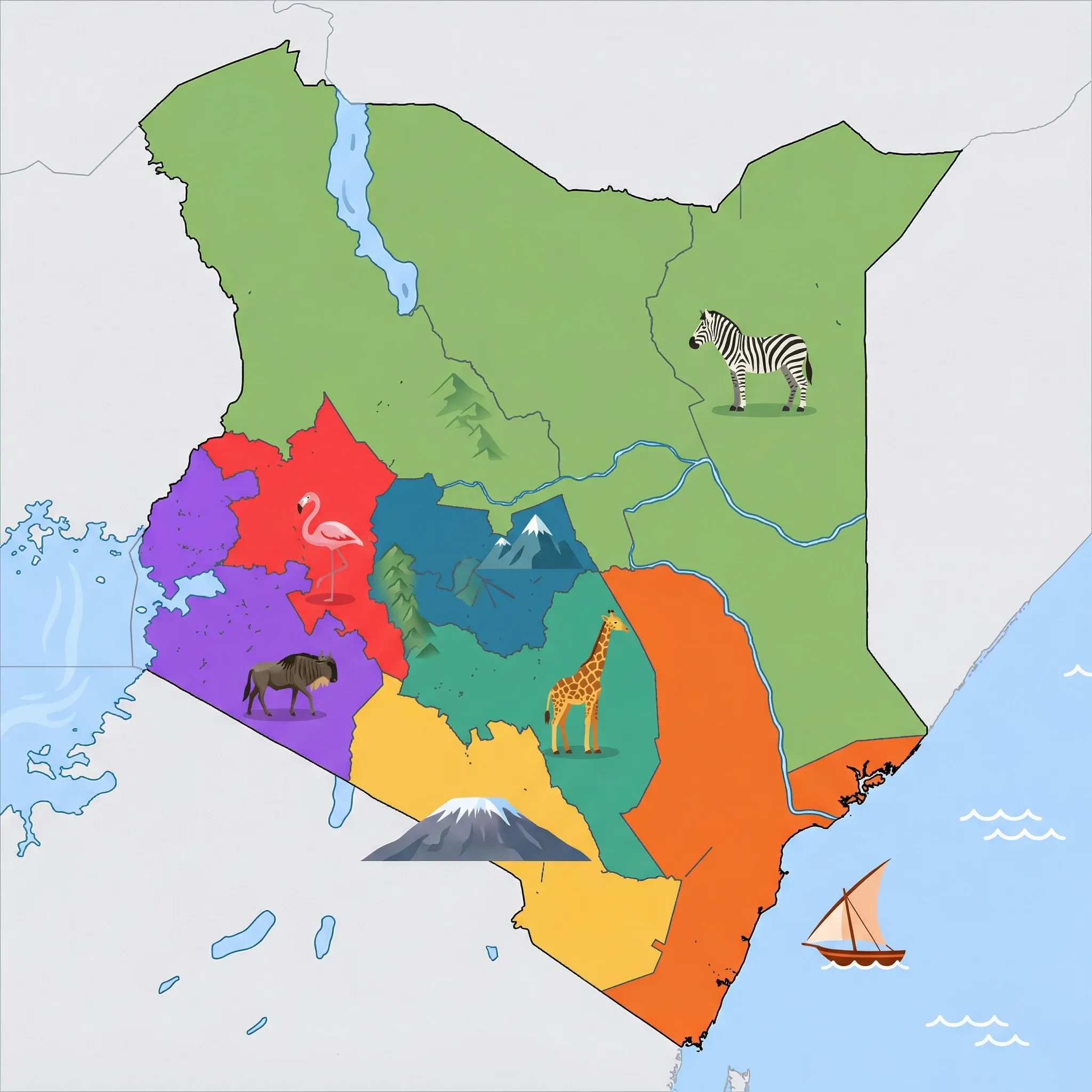
7 Regions
Amboseli & Tsavo (southern parks)
Land of giants under the watch of Kilimanjaro 🐘🏔️
Lake Nakuru & Rift Valley
Lakes, craters, and cycling among the wildlife 🦩🚲
Masai Mara & Southwest
The world's greatest wildlife theatre 🦁🦓
Mombasa & Coast
Where ancient history meets wild coastal beauty 🌴🏰
Mount Kenya region
Snow-capped peaks and rhino sanctuaries 🏔️🦏
Nairobi & Central Highlands
The safari capital of the world 🏙️🦁
Northern Kenya (Samburu, Turkana)
The rugged frontier of the Special Five 🦒🏜️
Click on a region marker to explore details. Use the dropdown to color regions by activity suitability.

Getting There & Around
Getting There
- By Air – Jomo Kenyatta International Airport (NBO) in Nairobi is the primary regional hub. Moi International Airport (MBA) in Mombasa serves the Mombasa & Coast region.
- By Land – Long-distance buses connect to Tanzania and Uganda, but these are often arduous for young children. The Namanga border post is the main entry point from Arusha, Tanzania.
- Entry Requirements – Visas have been replaced by the Electronic Travel Authorisation (eTA). All visitors, including infants, must apply online before travel. Check your government website for the latest visa requirements, or use the IATA Travel Centre entry-requirements checker.
Getting Around
- Domestic Flights – The quickest way to cover long distances, e.g., from Nairobi to the Masai Mara. Carriers like Safarilink and AirKenya operate from Wilson Airport. Note strictly enforced 15kg soft-bag luggage limits.
- Train (SGR) – The Madaraka Express connects Nairobi and Mombasa in roughly 5 hours. It is modern, safe, and scenic, passing through Tsavo where you can spot elephants from the window. Book tickets weeks in advance.
- Private Driver/Guide – The most common option for families. Hiring a 4x4 safari van or Land Cruiser with a driver allows flexibility and comfort. Ensure the vehicle has working seatbelts in the back.
- Taxis – In major cities, use apps like Uber or Bolt for safety and transparent pricing. Avoid hailing random taxis on the street.

Packing List
Small safari planes strictly forbid hard-shell suitcases; bags must be squashed into tight holds.
Safari vehicles are open-sided; fine dust covers everything during game drives.
Avoid dark blue and black which attract painful tsetse flies, and bright white which scares animals.
Many eco-lodges run on solar or generators that turn off at night; essential for bathroom trips.
Single-use plastic bottles are strictly banned in all National Parks and forests.
Animals can be distant; having their own pair keeps kids engaged and prevents arguments.

Activities & Best Times

Adventure & Nature
ExcellentHiking, wildlife, outdoor exploration, ecotourism
A world-class destination offering unique walking and cycling safaris among herds of plains game in dramatic volcanic landscapes like Hell's Gate and Mount Longonot. Peak visitation occurs during the dry seasons when wildlife congregates at water sources and trails are safest for family exploration.
Offers world-class high-altitude trekking on Mount Kenya and elite private conservancy safaris in Laikipia, home to unique species like the Grevy's zebra. Dry seasons provide optimal wildlife viewing and clear mountain vistas, while heavy rains in April-May and November significantly degrade trail conditions.
A world-class safari destination featuring iconic views of Mount Kilimanjaro and unique red elephants in vast wilderness areas. Peak months align with the dry seasons when wildlife congregates at permanent water sources, offering unparalleled viewing opportunities.

Beach & Sea
ExcellentBeach resorts, marine activities: diving, snorkelling, kite surfing, wind surfing, sailing

City & Cultural
Very GoodUrban tourism, museums, historical sites, architecture
Features authentic heritage sites such as Lord Egerton Castle and Hyrax Hill, providing sophisticated families with a deep dive into Kenya's colonial and prehistoric history. These cultural landmarks are accessible most of the year, though the heavy rains of April and May can make rural access roads challenging.
Offers authentic immersion into Maasai culture and significant historical sites like the Taita Hills WWI Museum. Dry seasons provide optimal accessibility and comfort for visiting traditional villages and open-air landmarks.
Nairobi offers a sophisticated blend of colonial history, modern art galleries, and the National Museum, serving as East Africa's cultural heart. The experience is best during dry months to enjoy the city's vibrant street life and the Nairobi Arboretum's botanical collections.

Sports & Active
Very GoodSport tourism, fitness activities, active recreation
Offers exceptional natural infrastructure for high-altitude hiking and rock climbing, with Fischer's Tower and the Mount Longonot crater rim being regional highlights. Activity is best in the drier months to avoid the slippery volcanic soils and flash flood risks in the gorges during the long rains.
Features iconic mountaineering routes and internationally recognized adventure parks like The Forest and Ngare Ndare. Peak months offer the dry, stable conditions required for technical climbing and forest activities, whereas the wet seasons make high-altitude routes dangerous.
Boasts internationally recognized hiking at Ngong Hills and world-class cycling infrastructure in Karura Forest. These activities are highly weather-dependent, with the heavy rains of April, May, and November making trails too muddy and slippery for high-performance use.

Festivals & Seasonal
GoodEvents, celebrations, seasonal attractions
Safari Rally Kenya is a WRC World Championship event that attracts international competitors and spectators. While not as globally prominent as festivals in some regions, it's a major international motorsport event and deserves 'good' rating rather than 'marginal'.
The Great Migration is a world-class seasonal event where millions of wildebeest and zebras traverse the plains, peaking from July to October. Outside of this specific window and the surrounding transition months, the unique natural spectacle that defines this category is absent.

Road Trips & Scenic
GoodScenic drives, countryside tours, route-based travel
The Great Rift Valley Escarpment provides one of the world's most dramatic scenic drives, complemented by accessible lake-side loops. Driving is optimal when visibility is clear and unpaved secondary roads remain firm, avoiding the peak rainy months of April and May.
The Mount Kenya Ring Road and Aberdare Scenic Pass offer spectacular high-altitude driving with diverse ecosystem transitions. Peak months ensure clear visibility of the peaks and safe passage on unpaved sections which can become impassable during the long rains.
The legendary Jade Sea route and the scenic Marsabit highway offer some of Africa's most iconic and challenging expedition driving. These routes require dry conditions for safety on unpaved sections; heavy rains in April and November can make tracks entirely impassable.

Educational & Exploratory
GoodLearning experiences, scientific sites, historical education
Home to globally significant conservation research at Ol Pejeta and the Mount Kenya Wildlife Conservancy. These facilities offer exceptional learning opportunities regarding rhino conservation, with the best accessibility occurring during the region's dry windows.
Home to the world-renowned 'Cradle of Mankind' research sites, offering profound scientific value for families interested in paleoanthropology. Access to these remote research stations is highly dependent on dry conditions, making the peak seasons essential for a successful visit.
Features unique underwater viewing facilities at Mzima Springs for observing aquatic ecosystems, hippos, and fish in a natural setting. The site is best visited during dry months when water clarity is at its peak for scientific observation.

Theme Park & Entertainment
GoodAmusement parks, family entertainment venues
Modern facilities like Two Rivers Theme Park and Maji Magic Waterfront provide world-class family entertainment with international safety standards. Peak timing aligns with school holiday windows and dry weather, as many attractions feature significant outdoor components.
Chaka Ranch provides a solid regional family entertainment experience with high-quality facilities for the area. It is most popular during international and local school holiday peaks, though it does not reach the scale of global 'destination' theme parks.
Small-scale entertainment facilities like Mamba Village and Ngomongo cater to regional families; peak periods align with dry season school holidays.

Relaxation & Wellness
MarginalSpa retreats, wellness centers, peaceful getaways
Natural hot springs and geothermal spa facilities utilize the region's volcanic activity for unique therapeutic experiences. These outdoor-focused wellness spots are most appealing during the dry seasons when cooler air temperatures contrast pleasantly with the warm waters.
Natural thermal features like Lake Magadi and Maji Moto hot springs provide rustic, off-the-beaten-path wellness experiences in a raw wilderness setting. These are best enjoyed when accessibility is high and local humidity is lower during the region's dry periods.

Public Holidays & Calendar Next 12 months
Public holidays, festivals, cultural celebrations, and seasonal natural phenomena coming up in Kenya over the next 12 months.
Loading holidays and events...
Climate & Weather
Amboseli & Tsavo (southern parks)
Show Details
| Month | Temp °C | Rain | Humidity |
|---|
Lake Nakuru & Rift Valley
Show Details
| Month | Temp °C | Rain | Humidity |
|---|
Masai Mara & Southwest
Show Details
| Month | Temp °C | Rain | Humidity |
|---|
Mombasa & Coast
Show Details
| Month | Temp °C | Rain | Humidity |
|---|
Mount Kenya region
Show Details
| Month | Temp °C | Rain | Humidity |
|---|
Nairobi & Central Highlands
Show Details
| Month | Temp °C | Rain | Humidity |
|---|

Travel Advisory
All major global agencies maintain that travel to Kenya requires increased vigilance. While the country is open to tourism, there are persistent threats from terrorism and violent crime. Several agencies escalate their warnings to 'Reconsider Travel' or 'Do Not Travel' for specific regions, particularly those bordering Somalia, South Sudan, and Ethiopia, as well as certain high-crime neighborhoods in Nairobi.
Safety Topics
Traveller Advice (4 groups)

Female travellers should be cautious about travelling alone, particularly in the evening. Sexual assault risks exist in crowded city areas and some beach resorts.

Visitors should avoid displaying high-value items, limit road travel after dark, and use only trusted transportation services. It is essential to monitor local news for updates on security alerts and avoid any areas where large crowds or protests are gathering.

Staff from international organizations are advised that they may be specifically targeted for kidnapping by extremist groups in northeastern counties. Strict organizational security protocols and coordination with local authorities are highly recommended.

Sexual acts between same-sex individuals are illegal and can lead to imprisonment. Given conservative social attitudes, discretion is advised to avoid harassment or legal complications.
Agency Summaries
While general travel is possible, the government warns of a heightened terror threat. Strict 'no-travel' zones exist for areas bordering Somalia and parts of the northern coast.
Citizens are encouraged to maintain high awareness of their surroundings due to political instability, potential for demonstrations, and local security concerns.
Heightened safety risks from terrorism and crime exceed what is typical for New Zealanders. Specific urban neighborhoods and border regions are designated as higher risk.
Travellers should be extremely vigilant due to the pervasive threat of terrorism and high rates of violent crime across the nation.
Increased safety precautions are necessary throughout the country due to the danger of extremist violence and street crime. Regional restrictions apply to volatile border zones.
Vigilance is required because of criminal activity, the risk of terrorist attacks, kidnapping, and periodic civil unrest. Specific border regions carry significantly higher danger.
Information is provided for general guidance only and does not constitute travel, safety, medical, or legal advice. Conditions may change. Users are responsible for independently verifying information before travel.