

Overview
Kiribati is not your typical holiday destination; it is a vast nation of water and coral that challenges experienced travelers and rewards the adventurous. Straddling the equator, this archipelago comprises 33 atolls scattered across 3.5 million square kilometers of the Pacific Ocean. For families, a trip here is an education in geography, history, and resilience. The capital, South Tarawa, bustles with energy and history, while the outer islands offer a tranquil, traditional lifestyle where time seems to stand still. This is a place where children can learn about climate change firsthand, as the nation stands on the frontlines of rising sea levels.
The culture is deeply communal and welcoming to children. The maneaba (community meeting house) is the heart of every village, where elders share stories and decisions are made. While amenities are basic-hot water and air conditioning are not guaranteed everywhere-the richness of the experience lies in the people and the pristine environment. Families visiting Kiribati will find themselves immersed in a culture where fishing, singing, and family bonds are the pillars of daily life.
Key Attractions
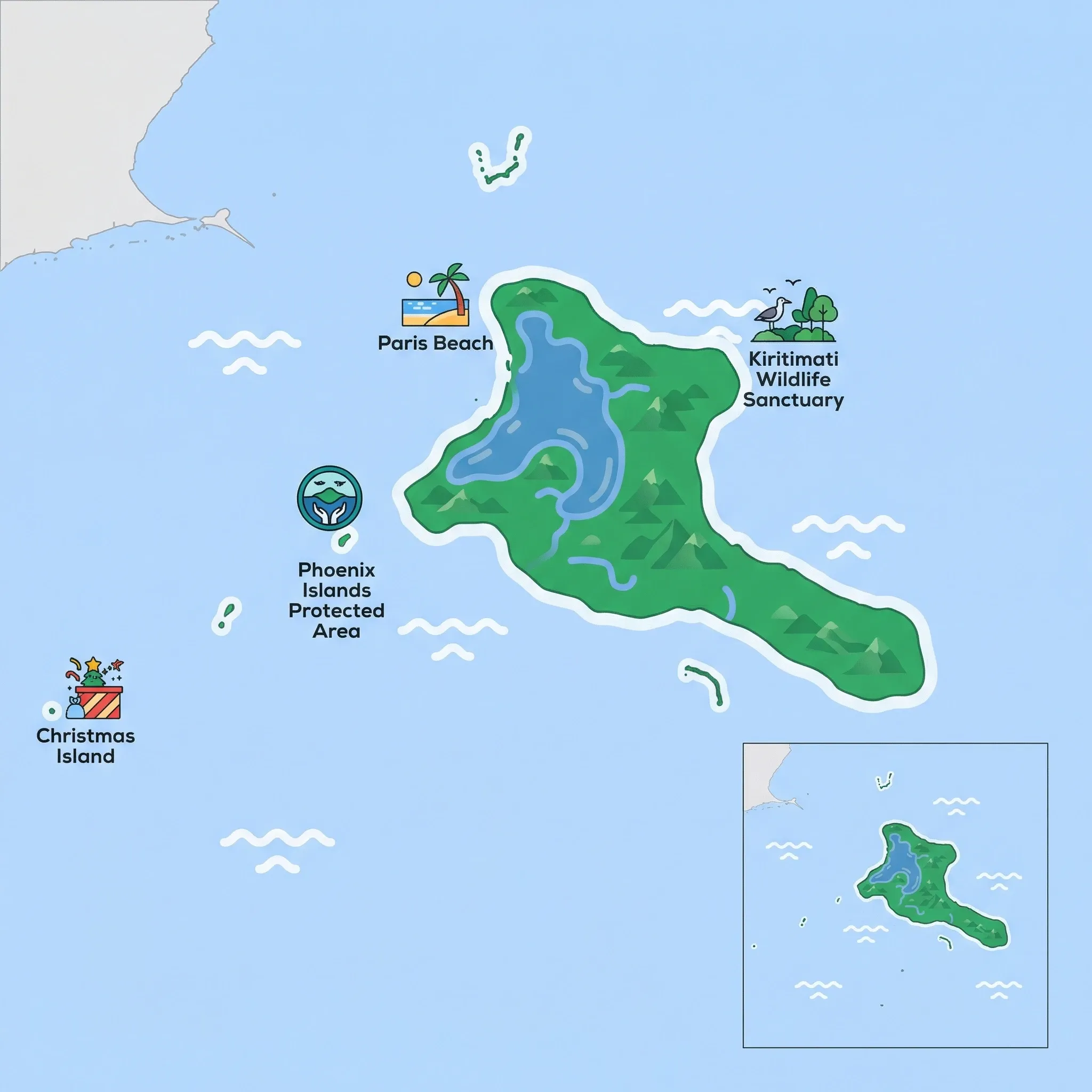
The crown jewel of the nation's natural heritage is the Phoenix Islands Protected Area (PIPA). As one of the largest marine protected areas in the world, it is a UNESCO World Heritage site teeming with untouched coral reefs and birdlife. While access is difficult and often requires a private charter or expedition cruise, its very existence defines the country's commitment to ocean conservation and serves as a profound lesson for young eco-warriors.
More accessible adventures await on South Tarawa, particularly in Betio, where the Battle of Tarawa took place during WWII. Families can explore rusting coastal defense guns, bunkers, and relics scattered across the island-a tangible history lesson for older children. For a change of pace, a boat trip to North Tarawa reveals a quieter world of thatched huts and pristine lagoons, perfect for swimming and canoeing in safety away from the urban bustle. The island of Kiritimati (Christmas Island) in the Line Islands group is another major draw, world-renowned for its birdwatching and fly-fishing, offering families the chance to see massive colonies of seabirds up close.
Practical Advice
Kiribati is a remote destination requiring careful planning. The best time to visit is during the dry season (roughly May to October), though the equatorial climate is hot and humid year-round. Medical facilities are limited, so comprehensive travel insurance with evacuation cover is non-negotiable. Families should bring a well-stocked medical kit. Visas are generally not required for citizens of the US, UK, EU, and Australia for short stays, but always verify before travel. Be aware that credit cards are rarely accepted outside a few hotels in Tarawa; this is a cash economy using the Australian Dollar.
Food & Drink
Typical meal times: Breakfast is usually 7:00 am to 9:00 am, lunch from 12:00 pm to 2:00 pm, and dinner from 6:30 pm to 8:30 pm.
Typical meal costs: $5–15 AUD (approx. $3.50–10 USD / €3–9 EUR) for street food or local stalls; $20–40 AUD (approx. $13–26 USD / €12–24 EUR) for mid-range restaurant meals.
Dietary requirements: The local diet relies heavily on fish, seafood, and coconut. Vegetarians may find options limited to rice, breadfruit, and pumpkin dishes. Gluten-free travelers should be cautious as soy sauce and imported processed foods are common.
Family-friendly dining: Dining is informal and kids are welcome everywhere. Highchairs are rare. Most meals are simple, consisting of grilled fish and rice, which is generally palatable for children.
Signature dishes:
- Te Bubuti – A comfort dish made from fish (or sometimes corned beef) baked with layers of taro leaves and thick coconut cream, similar to lasagna but without pasta.
- Palusami – Young taro leaves cooked with onions and curry powder in coconut cream, often baked in an earth oven.
- Ika Mata – Fresh raw fish marinated in lime juice and mixed with fresh coconut milk and diced vegetables.
- Te Tuae – A preserved dried paste made from the pandanus fruit, a traditional staple often eaten as a sweet snack.
- Roasted Lobster – Freshly caught lobster is abundant and often cheaper here than anywhere else, typically grilled simply with butter or coconut.

While daily living costs like local food and basic transport are low, the high cost of imported goods, accommodation scarcity, and expensive flights balances the budget to a mid-level. A family can expect to spend $150–250 AUD (approx. $100–165 USD / €90–150 EUR) per day on accommodation and meals.
Age Suitability





Did you know? Kiribati welcomes approximately 2,000 international visitors per year. Most visitors come from East Asia and the Pacific.
Why this score?
Kiribati offers significant adventure due to its extreme isolation and the logistical complexity of traveling between its 32 remote atolls. Visitors must contend with infrequent inter-island transport and rugged conditions while exploring un-curated WWII relics on Betio or the pristine wilderness of the Phoenix Islands Protected Area.
Why this score?
Medical facilities in Kiribati are minimal, with the main hospital in South Tarawa providing only basic care that is often insufficient for serious conditions. Modern healthcare standards are not met, and any significant injury or illness necessitates a costly and logistically difficult medical evacuation to Fiji, Australia, or New Zealand.
Why this score?
With fewer than 2,000 international arrivals annually, Kiribati is one of the least visited nations on Earth. The extremely limited infrastructure, with only 535 hotel beds nationwide, ensures that tourism remains restricted to a tiny number of specialized travelers, WWII historians, and niche adventure seekers.
While flights to Kiribati are expensive, on-ground costs are moderate. A mid-range hotel room costs $100–180 AUD (approx. $65–115 USD / €60–110 EUR) per night. Simple guesthouses are cheaper but basic. Transport is very low cost, with bus fares around $1–2 AUD (approx. $0.65–1.30 USD / €0.60–1.20 EUR). Imported food is pricey, but local seafood is reasonable.

Getting There & Around
Getting There
- By Air – The main gateway is Bonriki International Airport (TRW) on Tarawa. Flights are limited, primarily arriving from Nadi, Fiji (Fiji Airways) and Nauru/Brisbane (Nauru Airlines). Kiritimati (Christmas Island) is served by a weekly flight from Honolulu and Fiji.
- By Sea – Kiribati is a stop for some trans-Pacific cruise ships and private yachts, but there are no regular international passenger ferries.
- Entry Requirements – Visitors must have a passport valid for 6 months. Many Western nationals (US, UK, EU, AU) enjoy visa-free entry for 30–90 days. Check your government website for the latest visa requirements, or use the IATA Travel Centre entry-requirements checker.
Getting Around
- Minibuses – In South Tarawa, privately owned minibuses are the primary public transport. They are frequent, cheap (approx. $1–2 AUD), and a great way to meet locals, though often crowded and loud with music.
- Truck Hire – On outer islands, the main form of transport is often the back of a flatbed truck. Families can hire these for day trips to explore villages and beaches.
- Domestic Flights – Air Kiribati connects Tarawa to the outer Gilbert Islands. Schedules can be weather-dependent, so leave buffer days in your itinerary.
- Canoe/Boat – Crossing the lagoon between South and North Tarawa often involves a local boat or canoe, especially at high tide.

Packing List
Essential for protecting feet from sharp coral and stonefish in the lagoons.
Credit cards are rarely accepted and ATMs are unreliable or empty; bring sufficient cash.
Include needles and syringes; local clinics are basic and may lack sterile supplies.
Thighs and shoulders should be covered in villages to respect local strict Christian values.
Tap water is not potable; a filter bottle reduces plastic waste and ensures safety.
Customary to present to elders or hosts if visiting a village maneaba or homestay.
Street lighting is minimal and power outages occur; useful for walking at night.

Activities & Best Times

Adventure & Nature
MarginalHiking, wildlife, outdoor exploration, ecotourism
Phoenix Islands Protected Area is a UNESCO site but almost entirely inaccessible to tourists - no regular tours, no dive operators, requires private yacht charter costing tens of thousands of dollars. Not a viable activity for general tourism.
Beach & Sea
MarginalBeach resorts, marine activities: diving, snorkelling, kite surfing, wind surfing, sailing
While beaches are pristine, extreme remoteness, minimal tourism infrastructure, and very limited accessibility prevent this from being a 'good' beach destination by international standards. Flights are rare and expensive, accommodation severely limited.

City & Cultural
MarginalUrban tourism, museums, historical sites, architecture
Tarawa is not a city by international standards - it's a densely populated atoll settlement with minimal cultural institutions, museums, or organized tourist experiences. While Maneaba culture and WWII history are significant, presentation and interpretation are minimal.




Public Holidays & Calendar Next 12 months
Public holidays, festivals, cultural celebrations, and seasonal natural phenomena coming up in Kiribati over the next 12 months.
Loading holidays and events...

Travel Advisory
All major international agencies assess Kiribati as a low-risk destination where standard safety awareness is sufficient for travel.
Safety Topics
Traveller Advice (4 groups)

When visiting outer islands, be prepared for a total lack of internet and mobile phone services. Maritime travel is often the only way to reach these areas, but vessels may be overcrowded and lack international safety equipment.

Female visitors, especially those travelling alone, should exercise vigilance as they may experience verbal harassment. It is advisable to dress conservatively to respect local social norms and avoid walking alone on beaches or in isolated areas after dark.

Same-sex sexual activity is illegal and carries significant prison sentences. LGBTQ+ travellers should be extremely discreet and aware that public displays of affection may lead to legal trouble or social hostility.

Ensure your passport is valid for at least six months beyond your stay. Carry a sufficient supply of all necessary medications and secure comprehensive travel insurance that covers emergency medical evacuation by air, as local medical facilities are very limited.
Agency Summaries
There are no significant security warnings for Kiribati. Visitors should ensure they have comprehensive medical insurance that includes air evacuation.
Travellers should maintain a standard level of safety awareness as they would in Canada. Most visits are trouble-free, though visitors should be mindful of petty crime and environmental hazards.
The risk level is low and similar to Ireland. Travellers should use common sense, secure their belongings, and research local customs before arrival.
Kiribati is generally considered safe for visitors. The primary concerns involve sporadic commercial transportation and limited local infrastructure, rather than major security threats.
No specific travel restrictions are in place. Travellers should follow routine safety procedures, ensure adequate insurance, and be aware of limited local services.
The security environment is stable and comparable to Australia. Visitors are advised to respect local customs and be prepared for limited medical and transport services.
Information is provided for general guidance only and does not constitute travel, safety, medical, or legal advice. Conditions may change. Users are responsible for independently verifying information before travel.