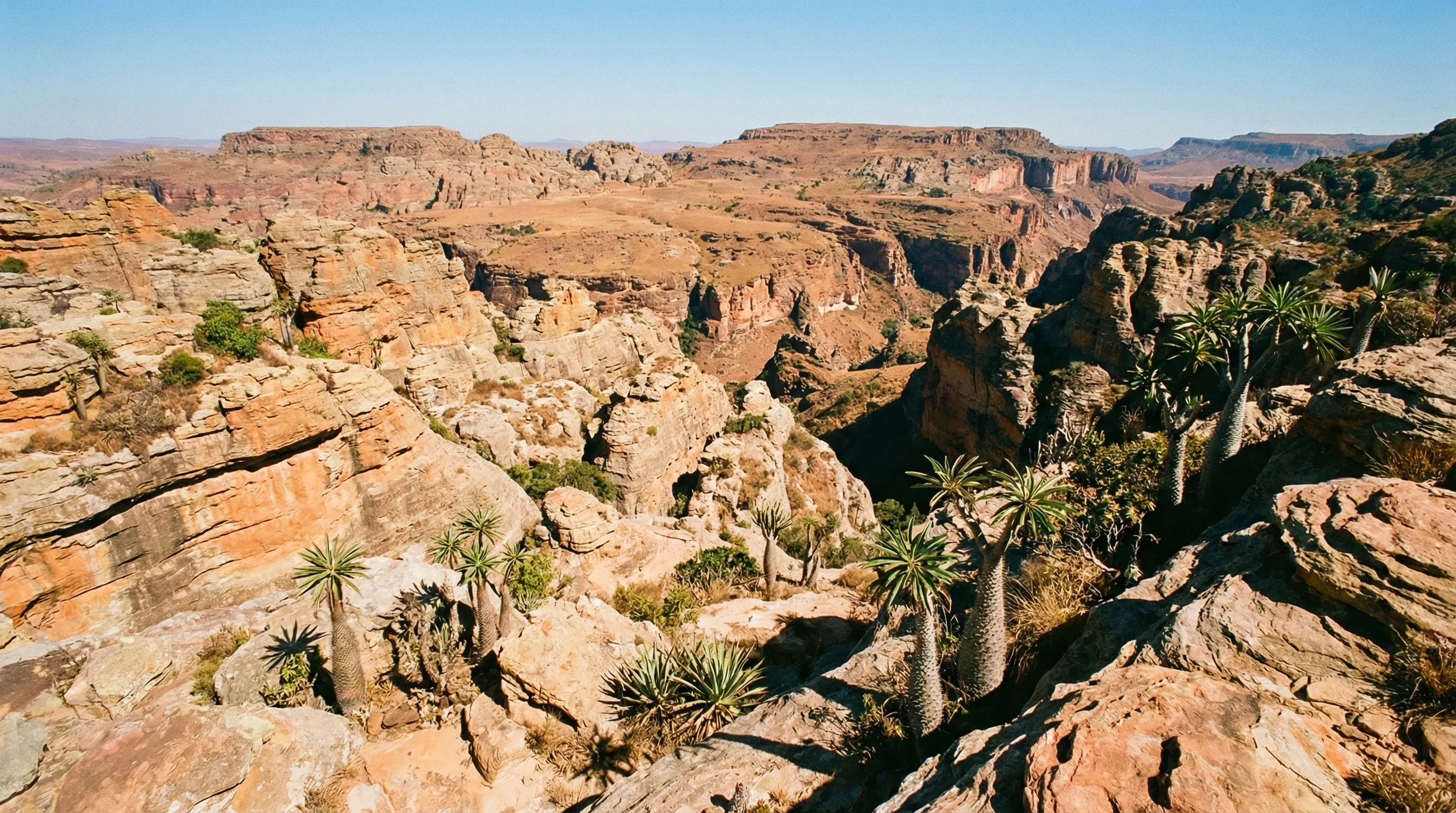

South & Southwest (spiny forest, Isalo)
Canyons, coastlines, and ring-tailed lemurs 🏜️
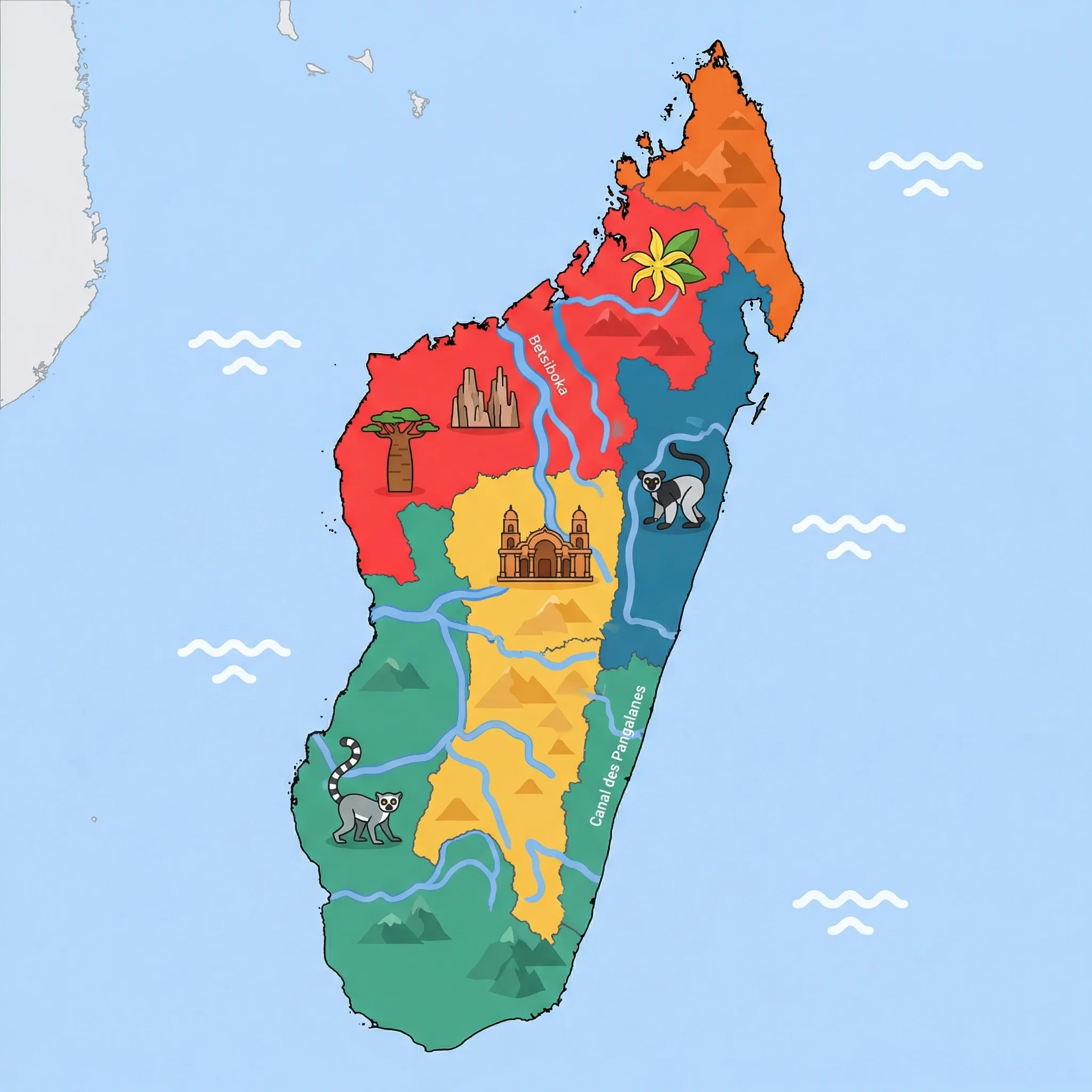
Click a region to explore
⚠️ SAFETY WARNING: Due to the risk of armed banditry on remote roads, government agencies (including AU, CA, USA, UK, IE, and NZ) advise travelers to exercise increased caution or reconsider travel in the southern regions. Overland travel should be done in convoy or with established tour operators, and night driving must be avoided. Families are strongly urged to consult their own government's official travel advisory before considering a trip, as circumstances and risk assessments vary.
Overview
The South is Madagascar's most dramatic landscape, resembling the American Wild West but with lemurs. The scenery shifts from highland rice paddies to vast savannahs, eroded sandstone mountains, and finally the semi-arid spiny forests near the coast. It is an adventurous region that rewards families who enjoy road trips, as the journey itself along the famous RN7 is the main attraction.
This area is home to the iconic Ring-tailed Lemur (King Julien from the movies), which is a huge draw for children. The culture here is distinct, with colourful Mahafaly tombs dotting the roadside. The climate becomes progressively hotter and drier as you move south, ending at the coastal towns of Toliara and Ifaty where the desert meets the Mozambique Channel.
Key Attractions
Isalo National Park is the jewel of the south. Known as the 'Colorado of Madagascar', it features deep canyons, natural swimming pools, and weird rock formations. The 'Piscine Naturelle' hike is doable for active children and ends with a swim in a stunning natural oasis. It is a magical place for a family picnic surrounded by curious ring-tailed lemurs.
Further south, the Arboretum d'Antsokay is a fantastic botanical garden that lets kids safely explore the bizarre 'spiny forest' flora without the danger of trekking into the deep bush. Finally, relaxing at Ifaty Beach or Anakao Beach offers snorkeling and whale watching (in season) alongside traditional Vezo fishing villages.
Practical Advice
The heat in Isalo and Toliara can be intense. Plan hikes for very early morning (starting 6:30 am). Always travel with a reputable driver who knows the security situation on the roads. Carry plenty of water.
Food & Drink
Typical meal times: Lunch 12:00 pm to 2:00 pm. Dinner 7:00 pm to 9:00 pm.
Typical meal costs: Meals are affordable. Expect to pay MGA 20,000–45,000 (approx. $4.50–10.00 USD / €4.00–9.00 EUR) for a good dinner.
Dietary requirements: Goat and zebu are common meats. In coastal Toliara/Ifaty, seafood is excellent. Vegetarian options are limited to vegetable sides in smaller towns.
Signature dishes:
- Hena osy – Goat meat stew, popular in the arid south where goats are common livestock.
- Mokary – Small round rice cakes cooked in a special pan, often eaten for breakfast or as a snack.
- Fresh Seafood – Toliara is famous for crab, squid, and octopus caught daily by Vezo fishermen.
Why this score?
Traveling through the semi-arid south involves long days on the road and hiking through dramatic sandstone canyons in high temperatures. The unique 'spiny forest' environment around Ifaty offers a rugged experience that is starkly different from the central highlands. Families must be prepared for basic conditions when visiting the more remote community reserves and coastal villages.
Why this score?
Medical facilities in the south are very sparse, with only basic regional hospitals in Fianarantsoa and Toliara that often face resource shortages. In the national parks like Isalo, there is virtually no medical infrastructure, and reaching a major town can take several hours over difficult terrain. Emergency response times are significantly delayed in this part of the country.
Why this score?
Isalo National Park is arguably the most famous park in Madagascar, serving as a primary highlight for those traveling the popular RN7 route. The region sees a consistent but modest flow of international trekkers and wildlife photographers visiting the Anja Reserve. Despite its iconic scenery, the vast distances and travel time keep global visitor numbers within the 'niche' category.

Prices are generally lower than the north but higher than the highlands. A family bungalow in Isalo or Ifaty costs MGA 180,000–450,000 (approx. $40–100 USD / €36–90 EUR). Fuel costs for the long drive will be a significant part of the budget.

Getting Here & Around
Getting Here
- Road – The Route Nationale 7 (RN7) is the classic route, taking 2-3 days from Tana with stops.
- Air – Toliara (TLE) has an airport connecting to Tana, allowing for a one-way drive and fly-back option.
Getting Around
- 4x4 Vehicle – Essential. While the RN7 is paved, it is potholed, and access to hotels or parks often involves dirt tracks.
- Boat – Required to reach Anakao Beach from Toliara (approx. 1 hour speed boat).
Nearby Airports (3 airports)
Tolagnaro
FTUFort Dauphin
Morondava
MOQMorondava
Toliara
TLEToliara
View full flight map for Madagascar →

Packing List
There is very little shade in Isalo canyons and spiny forests
Dry heat causes dehydration faster than you realize
Many eco-lodges run on solar power and cut electricity at night
Roads are dusty; protects face when driving with windows down
Frequent power cuts ('delestage') and limited street lighting make this essential for safety and night walks.
Roads are winding and often in poor condition; even sturdy stomachs may struggle on long drives.
The Highlands (including Antananarivo) get surprisingly cold at night, especially during the dry winter months.
Electricity can be unreliable in rural lodges, so backup power for phones and cameras is crucial.
Essential for keeping electronics safe during pirogue (canoe) trips or sudden rainforest downpours.

Activities & Best Times

Hiking, wildlife, outdoor exploration, ecotourism
Home to the world-unique spiny forest and the iconic Isalo National Park, offering unparalleled biodiversity and dramatic sandstone landscapes. Peak months provide dry, cooler conditions ideal for lemur trekking and canyon exploration, while summer rains can make remote trails impassable.

Urban tourism, museums, historical sites, architecture
Features the historic Haute Ville of Fianarantsoa and the unique silk and paper crafts of Ambalavao, offering deep insights into Malagasy heritage. The dry season is optimal for architectural walking tours, whereas the wet season brings extreme heat and potential road disruptions.

Sport tourism, fitness activities, active recreation
Offers world-class trekking infrastructure in Isalo and the challenging Pic Boby ascent, the highest accessible peak in Madagascar. Peak months offer the cool, stable weather required for high-exertion hiking in otherwise arid and heat-prone environments.

Beach resorts, marine activities: diving, snorkelling, kite surfing, wind surfing, sailing
Remote coastal outposts like Anakao and Ifaty offer pristine reef access and seasonal whale watching away from mass tourism. Peak timing aligns with the humpback whale migration and avoids the cyclone-prone, humid summer months.

Learning experiences, scientific sites, historical education
Highly specialized facilities like the Arboretum d'Antsokay and Maison de l'Isalo provide globally significant insights into island evolution and geology. These sites are best accessed during the dry season when transit via Toliara is most reliable.

Scenic drives, countryside tours, route-based travel
RN7 is described as 'iconic African driving route through diverse biomes' - this is far above marginal. Should be 'good' minimum for such a renowned route.

Attractions (9 total)



Public Holidays & Calendar Next 12 months
Public holidays, festivals, cultural celebrations, and seasonal natural phenomena coming up in South & Southwest (spiny forest, Isalo) over the next 12 months.
Loading holidays and events...

Travel Advisory
Consensus across all major agencies indicates that travelers should exercise a high degree of caution in Madagascar. Key risks include a high rate of violent crime (including armed robbery and carjacking), potential for sudden civil unrest, and very limited medical facilities. Special care is needed for travel outside of major cities and during the cyclone season.
Safety Topics
Traveller Advice (4 groups)

Travelers should be aware of local social norms and exercise discretion, as public attitudes towards the LGBTQ+ community can be conservative.

Solo female travelers should be particularly cautious in isolated areas and remote beaches where harassment or robbery can occur, even during daylight hours.

Maintain a high level of personal security awareness, avoid traveling alone after dark, and do not display items of wealth such as jewelry or electronics in public.

Accessibility infrastructure is extremely limited throughout Madagascar; individuals with mobility issues should plan extensively for transport and lodging challenges.
Agency Summaries
The security environment is currently stable but remains unpredictable. Travelers are warned about violent robberies on remote beaches and dangerous road conditions, particularly in the south and west.
Vigilance is required because of ongoing concerns regarding crime and the history of political protests. Visitors should avoid large crowds and remain informed of local developments.
Travelers should remain very vigilant due to widespread crime and the potential for political instability following recent governmental transitions.
Heightened vigilance is advised across the country because of significant crime rates, civil unrest risks, and limited medical infrastructure. Some southern and western regions carry higher danger due to banditry.
A high level of caution is necessary due to the combined threats of violent crime, frequent civil unrest, and the annual risk of severe cyclones.
Increased safety precautions are recommended due to the high frequency of violent crimes, including carjackings and robberies, and the possibility of political demonstrations turning violent.
Information is provided for general guidance only and does not constitute travel, safety, medical, or legal advice. Conditions may change. Users are responsible for independently verifying information before travel.