

⚠️ SAFETY WARNING: Check your government's latest travel advice before booking. While most of Malaysia is safe, some coastal areas of eastern Sabah (Borneo) have specific security advisories regarding kidnapping risks. Always stick to established tourist routes in these regions.
Overview
Malaysia is a tropical paradise that offers families the best of two worlds: the peninsula’s modern cities and colonial history, and Borneo’s wild, ancient rainforests. Separated by the South China Sea, the country is a melting pot of Malay, Chinese, Indian, and indigenous cultures, creating a safe, welcoming, and incredibly diverse environment for traveling with children. The climate is hot and humid year-round, but the warmth of the people-and the food-is even more memorable. Whether you are navigating the futuristic skyline of Kuala Lumpur or cooling off in the Cameron Highlands, the infrastructure is excellent, English is widely spoken, and the vibe is distinctively relaxed.
For families, Malaysia is an easy introduction to Southeast Asia. It balances the thrill of exotic wildlife and jungle trekking with the comforts of air-conditioned malls and reliable transport. You can breakfast on roti canai, spend the morning snorkeling with clownfish in Langkawi, and end the day in a world-class theme park. The country's affordability allows families to enjoy diverse experiences-from river safaris to island hopping-without breaking the bank.
Key Attractions
Start your journey in the capital, where the Petronas Twin Towers dominate the skyline; kids will love the park and paddling pools at their base, and the futuristic Petrosains, The Discovery Centre inside. Just a short train ride away, the massive golden statue at Batu Caves guards a limestone temple that requires a climb of 272 rainbow-colored steps-watch out for the cheeky monkeys! For a change of pace, head to the KL Bird Park, a massive free-flight aviary where peacocks and hornbills roam freely.
Nature-loving families should fly across to Malaysian Borneo - Sabah (Mt Kinabalu, Sepilok) to visit the Rainforest Discovery Centre (RDC) or take a river cruise on the Kinabatangan River to spot pygmy elephants and proboscis monkeys in the wild. If you prefer islands, Langkawi offers the spectacular Langkawi Sky Bridge and boat tours through the Kilim Karst Geoforest Park mangroves. For a cultural twist, the historic streets of Penang offer famous street art and the funicular ride up Penang Hill.
Practical Advice
Malaysia is hot and humid year-round, with temperatures averaging 27-32°C (80-90°F). Light, breathable clothing is essential. The monsoon season varies by region (East Coast is wet Nov–Feb; West Coast is wetter Apr–Oct), so check the forecast for your specific islands. Dengue fever is a risk, so diligent mosquito protection is vital for children. Grab (the local Uber) is the most convenient way for families to get around cities-it is cheap, safe, and air-conditioned.
Food & Drink
Typical meal times: Lunch is typically served from 12:30 pm to 2:00 pm, and dinner from 6:30 pm to 9:30 pm. Hawker centers often stay open late.
Typical meal costs: RM 10–20 (approx. $2.30–4.60 USD / –2.10–4.20 EUR) for street food; RM 40–80 (approx. $9–18 USD / –8.50–17 EUR) for mid-range restaurant meals.
Dietary requirements: Malaysia is extremely friendly for Halal diets (it is the standard). Vegetarian options are widely available in Indian and Chinese restaurants, though check for shrimp paste in Malay dishes. Nut allergies require vigilance as peanuts are common in sauces (satay).
Family-friendly dining: Malaysians love children, and dining is a communal affair. ‘Hawker centers’ (food courts) are perfect for families as everyone can pick dishes from different stalls. Highchairs are common in malls and restaurants but less so at street stalls.
Signature dishes:
- Nasi Lemak – The national dish of coconut milk rice, sambal (spicy paste), peanuts, cucumber, and egg. Kids often eat the rice and chicken without the spicy sambal.
- Satay – Skewered, grilled meat (chicken or beef) served with a sweet peanut dipping sauce. A universal hit with children.
- Roti Canai – A crispy, flaky flatbread usually served with dhal (lentil curry). It is a classic breakfast that kids enjoy tearing apart with their hands.
- Laksa – A spicy noodle soup that varies by region; Penang's version is tangy with fish broth, while Sarawak's is creamy and coconut-based.
- Cendol – A sweet dessert of shaved ice, coconut milk, palm sugar syrup, and green jelly noodles. The perfect cool-down treat.

A family of four can expect to spend around RM 500–750 (approx. $115–170 USD / –105–160 EUR) per day, covering mid-range family accommodation, Grab transport, and plenty of delicious food. Street food meals are incredibly cheap, while entry fees for major wildlife or theme park attractions will be your biggest expense.
Age Suitability





Did you know? Malaysia welcomes approximately 10.1 million international visitors per year. Most visitors come from East Asia and the Pacific.

Explore Regions
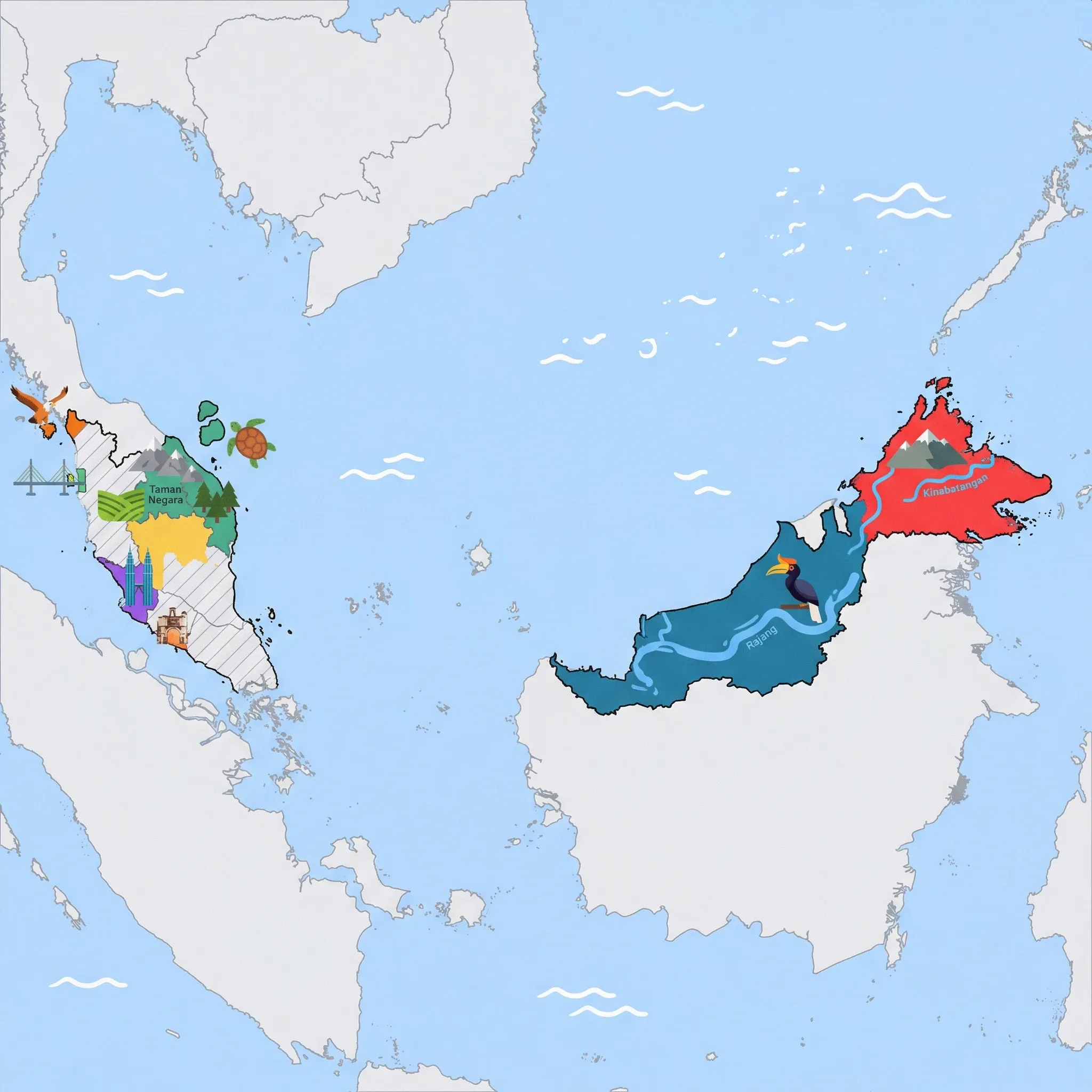
8 Regions
Cameron Highlands
Cool breezes, rolling tea fields, and strawberry sweets 🍓🍃
Kuala Lumpur
A jungle city of skyscrapers, street food, and vibrant culture 🏙️🐒
Langkawi
Ancient legends, emerald waters, and duty-free relaxation 🦅🏖️
Malacca
Living history, colorful trishaws, and river adventures 🏮🛶
Malaysian Borneo - Sabah (Mt Kinabalu, Sepilok)
Wild rainforests, orangutans, and island adventures 🦧🏔️
Malaysian Borneo - Sarawak (Kuching)
Land of the Hornbills, hidden caves, and the City of Cats 😸🌿
Penang
Street food capital, heritage art, and funicular rides 🍜🎨
Perhentian & East Coast Islands
Crystal clear water, sea turtles, and barefoot island life 🐢🏝️
Click on a region marker to explore details. Use the dropdown to color regions by activity suitability.

Getting There & Around
Getting There
- By Air – Kuala Lumpur International Airport (KUL) is the major hub, with direct flights from across Asia, Europe, and the Middle East. It connects directly to the city via the KLIA Ekspres train.
- By Land – You can enter by bus or train from Singapore in the south or Thailand in the north. The train journey from Singapore now requires a shuttle train to JB Sentral.
- By Sea – Ferries connect Langkawi to Satun (Thailand) and Penang to Medan (Indonesia).
- Entry Requirements – Most visitors must complete the Malaysia Digital Arrival Card (MDAC) online 3 days before arrival. Check your government website for the latest visa requirements, or use the IATA Travel Centre entry-requirements checker.
Getting Around
- Grab (Ride Hailing) – The most essential app for families. It is safe, affordable, and saves you from negotiating taxi fares. Essential for getting around Kuala Lumpur and Penang.
- Trains – The ETS (Electric Train Service) is a comfortable and scenic way to travel the west coast, connecting KL to Ipoh and Penang. Within KL, the LRT and MRT lines are modern and stroller-friendly.
- Domestic Flights – Essential for hopping between the peninsula and Malaysian Borneo - Sabah or Sarawak. AirAsia and Malaysia Airlines offer frequent, low-cost connections.
- Buses – Long-distance buses are often luxurious with reclining seats ('VIP' coaches) and are very cheap, though travel times can be long for young children.

Packing List
You will remove shoes constantly at temples, homes, and even some shops/hostels.
Essential for kids to prevent dengue; easier to apply than sticky sprays.
Many public toilets only provide a water hose; carry your own paper.
Protects electronics during sudden tropical downpours or island boat trips.
Useful for modesty at mosques and as a light cover-up against powerful A/C.

Activities & Best Times

Adventure & Nature
ExcellentHiking, wildlife, outdoor exploration, ecotourism
A world-class destination for rainforest immersion, featuring iconic wildlife like orangutans at Sepilok and the unique ecosystem of Mt Kinabalu. Drier months are essential for safe trekking and optimal wildlife spotting along the Kinabatangan River.
While Langkawi has a UNESCO Geopark and quality mangrove tours, it does not meet the global standard for 'excellent' adventure/nature destinations. Costa Rica, New Zealand, and Norway set that bar. Langkawi is a very strong regional destination but not world-class.
Features high-quality rainforest experiences at The Habitat Penang Hill and world-class insect conservation at Entopia, providing genuine immersion in tropical biodiversity. The dry season ensures trail accessibility and optimal wildlife viewing, whereas the peak rainfall period in late autumn makes jungle paths hazardous and degrades the experience.

City & Cultural
ExcellentUrban tourism, museums, historical sites, architecture
George Town is a UNESCO World Heritage site offering an authentic blend of colonial history, vibrant street art, and world-class street food that appeals to sophisticated travelers. Peak conditions occur during the cooler, drier months of the northeast monsoon, while the heavy rains of September-November can disrupt exploration of the historic core.
Kuching is a highly authentic capital celebrated for its Riverside heritage, historic bazaars, and a world-class culinary identity that appeals to sophisticated travelers. The city's charm is best explored during the dryer season, though its museums and food scenes remain vibrant through the shoulder months.
Home to iconic landmarks such as the Sky Bridge and Eagle Square, alongside museums showcasing Malaysian craft and history. The island's cultural sites are most enjoyable during the dry season when outdoor accessibility is at its highest.

Beach & Sea
Very GoodBeach resorts, marine activities: diving, snorkelling, kite surfing, wind surfing, sailing
Tanjung Rhu and Pantai Cenang are nationally significant beaches with calm conditions - this warrants 'very_good'. Not 'excellent' (not Maldives/Caribbean level) but better than 'good'.
Exceptional marine biodiversity and shore-accessible reefs warrant 'very_good'. This is one of Southeast Asia's best diving/snorkeling destinations - better than 'good' but not 'excellent' (not Maldives/Caribbean standard).
Batu Ferringhi and the National Park offer accessible coastal recreation, though water clarity and jellyfish can limit the rating compared to premier global beach destinations. Calm seas and lower precipitation from December to February provide the most consistent conditions for coastal activities and sailing.

Sports & Active
Very GoodSport tourism, fitness activities, active recreation
Excellent for active families due to established hiking routes, cycling climbs, and professional ziplining facilities. Peak months offer cooler, drier conditions essential for high-intensity activities and safe trail navigation.
Features established infrastructure for family activity including high-ropes courses and significant hiking routes at Tanjung Tuan. Best visited when precipitation is lower to enjoy the outdoor facilities and panoramic views of the Malacca Strait.
Home to the world's highest Via Ferrata and world-renowned trekking routes on Mt Kinabalu. Weather is a critical factor, as summit trails often close during the heavy rains and high winds of the monsoon season.

Educational & Exploratory
GoodLearning experiences, scientific sites, historical education
Significant facilities like Underwater World and the Geopark Discovery Centre provide high-quality scientific engagement for families. While mostly indoor, the peak season mirrors general tourism trends when all auxiliary services are fully operational.
Features highly-regarded institutions like Petrosains and Aquaria KLCC that provide destination-level learning experiences for sophisticated families. These are excellent year-round indoor options, though tourist infrastructure and peak travel services are most robust during the primary international vacation windows.
The Rainforest Discovery Centre and Sepilok are destination-level facilities for learning about tropical conservation and marine ecology. Peak months ensure better access to outdoor interpretive trails and active wildlife research stations.

Relaxation & Wellness
GoodSpa retreats, wellness centers, peaceful getaways
The region features authentic natural hot springs like Annah Rais that provide a unique restorative experience tied to the local jungle environment. These facilities are most accessible during the drier months, as rural road conditions can be more challenging during peak monsoon rainfall.
Features natural hot springs at Ayer Hangat Village, providing a unique therapeutic experience rooted in local legend. Best visited during drier months to enjoy the traditional outdoor architecture and surrounding gardens.
The region possesses several natural hot springs, though these are largely rustic local facilities that may lack the luxury standards expected by high-end international wellness travelers. Peak months align with the city's general tourism peak when humidity is slightly lower and conditions more comfortable for outdoor relaxation.

Road Trips & Scenic
GoodScenic drives, countryside tours, route-based travel
The scenic ring road and the steep, winding drive up Gunung Raya offer spectacular island vistas and rainforest immersion. Clearer skies and dry roads from December to March provide the safest and most visually rewarding driving conditions.
The Round-Island Drive and the iconic Sultan Abdul Halim Muadzam Shah Bridge offer scenic coastal and engineering vistas suitable for family touring. Travel is most rewarding when visibility is high and road conditions are dry, typically between December and March.
Scenic highland routes from Kota Kinabalu toward Ranau provide spectacular views of the Crocker Range and the Tip of Borneo. Drier months are preferred for road safety and clear visibility of the iconic mountain vistas.

Theme Park & Entertainment
GoodAmusement parks, family entertainment venues
ESCAPE Penang provides a unique, environmentally integrated adventure park experience that attracts international families. Peak periods align with major international school holiday windows in December and June, while heavy rainfall in the late monsoon months often leads to temporary attraction closures.
Home to internationally recognized family venues like KidZania and Sunway Lagoon, providing high-quality entertainment standards. While indoor parks remain viable, the outdoor water and theme parks are best visited during the mid-year school holiday windows to avoid the disruption of the heavy inter-monsoon thunderstorms.
Unique attractions like the Upside Down House and marine museums provide solid family entertainment. Peak visitation coincides with drier weather and the December school holiday period when these venues are most active.

Festivals & Seasonal
MarginalEvents, celebrations, seasonal attractions
While Penang hosts significant events like Thaipusam and the George Town Festival, these are highly date-specific and concentrated in early and mid-year. These festivals offer deep cultural insights for discerning families, but the region lacks a continuous year-round international festival calendar.
Specifically notable for the globally significant Thaipusam festival at Batu Caves in Jan/Feb, alongside vibrant Lunar New Year celebrations that appeal to international culture seekers. Outside of these specific major cultural windows, the region follows a more standard urban tourism calendar.
The Rainforest World Music Festival is a globally recognized cultural event that draws international visitors to the foothills of Mount Santubong. The festival typically occurs in mid-year, making June and July the essential period for travelers motivated by this event.

Public Holidays & Calendar Next 12 months
Public holidays, festivals, cultural celebrations, and seasonal natural phenomena coming up in Malaysia over the next 12 months.
Loading holidays and events...

Climate & Weather
Cameron Highlands
Show Details
| Month | Temp °C | Rain | Humidity |
|---|
Kuala Lumpur
Show Details
| Month | Temp °C | Rain | Humidity |
|---|
Langkawi
Show Details
| Month | Temp °C | Rain | Humidity |
|---|
Malacca
Show Details
| Month | Temp °C | Rain | Humidity |
|---|
Malaysian Borneo - Sabah (Mt Kinabalu, Sepilok)
Show Details
| Month | Temp °C | Rain | Humidity |
|---|
Malaysian Borneo - Sarawak (Kuching)
Show Details
| Month | Temp °C | Rain | Humidity |
|---|

Travel Advisory
All major agencies maintain a baseline advisory level of 'Normal Precautions' for Malaysia as a whole. While the country is generally safe, all agencies highlight a specific and significant security risk (including kidnapping and terrorism) in the eastern coastal regions of Sabah, particularly on offshore islands.
Safety Topics
Traveller Advice (3 groups)

To respect local cultural and religious sensitivities, particularly in rural or conservative areas and at places of worship, it is recommended to dress modestly and behave discreetly.

Ensure you submit the mandatory Digital Arrival Card (MDAC) online before your trip. Use reputable ride-hailing services rather than hailing taxis on the street, especially at night.

Same-sex relationships are illegal under both federal and Sharia law, which can apply to tourists. Public displays of affection may lead to police intervention, fines, or imprisonment. Exercise extreme discretion.
Agency Summaries
Irish citizens can visit for up to 90 days without a visa. Visitors are encouraged to follow standard safety routines and ensure they have comprehensive travel insurance.
Travelers should follow standard safety procedures in most of the country. Increased vigilance is required in eastern Sabah due to the threat of kidnapping by criminal and extremist groups.
Malaysia is considered generally safe, though visitors are advised to maintain standard safety awareness. A higher degree of caution is recommended specifically for the eastern coastal regions of Sabah due to security threats.
The overall advice level is at its lowest, but travelers are warned about kidnapping risks in the coastal areas of eastern Sabah and advised to monitor local weather due to seasonal flooding.
General travel to Malaysia is safe, but the government advises against all but essential travel to the islands and dive sites off the coast of eastern Sabah. Petty crime and a general threat of terrorism exist.
The general security situation is stable. However, regional escalations exist for the islands and coastal areas of eastern Sabah, where the threat of kidnapping for ransom is significant.
Information is provided for general guidance only and does not constitute travel, safety, medical, or legal advice. Conditions may change. Users are responsible for independently verifying information before travel.