

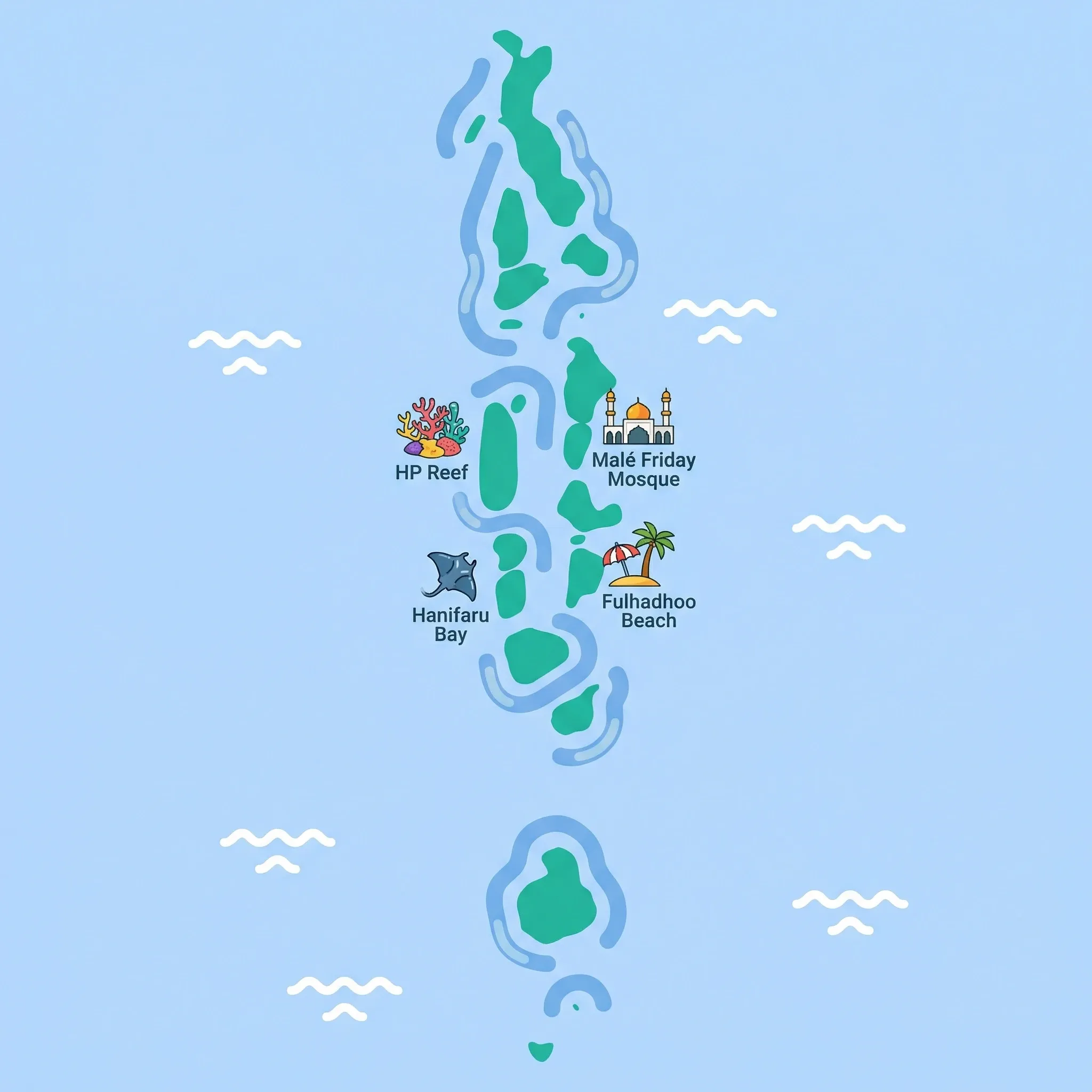
Overview
The Maldives is an archipelago of 26 coral atolls in the Indian Ocean, renowned for its geography where 99% of the nation is water. For families, this destination offers a unique "one island, one resort" experience, meaning you are never far from the sea. The calm, shallow lagoons surrounding the islands act as massive natural swimming pools, making them exceptionally safe for children to swim and snorkel. The climate is tropical and warm year-round, with temperatures averaging 30°C (86°F), although the dry season from December to April is the most popular time to visit.
Culturally, the Maldives is a 100% Muslim nation with a rich heritage of seafarers. While resort islands are relaxed bubbles of international luxury, local islands offer a glimpse into authentic Maldivian life with colorful houses, sandy streets, and friendly communities. Families will love the emphasis on marine life; it is common to spot baby sharks, stingrays, and heron birds right from the shore. The vibe is one of barefoot luxury-shoes are optional, and the pace is dictated by the sun and the tides, allowing families to disconnect from screens and reconnect with nature.
Key Attractions
The primary attraction of the Maldives is its underwater world. Families should prioritize snorkeling excursions to see vibrant coral gardens and sea turtles. Many resorts have "house reefs" accessible directly from the beach, perfect for beginners. For a unique cultural experience, a visit to the capital city is worthwhile to see the Malé Friday Mosque (Hukuru Miskiy). Built in 1658 from interlocking coral stones, its intricate carvings and lack of mortar are an architectural marvel that fascinates older children and adults alike.
Beyond the resorts, the natural phenomena of the Maldives are magical for kids. Dolphin-watching cruises at sunset are a hit, with spinner dolphins frequently jumping alongside boats. In Baa Atoll, the Hanifaru Bay offers world-class manta ray sightings (seasonally), while some islands feature "glowing beaches" at night due to bioluminescent plankton-a fairy-tale experience for little ones. Submarine tours are also available from Malé, allowing non-swimmers to witness the deep reef life in comfort.
Practical Advice
The best time to visit is between November and April to avoid the monsoon rains, though the wet season (May to October) offers lower prices. Sun protection is critical; the equatorial sun is stronger than many travelers expect, so high-SPF waterproof sunscreen and rash guards are essential for kids. Transfers to resorts are by speedboat or seaplane; seaplanes are an adventure in themselves but can be loud, so ear protection for infants is recommended. While resorts serve alcohol, it is strictly prohibited on local inhabited islands.
Food & Drink
Typical meal times: Breakfast is usually served from 7:00 am to 10:00 am. Lunch typically runs from 12:30 pm to 2:30 pm, and dinner is a leisurely affair from 7:30 pm to 10:00 pm. On local islands, cafes may open as early as 6:00 am for morning prayers and close around 11:00 pm.
Typical meal costs: Prices vary drastically between local islands and resorts. On local islands, a meal costs around 75–230 MVR (approx. $5–15 USD / €4.50–14 EUR). In resorts, a main dish can range from 460–1,200 MVR (approx. $30–80 USD / €28–75 EUR), with buffet dinners often costing 1,500–2,300 MVR (approx. $100–150 USD / €90–140 EUR) per person.
Dietary requirements: Resorts are exceptionally accommodating, offering extensive vegetarian, vegan, and gluten-free menus. Chefs are used to catering to international allergies. On local islands, vegetarian options like vegetable curries are common, but strict gluten-free dining requires careful communication.
Family-friendly dining: Resorts are designed for families, providing highchairs, kid-friendly buffets with pasta and pizza stations, and early dining hours. Local cafes are welcoming to children but may not have specific kids' menus or highchairs.
Signature dishes:
- Mas Huni – A traditional breakfast of shredded smoked tuna, grated coconut, lime, and chili, eaten with roshi (flatbread). It is fresh and zesty, though kids might prefer a non-spicy version.
- Garudhiya – A clear, fragrant fish broth made from fresh tuna, usually served with rice, lime, and chili on the side. It is a simple, healthy staple.
- Hedhikaa – A collective name for "short eats" or snacks served with tea, such as bajiya (fish samosas) and gulha (fried fish balls).
- Saagu Bondibai – A sweet sago pudding cooked with coconut milk and condensed milk, often spiced with cardamom and rose water-a hit with children with a sweet tooth.
Safety
The Maldives is generally very safe for tourists, especially within resort islands which are private and secure. However, travelers should exercise increased caution in Malé due to occasional civil unrest or political protests. Avoid large gatherings in the capital. Water safety is the primary concern for families; currents can be strong even in lagoons, so never leave children unattended near the water and ensure life jackets are worn on all boat transfers.
Age Suitability





Did you know? Maldives welcomes approximately 1.7 million international visitors per year. Most visitors come from Europe.
Why this score?
While the region offers exceptional marine activities like diving in the Baa Atoll, the overall experience is characterized by high-end comfort and manicured resort environments rather than rugged wilderness. The flat geography and lack of challenging terrain or off-the-beaten-path exploration keep the adventure level moderate and safe for families. Most 'adventures' are guided water sports or seaplane transfers that prioritize convenience over physical challenge.
Why this score?
Medical services are concentrated in the capital city of Malé, where hospitals like ADK provide decent care, but the archipelago's geography creates significant barriers to emergency access. Most resorts have on-site clinics for minor ailments, but serious medical issues often require expensive seaplane evacuations to the capital or even medical repatriation to nearby countries like India or Singapore. The system is functional for basic tourist needs but lacks the specialized capacity of major global medical hubs.
Why this score?
The Maldives is a premier global destination attracting over 1.6 million international visitors annually, primarily for its luxury 'one island, one resort' concept. It maintains a very high international profile despite its smaller total volume compared to mega-cities, supported by an extensive infrastructure of over 50,000 hotel beds. The region is well-established in the global tourism market with strong connectivity to Europe, the Middle East, and Asia.

The Maldives is a high-end destination. While guesthouses on local islands offer budget options, the typical family resort experience is expensive. A night in a family beach villa starts around MVR 7,700–15,400 (approx. $500–1,000 USD / €460–920 EUR). Seaplane transfers add MVR 6,000–9,000 (approx. $400–600 USD / €370–550 EUR) per person. All resort bills attract a hefty service charge and tourism tax (TGST).

Getting There & Around
Getting There
- By Air – Velana International Airport (MLE) near Malé is the main gateway. It receives direct flights from major hubs in the Middle East, Asia, and Europe. From here, you transfer to your island.
- By Sea – Speedboat transfers are common for resorts in the North and South Malé Atolls. They are fast (20–60 minutes) and operate 24/7.
- By Seaplane – For resorts in distant atolls, seaplanes are the standard mode. They only fly during daylight hours (6:00 am to 4:00 pm), so flight arrival times must align with this window.
- Entry Requirements – All tourists receive a free 30-day visa on arrival. You must have a confirmed hotel booking, return ticket, and complete the IMUGA Traveller Declaration within 96 hours of your flight. Check your government website for the latest visa requirements, or use the IATA Travel Centre entry-requirements checker.

Packing List
Strictly required to protect fragile coral ecosystems; non-reef-safe brands may be banned at resorts.
The equatorial sun is intense; sunscreen alone often isn't enough for kids in the water all day.
Essential for keeping phones and clothes dry during speedboat transfers and rainy season showers.
Transfers between islands are by boat or seaplane, which can be choppy and induce nausea.
Constant saltwater exposure tangles hair badly; resorts may not provide enough conditioner.
Ocean breezes are strong; swimsuits hung on balcony railings will blow away without them.
Tropical islands are lush and mosquitoes can be active, especially at dawn and dusk.

Activities & Best Times

Beach & Sea
ExcellentBeach resorts, marine activities: diving, snorkelling, kite surfing, wind surfing, sailing
The Maldives is one of the world's premier beach and marine destinations, featuring pristine white sand beaches, crystal-clear turquoise waters, world-class diving and snorkeling, and luxury overwater accommodations. This is a globally iconic beach destination that should serve as the benchmark for 'excellent' beach_sea ratings.

Adventure & Nature
Very GoodHiking, wildlife, outdoor exploration, ecotourism
The region features unique biodiversity hotspots such as the Baa Atoll UNESCO Biosphere Reserve, renowned for manta ray and whale shark encounters. Peak visitation occurs during the dry northeast monsoon, though certain wildlife activities remain strong through the shoulder months.

City & Cultural
GoodUrban tourism, museums, historical sites, architecture
Malé offers cultural sites of national significance (Grand Friday Mosque, Sultan Park, National Museum), but lacks the UNESCO heritage density, world-class museums, or globally significant cultural institutions required for 'excellent' rating. Compared to internationally outstanding cultural destinations (Paris, Rome, Kyoto), Malé provides good cultural experiences but is not in the same league.

Educational & Exploratory
MarginalLearning experiences, scientific sites, historical education
Specialized marine discovery centers offer destination-level educational insights into coral restoration and Indian Ocean marine biology. These facilities are primarily visited during the main tourism window when sea conditions allow for integrated field research and boat access.

Sports & Active
MarginalSport tourism, fitness activities, active recreation
Dedicated infrastructure like the Whale Submarine and specific picnic islands provide organized marine sports and active outdoor experiences. Optimal conditions for these activities are found during the calmer, dry months between December and April.




Public Holidays & Calendar Next 12 months
Public holidays, festivals, cultural celebrations, and seasonal natural phenomena coming up in Maldives over the next 12 months.
Loading holidays and events...

Travel Advisory
Five of the six major agencies recommend exercising a high degree of caution or increased vigilance. The primary risks include potential terrorist attacks and political instability in the capital, though resort islands remain largely secure.
Safety Topics
Traveller Advice (3 groups)

Outside of resort islands, women should dress modestly by covering their shoulders and knees. Avoid walking alone in isolated areas or on local islands at night.

Same-sex relationships are illegal and can lead to prosecution, fines, or imprisonment. Public displays of affection are generally discouraged for all, but particularly for same-sex couples.

All visitors must complete a digital Traveller Declaration via the IMUGA portal within 96 hours before arrival. Ensure your passport is valid for at least six months.
Agency Summaries
High caution is advised due to potential civil unrest and the threat of terrorism. Protests in Male can escalate into violence. The government is also implementing harsher penalties for drug crimes.
Irish citizens should be mindful of their surroundings and stay informed via local news. Consular assistance is limited as there is no resident Irish embassy in the country.
Visitors should exercise increased caution due to the risk of terrorism. Extremist groups may target tourist areas, transportation hubs, and local markets. Emergency response times may be significantly delayed on remote islands.
New Zealanders should exercise increased caution due to the threat of terrorism, which has previously involved IEDs and arson. Civil unrest and petty crime are also concerns, particularly in the capital.
Most visits are trouble-free, but travellers should be aware of the threat of terrorism and the legal differences in the country. Strict penalties apply for drug-related offenses.
Travellers should remain highly vigilant across the Maldives because of a constant threat of terrorist activity. While resort islands are generally safe, safety risks are higher in the capital and on islands with local populations.
Information is provided for general guidance only and does not constitute travel, safety, medical, or legal advice. Conditions may change. Users are responsible for independently verifying information before travel.