

⚠️ SAFETY WARNING: Due to the threat of kidnapping, terrorism, and violent crime, government agencies (including CA, USA, UK, AU, IE, and NZ) advise travelers to reconsider or avoid non-essential travel to Mauritania. High-risk areas include the eastern and northern border zones, which are often designated as military no-go zones. Families are strongly urged to consult their own government's official travel advisory before considering a trip, as circumstances and risk assessments vary.
Overview
Mauritania is a destination for families who have already traded beach resorts for backpacks. Dominated by the Sahara Desert, which covers nearly all of the country, it offers a landscape of stark, dramatic beauty that feels like another planet. The Atlantic coastline provides a refreshing counterpoint, where the desert crashes into the sea. Culturally, it is a bridge between the Maghreb and Sub-Saharan Africa, offering a unique blend of Arab-Berber and African traditions that is welcoming, though conservative. For children, the sheer scale of the dunes and the novelty of nomadic life-sleeping in tents and riding camels-can be magical.
Travel here requires patience and preparation. Infrastructure is limited outside Nouakchott, and the heat can be intense. However, the reward is an experience of solitude and silence that is increasingly rare in the modern world. Families will navigate a land where time seems to slow down, shared meals are a ritual of connection, and the history of ancient trade routes is written in the sand.
Key Attractions
The crown jewel of Mauritania's natural heritage is Banc d'Arguin National Park, a UNESCO World Heritage site where the desert meets the ocean. It is one of the world's most important bird sanctuaries, hosting millions of migratory birds. Families can take traditional sailing boats (lanches) to watch flamingos, pelicans, and terns in the shallow waters-a gentle and awe-inspiring wildlife experience that contrasts sharply with the arid interior.
In the heart of the desert lies the Chinguetti & Adrar (desert) region, home to the country's most iconic historic sites. The Ancient Ksour of Chinguetti is a medieval trading centre famous for its ancient libraries, where families can see centuries-old manuscripts preserved by local guardians. Nearby, the Ancient Ksour of Ouadane offers atmospheric stone ruins perched on a hill, perfect for exploring. For a geology lesson on a massive scale, the Eye of the Sahara (Richat Structure) is a mysterious circular formation visible from space, best appreciated from the ground as a vast, rocky landscape that sparks the imagination of young explorers.
Further north in the Saharan North, the Ben Amera Monolith rises dramatically from the flat desert floor. It is one of the largest monoliths in the world, second only to Uluru. Camping at its base offers a surreal experience of isolation and beauty. Back in the capital, the National Museum of Mauritania provides essential context on the country's archaeology and ethnography, while the Saudi Mosque stands as a major landmark of the city's skyline.
Practical Advice
The best time to visit is between November and February, when daytime temperatures are manageable (25–30°C / 77–86°F), though nights in the desert can be surprisingly cold. Visas are required for most visitors; while a visa-on-arrival system existed previously, it has recently transitioned to an online e-visa system for many nationalities, so checking the latest official protocol is critical. Malaria prophylaxis is recommended for the southern regions, and yellow fever vaccination is mandatory for entry.
Food & Drink
Typical meal times: Lunch is the main meal, typically served late from 1:00 pm to 3:00 pm. Dinner is lighter and eaten after 8:00 pm or 9:00 pm.
Typical meal costs: 200–400 MRU (approx. $5–10 USD / €4.50–9 EUR) for a simple local meal; 800–1,500 MRU (approx. $20–38 USD / €18–34 EUR) for a mid-range dinner.
Dietary requirements: Cuisine is heavily meat-based (lamb, goat, camel) and relies on dairy and grains. Vegetarians may find it challenging outside the capital and should be prepared to eat a lot of plain couscous, rice, and bread. Peanuts are occasionally used in sauces.
Family-friendly dining: Eating is often communal, with a large platter placed in the centre for everyone to share using their right hand. This can be a fun, bonding experience for children, though spoons are usually available for foreigners.
Signature dishes:
- Thieboudienne – A hearty dish of fish, rice, and vegetables cooked in a rich tomato sauce, adopted from Senegal and beloved nationally.
- Mechoui – Whole roasted lamb or sheep, cooked slowly until tender, typically served at feasts or for special guests.
- Mahfe – A meat stew (often goat or camel) cooked in a peanut and tomato sauce, served over rice or couscous.
- Mauritanian Mint Tea – A foamy, sweet green tea ritual served in three rounds, representing life, love, and death.
Safety
Beyond the government advisory warnings, families must prioritise logistics for safety. Self-driving is not recommended due to difficult terrain, lack of signage, and security risks in remote areas. Travel should always be undertaken with a reputable, registered guide and a 4x4 vehicle. Avoid all travel at night to reduce the risk of accidents and banditry. Stay on paved roads where possible and strictly adhere to military checkpoints. Drinking water must be bottled or purified.

While local food is inexpensive, the logistics of safe family travel raise the daily cost. A family of four should budget 6,000–10,000 MRU (approx. $150–250 USD / €135–225 EUR) per day, primarily for private 4x4 hire with a driver, fuel, and guide fees, which are essential for exploring the desert regions safely.
Age Suitability




Did you know? Mauritania welcomes approximately 30,000 international visitors per year.
Explore Regions
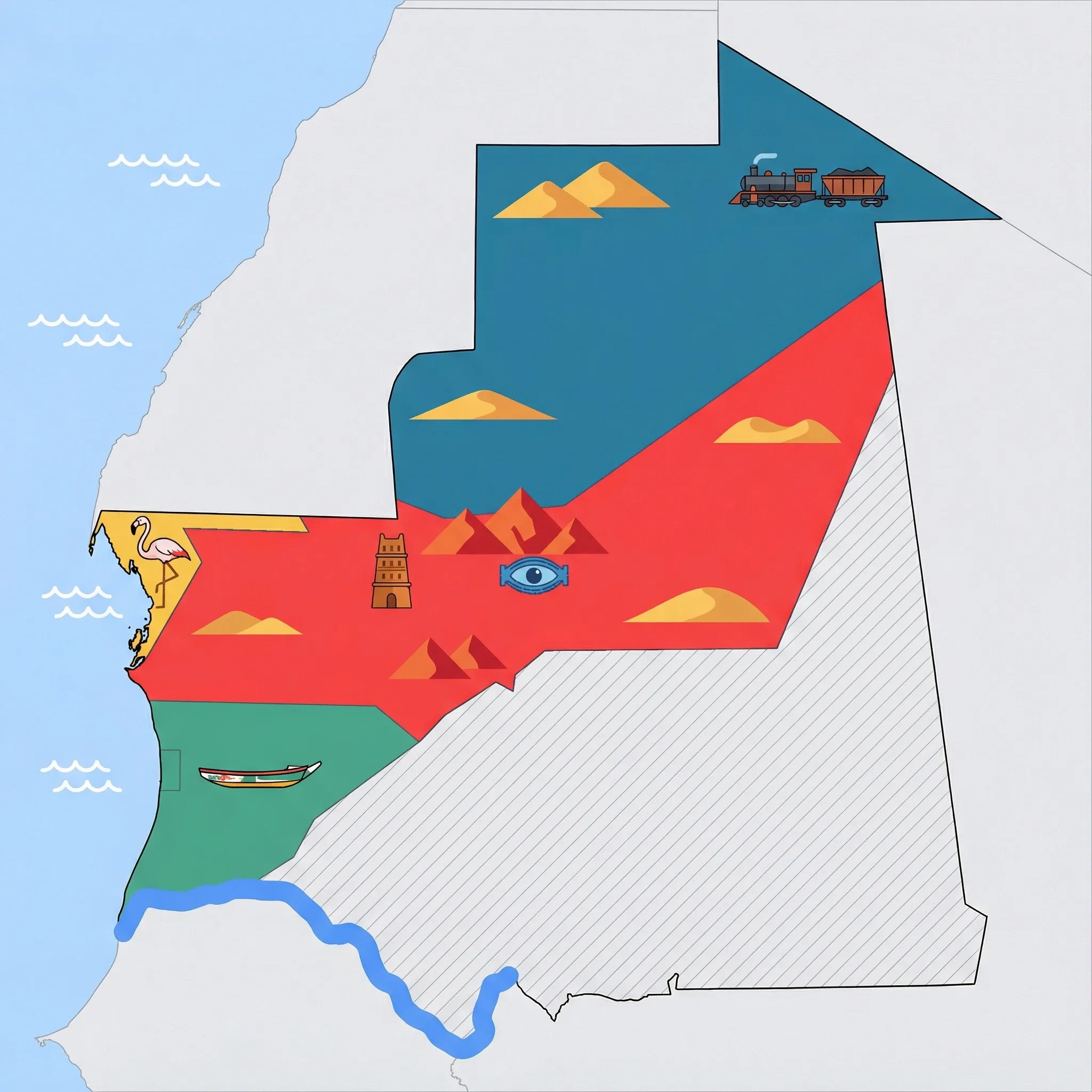
4 Regions
Banc d'Arguin (birds)
Where the golden desert meets the silver sea 🌊🦅
Chinguetti & Adrar (desert)
Ancient cities hidden in the golden dunes 🐪📜
Nouakchott
The bustling gateway between the Sahara and the Atlantic 🏙️🐟
Saharan North
The extreme iron frontier 🚂🏜️
Click on a region marker to explore details. Use the dropdown to color regions by activity suitability.

Getting There & Around
Getting There
- By Air – Nouakchott–Oumtounsy International Airport (NKC) is the main gateway, receiving flights from Paris, Casablanca, Istanbul, and regional West African hubs.
- By Land – The border with Senegal at Diama (seasonal/dam) or Rosso (ferry) connects the south. The crossing from Western Sahara at Guerguerat connects to the north, but the road through 'No Man's Land' requires caution.
- Entry Requirements – Most visitors require a visa. An e-visa system is in place, though protocols change frequently. Check your government website for the latest visa requirements, or use the IATA Travel Centre entry-requirements checker.
Getting Around
- Car Hire – The only viable option for families is hiring a 4x4 with an experienced local driver/guide. This is essential for navigating the desert terrain of Chinguetti & Adrar (desert) safely. Self-driving is strongly discouraged.
- Domestic Flights – Mauritania Airlines operates flights between Nouakchott and Nouadhibou, cutting down a long desert drive.
- Iron Ore Train – A famous mode of transport in the north. While adventurous tourists sometimes ride atop the ore wagons, this is dangerous and not recommended for children. The train occasionally has a passenger carriage, which is a safer but very basic way to witness this industrial spectacle.

Packing List
Essential for protecting eyes during sandstorms or if near the dusty Iron Ore Train.
Used locally to wrap the face and head for protection against sun, wind, and sand.
The desert air is extremely dry and dusty; this helps prevent nosebleeds and discomfort.
Power cuts are common and desert camping is pitch black; red light preserves night vision.
Provides a clean sleeping layer when staying in basic guest houses or communal nomad tents.
Sand gets everywhere; essential for protecting phones, cameras, and documents.

Activities & Best Times

Adventure & Nature
Very GoodHiking, wildlife, outdoor exploration, ecotourism
Offers world-class desert immersion including the dunes of Erg Ouaran and the unique Eye of the Sahara geological site. Exploration is only viable during the cooler winter months, as summer temperatures frequently exceed 40°C.
UNESCO World Heritage site, one of the world's most significant bird sanctuaries (over 2 million migratory birds), globally important coastal ecosystem. Meets international standards for 'very_good' nature tourism.
Authentic desert-meets-ocean landscapes and camel markets offer unique Saharan immersion for experienced travelers. Peak winter months are essential for safe and comfortable exploration of the dunes and coastal trails before the extreme summer heat begins.

City & Cultural
Very GoodUrban tourism, museums, historical sites, architecture
Home to UNESCO-listed ancient ksour and historic Saharan architecture that provides a highly authentic experience for sophisticated travelers. The peak season aligns with mild temperatures suitable for walking through historic quarters like Chinguetti and Ouadane.
The capital showcases a distinctive fusion of Islamic architecture and vibrant West African market culture, centered around the iconic Saudi Mosque. Visitation peaks in winter when the walking climate is optimal for exploring the National Museum and bustling markets.
Explores the unique industrial heritage of the Zouerat mining region and its connection to the trans-Saharan trade and the iron ore industry. Visits are best during the cooler winter months to avoid debilitating desert heat and frequent dust storms.

Road Trips & Scenic
GoodScenic drives, countryside tours, route-based travel
As the starting point for the legendary Route de l'Espoir, the region offers world-class Saharan driving experiences for self-sufficient travelers. Winter provides the most stable conditions, avoiding the peak heat and sandstorm risks common from May through September.
Features iconic 4x4 desert routes and the dramatic Amogjar Pass, offering a premier Saharan driving experience. Travel is discouraged in the summer due to extreme heat and the increased risk of sandstorms and vehicle failure.
The Nouakchott–Nouadhibou highway offers a world-class desert driving experience with access to remote coastal tracks like the Piste d'Iwik. Winter provides the safest and most comfortable driving conditions, avoiding the extreme engine stress and discomfort of 40°C+ summer temperatures.

Sports & Active
GoodSport tourism, fitness activities, active recreation
Renowned for multi-day desert trekking and camel expeditions along established routes between oases. The physical exertion required means that only the winter months are safe and comfortable for these activities.
Supports specialized activities like long-distance desert cycling and dune trekking, though infrastructure is limited to basic routes. The window for peak activity is narrow, restricted to the coolest months to ensure safety during high-exertion outdoor pursuits.
The challenging ascent of the Ben Amera monolith is a significant draw for experienced climbers and trekkers seeking unique desert routes. Peak conditions occur in the coldest months to ensure the rock surface is cool enough for safe climbing.

Beach & Sea
MarginalBeach resorts, marine activities: diving, snorkelling, kite surfing, wind surfing, sailing
Offers a raw, authentic coastal experience at Port de Pêche rather than traditional luxury resorts; peak months provide relief from Saharan heat with pleasant Atlantic breezes. Summer months are avoided due to rising humidity and peak temperatures that degrade the coastal experience.
Rugged, windswept coastal sites like Cap Tafarit offer raw Atlantic beauty rather than traditional resort infrastructure. Visitation is best during the cooler months to avoid the scorching sun and high humidity of the Saharan summer.

Educational & Exploratory
MarginalLearning experiences, scientific sites, historical education
Provides rare access to medieval manuscript libraries in Chinguetti, offering profound historical insight for niche travelers. The limited facilities and lack of climate control in these historic structures make summer visitation highly uncomfortable.
The Ecomusée du Banc d'Arguin offers specific scientific insights into the intersection of desert and marine ecosystems. Optimal visitation aligns with peak bird activity and the presence of international research initiatives during the cooler winter season.

Public Holidays & Calendar Next 12 months
Public holidays, festivals, cultural celebrations, and seasonal natural phenomena coming up in Mauritania over the next 12 months.
Loading holidays and events...

Climate & Weather
Banc d'Arguin (birds)
Show Details
| Month | Temp °C | Rain | Humidity |
|---|
Chinguetti & Adrar (desert)
Show Details
| Month | Temp °C | Rain | Humidity |
|---|
Nouakchott
Show Details
| Month | Temp °C | Rain | Humidity |
|---|
Saharan North
Show Details
| Month | Temp °C | Rain | Humidity |
|---|

Travel Advisory
All major agencies maintain a high-level warning for Mauritania, primarily due to terrorism, the threat of kidnapping against Westerners, and violent crime. Non-essential travel is discouraged for the entire country, while large regional sections are considered too dangerous for any travel.
Safety Topics
Traveller Advice (3 groups)

Staff from international organizations are at a heightened risk of kidnapping in the eastern and northern regions. Professional security assessments and escorts are strongly recommended when operating outside Nouakchott.

Female travellers should dress conservatively and avoid moving alone, particularly after dark. There are significant legal risks when reporting sexual assault, as local laws may require victims to provide specific proof to avoid being charged with non-consensual acts themselves.

A pre-approved electronic visa is mandatory for entry; visas are no longer issued upon arrival at the border or airport. Travellers should carry multiple photocopies of their passport at all times as identity checks are frequent.
Agency Summaries
New Zealand classifies the security situation as unpredictable, citing kidnapping and terrorism as major threats. Travel to northern and eastern provinces is strongly discouraged due to armed banditry and military operations.
Canadians are advised to avoid non-essential travel due to significant threats of terrorism and kidnapping. Highest risk levels apply to northern and eastern border regions where extremist groups and bandits are active. Westerners are frequently targeted for abduction.
Australia advises a high degree of caution overall with a recommendation to reconsider travel plans due to kidnapping risks and terrorism. Violent crime is on the rise, and landmines remain a hazard near the Western Sahara border, particularly after sandstorms.
British authorities advise against all travel to eastern regions and border zones, and all but essential travel elsewhere. There is a high risk of terrorism and kidnapping throughout the country. Civil unrest and demonstrations occur periodically in the capital.
Ireland advises against non-essential travel due to serious security concerns. Irish citizens have very limited consular support as there is no local embassy. E-visas must be obtained online prior to departure.
The U.S. government recommends reconsidering travel because of crime and terrorism. Violent crimes like armed robbery and assault are common. Military-restricted zones in the north and along the Mali/Algeria borders are extremely dangerous and off-limits to visitors.
Information is provided for general guidance only and does not constitute travel, safety, medical, or legal advice. Conditions may change. Users are responsible for independently verifying information before travel.