
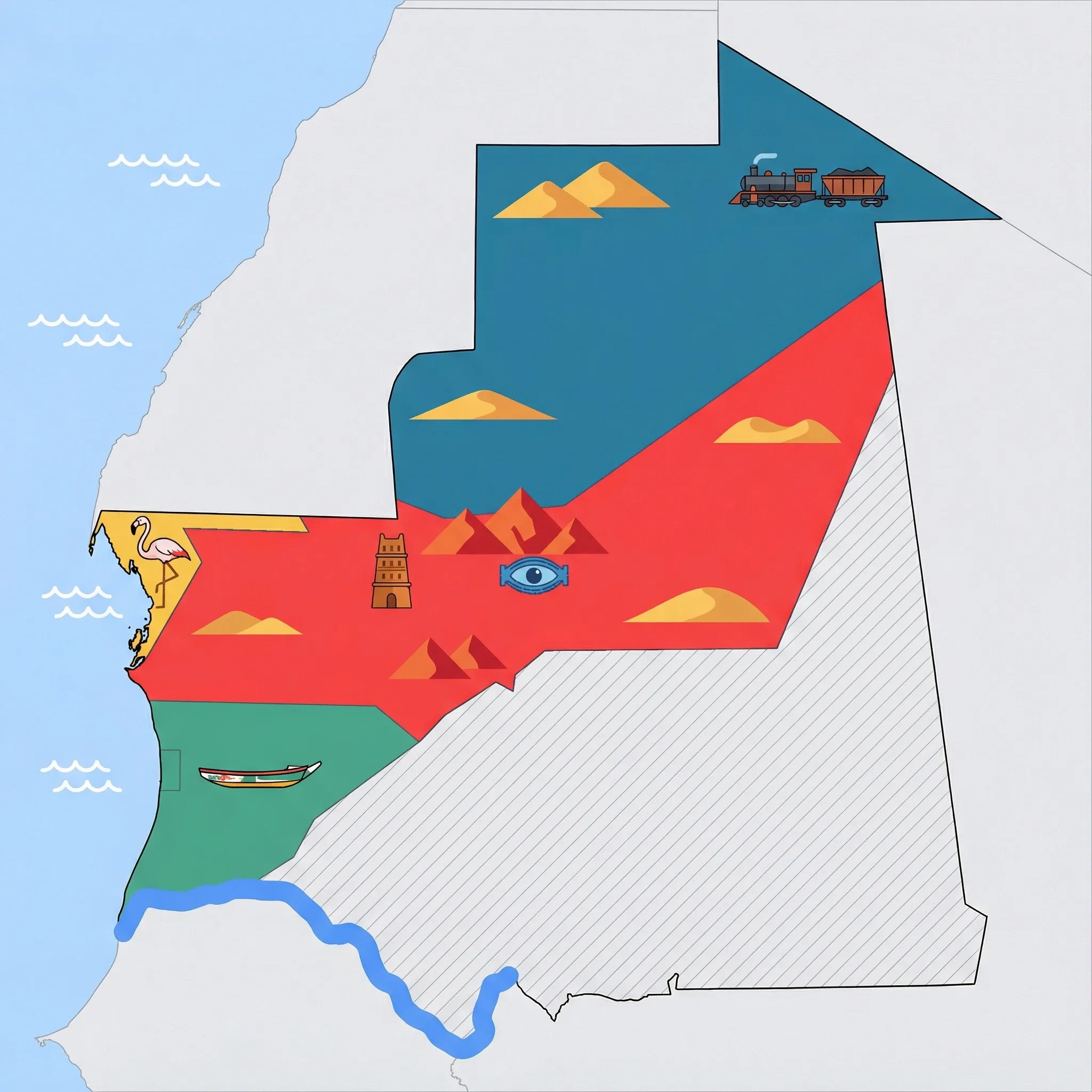
Click a region to explore
⚠️ SAFETY WARNING: DO NOT TRAVEL. Governments including the USA (Level 3/4), UK, Canada, and New Zealand strongly advise against all travel to this region, particularly areas near the borders with Algeria and Western Sahara. The risk of terrorism, kidnapping, and banditry is extremely high. The border zones contain active minefields. Travelers should not enter this region without professional security, local guides, and military clearance. The description below is for informational purposes only.
Overview
The Saharan North is not a tourist destination in the traditional sense; it is a raw, industrial frontier set against a backdrop of apocalyptic beauty. This is the land of iron. The ground itself often glitters with minerals, and the silence is broken only by the rumble of the "Iron Train," one of the longest trains in the world, which snakes its way from the mines of Zouerat to the coast. It is a harsh, unforgiving landscape that attracts only the most extreme adventurers and geologists.
For the very few intrepid families that venture this far (under strict security), the draw is the sheer scale of the planet. The sky seems bigger here, and the isolation is absolute. There are no hotels, no restaurants, and no comfort. It is camping in its wildest form. The region is home to nomadic camel herders who navigate the invisible borders of the deep Sahara, living much as they have for millennia, though now often equipped with satellite phones.
Key Attractions
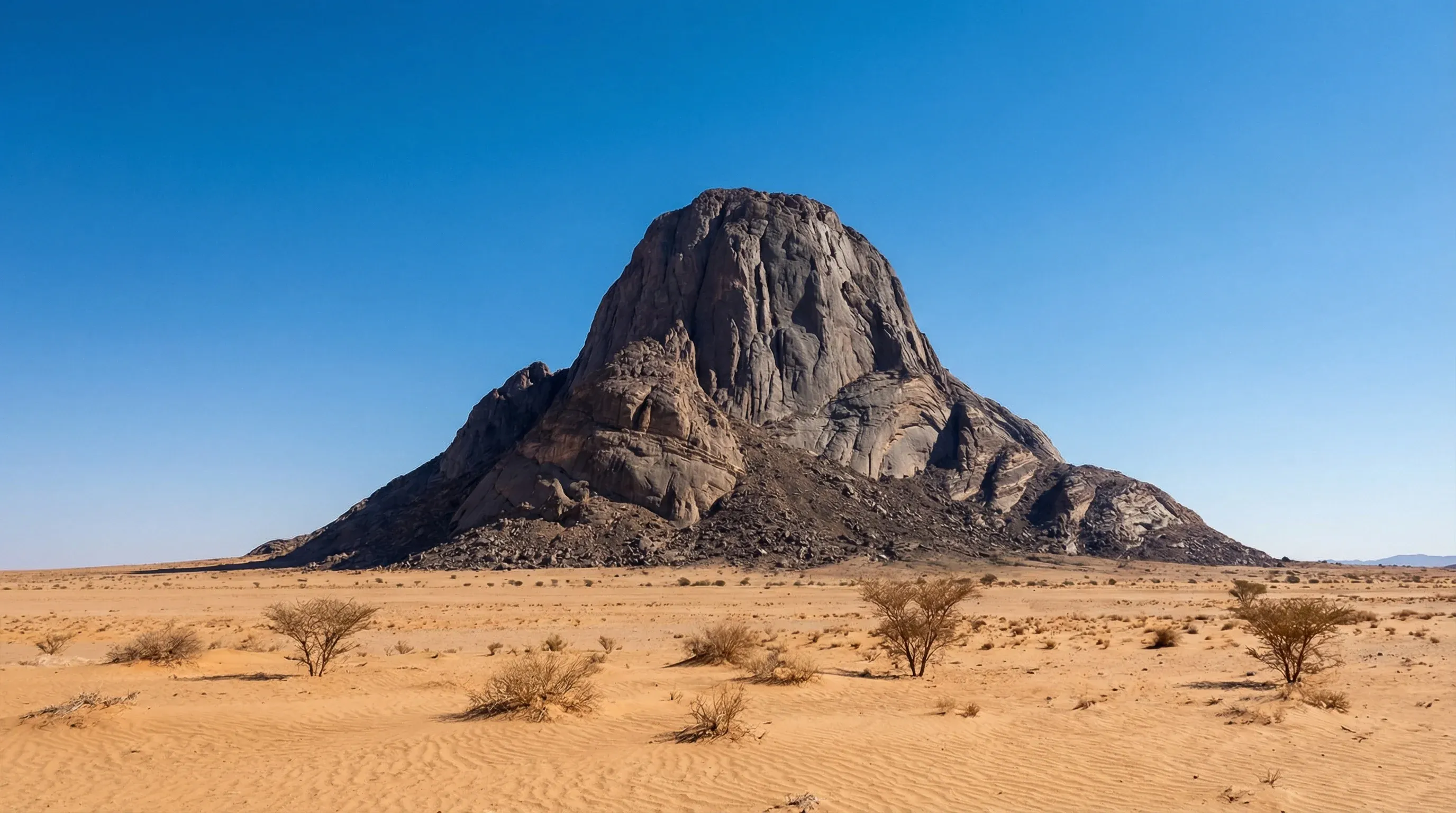
The primary natural wonder is the Ben Amera Monolith. Rising over 600 meters from the flat desert floor, it is the second-largest monolith in the world (after Uluru). It looks like a black mountain dropped from the sky. Nearby is a smaller monolith, Aisha, which features an art installation of sculptures carved into the rocks at its base—a surreal gallery in the middle of nowhere.
The other "attraction" is the Iron Ore Train. While some travelers hop on top of the wagons for the journey to the coast, this is extremely dangerous and dusty, and absolutely not recommended for children. However, watching this 2.5-kilometer-long metal snake rumble past from a safe distance in the desert is a spectacle of industrial power that leaves a lasting impression.
Practical Advice
This region requires military permission to enter. There is no "best time" other than mid-winter (December/January), as heat in other months is lethal. You must be self-sufficient with fuel, water (at least 5-10 liters per person per day), and food. There is no cell service; a satellite phone is mandatory.
Food & Drink
Typical meal times: Determined entirely by your camp schedule.
Typical meal costs: N/A - There are no restaurants. You must bring all your own food or hire a logistics team.
Dietary requirements: You eat what you bring. Fresh produce will spoil quickly in the heat.
Signature dishes:
- Canned Mackerel & Bread – The staple diet of the desert traveler in this region.
- Sweet Tea – The only constant comfort, brewed over acacia wood fires at every stop.
Why this score?
The Saharan North is a true wilderness frontier featuring the massive Ben Amera monolith and the world's longest iron ore train. The terrain is exceptionally harsh, infrastructure is virtually non-existent, and travel often requires specialized permits and high-level self-sufficiency in extreme heat.
Why this score?
Medical facilities in the north are extremely limited, with only basic mining-related clinics in Zouerat. For a foreign traveler, there is virtually no accessible professional medical care, and any emergency would necessitate a high-stakes rescue operation in a desert environment far from any modern hospital.
Why this score?
This is one of the least visited inhabited places on Earth, primarily known for iron ore mining and extreme desert monoliths. Only a handful of extreme adventure travelers and transit tourists following the iron ore train route visit this frontier zone annually.

While there is nothing to buy, the cost is 'High' because safe travel requires a fully supported expedition. You need to hire reliable 4x4s, drivers, a cook, and potentially security. An expedition here costs upwards of 8,000–12,000 MRU (approx. $200–300 USD / €190–280 EUR) per person per day.

Getting Here & Around
Getting Here
- Train – The Iron Ore train runs from Nouadhibou to Zouerat. It takes 14–20 hours. There is one passenger carriage, which is crowded and basic. Most hardened travelers ride in the open ore wagons, which is dangerous.
- Driving – Access is via off-road tracks from Atar. It is hundreds of kilometers of open desert. GPS and local guides are mandatory to avoid drifting into minefields near the Western Sahara border.
Getting Around
- Car (4x4) – The only way to move around. You typically need a convoy of two vehicles in case one breaks down.
- Walking – Only advisable around the immediate campsite or the base of Ben Amera Monolith due to heat and disorientation risks.
Nearby Airports (1 airport)
Tazadit Airport
OUZZouerate
View full flight map for Mauritania →

Packing List
There is zero mobile coverage and high risk; this is your only link to the outside world.
Sandstorms are frequent and severe; sunglasses are not enough protection.
GPS can fail; knowing how to navigate traditionally is a critical backup.
If near the iron train or in a storm, the dust is choking and metallic.
Essential for protecting eyes during sandstorms or if near the dusty Iron Ore Train.
Used locally to wrap the face and head for protection against sun, wind, and sand.
The desert air is extremely dry and dusty; this helps prevent nosebleeds and discomfort.
Power cuts are common and desert camping is pitch black; red light preserves night vision.
Provides a clean sleeping layer when staying in basic guest houses or communal nomad tents.
Sand gets everywhere; essential for protecting phones, cameras, and documents.

Activities & Best Times

Hiking, wildlife, outdoor exploration, ecotourism
Home to Ben Amera, the world's second-largest monolith, offering a surreal Saharan landscape for adventurous wilderness exploration and nomadic encounters. Travel is strictly seasonal, peaking in winter when temperatures are manageable for desert trekking and camping.

Urban tourism, museums, historical sites, architecture
Explores the unique industrial heritage of the Zouerat mining region and its connection to the trans-Saharan trade and the iron ore industry. Visits are best during the cooler winter months to avoid debilitating desert heat and frequent dust storms.

Scenic drives, countryside tours, route-based travel
The iconic Sahara Iron Route follows the world's longest train through remote desert landscapes, providing a rugged and authentic overlanding experience. Peak winter months offer the necessary visibility and safe temperatures for traversing deep desert pistes.

Sport tourism, fitness activities, active recreation
The challenging ascent of the Ben Amera monolith is a significant draw for experienced climbers and trekkers seeking unique desert routes. Peak conditions occur in the coldest months to ensure the rock surface is cool enough for safe climbing.




Public Holidays & Calendar Next 12 months
Public holidays, festivals, cultural celebrations, and seasonal natural phenomena coming up in Saharan North over the next 12 months.
Loading holidays and events...

Travel Advisory
All major agencies maintain a high-level warning for Mauritania, primarily due to terrorism, the threat of kidnapping against Westerners, and violent crime. Non-essential travel is discouraged for the entire country, while large regional sections are considered too dangerous for any travel.
Safety Topics
Traveller Advice (3 groups)
Staff from international organizations are at a heightened risk of kidnapping in the eastern and northern regions. Professional security assessments and escorts are strongly recommended when operating outside Nouakchott.

Female travellers should dress conservatively and avoid moving alone, particularly after dark. There are significant legal risks when reporting sexual assault, as local laws may require victims to provide specific proof to avoid being charged with non-consensual acts themselves.

A pre-approved electronic visa is mandatory for entry; visas are no longer issued upon arrival at the border or airport. Travellers should carry multiple photocopies of their passport at all times as identity checks are frequent.
Agency Summaries
New Zealand classifies the security situation as unpredictable, citing kidnapping and terrorism as major threats. Travel to northern and eastern provinces is strongly discouraged due to armed banditry and military operations.
Canadians are advised to avoid non-essential travel due to significant threats of terrorism and kidnapping. Highest risk levels apply to northern and eastern border regions where extremist groups and bandits are active. Westerners are frequently targeted for abduction.
Australia advises a high degree of caution overall with a recommendation to reconsider travel plans due to kidnapping risks and terrorism. Violent crime is on the rise, and landmines remain a hazard near the Western Sahara border, particularly after sandstorms.
British authorities advise against all travel to eastern regions and border zones, and all but essential travel elsewhere. There is a high risk of terrorism and kidnapping throughout the country. Civil unrest and demonstrations occur periodically in the capital.
Ireland advises against non-essential travel due to serious security concerns. Irish citizens have very limited consular support as there is no local embassy. E-visas must be obtained online prior to departure.
The U.S. government recommends reconsidering travel because of crime and terrorism. Violent crimes like armed robbery and assault are common. Military-restricted zones in the north and along the Mali/Algeria borders are extremely dangerous and off-limits to visitors.
Information is provided for general guidance only and does not constitute travel, safety, medical, or legal advice. Conditions may change. Users are responsible for independently verifying information before travel.