

Mexico is a country of dazzling contrasts that captivates children from the moment they arrive. Its geography ranges from the turquoise Caribbean coast and steamy jungles of the south to the cactus-studded deserts of the north and the cool, high-altitude central plateau. For families, this diversity means you can combine a relaxing beach holiday with genuine adventure. The culture is profoundly family-centric; children are welcomed everywhere, from upscale restaurants to late-night town squares, where families gather while kids play football and chase balloons.
Beyond the famous resorts, the real magic lies in the experiences: swimming in underground rivers, exploring colourful colonial towns with cobblestone streets, and tasting food that goes far beyond the Tex-Mex versions found abroad. Whether you are exploring the Yucatán Peninsula or the mountains of Chiapas, the warmth of the Mexican people makes navigating the country with little ones surprisingly easy.
Key Attractions
For water-loving families, the Yucatán Peninsula is unmissable. Here, you can swim in cenotes (natural limestone sinkholes) like the stunning Cenote Ik Kil, which features hanging vines and deep blue waters, or explore the underwater caves of Cenote Dos Ojos. Over on the Pacific coast, Balandra Beach in Baja California is often called Mexico's most beautiful beach; its waters are so shallow that toddlers can walk out safely for hundreds of metres. Nearby, a boat trip to see El Arco (The Arch) offers the chance to spot sea lions basking on the rocks.
In the interior, Mexico City is a treasure trove for educational fun. The massive Bosque de Chapultepec is an urban park twice the size of Central Park, home to the Chapultepec Castle and a zoo. For rainy days, the Acuario Inbursa is excellent. Further south, nature-loving families should head to Chiapas to take a boat ride through the imposing Cañón del Sumidero National Park, where crocodiles sunbathe on the riverbanks. For a unique wildlife experience, Africam Safari in Puebla allows you to drive through habitats where giraffes and zebras roam freely.
Practical Advice
The best time to visit is during the dry season (November to April). Visa rules are generous, with most Western families receiving 180 days on arrival, but you must complete an FMM (tourist card), now often digital. Health-wise, never drink tap water; stick to sealed bottles. Altitude sickness can affect children in Mexico City (2,240m), so take it easy for the first few days.
Food & Drink
Typical meal times: Breakfast is 7:00 am to 10:00 am. Lunch (la comida) is the main meal, served late from 2:00 pm to 4:00 pm. Dinner (la cena) is lighter and typically eaten from 8:00 pm to 10:00 pm.
Typical meal costs: $200–450 MXN (approx. $10–25 USD / £8–20 GBP) per person for a main meal in a mid-range restaurant. Street food and tacos cost significantly less ($20–50 MXN each).
Dietary requirements: Vegetarian options are increasingly common (look for beans, cheese, and cactus 'nopal'), but check that beans are not cooked with lard (manteca). Gluten-free travellers have it easy with corn tortillas, but always ask about wheat flour (harina de trigo) usage.
Family-friendly dining: Mexican dining is incredibly informal and child-friendly. Highchairs are common in restaurants, and staff will often go out of their way to entertain babies. Kids menus usually feature quesadillas or breaded chicken (milanesa).
Signature dishes:
- Cochinita Pibil – Slow-roasted pork from the Yucatán, marinated in citrus and achiote (not spicy), perfect for kids.
- Sopa de Lima – A comforting, mild chicken and lime soup with tortilla strips.
- Molletes – Open-faced bread rolls topped with refried beans and melted cheese, often eaten for breakfast.
- Tacos al Pastor – Thinly sliced pork cooked on a spit with pineapple; ask for salsa on the side to control the heat.
Safety
Stick to regulated taxis (Uber is safe in CDMX but restricted in some airports/resorts) and first-class buses (ADO). Avoid hailing taxis on the street. In beach towns, be aware of strong currents and flags. Petty theft can happen, so keep valuables hidden. Most importantly, stay updated on regional travel advisories, as safety situations can change by state.

A family of four can expect to spend around $3,500–5,500 MXN (approx. $190–300 USD / £150–240 GBP) per day covering mid-range accommodation, meals, and activities. Street food significantly lowers costs.
Age Suitability





Did you know? Mexico welcomes approximately 45.0 million international visitors per year. Most visitors come from Americas.

Explore Regions
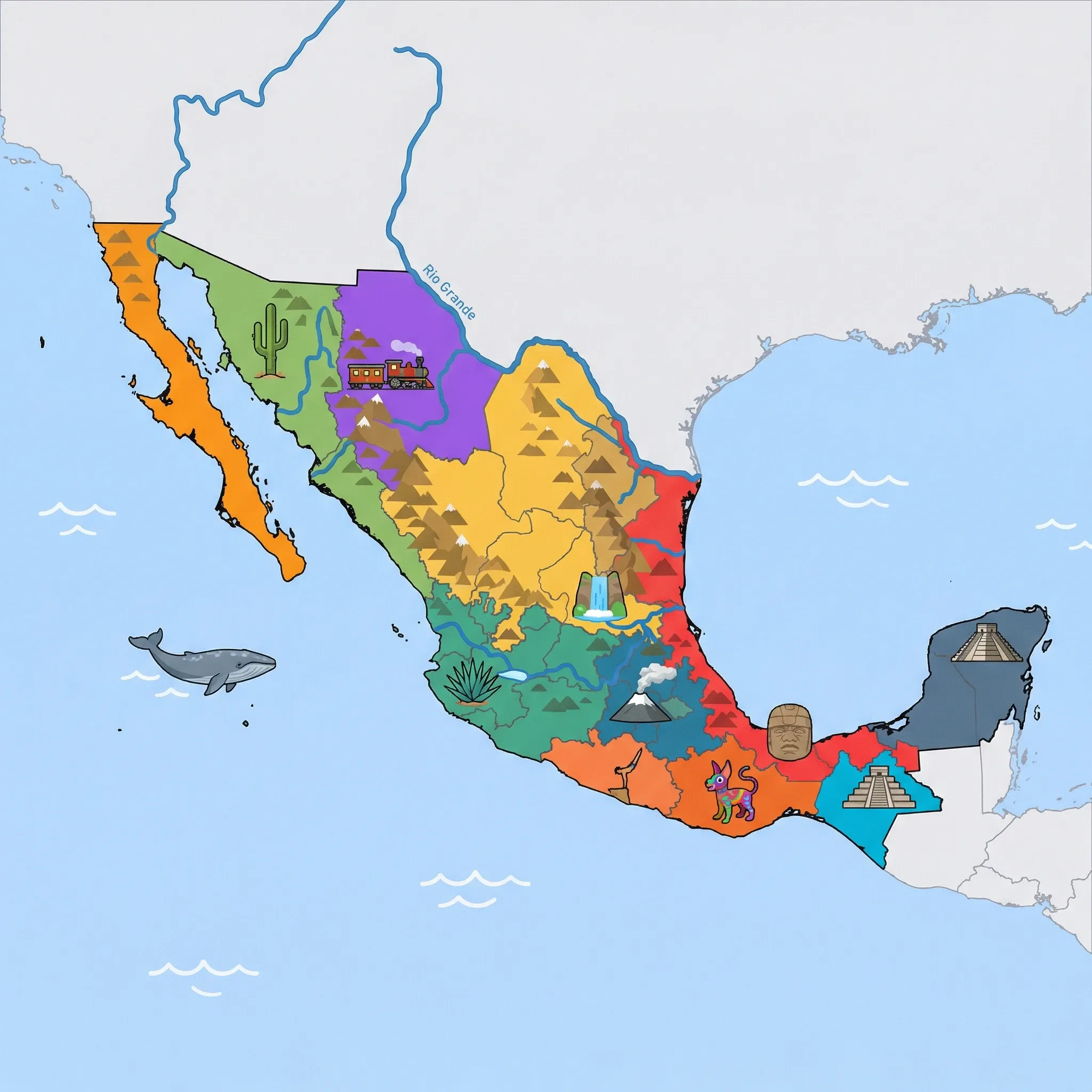
11 Regions
Baja California & Pacific Peninsula
Where the desert meets the deep blue sea 🐋🌵
Central Highlands & Mexico City Region
Ancient pyramids and modern energy in the clouds 🏛️🏙️
Chiapas & Maya Highlands
Jungle ruins and living Maya culture 🐆🌿
Guerrero & Pacific South
Golden sands and silver cities 🌊⛰️
Gulf Coast & Lowlands
Coffee, culture, and the roots of Mexico ☕🗿
North-Central Highlands
Silver mines and surrealist gardens 🏰🍃
Northern Borderlands & Chihuahuan Desert
Canyons deeper than the Grand Canyon 🚂🏜️
Northwest Pacific & Sonoran Desert
Red deserts and golden coasts 🦐☀️
Oaxaca & Southern Highlands
The land of seven moles and ancient traditions 🍛🧶
West-Central Mexico & Bajío
The land of tequila, mariachi, and butterflies 🦋🎺
Yucatán Peninsula
Caribbean turquoise waters and Maya mysteries 🏖️🗿
Click on a region marker to explore details. Use the dropdown to color regions by activity suitability.

Getting There & Around
Getting There
- By Air – Mexico City International Airport (MEX) is the main hub, with Cancún (CUN) serving the Yucatán Peninsula. Direct flights are available from major US, Canadian, and European cities.
- By Land – Families can drive across the US border or take buses, but this is generally recommended only for experienced travellers due to safety complexities in border regions.
- Entry Requirements – Citizens of the US, Canada, UK, and Schengen area do not need a visa for stays up to 180 days but must complete an FMM (tourist card). Check your government website for the latest visa requirements, or use the IATA Travel Centre entry-requirements checker.
Getting Around
- Bus – The first-class bus network, dominated by ADO in the south, is excellent, safe, and comfortable (often with AC and movies). It connects major hubs like the Yucatán Peninsula and Oaxaca efficiently.
- Car Hire – Useful for exploring the Baja California peninsula or the Yucatán at your own pace. Always use toll roads (cuotas) for safety and better conditions. Avoid driving at night.
- Domestic Flights – Budget carriers like Volaris and VivaAerobus make hopping between distant regions like Mexico City and the beaches affordable.

Packing List
Strictly required in cenotes and marine parks to protect ecosystems; regular sunscreen is often confiscated.
Essential for protecting feet on rocky cenote floors and hot sand; widely used by locals.
High-altitude cities like Mexico City and San Cristóbal get surprisingly cold at night, even in summer.
Many colonial towns have uneven cobblestone streets that make strollers difficult to use.
Easier to apply on squirming kids than spray and essential for preventing dengue in tropical areas.

Activities & Best Times

Adventure & Nature
ExcellentHiking, wildlife, outdoor exploration, ecotourism
A premier destination for wilderness immersion, featuring unique desert-to-sea ecosystems and the world-renowned grey whale calving lagoons. The winter peak offers life-changing wildlife encounters, while the intense summer heat makes trekking and desert exploration physically hazardous.
Boasts incredible biodiversity and immersion in the Sierra Norte highlands through established ecotourism centers. The dry winter season is optimal for mountain exploration, whereas the heavy summer rains often lead to difficult trail conditions.
The Copper Canyon system offers world-class wilderness immersion and canyon exploration four times the size of the Grand Canyon. Peak seasons avoid the freezing winter sierra temperatures and the extreme Chihuahuan desert heat of June through August.

City & Cultural
ExcellentUrban tourism, museums, historical sites, architecture
Home to some of the world's most beautiful colonial cities and UNESCO sites, offering a rich tapestry of history, world-class museums, and sophisticated gastronomy. Winter and spring provide ideal walking weather, while September's heavy rainfall marks the only period where urban exploration is less recommended for families.
Offers a sophisticated blend of iconic urban landmarks like the Tijuana Arch and the serene Malecón de La Paz, supported by unique botanical gardens. Spring and autumn provide the most comfortable climate for experiencing the region's culinary evolution and urban street life.
A UNESCO-listed colonial center with profound indigenous heritage, world-class gastronomy, and iconic archaeological sites like Monte Albán. Peak months offer ideal walking weather, while summer shoulder months remain popular despite the increased rainfall.

Sports & Active
Very GoodSport tourism, fitness activities, active recreation
Boasts significant infrastructure like the Ixtapa-Zihuatanejo Ciclopista and professional-grade adventure courses at Xtasea. Optimal conditions occur during the dry months when humidity is manageable for high-exertion outdoor activities.
Features professionally managed adventure centers in scenic highland locations, providing high-standard zip-lining and outdoor activity infrastructure suitable for active families. Operations are most reliable during the clear dry season from November to April, while summer thunderstorms often lead to temporary closures of outdoor equipment.
Boasts high-infrastructure outdoor centers like Wild Canyon and Cabo Adventures, offering world-class zip-lining and desert sport facilities. The cooler months are essential for high-exertion activities to avoid the extreme midday temperatures characteristic of the peninsula.

Theme Park & Entertainment
Very GoodAmusement parks, family entertainment venues
Hosts internationally recognized venues like Six Flags Mexico and the flagship KidZania, offering high-quality entertainment infrastructure. Peak visitation aligns with major school holidays and drier periods, while September's heavy rainfall can lead to ride closures and a diminished outdoor experience.
Provides high-quality family entertainment including internationally recognized concepts like KidZania and significant regional water parks with modern facilities. Peak seasons align with international and domestic school holiday windows, though the mid-year rainy season can affect outdoor water park suitability and operations.
Features several regional waterparks like El Vergel that provide high-quality family entertainment in an arid climate. Best visited during the warm spring months when water activities are most refreshing but before the peak summer heat becomes oppressive.

Beach & Sea
Very GoodBeach resorts, marine activities: diving, snorkelling, kite surfing, wind surfing, sailing
Cancún, Playa del Carmen, and Tulum are internationally renowned Caribbean beach destinations attracting millions of visitors annually. The current 'good' rating significantly underrates this region's global beach tourism significance. While perhaps not at the very pinnacle globally, these beaches are world-famous and warrant 'very_good' at minimum.
Home to iconic coastal landmarks like El Arco and the turquoise waters of Playa Balandra, offering world-class snorkeling in the 'aquarium of the world'. Peak visitation aligns with whale migration and pleasant air temperatures, while the extreme humidity and heat of July-September are less desirable.
Features iconic Pacific destinations like Puerto Escondido and Huatulco with significant surfing and coastal recreation. Best visited during the dry season for calmest seas and maximum water clarity for snorkeling.

Educational & Exploratory
GoodLearning experiences, scientific sites, historical education
Internationally significant marine science centers like the Museo de la Ballena offer families deep insights into ocean conservation. These experiences are most impactful during the peak whale-watching season when the scientific context aligns with real-world sightings.
Features significant scientific and marine learning centers like Acuario Inbursa that serve as major regional draws for families. These indoor facilities are viable year-round, though visitor numbers peak during domestic holiday windows and the drier spring months.
The classification notes describe 'the major Aquarium del Puerto de Veracruz, providing a high-quality science experience' - this contradicts the 'marginal' rating. A major, high-quality aquarium warrants 'good' rating, especially when combined with the region's archaeological and cultural learning opportunities.

Relaxation & Wellness
GoodSpa retreats, wellness centers, peaceful getaways

Road Trips & Scenic
GoodScenic drives, countryside tours, route-based travel

Public Holidays & Calendar Next 12 months
Public holidays, festivals, cultural celebrations, and seasonal natural phenomena coming up in Mexico over the next 12 months.
Loading holidays and events...
Climate & Weather
Baja California & Pacific Peninsula
Show Details
| Month | Temp °C | Rain | Humidity |
|---|
Central Highlands & Mexico City Region
Show Details
| Month | Temp °C | Rain | Humidity |
|---|
Chiapas & Maya Highlands
Show Details
| Month | Temp °C | Rain | Humidity |
|---|
Guerrero & Pacific South
Show Details
| Month | Temp °C | Rain | Humidity |
|---|
Gulf Coast & Lowlands
Show Details
| Month | Temp °C | Rain | Humidity |
|---|
North-Central Highlands
Show Details
| Month | Temp °C | Rain | Humidity |
|---|

Travel Advisory
All major agencies maintain a baseline of increased vigilance for Mexico. While many tourist areas remain accessible, widespread criminal activity and recent localized spikes in cartel-related violence in western states necessitate a high degree of caution.
Safety Topics
Traveller Advice (4 groups)

While major cities and resort destinations are generally accepting, social attitudes in rural regions can be conservative. Travelers should be mindful of local sentiments regarding public displays of affection.

Female travelers should remain particularly alert as incidents of harassment and sexual assault have been reported, even in tourist areas. It is safer to travel in groups and use reputable, pre-arranged transportation.

Stay within well-known tourist zones and travel primarily by air. If driving is necessary, use toll roads during daylight hours and avoid secondary or isolated routes. Monitor local news constantly for sudden security changes or roadblocks.

Older travelers should consider the physical demands of high-altitude destinations like Mexico City. Ensure comprehensive health insurance is in place, as private medical care in cities is excellent but expensive, whereas rural facilities are often limited.
Agency Summaries
New Zealanders should exercise heightened caution because of pervasive violent crime and drug-related conflicts. Specific regional warnings are in place for many states where travelers are advised to avoid non-essential trips.
Travelers should be extremely careful due to prevalent crime and kidnapping. While the national level is set at increased caution, specific states carry 'Do Not Travel' warnings because of extreme violence. U.S. government personnel face restricted movement in many high-risk zones.
Irish citizens are advised to be very cautious across the country. Travel to Jalisco is currently discouraged entirely due to ongoing security operations and violence. Many other states are designated for essential travel only due to high levels of insecurity.
The security situation is unpredictable and potentially dangerous in several states. Travelers in Jalisco are advised to stay indoors following significant unrest and road blockades. Violent incidents, including arson and armed confrontations, have increased following a major law enforcement operation.
A high level of vigilance is required due to the persistent threat of violent crime. Recent security incidents in Jalisco and neighboring states have led to shelter-in-place advisories and significant transportation disruptions, including flight cancellations in major tourist hubs.
Canadians are urged to remain highly vigilant throughout Mexico due to widespread criminal activity. Emergency shelter-in-place orders are currently active in Jalisco and Nayarit following violent clashes between security forces and criminal groups. High levels of violence and organized crime are reported in many regions.
Information is provided for general guidance only and does not constitute travel, safety, medical, or legal advice. Conditions may change. Users are responsible for independently verifying information before travel.