
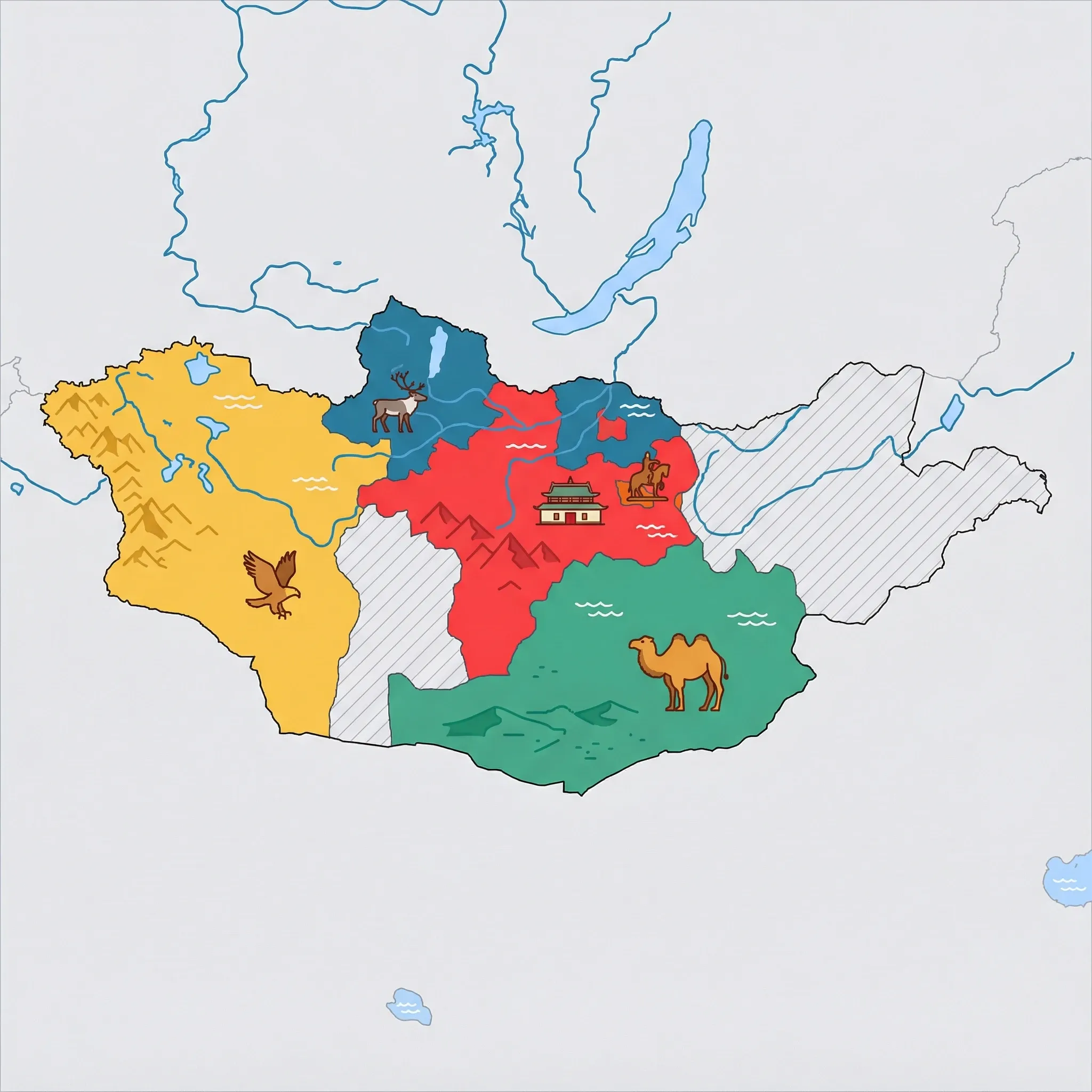
Click a region to explore
Safety Advisory: The Gobi is extremely remote with a harsh climate. Summer temperatures can exceed 40°C (104°F). Dehydration is a real risk for children; always carry double the water you think you need. Medical facilities are scarce outside Dalanzadgad.
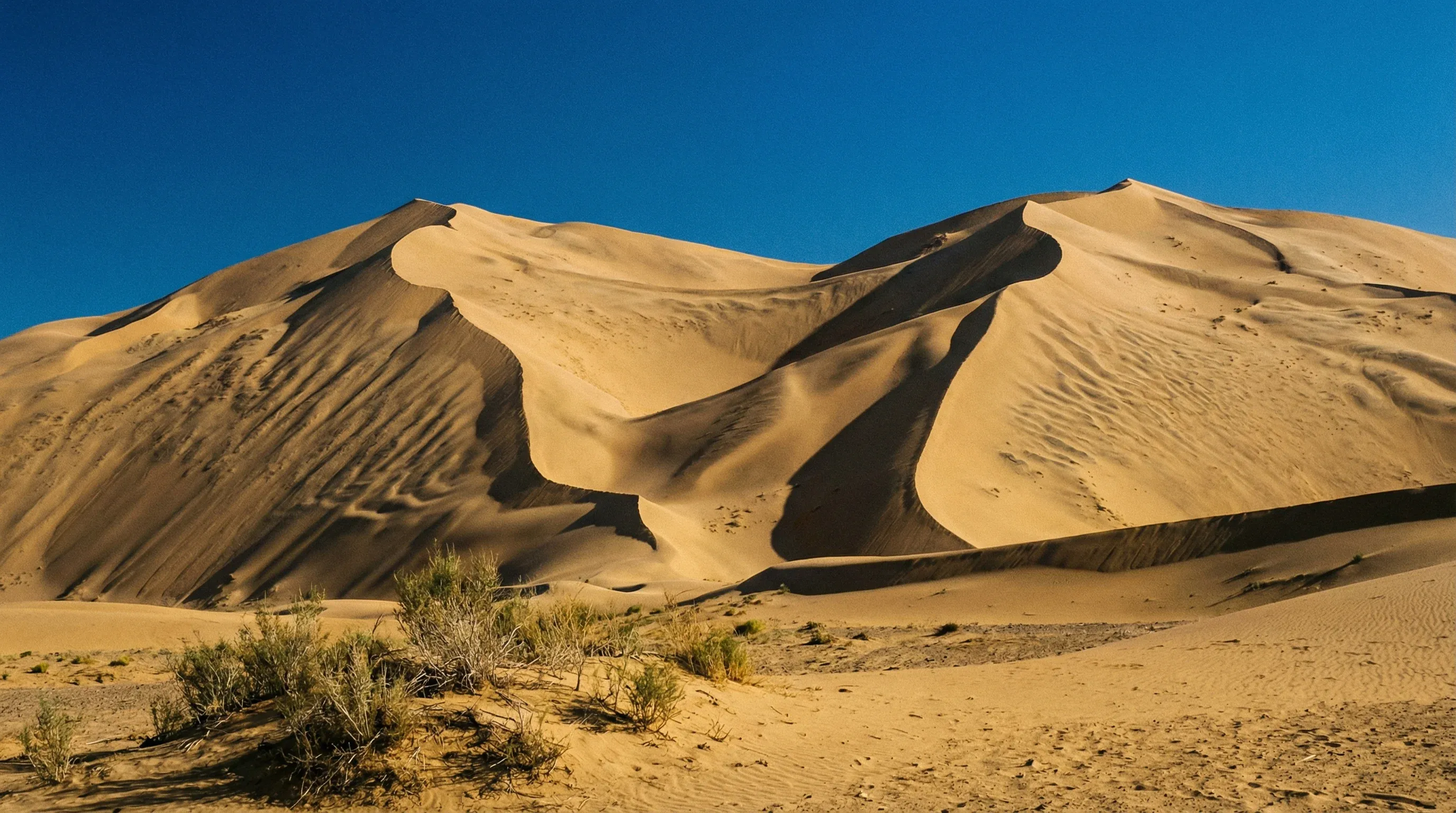
The Gobi Desert is not a lifeless void of sand, but a diverse ecosystem of mountains, ice canyons, and shrublands that captivates the imagination of children and adults alike. It is one of the few places on Earth where you can dig for dinosaur bones in the morning (at the famous Flaming Cliffs) and ride a Bactrian (two-humped) camel into the sunset in the evening. The sheer scale of the landscape teaches children about nature's power; the silence at night, under a dome of stars undisturbed by light pollution, is a profound experience for families used to city living. While the travel involves long days in a vehicle on corrugated dirt tracks—often jokingly called the "Gobi Massage"—the destinations are iconic and rewarding.
The region is best suited for families with slightly older children (ages 6+) who can handle long car rides, although toddlers are welcomed warmly by locals. The terrain shifts dramatically as you drive: flat gravel plains turn into the jagged peaks of the Gurvan Saikhan National Park, and suddenly, massive walls of sand appear on the horizon. Culturally, the Gobi nomads are incredibly resilient, herding camels and goats in conditions that seem impossible to outsiders. Visiting a camel-herding family offers a distinct contrast to the horse-centric culture of Central Mongolia.
Key Attractions
The star attraction is Khongoryn Els Sand Dunes, known as the "Singing Sands." These dunes reach heights of up to 300 meters. Climbing to the top is a physically demanding challenge that takes about 45 minutes to an hour, but the view is unbeatable. Kids love the descent—running, jumping, or sledding down the soft sand which emits a low-frequency hum or "song" as the grains shift. It is a giant natural playground.
Another geological marvel is Yolyn Am (Eagle Valley), a deep, narrow gorge within the Gurvan Saikhan mountains. Remarkably, this valley is so deep and shadowed that a thick layer of ice often survives well into the summer months (until July). Families can hike along the stream, hopping over rocks and spotting pikas (small mountain mammals) and circling vultures. It’s an easy, flat walk that is very manageable for children.
For a touch of history and spirituality amidst the void, Ongi Monastery (Ongiin Khiid) serves as a poignant rest stop between the central steppes and the deep Gobi. The ruins of this formerly massive complex are scattered across the hills, offering a moody, atmospheric place for kids to explore while learning about the religious purges of the 1930s. Nearby, the Khamar Monastery (Hamarin Khiid) offers a glimpse into the "Energy Center" of Mongolia, a place locals believe revitalizes the spirit.
Practical Advice
The best travel window is late May, June, late August, and September. July is the hottest month and can be uncomfortable for small children. Avoid winter entirely as temperatures drop to -40°C. Transport is exclusively by 4WD minivan or jeep. Pack loose, light-colored clothing to reflect the sun, and bring heavy fleeces for the nights, which can be surprisingly cold.
Food & Drink
Typical meal times: Breakfast 7:30 am – 9:00 am; Lunch 12:30 pm – 2:00 pm; Dinner 7:00 pm – 8:30 pm.
Typical meal costs: Tourist camps charge 20,000–35,000 MNT (approx. $6–10 USD / €5–9 EUR) per meal if not included. Local town canteens are cheaper: 10,000–15,000 MNT (approx. $3–4.50 USD / €2.50–4 EUR).
Dietary requirements: Fresh vegetables are scarcer here than in the north. The diet is heavily reliant on mutton, goat meat, and flour. Vegans must bring supplements and protein bars.
Signature dishes:
- Khorkhog – The famous "Mongolian Barbecue." Mutton and vegetables are cooked inside a metal milk canister with hot stones from the fire. The smooth, greasy stones are handed to guests to rub in their hands for luck/health.
- Suutei Tsai – Salty milk tea, often served with millet or fried dough floating in it. In the Gobi, it may be made with camel milk, which is richer and slightly saltier.
Why this score?
Traveling here is a significant undertaking involving vast distances over trackless desert, extreme temperature swings, and basic living conditions. Families must be prepared for long days in off-road vehicles and limited water resources while exploring remote dunes and canyons. It offers a true sense of exploration that is far removed from standard holiday destinations.
Why this score?
Outside of the provincial center of Dalanzadgad, which has only basic hospital services, medical care is virtually non-existent. The vast distances between attractions mean that emergency response times are very slow, and specialized care is only available in the capital. Visitors are highly dependent on their tour operators' first aid capabilities and emergency communication gear.
Why this score?
The Gobi is Mongolia's most iconic brand, famous for dinosaur fossils and the singing dunes of Khongoryn Els. While it is a bucket-list item for many, the high cost of logistics and extreme climate keep visitor volumes firmly in the niche category. Tourism is concentrated in a few key clusters like Yolyn Am and the Flaming Cliffs.

Similar to Central Mongolia, but fuel costs are higher due to distances. A mid-range tour (driver, vehicle, fuel, camp accommodation, food) averages $120–200 USD (approx. 400,000–680,000 MNT / €110–185 EUR) per person per day. Budget travelers staying in guest gers can lower this to $70–90 USD (approx. 240,000–300,000 MNT / €65–85 EUR). Flights to Dalanzadgad cost approx. 850,000–1,200,000 MNT (approx. $250–350 USD / €230–325 EUR) round trip.

Getting Here & Around
Getting Here
- Airports – Dalanzadgad (DLZ) is the regional hub. Domestic flights from Ulaanbaatar operate seasonally (summer) and take 1.5 hours, saving two days of driving.
- Driving – The drive from Ulaanbaatar to Dalanzadgad is on a paved road (approx. 550km, 7–9 hours). However, reaching sites like Khongoryn Els Sand Dunes requires hours of off-road driving from Dalanzadgad.
- Train – The Trans-Mongolian train stops in Sainshand (East Gobi), near Khamar Monastery (Hamarin Khiid), but this is far from the main sand dunes and canyons of the South Gobi.
Getting Around
- Car – Essential. You cannot visit the Gobi without a reliable 4WD vehicle (Land Cruiser or UAZ) and a driver who knows the tracks. GPS is unreliable; local knowledge is vital.
- Camel – Short camel rides are a popular way to explore the base of the dunes at Khongoryn Els Sand Dunes.
- Walking – Hiking is limited to specific sites like Yolyn Am (Eagle Valley). Do not wander into the open desert alone due to the risk of getting lost.
Nearby Airports (1 airport)
Gurvan Saikhan Airport
DLZDalanzadgad
View full flight map for Mongolia →
Official Links

Packing List
Essential for protecting the face and neck during dust storms or windy jeep rides.
The air is extremely dry and dusty; children's eyes often get irritated.
Gers can become ovens in the afternoon sun; air movement helps toddlers sleep.
Dehydration happens fast in the dry heat; water alone sometimes isn't enough.
Ger camps and outhouses often lack electricity at night; hands-free lighting is essential for bathroom trips.
You must remove shoes every time you enter a family's ger. Laces become very frustrating very quickly.
Showers can be scarce in the remote steppes. Wipes are the standard 'Mongolian shower' for days on the road.
It is customary to offer small tokens to the children of host families when visiting their gers.
Electricity in rural camps is often limited to a few hours of generator time or solar power.
To carry your own trash out of remote areas (leave no trace) and protect electronics from fine Gobi dust.

Activities & Best Times

Hiking, wildlife, outdoor exploration, ecotourism
Features extraordinary landscapes like the 'Singing Dunes' and ice-filled Yolyn Am gorge, offering authentic wilderness immersion for active families. Best visited in summer to avoid extreme sub-zero temperatures and high-velocity spring sandstorms.

Urban tourism, museums, historical sites, architecture
Centers on significant heritage sites like Ongi Monastery and the historic Flaming Cliffs, providing deep insights into nomadic traditions and paleontological history. Visitation is concentrated in summer when cultural infrastructure is fully accessible and conditions are pleasant for exploration.

Learning experiences, scientific sites, historical education
Home to globally significant fossil sites where families can engage with natural history at the South Gobi Museum and dinosaur information centers. Operational seasons are limited to the warmer months when specialized museums and field sites are staffed for tourists.

Sport tourism, fitness activities, active recreation
Provides high-quality hiking and cycling opportunities along recognized routes in Yolyn Am and the Khongoryn Els dunes. Peak season offers manageable temperatures and accessible trails, while winter makes these physically demanding activities dangerous due to extreme cold.

Scenic drives, countryside tours, route-based travel
The South Gobi Loop offers a rugged, off-grid expedition through dramatic landscapes, though it lacks the paved infrastructure and services expected of world-class touring routes. Travel is restricted to late spring through early autumn due to harsh winter conditions and difficult terrain.




Public Holidays & Calendar Next 12 months
Public holidays, festivals, cultural celebrations, and seasonal natural phenomena coming up in Gobi Desert over the next 12 months.
Loading holidays and events...

Travel Advisory
All major international agencies currently designate Mongolia as a low-risk destination where standard safety measures are sufficient. There are no active regional travel prohibitions or heightened security warnings beyond typical urban crime awareness.
Safety Topics
Traveller Advice (4 groups)

Rural travel requires significant preparation for extreme weather and limited infrastructure. It is recommended to travel with local guides, carry a satellite phone for communication in remote areas, and pack ample water and supplies.
Accessibility in Ulaanbaatar is very limited. While some sidewalks have tactile paving, most public buildings and transport systems remain inaccessible for wheelchair users, and elevators are often too small for standard equipment.

While same-sex relationships are not illegal, there is a lack of legal recognition for same-sex unions. Members of the community may face social discrimination, verbal abuse, or harassment, so discretion in public is recommended.

Female visitors should avoid solo travel, particularly at night, due to reports of harassment and infrequent sexual assault. It is safer to use registered taxi apps rather than hailing cars on the street.
Agency Summaries
No specific travel restrictions are in place, but visitors should be aware of the global threat of terrorism. Petty theft occurs in crowded areas. Road travel outside the capital can be hazardous due to poor infrastructure.
Irish citizens can visit Mongolia visa-free for tourism for up to 30 days until the end of 2026. Consular assistance is managed through the embassy in Beijing, as there is no local mission.
The overall risk is low, but tourists must register with local immigration authorities within 48 hours of arrival. Be cautious of scams involving fake police officers and exercise care during extreme winter weather conditions.
New Zealand does not have a specific travel advisory for Mongolia, suggesting a standard security environment. Travellers should focus on health precautions, particularly regarding water safety and winter air quality.
While generally safe, there is an upward trend in street crime and occasional violent incidents in larger cities. Visitors should stay in well-lit areas and use reputable transport. Female travellers are encouraged to avoid travelling alone.
Travellers should remain alert in urban centers where petty crimes like pickpocketing are frequent. Increased vigilance is recommended during major public holidays and festivals due to higher crime rates. There are reports of individuals impersonating police to rob visitors.
Information is provided for general guidance only and does not constitute travel, safety, medical, or legal advice. Conditions may change. Users are responsible for independently verifying information before travel.