

Overview
Montenegro may be small, but it delivers a massive travel experience for families. Known locally as Crna Gora (Black Mountain), this Balkan gem offers a stunning contrast between its glittering Adriatic coastline and its wild, rugged interior. For parents, the compact size is a huge advantage; you can drive from the palm-lined coast to fresh alpine air in under three hours. The atmosphere is relaxed and welcoming, with a culture that deeply values children and family life.
The coast is dominated by the spectacular Bay of Kotor, often called Europe's southernmost fjord, where calm, lake-like waters are perfect for young swimmers. Further south, the Budva Riviera buzzes with energy, while the Ulcinj & Southern Coast offers miles of sandy beaches rare in this part of the Adriatic. Inland, the landscape transforms into dramatic limestone peaks, glacial lakes, and deep canyons, providing an adventurous playground for active families.
Key Attractions
Start your journey in the UNESCO-listed Bay of Kotor. Kids will love the boat trip to Our Lady of the Rocks, a church built on an artificial island created by sinking old ships. Nearby, the pedestrian-only Perast Old Town allows children to run free along the waterfront. Active families can tackle the climb up to Kotor Fortress (San Giovanni) for breathtaking views, though early morning is best to beat the heat.
Heading inland, Lake Skadar National Park is a must for nature lovers-its vast wetlands are teeming with birds, including pelicans, and boat tours often include swimming stops in fresh water. In the north, Durmitor National Park offers cooler temperatures and easy hiking trails around the Black Lake. Don't miss the Đurđevića Tara Bridge, which spans the massive Tara River Canyon; adventurous teens might even brave the ziplines there. Back on the coast, Budva Old Town (Stari Grad) is a mini-Dubrovnik that captures kids' imaginations with its citadel and narrow streets.
Practical Advice
The best time to visit is May, June, or September. July and August can be fiercely hot (over 35°C/95°F) and crowded. The currency is the Euro (€), making it easy for travelers coming from EU countries. Tap water is generally safe, but bottled water is common in rural areas. Montenegrin roads are incredibly scenic but often winding and narrow; if you rent a car, take your time and be prepared for "serpentine" mountain passes.
Food & Drink
Typical meal times: Lunch is the main meal of the day, typically eaten between 1:00 pm and 4:00 pm. Dinner is a lighter affair, usually served from 8:00 pm to 10:00 pm, though tourist areas serve food all day.
Typical meal costs: €35–60 (approx. $38–65 USD / £30–50 GBP) for a family of four in a mid-range tavern (konoba). Pizza or pasta dishes cost around €8–12 (approx. $9–13 USD / £7–10 GBP).
Dietary requirements: Vegetarians will find plenty of options including fresh salads, grilled vegetables, and cheese dishes. Gluten-free awareness is growing in coastal towns but can be limited inland; grilled meats and fish are safe staples.
Family-friendly dining: Children are welcomed everywhere. Highchairs are common in resort towns but less so in rural konobas. "Kid's menus" are rare because portions are generally huge and easily shared, or kids simply eat smaller portions of pasta and pizza, which are ubiquitous.
Signature dishes:
- Crni Rižot (Black Risotto) – A coastal classic coloured with cuttlefish ink; kids are often delighted (or horrified!) by how it turns their tongues black.
- Burek – Flaky phyllo pastry filled with cheese, meat, or spinach, sold at bakeries everywhere for a perfect cheap breakfast or snack.
- Kačamak – A hearty mountain dish of cornmeal, potatoes, and cheese melted into a fondue-like consistency; immense energy for hiking.
- Ćevapi – Small grilled skinless sausages served in flatbread; a guaranteed hit with children who like burgers.
- Priganice – Small fried dough balls served with honey or cheese, often given as a complimentary starter or dessert.

Montenegro is affordable compared to Western Europe but prices rise sharply in coastal hubs like Kotor and Budva during summer. A family of four can expect to spend around €140–200 (approx. $150–215 USD / £120–170 GBP) per day for mid-range accommodation, car hire, and meals. Supermarket prices are reasonable, and bakeries provide very cheap lunches.
Age Suitability





Did you know? Montenegro welcomes approximately 2.0 million international visitors per year. Most visitors come from Europe.

Explore Regions
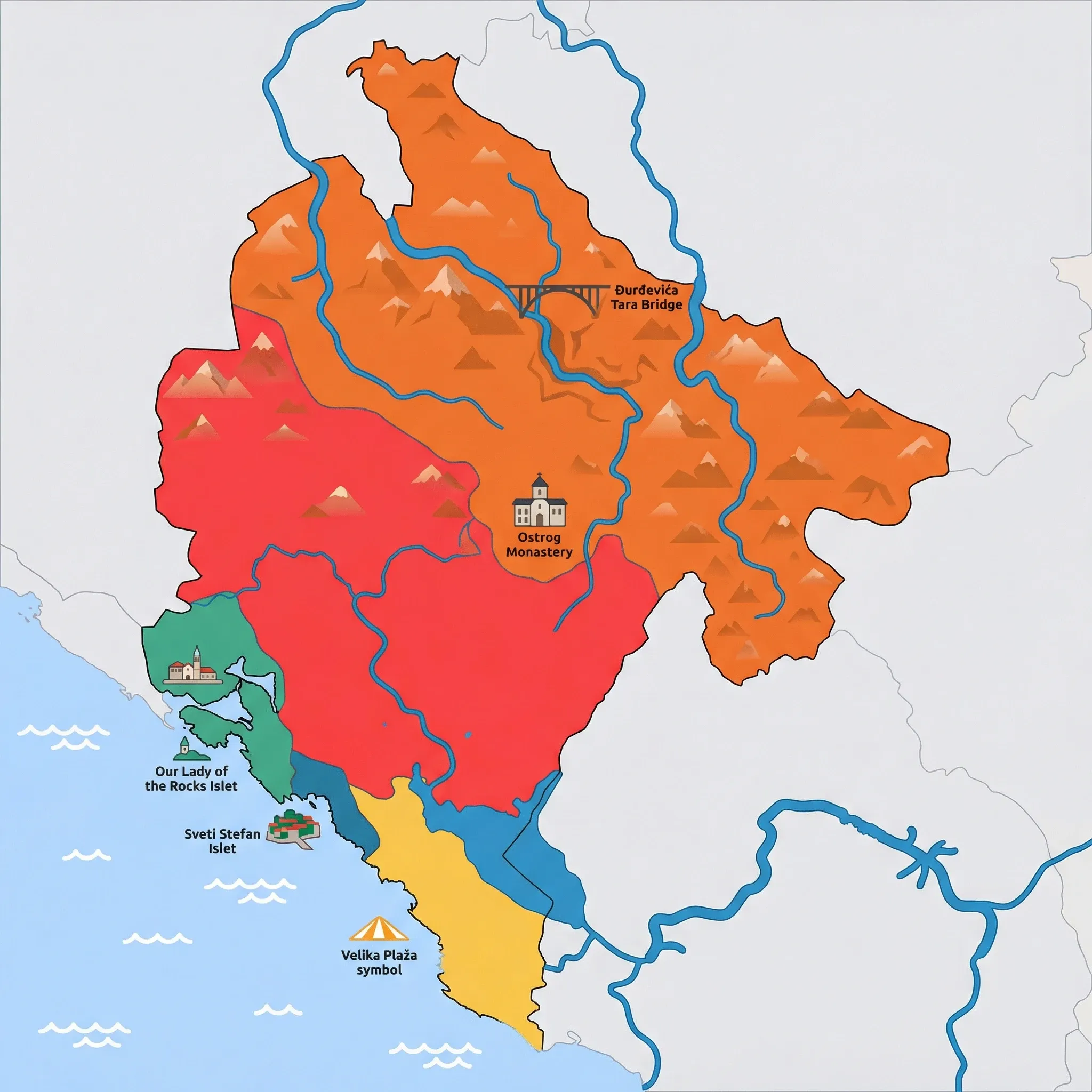
5 Regions
Bay of Kotor (Kotor, Perast)
Where mountains meet the sea in a medieval fairytale 🏰🐱⛰️
Budva Riviera (Budva, Sveti Stefan)
Sun, sand, and centuries of history ☀️🏰🌊
Durmitor & Northern Mountains
Wild peaks, glacial lakes, and Europe's deepest canyon 🌲🐻🏞️
Podgorica & Central
Pelicans, palaces, and cliffs 🦅🕍🛶
Ulcinj & Southern Coast
Endless sand, pirate legends, and kite surfers 🏴☠️🏖️🪁
Click on a region marker to explore details. Use the dropdown to color regions by activity suitability.

Getting There & Around
Getting There
- By Air – Tivat Airport (TIV) serves the coast directly, while Podgorica Airport (TGD) serves the capital. Many families also fly into Dubrovnik (DBV) in Croatia and drive across the border (approx. 45 mins to the border).
- By Train – The iconic Belgrade-Bar railway connects the Serbian capital to the Montenegrin coast, offering dramatic canyon views.
- Entry Requirements – Citizens of the EU, US, UK, Canada, and Australia can enter visa-free for stays up to 90 days. Check your government website for the latest visa requirements, or use the IATA Travel Centre entry-requirements checker.
Getting Around
- Car Hire – The best way to explore families. It allows you to connect the Bay of Kotor with the Durmitor & Northern Mountains at your own pace. Drive carefully on winding mountain roads.
- Trains – The railway from Bar to Podgorica and on to Belgrade is one of Europe's most scenic journeys, crossing the spectacular Lake Skadar National Park. It's cheap but older trains can be slow.
- Buses – A dense network connects major towns like Budva, Kotor, and Podgorica. While reliable and cheap, they can be crowded in summer and less convenient with strollers.

Packing List
Most beaches are pebbly or concrete, and sea urchins are common in the rocky shallows.
Roads are famously winding and serpentine, especially the route from Kotor to Lovćen.
Even in August, temperatures in the Durmitor mountains can drop significantly in the evening.
Many small bakeries, ice cream stands, and rural parking lots do not accept cards.
Essential if you plan to visit Lake Skadar or the Ada Bojana river area.

Activities & Best Times

Adventure & Nature
ExcellentHiking, wildlife, outdoor exploration, ecotourism
Home to the UNESCO-listed Durmitor Massif and the deep Tara River Canyon, this region offers spectacular, authentic wilderness experiences. Peak summer provides the most stable conditions for high-altitude trekking and river rafting, while shoulder months offer fewer crowds and stunning seasonal foliage despite variable weather.
The Ulcinj Salina is one of the most important birdwatching sites in Europe, while the Valdanos olive groves offer ancient, atmospheric hiking trails. Peak months align with the spectacular bird migration seasons and cooler temperatures suitable for exploring the coastal delta and groves.
The dramatic fjord-like landscape provides exceptional hiking on the Ladder of Kotor and rural immersion at traditional smokehouses and farms. May, June, and September offer ideal temperatures for exploration, whereas mid-summer can be too hot for strenuous trekking and winters are exceptionally wet.

City & Cultural
Very GoodUrban tourism, museums, historical sites, architecture
While Kotor Old Town is UNESCO-listed and beautiful, the region has one major historic town (Kotor) plus smaller settlements. 'Excellent' should be reserved for regions with world-class cultural density (Venice, Florence, Paris scale). Bay of Kotor is outstanding for the Balkans but not a global top-tier cultural destination.
The fortified Old Town of Budva and the historic Miločer Park provide sophisticated, high-quality cultural heritage in a compact setting. Ideal walking weather occurs in May, June, and September; summer months are viable but often overwhelmed by mass-market crowds and high temperatures.
Cetinje is the historic heart of Montenegro with museums of national importance, while Podgorica offers contemporary galleries. Extremely high winter rainfall and high summer temperatures in the Zeta Plain limit peak suitability to transitional seasons.

Sports & Active
Very GoodSport tourism, fitness activities, active recreation
Ada Bojana is a world-renowned destination for kitesurfing due to the consistent 'Maestral' thermal wind that blows throughout the summer. While other activities like cycling are possible in spring/autumn, the prime kiteboarding season is strictly defined by the reliable summer winds and warm waters.
Features internationally recognized cycling segments of the EuroVelo 8 and high-quality adventure parks on the surrounding massifs. Activity is best in late spring and early autumn; summer heat and high tourist traffic on narrow roads make July and August less optimal for cycling.
Renowned for world-class rafting on the Tara River and iconic high-altitude hiking routes like Bobotov Kuk. Specialized infrastructure including ziplines and adventure parks caters well to active families during the warmer months, while winter snow and spring runoff create barriers for most organized outdoor sports.

Beach & Sea
GoodBeach resorts, marine activities: diving, snorkelling, kite surfing, wind surfing, sailing
Home to Velika Plaža, the longest sandy beach on the Adriatic, and the unique river-sea delta of Ada Bojana, offering a distinct sandy alternative to the region's typical pebble coasts. Peak visitation occurs in mid-summer when sea temperatures are highest, though infrastructure remains less polished than major Mediterranean hubs.
While the bay's beaches are smaller and pebbly compared to the open coast, the calm, crystal-clear waters of Orahovac and Morinj are excellent for families. The swimming season is strictly confined to the warm summer months when water temperatures reach comfortable levels for international travelers.
Home to iconic Adriatic landmarks like Sveti Stefan and Mogren Beach, offering crystal-clear waters and high-quality resort infrastructure. Peak season coincides with the warmest sea temperatures in summer, while late spring and early autumn offer quieter but cooler conditions.

Educational & Exploratory
GoodLearning experiences, scientific sites, historical education
The Maritime Museum and Boka Aquarium provide significant specialized learning opportunities regarding the region's unique marine biology and naval heritage. These facilities align their peak operations with the summer tourist season, seeing significantly reduced accessibility and activity during the rainy winter months.
The Ulcinj Salina Bird Reserve & Museum offers a significant scientific look at Mediterranean salt production and avian ecology, though it is a niche educational draw. Visiting is best during peak migration in spring and autumn when the ecological importance of the site is most visible.
The Natural History Museum and specialized visitor centers at Lake Skadar provide solid scientific engagement for families. While authentic, they are secondary to the region's nature and culture offerings.

Road Trips & Scenic
GoodScenic drives, countryside tours, route-based travel
The Panoramic Route 'Between Two Magical Shores' and the drive through the Valdanos olive groves provide stunning vistas of the southern coast. Late spring and early autumn offer the best visibility and light for photography, while avoiding the heavy traffic congestion common on coastal roads in July and August.
The Kotor-Lovćen Serpentine is one of Europe's most famous scenic drives, offering breathtaking panoramas of the Adriatic. Peak conditions occur when roads are dry and visibility is high, while July and August see heavy traffic congestion on the narrow coastal loops.
Features spectacular scenic routes including the M2.3 ascent and the Adriatic Highway, offering world-class views of the coastline. May, June, and September are preferred to avoid the significant traffic congestion common in July and August.

Ski & Snow
GoodWinter sports, ski resorts, snow activities
The region features developing ski infrastructure at modern centers like Kolašin 1600 and traditional spots like Savin Kuk, offering a less crowded alpine alternative. Peak snow reliability is in January and February; shoulder months offer good value but are subject to variable snow cover due to relatively moderate altitudes.
Ski Center Vučje provides a small-scale, authentic winter sports experience for families, though it lacks the infrastructure of world-class alpine resorts. The season is short due to fluctuating snow lines.

Relaxation & Wellness
MarginalSpa retreats, wellness centers, peaceful getaways
Theme Park & Entertainment
MarginalAmusement parks, family entertainment venues
Aqua Park Budva provides a major family entertainment option, though it is a regional rather than global-destination park. It is strictly seasonal, operating during the peak warm summer months when family tourism is highest.
Imanje Knjaz Aqua Park serves as a localized family entertainment hub, primarily useful for cooling off during the peak summer heat. It is not an international destination-level theme park.

Public Holidays & Calendar Next 12 months
Public holidays, festivals, cultural celebrations, and seasonal natural phenomena coming up in Montenegro over the next 12 months.
Loading holidays and events...
Climate & Weather
Bay of Kotor (Kotor, Perast)
Show Details
| Month | Temp °C | Rain | Humidity |
|---|
Budva Riviera (Budva, Sveti Stefan)
Show Details
| Month | Temp °C | Rain | Humidity |
|---|
Durmitor & Northern Mountains
Show Details
| Month | Temp °C | Rain | Humidity |
|---|
Podgorica & Central
Show Details
| Month | Temp °C | Rain | Humidity |
|---|
Ulcinj & Southern Coast
Show Details
| Month | Temp °C | Rain | Humidity |
|---|

Travel Advisory
All major international agencies agree that Montenegro is safe for travel and requires only standard safety awareness. There are no significant country-wide security threats, although localized protests and seasonal petty crime occur.
Safety Topics
Traveller Advice (3 groups)

Women should exercise standard caution, particularly when out alone at night. There have been infrequent reports of drink spiking and assault in nightlife districts; always stay with trusted companions and monitor your beverages.

While same-sex relationships are legal, social attitudes can be conservative in certain areas. Discretion regarding public displays of affection is recommended to avoid unwanted attention or harassment.

All foreign visitors must register with the local police or a tourism office within 24 hours of arrival. Most hotels and registered rental accommodations will handle this for you, but it is your responsibility to confirm it has been completed.
Agency Summaries
No major travel restrictions are in place. Visitors are advised to monitor local news for reports of protests, such as those in the Zeta region, which can occasionally disrupt transportation to Podgorica Airport.
Montenegro is considered safe for visitors. Standard safety measures are recommended. Travellers should stay alert to their surroundings and use extra care when navigating narrow or winding mountain roads.
New Zealand does not have a specific high-risk advisory for Montenegro. Standard travel precautions apply, with a strong recommendation for comprehensive health insurance that includes medical evacuation.
Irish citizens are encouraged to follow standard safety protocols and stay informed of local developments. Registration of stay is a legal requirement for all foreign visitors.
The country is generally safe, though travellers should be mindful of petty crime and fraud. Vigilance is advised near the Kosovo border due to unpredictable security, and visitors should avoid any large public gatherings or protests.
Travellers should maintain a standard level of safety awareness. While the crime rate is generally low, petty theft like pickpocketing is more frequent during the peak summer tourist season, particularly in crowded areas and on public transport.
Information is provided for general guidance only and does not constitute travel, safety, medical, or legal advice. Conditions may change. Users are responsible for independently verifying information before travel.