

Overview
Mozambique is a captivating blend of Portuguese heritage, vibrant African culture, and some of the world's most spectacular coastline. Stretching over 2,500 kilometres along the Indian Ocean, it offers a slower, more authentic pace of life than its neighbours. For families, the primary draw is the water: warm, turquoise, and teeming with life. This is not a destination for 'tick-box' tourism; it is a place to disconnect, where days are spent snorkeling over coral gardens, sailing on traditional dhows, and exploring markets rich with the scent of spices and roasting cashews.
While the logistics of travel here can be challenging-roads are long and sometimes rough-the rewards are immense. The southern region of Maputo & South offers accessible wildlife reserves where elephants roam near the beach, while the Inhambane & Tofo coastline is legendary for its 'ocean safaris.' Children will be fascinated by the blend of colonial architecture and bustling local life, and the genuine warmth of the Mozambican people makes families feel welcome everywhere.
Key Attractions
For a world-class beach experience, the Bazaruto Archipelago National Marine Park is unmissable. These islands offer calm, clear waters perfect for children to snorkel, and the rare chance to spot dugongs. Further south, the town of Tofo is famous for its resident whale sharks and manta rays, offering safe ocean encounters for older children. In the capital, families can explore the historic Fortaleza de Maputo (Maputo Fort) and the stunning Maputo Railway Station, often cited as one of the world's most beautiful train stations.
Nature lovers should prioritize Gorongosa National Park in central Mozambique. Once war-torn, it is now one of Africa's greatest conservation success stories, offering families a chance to see lions, elephants, and wild dogs in a lush, diverse landscape. Closer to the capital, Maputo National Park (Milibangalala Beach) combines bush and beach, allowing you to see hippos and elephants before driving over dunes to untouched shores.
Practical Advice
Best time to visit: The dry season (May to November) is ideal, with cooler temperatures and lower malaria risk. September to November is excellent for whale watching.
Health: Mozambique is a malaria zone. Prophylaxis is essential for all family members. Drink only bottled or filtered water.
Visas: As of 2026, citizens of 29 countries (including the US, UK, and EU) are visa-exempt for tourism but must obtain an eTA (Electronic Travel Authorization) and pay a processing fee online at least 48 hours before travel.
Safety
Aside from the specific regional conflicts in the far north, the main risks for families are road safety and petty crime. Avoid driving at night under any circumstances; roads are unlit, and livestock or pedestrians are hard to see. Police checkpoints are common; carry notarized copies of your documents and be polite but firm if asked for a bribe (ask for a written fine). In Maputo & South, keep valuables hidden and avoid walking in isolated areas after dark.
Food & Drink
Typical meal times: Lunch is usually served from 12:00 pm to 2:30 pm, and dinner from 6:30 pm to 9:30 pm.
Typical meal costs: A meal at a local restaurant costs around 600–900 MZN (approx. $9.50–14.00 USD / €8.50–13.00 EUR), while a mid-range dinner for two with drinks runs 2,500–3,500 MZN (approx. $39–55 USD / €36–50 EUR).
Dietary requirements: Vegetarian options are generally available (salads, vegetable curries), but vegan and gluten-free awareness is low outside major tourist lodges. Seafood and peanuts are staples, so be vigilant with allergies.
Family-friendly dining: Mozambican dining is relaxed and children are welcome everywhere. 'Prego' rolls (steak sandwiches) and fresh fruit juices are reliable hits with kids.
Signature dishes:
- Galinha à Zambeziana – Chicken marinated in lime, garlic, pepper, and coconut milk, grilled to perfection.
- Matapa – A rich stew made from cassava leaves, ground peanuts, garlic, and coconut milk, often served with crab or prawns.
- Camarão Grelhado – Grilled prawns, ranging from tiger to queen size, usually served with peri-peri sauce (served on the side for kids).
- Pãozinho – Fresh Portuguese-style bread rolls, a staple at every meal and perfect for snacking.

While local food and produce are inexpensive, tourism infrastructure is priced for the international market. A family of four should budget 16,000–25,000 MZN (approx. $250–390 USD / €230–360 EUR) per day for mid-range lodge accommodation, car hire, and meals. Activities like ocean safaris add significantly to costs. Budget travel is difficult for families due to limited safe public transport.
Age Suitability





Did you know? Mozambique welcomes approximately 492,000 international visitors per year. Most visitors come from Africa.

Explore Regions
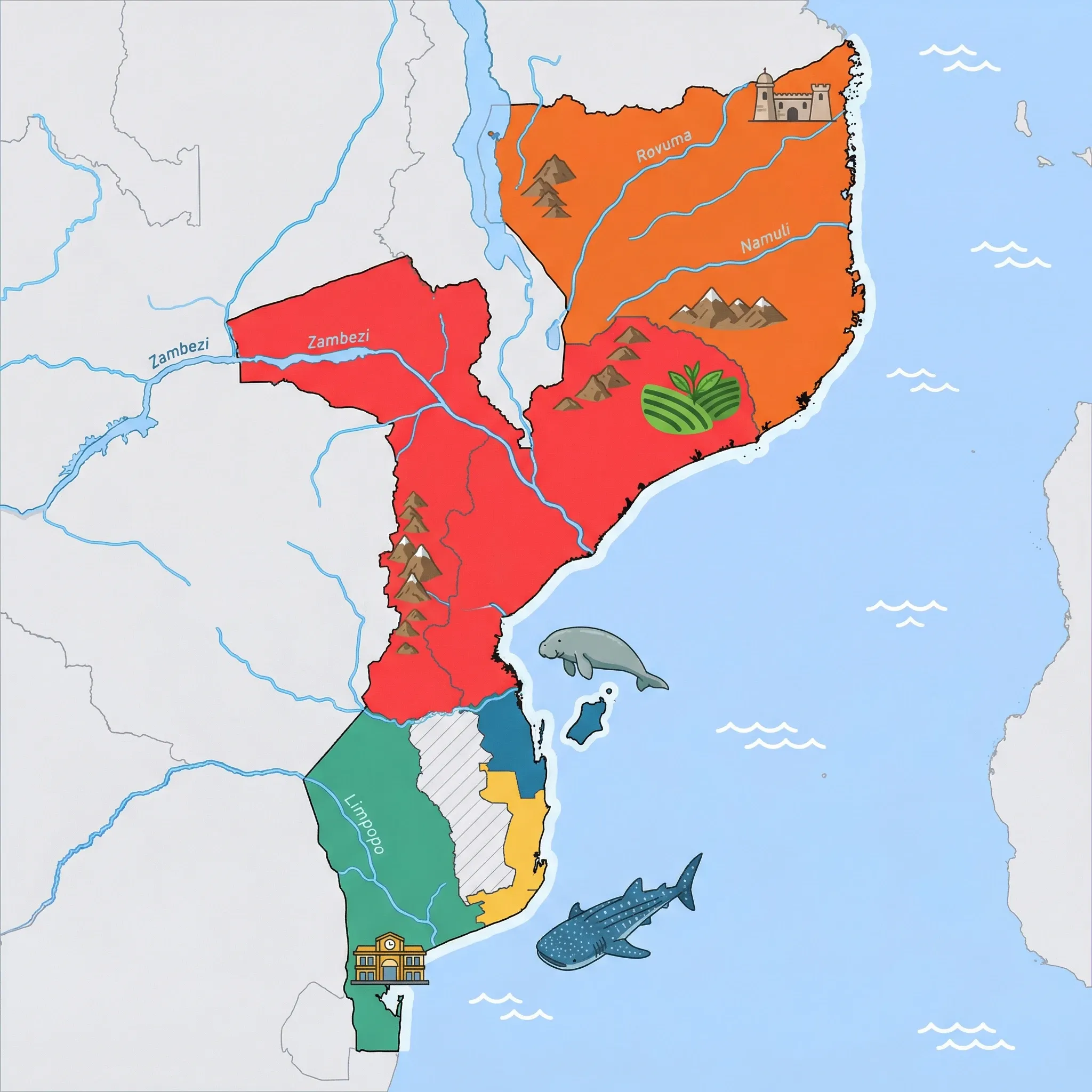
5 Regions
Bazaruto & Vilankulo (islands)
Where golden dunes meet the turquoise Indian Ocean 🏝️
Inhambane & Tofo
Historic charm meets the giants of the deep 🐋
Maputo & South
City beats, elephants, and wild southern beaches 🐘
Northern Mozambique & Quirimbas
Ancient history and untamed wilderness ⚠️
Zambézia & Central
The wild heart of Mozambique's safari revival 🦁
Click on a region marker to explore details. Use the dropdown to color regions by activity suitability.

Getting There & Around
Getting There
- By Air – Maputo International Airport (MPM) is the main hub, with connections from Johannesburg, Doha, and Lisbon. Direct flights also serve Vilankulo for the Bazaruto & Vilankulo (islands).
- By Road – The Ressano Garcia border post connects Maputo to South Africa (near Kruger Park). It is busy; consider the quieter Komatipoort crossing if driving yourself.
- Entry Requirements – Visa-exempt travellers (including US/UK/EU) must obtain an eTA online 48 hours prior to travel. Check your government website for the latest visa requirements, or use the IATA Travel Centre entry-requirements checker.
Getting Around
- Car Hire – A 4x4 is essential for exploring beyond Maputo, as many roads to beaches like Maputo National Park (Milibangalala Beach) are sandy tracks. Driving is on the left.
- Domestic Flights – LAM Mozambique and private charters are the safest way to cover long distances, such as reaching Bazaruto & Vilankulo (islands) or Pemba from the capital.
- Private Transfers – Lodges often provide transfers. Avoid 'chapas' (minibuses) with children as they are overcrowded and safety standards are poor.

Packing List
Mozambique uses the 3-pin 'South African' plug (Type M), which universal adapters rarely include.
Essential for protecting the pristine coral ecosystems in marine reserves like Bazaruto.
Street lighting is scarce and power cuts happen; essential for navigating lodges at night.
Keeps valuables safe during dhow sailing trips and wet ocean safari boat launches.
Tolls, police fines, and rural markets often cannot accept cards or large bills.
Fine sand is everywhere, especially if visiting the dunes of Bazaruto or Suguta.

Activities & Best Times

Adventure & Nature
ExcellentHiking, wildlife, outdoor exploration, ecotourism
Gorongosa National Park is a world-class conservation success offering exceptional biodiversity and high-end eco-lodges perfect for sophisticated families. The dry season (July-October) is optimal for wildlife viewing as animals congregate near water and park infrastructure is fully operational.
Home to the Niassa Special Reserve, providing an authentic and rugged wilderness experience that appeals to families seeking off-the-beaten-path safari. Visitation is restricted to the dry season as summer rains frequently make the remote tracks and bush camps inaccessible.
Features diverse ecosystems including massive sand dunes, mangroves, and protected marine habitats with rare species like dugongs. The winter months offer comfortable temperatures for dune hiking and the chance to spot humpback whales during their annual migration.

City & Cultural
ExcellentUrban tourism, museums, historical sites, architecture
The Island of Mozambique is a UNESCO World Heritage site offering a world-class blend of African, Arab, and Portuguese history within a living urban environment. The cooler, dry winter months are ideal for exploring the historic fortresses and stone town architecture without extreme tropical heat.
The region features significant rock art at Chinhamapere and unique Afro-Portuguese heritage in the coastal cities of Beira and Quelimane. Cooler, drier months are essential for exploring these urban and heritage sites comfortably before the intense humidity of the rainy season.
Inhambane is one of East Africa's oldest settlements, featuring authentic colonial architecture, iconic cathedrals, and vibrant local markets. The winter months offer the most pleasant conditions for walking tours of the historic urban core.

Sports & Active
Very GoodSport tourism, fitness activities, active recreation
A premier destination for specialized sports including world-renowned horse safaris on the beach and elite-level kitesurfing in the Vilankulo lagoon. While diving is best in mid-year, kitesurfing conditions remain excellent into October as the trade winds persist.
Supported by major scuba diving centers and established coastal horse riding trails, this region caters well to active families. Peak season offers the best conditions for both sea-based and land-based activities without extreme tropical heat.
Renowned for world-class kitesurfing, diving, and coastal trekking between Ponta do Ouro and Malongane. The winter months provide consistent conditions and manageable temperatures for high-energy outdoor activities.

Beach & Sea
GoodBeach resorts, marine activities: diving, snorkelling, kite surfing, wind surfing, sailing
Praia de Zalala and Macuti Beach offer expansive, authentic coastal experiences with significant local character. Peak visitation occurs during the dry winter months when seas are calmest and the risk of tropical cyclones is minimal.
Offers high-end exclusivity and pristine coral reefs in the Quirimbas Archipelago, though infrastructure is more limited than the Maldives. Peak months offer optimal underwater visibility and calm seas, while the summer wet season brings cyclone risks and heavy humidity.
Home to the Bazaruto Archipelago National Marine Park, offering world-class diving at Two Mile Reef and pristine island environments comparable to the Maldives. Peak visitation occurs during the dry season when underwater visibility is highest and the risk of tropical cyclones is minimal.

Road Trips & Scenic
GoodScenic drives, countryside tours, route-based travel
The Gurué Tea Route and Manica Mountain passes provide stunning scenic drives through lush highlands and rural tea estates. These routes are best explored in the peak dry season when unpaved sections are most reliable and mountain visibility is highest.
Features spectacular coastal drives and remote wilderness routes through the Niassa highlands that appeal to adventurous, self-sufficient travelers. Driving is highly seasonal, with peak conditions occurring only after the mud clears from the substantial summer rains.
The 'Coconut Coast' and Inhambane Peninsula offer unique scenic drives through palm-fringed landscapes and coastal villages. Dry season travel is essential as some coastal tracks can become difficult during the heavy summer rains.

Educational & Exploratory
MarginalLearning experiences, scientific sites, historical education
The Maritime Museum provides significant historical context for the region's trade history, though it serves more as a supplement to the cultural landscape than a primary destination. Conditions for visiting follow the general tourism window to avoid the peak monsoon humidity.
The Natural History Museum and Inhaca's Marine Biology Museum provide authentic scientific insights into the Mozambique Channel. Access to Inhaca is most reliable during the calmer, drier winter months.

Theme Park & Entertainment
MarginalAmusement parks, family entertainment venues

Public Holidays & Calendar Next 12 months
Public holidays, festivals, cultural celebrations, and seasonal natural phenomena coming up in Mozambique over the next 12 months.
Loading holidays and events...
Climate & Weather
Bazaruto & Vilankulo (islands)
Show Details
| Month | Temp °C | Rain | Humidity |
|---|
Inhambane & Tofo
Show Details
| Month | Temp °C | Rain | Humidity |
|---|
Maputo & South
Show Details
| Month | Temp °C | Rain | Humidity |
|---|
Northern Mozambique & Quirimbas
Show Details
| Month | Temp °C | Rain | Humidity |
|---|
Zambézia & Central
Show Details
| Month | Temp °C | Rain | Humidity |
|---|

Travel Advisory
All major agencies recommend exercising increased vigilance due to high crime, civil unrest, and localized terrorism. While the country is generally accessible, specific northern regions are under 'Do Not Travel' advisories.
Safety Topics
Agency Summaries
Heightened security risks and kidnapping threats persist across the country. Higher risk levels apply to northern regions due to militant activity.
There are significant security concerns nationwide related to civil unrest, violent crime, and terrorism. Extensive travel restrictions are in place for the northern provinces.
The advisory level was recently adjusted to reflect a decrease in election protests, though caution is still required nationwide due to health risks, crime, and terrorism. Northern provinces remain at 'Do Not Travel' status.
Irish citizens are advised to be alert to street crime and avoid specific areas of Maputo City after dark. New visa-free rules for tourists are in effect.
Travellers should remain extremely vigilant due to high crime rates, the threat of terrorism in the north, and potential for violent civil unrest. Regional travel bans are in place for several northern districts.
While general advice is standard, the FCDO maintains strict warnings against travel to several northern districts. Crime and kidnapping for ransom are major concerns in urban areas like Maputo.
Information is provided for general guidance only and does not constitute travel, safety, medical, or legal advice. Conditions may change. Users are responsible for independently verifying information before travel.