
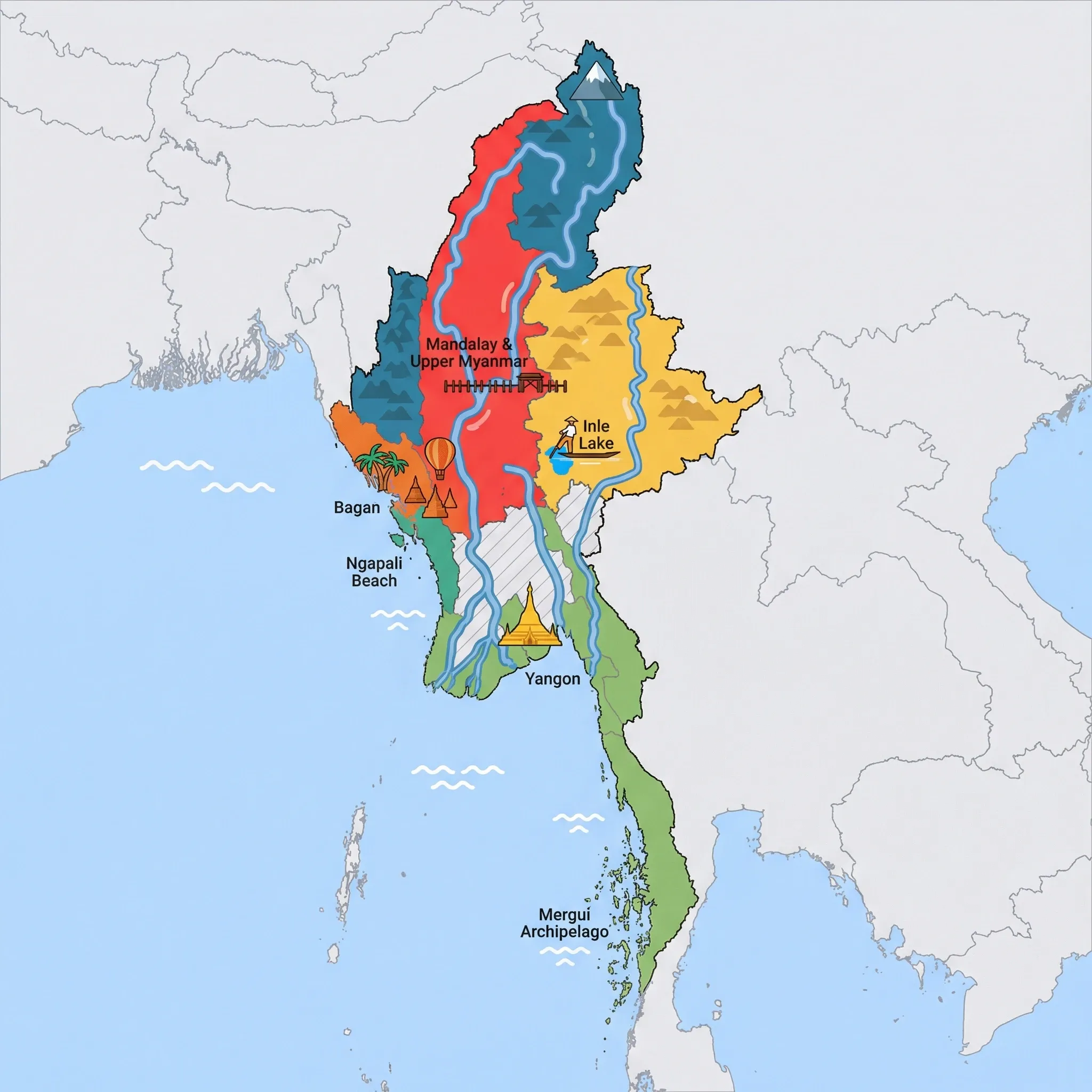
Click a region to explore
⚠️ SAFETY WARNING: Due to the volatile political situation and potential for armed conflict, government agencies (including CA, USA, UK, AU, IE, NZ) advise travelers to avoid all travel to Myanmar, including the Bagan region. Security incidents have occurred in the surrounding Magway Region, and medical infrastructure is severely limited. Families are strongly urged to consult their own government's official travel advisory before considering a trip, as circumstances and risk assessments vary.
Overview
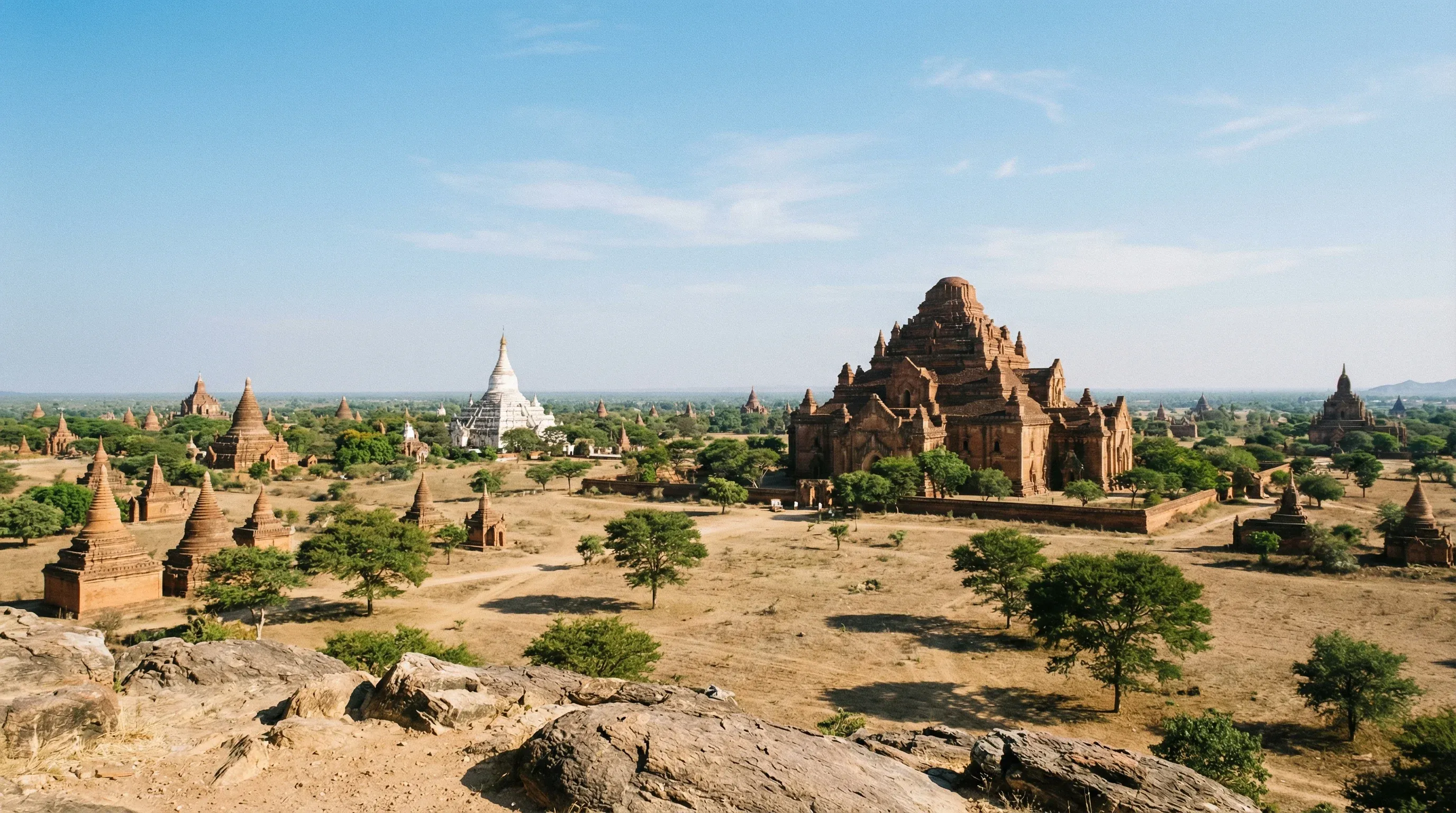
Bagan is often described as one of the world's greatest archeological sites, rivalling Angkor Wat in scale and ambition. For families, the sheer density of history here is staggering; across a dusty plain roughly the size of Manhattan, thousands of stupas, temples, and monasteries rise from the earth. The landscape is otherworldly, particularly at sunrise and sunset when the brick red ruins glow against the semi-arid backdrop. Unlike a sterile museum, this is a living landscape where local farmers herd goats between 11th-century monuments.
The climate here is part of Myanmar's "Dry Zone," meaning it is often hotter and dustier than the coast or the hills. For children, the experience feels like an adventure movie; they can see the remains of a fallen empire and explore dark corridors (with a flashlight). While the famous hot air balloons are a signature image, the ground-level exploration via e-bike (electric scooter) allows families to find their own quiet corner of history away from the tour bus crowds.
Key Attractions
The Ananda Temple is the most perfectly preserved temple in Bagan, known as the "Westminster Abbey of Burma." Its cruciform shape and four colossal standing Buddhas are awe-inspiring for children, and the ventilation system designed centuries ago keeps the interior surprisingly cool. Nearby, the Shwezigon Pagoda serves as the prototype for Burmese stupas; its golden bell shape is dazzling, and kids often enjoy finding the "lucky" spots in the pavement used by ancient kings.
For a break from temples, the Bagan Archaeological Museum houses the smaller treasures found in the rubble, including intricate stone carvings and ancient hairstyles of the era. A short drive away, Mount Popa (Popa Taung Kalat) offers a completely different experience. It is an extinct volcano core topped with a monastery, accessible by 777 steps. It is known as the home of the "Nats" (spirits) and is populated by hundreds of cheeky monkeys that children find entertaining, though caution is needed with food.
Practical Advice
The heat in Bagan can be intense. Plan temple visits for early morning (7:00 am to 10:00 am) and late afternoon (4:00 pm to 6:00 pm). Spend the midday heat at your hotel pool. E-bikes are the most family-friendly way to get around; they are silent, easy to ride, and allow you to cover more ground than bicycles without the fatigue.
Food & Drink
Typical meal times: Lunch is usually served from 11:30 am to 1:30 pm, and dinner from 6:30 pm to 8:30 pm.
Typical meal costs: A meal for a family of four in a decent tourist restaurant costs roughly 45,000–85,000 MMK (approx. $15–28 USD / €14–26 EUR).
Dietary requirements: Vegetarian options are excellent here due to Buddhist influence. Peanuts are very common in local salads (especially Tea Leaf Salad), so alert kitchens to nut allergies immediately.
Signature dishes:
- Lahpet Thoke – Fermented tea leaf salad mixed with crunchy beans, garlic, and dried shrimp (can be ordered without shrimp).
- Ponyegyi – A black bean paste curry made from fermented soy beans, a specialty of the Bagan/Nyaung-U region.
- Tamarind Flakes – Sweet and sour digestives often served as a complimentary sweet after meals in this region.
Why this score?
Exploration is primarily conducted via electric bikes on sandy but relatively flat trails between monuments. While the dusty, rustic environment feels exotic, the high density of visitor services and lack of steep terrain prevent it from being a truly rugged wilderness experience.
Why this score?
Local medical facilities are very basic and primarily cater to the local population with limited English-speaking staff. Major emergencies typically require a multi-hour drive to Mandalay or an expensive medical evacuation to Yangon or Bangkok for international standard care.
Why this score?
While globally iconic for its 2,000 ancient temples, Bagan receives fewer international visitors than regional peers like Angkor Wat. The infrastructure is dedicated to tourism, featuring numerous hotels and guided tours, but total visitor numbers remain moderate relative to global hotspots.

Bagan relies heavily on tourism, so prices in the Archaeological Zone are higher than in rural towns. A mid-range family hotel with a pool costs 100,000–180,000 MMK (approx. $35–60 USD / €32–55 EUR) per night. Entry to the zone requires a ticket (approx. 30,000 MMK / $10 USD). Local meals are cheap, but tourist-oriented restaurants charge 15,000–25,000 MMK (approx. $5–8 USD / €4.50–7.50 EUR) per main dish.

Getting Here & Around
Getting Here
- Airports – Nyaung U Airport (NYU) is the gateway. Flights from Yangon take approximately 80 minutes.
- Boat – The Ayeyarwady River cruise from Mandalay is a popular slow-travel option, taking roughly 10–12 hours downstream.
- Bus – Long-distance buses from Yangon or Mandalay are available but the journey is long (9+ hours from Yangon) and roads can be rough.
Getting Around
- E-bike – The most popular method. Silent electric scooters can be rented by the day and allow families to explore the Bagan Archaeological Zone independently.
- Horse Cart – A traditional way to see the temples, though slower and bumpier than e-bikes.
- Taxi – Air-conditioned cars can be hired for full-day temple tours, which is recommended for families with very young children or during the hottest months.
Nearby Airports (1 airport)
Nyaung
NYUNyaung-u
View full flight map for Myanmar →

Packing List
You must remove shoes and socks at every single temple entrance; laces become very frustrating.
Many temple interiors are dark, and exploring the corridors is much more fun for kids with light.
The dry zone is extremely dusty, especially when riding e-bikes or horse carts.
Myanmar requires pristine, unfolded USD bills for exchange; damaged notes are often rejected.
Bills must be crisp, uncreased, and unmarked (newer "big head" notes) or they will be rejected.
You must remove shoes and socks at every pagoda; laces become a hassle very quickly.
Power outages are frequent and street lighting is poor, even in major cities and hotels.
Essential for cleaning feet after walking barefoot in temples and for general hygiene.
To keep devices charged during frequent and unpredictable electricity blackouts.
Useful for managing mild food poisoning or stomach upsets which can occur with local food.

Activities & Best Times

Urban tourism, museums, historical sites, architecture
Bagan is a world-class UNESCO World Heritage site with over 2,000 ancient pagodas and temples, offering an unparalleled archaeological experience. The peak winter months provide dry, cool weather essential for exploring the vast site, while the extreme heat of April-May and the monsoon rains make other periods less suitable.

Hiking, wildlife, outdoor exploration, ecotourism
Features unique natural landmarks like the volcanic Mount Popa and the Ayeyarwady River, offering authentic hiking and scenic river exploration. Outdoor immersion is best during the cooler dry season to avoid the intense Central Myanmar heat and muddy trail conditions during the rains.

Scenic drives, countryside tours, route-based travel
The Bagan Archaeological Zone Loop and the scenic drive to Mount Popa offer high-quality rural touring and spectacular landscape views. Optimal driving conditions and visibility occur from November to February, while dust in the hot season and road conditions in the wet season can be challenging.

Sport tourism, fitness activities, active recreation
Active exploration is primarily centered on the iconic temple cycling loops and the summit trail at Mount Popa. While authentic, the infrastructure is limited to these specific routes, and the activity is physically demanding during the high-heat months of April and May.

Amusement parks, family entertainment venues
The Bagan Aquatic Center provides a localized family entertainment option, primarily useful for cooling off during the peak heat of the dry zone summer. It is not an international destination-level attraction and is less relevant during the cooler winter tourism peak.

Attractions (10 total)



Public Holidays & Calendar Next 12 months
Public holidays, festivals, cultural celebrations, and seasonal natural phenomena coming up in Bagan over the next 12 months.
Loading holidays and events...

Travel Advisory
The majority of global agencies advise against all travel to Myanmar due to extreme risks from active armed conflict, political violence, and arbitrary detention.
Safety Topics
Traveller Advice (4 groups)

Media workers face a critical risk of arrest, detention, and prosecution for reporting activities or expressing views critical of the military regime.

Humanitarian access is severely restricted in conflict zones. Aid workers may face security threats from airstrikes, landmines, and blocked transportation routes.

Travellers currently in the country should consider departing via commercial means while they are still available. Avoid all political gatherings, demonstrations, and military sites.

Same-sex relationships remain illegal under local laws, and social stigma may lead to discrimination, though general security concerns currently outweigh targeted risks.
Agency Summaries
New Zealand advises against travel to Myanmar due to civil unrest and the risk of armed conflict, emphasizing that basic services and consular assistance are severely limited.
The Canadian government advises against any travel to Myanmar due to widespread civil unrest, armed conflict, and the threat of arbitrary detention, kidnapping, and terrorism.
Ireland strongly advises its citizens to avoid all travel to Myanmar due to the unstable political environment and the potential for rapid security deterioration following the 2021 coup.
Australia maintains its highest warning level for Myanmar, warning of unpredictable violence, explosions, and the risk of arbitrary detention for foreign nationals across the country.
U.S. authorities recommend avoiding all travel to Myanmar because of high risks from armed conflict, civil unrest, arbitrary local law enforcement, and critical health infrastructure shortages.
The UK advises against all travel to a majority of states and regions in Myanmar and against non-essential travel to the rest, citing a volatile security situation and ongoing military conflict.
Information is provided for general guidance only and does not constitute travel, safety, medical, or legal advice. Conditions may change. Users are responsible for independently verifying information before travel.