
Mandalay & Upper Myanmar
The royal heart of golden traditions 👑🙏
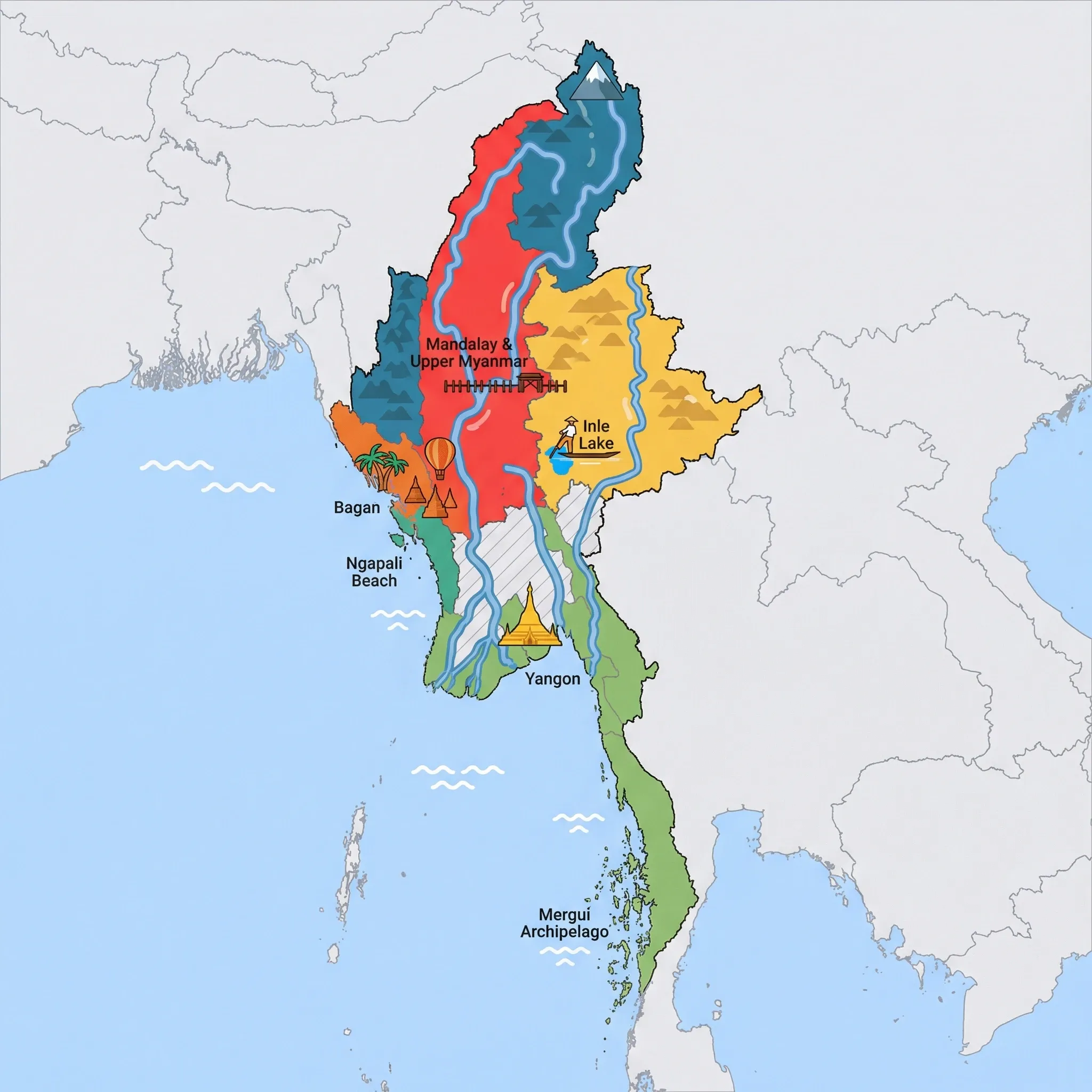
Click a region to explore
⚠️ SAFETY WARNING: Due to martial law in townships and active armed conflict in the Sagaing Region, government agencies (including CA, USA, UK, AU, IE, NZ) advise travelers to avoid travel to large parts of Mandalay Region and Upper Myanmar. Urban Mandalay has seen relative calm but risk remains high. Families are strongly urged to consult their own government's official travel advisory before considering a trip, as circumstances and risk assessments vary.
Overview
Mandalay is a name that evokes colonial nostalgia, but the modern city is a bustling, dusty grid of motorcycle traffic and commerce. However, for families, the magic lies just outside the concrete center. This was the last royal capital of Burma, and the region is dense with history. It serves as the hub for visiting three ancient cities—Amarapura, Sagaing, and Inwa—which offer a playground of ruins, pagodas, and horse-cart rides that children adore.
Just east of the heat lies Pyin Oo Lwin, a former British hill station that feels like a different country. With cool air, strawberry fields, and horse-drawn carriages (gharries) that look like Cinderella coaches, it is a fantastic family escape. The culture here is deeply traditional; you will see more monks and nuns here than almost anywhere else, and the arts—from gold leaf pounding to marble carving—are still practiced visibly on the streets.
Key Attractions
In the city, Mandalay Hill is a must. A covered stairway (or an elevator) leads to the top for panoramic views; it's a great spot to orient kids to the landscape. At the base lies Kuthodaw Pagoda, home to the "World's Largest Book"—729 marble slabs inscribed with Buddhist scriptures, a fascinating maze of white stupas for kids to wander through.
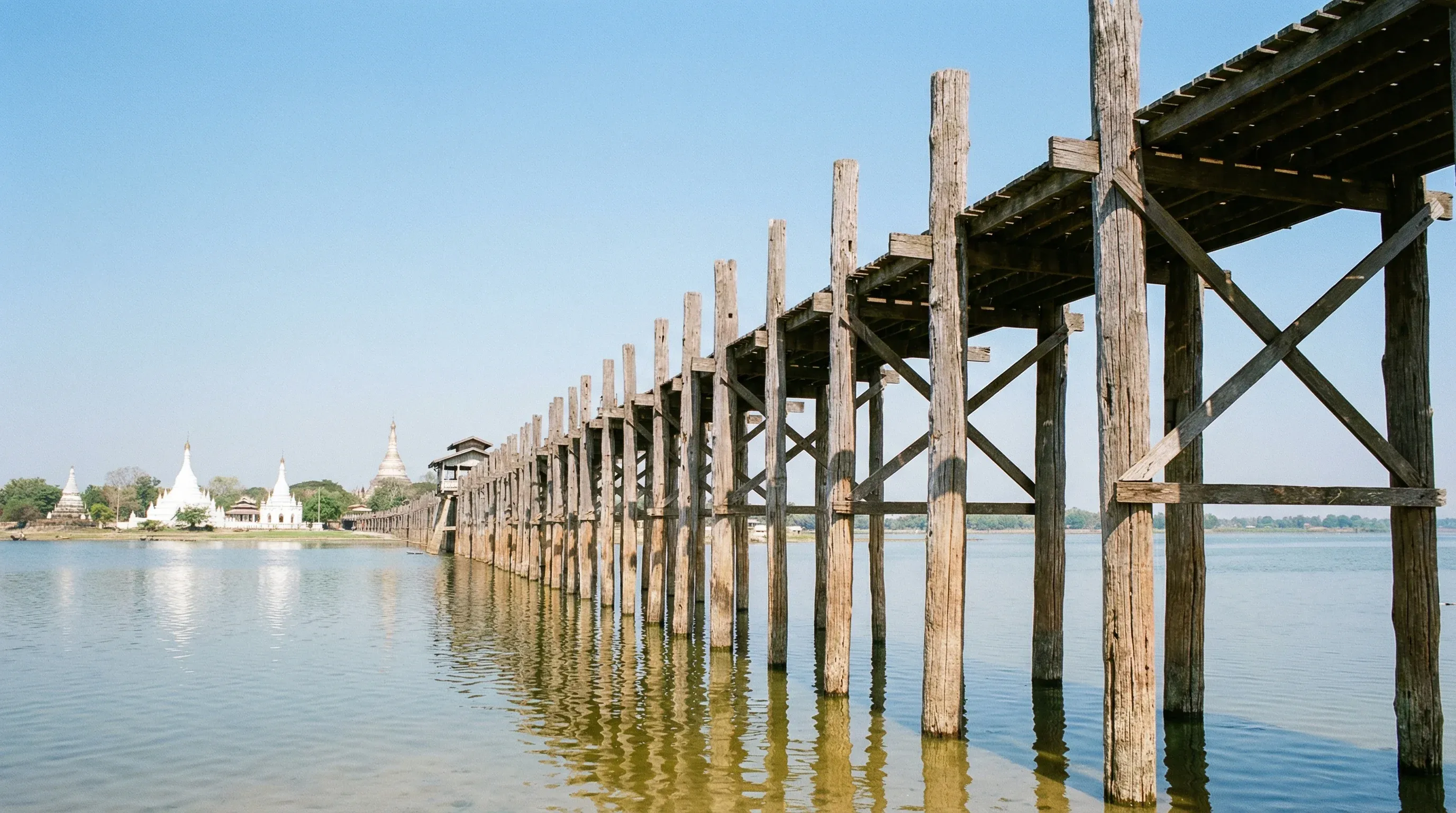
South of the city, the U Bein Bridge in Amarapura is iconic. It is the world's longest teak bridge, and walking across it at sunset with locals commuting and monks strolling is a memorable experience (though hold hands, as there are no rails!). A short boat ride away is Inwa Ancient City, where the primary mode of transport is horse cart, taking you to tilted watchtowers and the stunning teak Shwenandaw Monastery, the only original building from the Royal Palace that survived WWII.
Practical Advice
Mandalay is hot and dusty. Plan outdoor activities for early morning. Taxis are cheap and air-conditioned—use them rather than walking. For Pyin Oo Lwin, bring a sweater.
Food & Drink
Typical meal times: Lunch 11:30 am to 1:30 pm; Dinner 6:00 pm to 8:30 pm.
Typical meal costs: Street food is incredibly cheap; sit-down family meals range from 40,000–80,000 MMK (approx. $13–26 USD / €12–25 EUR).
Dietary requirements: Chinese influence is strong here, so noodle dishes are plentiful. Oily curries are standard; ask for plain rice and stir-fried greens for picky eaters.
Signature dishes:
- Mandalay Mee Shay – Rice noodles with meat sauce, pickles, and sticky rice flour glue—a local favorite distinct from the Shan version.
- Mont Di – Thick rice noodles mixed with chicken curry, simple and kid-friendly.
- Htohpu Nway – Warm chickpea tofu served as a semi-liquid porridge with noodles, usually for breakfast.
Why this score?
Most attractions are located within the urban sprawl or on accessible hills like Sagaing, offering a mix of history and light walking. Nearby hill stations like Pyin Oo Lwin provide some outdoor recreation, but the overall experience remains largely developed and accessible.
Why this score?
As Myanmar's second-largest city, Mandalay hosts several government and private hospitals that are superior to those in rural areas. While language barriers persist, it is one of the few places in Upper Myanmar where basic stabilization and moderate medical care are feasible for foreigners.
Why this score?
Serving as the northern transport hub and cultural capital, this region is a primary destination for those visiting ancient royal cities. While it holds significant historical importance, its tourist numbers are constrained by the overall lower inbound flow to Myanmar compared to Thailand or Vietnam.

Similar to Yangon, costs are reasonable. A good hotel room costs 90,000–160,000 MMK (approx. $30–55 USD / €28–50 EUR). The main 'Archaeological Zone' ticket covers multiple sites (Mandalay Palace, Inwa, etc.) and costs roughly 10,000 MMK ($3–4 USD), though collection is sporadic. Hiring a private taxi for a full day of sightseeing to the ancient cities is great value at approx. $30–40 USD.

Getting Here & Around
Getting Here
- Airports – Mandalay International Airport (MDL) is far from the city (1 hour drive). It serves limited international routes and domestic connections.
- Train – The rail line from Yangon is legendary for its bumpiness and length (15+ hours). It is an adventure, but perhaps too grueling for young kids.
Getting Around
- Taxi/Grab – The best way to move around Mandalay city. You can hire a driver for the whole day to visit the ancient cities.
- Horse Cart – The mandatory transport method within Inwa Ancient City and popular in Pyin Oo Lwin.
- Pick-up Truck – Local public transport (Songthaew style), cheap but crowded and confusing for tourists.
Nearby Airports (4 airports)
Homalin Airport
HOXHomalin
Kalay Airport
KMVKalemyo
Mandalay International
MDLMandalay
Nay Pyi Taw Airport
NYTNaypyidaw
View full flight map for Myanmar →

Packing List
Mandalay is very dusty; you will want to wipe hands and faces frequently after tuk-tuk rides.
At midday, temple tiles get scorching hot. While technically barefoot is the rule, sometimes socks are tolerated on the outer grounds.
Essential if you take a day trip to Pyin Oo Lwin, which is significantly cooler than the city.
Useful not just for health, but for filtering the heavy dust and exhaust fumes in open-air transport.
Bills must be crisp, uncreased, and unmarked (newer "big head" notes) or they will be rejected.
You must remove shoes and socks at every pagoda; laces become a hassle very quickly.
Power outages are frequent and street lighting is poor, even in major cities and hotels.
Essential for cleaning feet after walking barefoot in temples and for general hygiene.
To keep devices charged during frequent and unpredictable electricity blackouts.
Useful for managing mild food poisoning or stomach upsets which can occur with local food.

Activities & Best Times

Hiking, wildlife, outdoor exploration, ecotourism
Offers a unique blend of botanical excellence at Pyin Oo Lwin and iconic pilgrimage hikes at Mandalay Hill. Best experienced during the cooler months when gardens are in full bloom and trail conditions are stable and dry.

Urban tourism, museums, historical sites, architecture
As the cultural heart of Myanmar, the region offers exceptional heritage sites like the world's largest book at Kuthodaw and the royal history of Inwa and Mandalay Palace. Peak visitation aligns with the cool, dry season, while the extreme heat of April and monsoon rains make summer travel challenging for urban exploration.

Events, celebrations, seasonal attractions
As the cultural heart of Myanmar, Mandalay hosts the Thingyan Water Festival at massive scale. Same reasoning as Yangon - this is a significant cultural event that merits 'good' for families seeking authentic cultural experiences.

Scenic drives, countryside tours, route-based travel
The scenic ascent to the former British hill station of Pyin Oo Lwin and the heritage routes connecting ancient capitals offer evocative driving experiences. Peak months provide the best visibility for mountain passes like Gokteik Gorge before the heavy summer rains arrive.

Sport tourism, fitness activities, active recreation
Cycling through the ancient ruins of Inwa and trekking the Anisakan Waterfall trails provide active families with high-quality, authentic movement-based exploration. Activity is restricted by intense dust and heat in the spring and slippery trails during the monsoon.

Learning experiences, scientific sites, historical education
National and science museums offer regional historical insights but do not currently meet the global benchmarks of standalone destination-level educational facilities. These are best visited during the high tourism season for maximum facility availability and comfort.

Spa retreats, wellness centers, peaceful getaways
Regional hot springs like Kabaing provide rustic wellness opportunities popular with locals but lack international-standard luxury spa amenities. The cool winter months are the only period where thermal baths are pleasant given the tropical climate.

Amusement parks, family entertainment venues
Local water parks and recreation centers cater primarily to domestic markets, lacking the world-class infrastructure for international travelers. Peak demand spikes during the Thingyan festival in April when water-based entertainment is culturally central.

Attractions (15 total)



Public Holidays & Calendar Next 12 months
Public holidays, festivals, cultural celebrations, and seasonal natural phenomena coming up in Mandalay & Upper Myanmar over the next 12 months.
Loading holidays and events...

Travel Advisory
The majority of global agencies advise against all travel to Myanmar due to extreme risks from active armed conflict, political violence, and arbitrary detention.
Safety Topics
Traveller Advice (4 groups)

Media workers face a critical risk of arrest, detention, and prosecution for reporting activities or expressing views critical of the military regime.

Humanitarian access is severely restricted in conflict zones. Aid workers may face security threats from airstrikes, landmines, and blocked transportation routes.

Travellers currently in the country should consider departing via commercial means while they are still available. Avoid all political gatherings, demonstrations, and military sites.

Same-sex relationships remain illegal under local laws, and social stigma may lead to discrimination, though general security concerns currently outweigh targeted risks.
Agency Summaries
New Zealand advises against travel to Myanmar due to civil unrest and the risk of armed conflict, emphasizing that basic services and consular assistance are severely limited.
The Canadian government advises against any travel to Myanmar due to widespread civil unrest, armed conflict, and the threat of arbitrary detention, kidnapping, and terrorism.
Ireland strongly advises its citizens to avoid all travel to Myanmar due to the unstable political environment and the potential for rapid security deterioration following the 2021 coup.
Australia maintains its highest warning level for Myanmar, warning of unpredictable violence, explosions, and the risk of arbitrary detention for foreign nationals across the country.
U.S. authorities recommend avoiding all travel to Myanmar because of high risks from armed conflict, civil unrest, arbitrary local law enforcement, and critical health infrastructure shortages.
The UK advises against all travel to a majority of states and regions in Myanmar and against non-essential travel to the rest, citing a volatile security situation and ongoing military conflict.
Information is provided for general guidance only and does not constitute travel, safety, medical, or legal advice. Conditions may change. Users are responsible for independently verifying information before travel.