

Overview
Nicaragua is a land of dramatic geography and warm culture, often overshadowed by its neighbors but offering a far more uncrowded experience. Dominated by a chain of impressive volcanoes and vast freshwater lakes, the country feels untamed and exciting for children. The vibe here is rustic and authentic; you won't find endless rows of chain resorts, but rather family-run guesthouses, colonial courtyards, and nature reserves teeming with howler monkeys and tropical birds. For families, it offers a unique biology classroom where geology comes to life-smoke billows from craters, and islands rise from the mist of Lake Nicaragua.
Culturally, Nicaragua is deeply welcoming to children. The pace of life is slow, revolving around rocking chairs on sidewalks and vibrant town squares. While infrastructure can be basic compared to Costa Rica, the trade-off is genuinely lower costs and a sense of discovery. Families can kayak through mangrove forests, ride horses on Pacific beaches, and explore historic cities painted in pastel hues, all in a single trip. It is a destination that rewards the adventurous spirit, perfect for families with older children or teens ready to explore beyond the resort walls.
Key Attractions
The undisputed highlight for most families is Masaya Volcano National Park. It is one of the few places on earth where you can drive right up to the crater rim and look down into a bubbling lava lake-a sight that leaves children awestruck. Nearby, the colonial city of Granada serves as a perfect base to explore the Isletas de Granada, a labyrinth of tiny islands in Lake Nicaragua best explored by boat, where kids can spot monkeys swinging in the trees.
For a true island adventure, Ometepe Island is magical. Formed by two volcanoes, Volcán Concepción and Volcán Maderas, rising from the lake, it offers kayaking, swimming in natural springs (Ojo de Agua), and hiking trails filled with petroglyphs. On the Pacific coast, León & Northwest offers history and adrenaline; here you can visit the grand Cathedral of León, the largest in Central America, before taking teens to Cerro Negro Volcano for the unique sport of volcano boarding.
If you seek classic Caribbean turquoise waters, a flight to the Corn Islands & Caribbean is essential. Unlike the Pacific's dark volcanic sands, places like Pearl Cays offer white sand and snorkeling in crystal-clear water, providing a relaxing counterpoint to the mainland's adventures.
Practical Advice
The dry season (November to April) is the best time to visit, keeping travel logistics easy and skies blue. The wet season (May to October) is lush but can make rural roads difficult. U.S., UK, and EU citizens generally do not need a visa for stays up to 90 days but must purchase a Tourist Card ($10 USD) upon arrival. Healthcare is limited outside Managua; carry a comprehensive medical kit and travel insurance. Mosquito-borne illnesses like dengue exist, so repellent is non-negotiable.
Food & Drink
Typical meal times: Breakfast is early, often 7:00 am to 9:00 am. Lunch is the main meal, served 12:00 pm to 2:00 pm. Dinner is usually lighter, eaten between 6:30 pm and 8:30 pm.
Typical meal costs: 150–350 NIO (approx. $4–9.50 USD / €3.80–9 EUR) for local dining; 500–900 NIO (approx. $13.50–24.50 USD / €12.50–23 EUR) for mid-range restaurants.
Dietary requirements: Vegetarian options are increasingly common in tourist hubs like Granada and León (look for comedores serving rice, beans, and plantains). Gluten-free travelers can rely on corn tortillas, but cross-contamination is a risk. Vegan cheese is rare outside expat cafes.
Family-friendly dining: Nicaraguans love children, and restaurants are casual. Highchairs are available in modern places but rare in local sodas. Kids usually love the fresh fruit smoothies (batidos) and simple grilled chicken.
Signature dishes:
- Gallo Pinto – The national heartbeat: a mixture of rice and red beans fried together with onions and peppers, eaten at breakfast, lunch, and dinner.
- Vigorón – A Granada specialty featuring boiled yuca and crispy pork rinds (chicharrón) topped with a zesty cabbage slaw, traditionally served on a banana leaf.
- Quesillo – A soft, braid-like cheese served in a tortilla with pickled onions and a dollop of sour cream-messy, delicious, and a fun snack for kids.
- Nacatamal – A Sunday tradition: massive tamales filled with pork, rice, potato, and mint, steamed in plantain leaves.
Safety
While street crime like pickpocketing is common in crowded areas and bus terminals, violent crime against tourists is statistically lower than in some neighboring countries. However, political sensitivity is high. Avoid any public demonstrations, do not discuss politics with strangers, and never photograph police or military personnel. Use radio-dispatched taxis or hotel transfers rather than hailing cabs on the street, especially in Managua. Power outages can occur, so carry a flashlight.

Nicaragua is one of the most affordable destinations in the Americas. A family of four can travel comfortably for 3,700–5,500 NIO (approx. $100–150 USD / €95–140 EUR) per day, covering mid-range guesthouses, meals, and activities. Local street food makes dining incredibly cheap, though imported goods and luxury coastal resorts will align more with Western prices.
Age Suitability





Did you know? Nicaragua welcomes approximately 818,000 international visitors per year. Most visitors come from Americas.

Explore Regions
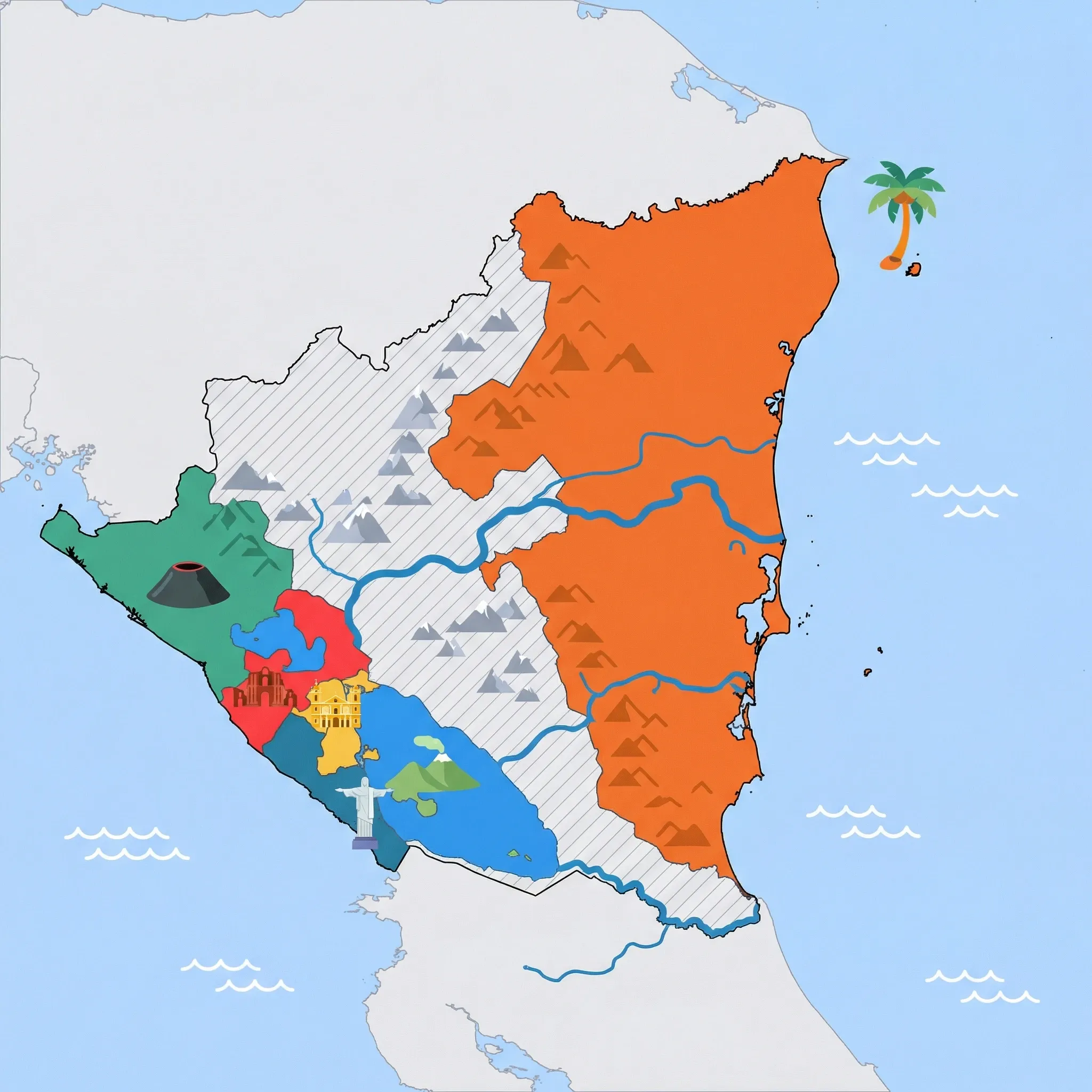
6 Regions
Corn Islands & Caribbean
Turquoise waters, Creole rhythms, and barefoot island life 🏝️
Granada & Masaya
Colonial charm, active volcanoes, and lake adventures 🌋
León & Northwest
Revolutionary history, white cathedrals, and volcano boarding 🏛️
Managua
The urban heart, historic ruins, and lakeside promenades 🏙️
Ometepe Island
Two volcanoes, one magical island 🌋🌴
San Juan del Sur & Pacific
Sun, surf, and sea turtles 🐢🏄♂️
Click on a region marker to explore details. Use the dropdown to color regions by activity suitability.

Getting There & Around
Getting There
- By Air – Augusto C. Sandino International Airport (MGA) in Managua is the main gateway. Direct flights arrive from Miami, Houston, and regional hubs like Panama City and San Salvador.
- By Land – The Peñas Blancas border crossing connects Nicaragua with Costa Rica. It is a popular route for travelers combining both countries, though queues can be long. The Guasaule border connects to Honduras in the north.
- Entry Requirements – Visitors from the US, UK, and EU typically need a passport valid for 6 months. A Tourist Card must be purchased on arrival for $10 USD (cash only). Check your government website for the latest visa requirements, or use the IATA Travel Centre entry-requirements checker.
Getting Around
- Shuttles & Private Transfers – The safest and most convenient option for families. Shared tourist shuttles connect major hubs like Granada & Masaya, León, and San Juan del Sur. They offer door-to-door service and air conditioning.
- Taxis – Plentiful in cities. ALWAYS negotiate the price before getting in (no meters). In Managua, only use radio-dispatched or hotel-booked taxis for safety.
- Domestic Flights – La Costeña airlines flies from Managua to the Corn Islands & Caribbean. It is the fastest way to reach the Caribbean coast (1 hour vs. a grueling overland/ferry trip).
- Ferries – Essential for reaching Ometepe Island from San Jorge. The Che Guevara ferry is larger and more stable for children than the smaller lanchas (wooden boats).
- Chicken Buses – Refurbished US school buses. While iconic and dirt cheap, they are often overcrowded, hot, and driven aggressively. Not recommended for families with young children or luggage.
Official Links

Packing List
Street lighting is poor in towns and power outages are relatively common.
Essential for keeping electronics dry during wet boat rides to Ometepe or the Corn Islands.
Voltage fluctuations can occur and may damage sensitive electronics like tablets or chargers.
English is rarely spoken outside of major hotels; basic Spanish is vital for local interaction.
Tap water is generally not safe to drink; this saves money and reduces plastic waste.

Activities & Best Times

Adventure & Nature
ExcellentHiking, wildlife, outdoor exploration, ecotourism
A unique UNESCO Biosphere Reserve featuring twin volcanoes and lush cloud forests within a freshwater lake. Peak season offers clear views and accessible trails, whereas the heavy rains of May-October make volcano trekking hazardous.
Home to major attractions like Da' Flying Frog and turtle nesting sites at La Flor Wildlife Refuge. Peak months coincide with the dry season and the mass arribadas of sea turtles during the mid-year 'Canícula' dry spell.
A premier destination for volcanic exploration, featuring the active Cerro Negro and Telica volcanoes for unique crater-side experiences. The dry season (Dec-Mar) provides ideal conditions for hiking, while the peak rainy months (Sep-Oct) make trails difficult and potentially hazardous.

Beach & Sea
Very GoodBeach resorts, marine activities: diving, snorkelling, kite surfing, wind surfing, sailing
Caribbean diving and snorkeling quality rivals Belize/Honduras. The note mentions 'pristine Caribbean waters with high-quality snorkeling and diving' which warrants very_good on international scale. Good should be reserved for standard beach destinations.
Features iconic Pacific surf breaks at Playa Maderas and pristine coves like Playa Hermosa. Peak visitation occurs during the dry season when offshore winds create ideal surfing conditions and clear skies.
Las Peñitas and Poneloya offer authentic Pacific coastal experiences with consistent surf and access to the Juan Venado Island mangrove reserve. International travelers should target the dry season for calm boat navigation and sunny beach conditions, avoiding the stormier months of September and October.

City & Cultural
Very GoodUrban tourism, museums, historical sites, architecture
Anchored by the historic San Juan del Sur district and the major Christ of the Mercy monument overlooking the bay. Best experienced in the dry season when the town's vibrant street life and outdoor viewpoints are most accessible.
Granada is one of the Americas' most authentic colonial cities, complemented by the world-class artisan markets of Masaya. The region is best experienced during the dry season festivals; the peak rainy season in September and October can significantly disrupt walking tours and outdoor cultural events.
The city boasts significant heritage sites including the National Palace of Culture and the haunting ruins of the Old Cathedral, reflecting its resilient history. International families find the cultural vibrancy of the Plaza de la Revolución most accessible during the dry months when walking tours are more pleasant.

Sports & Active
Very GoodSport tourism, fitness activities, active recreation
Includes world-class zip-lining at Las Nubes and well-known hiking routes between coastal bays. Peak months offer reliable weather for outdoor activities, while the intense rainfall of late autumn significantly degrades trail conditions.
Offers the globally unique sport of volcano boarding on Cerro Negro alongside significant trekking routes through the Maribios volcanic chain. Optimal conditions are found in the dry season when the volcanic ash surfaces are stable and weather is predictable for outdoor adventure.
Offers world-class, strenuous volcano hiking on Concepción and Maderas with significant elevation gain. Optimal conditions occur in the dry season when volcanic ash slopes are stable, unlike the rainy months when mud and low visibility create dangerous conditions.

Road Trips & Scenic
GoodScenic drives, countryside tours, route-based travel
The Southern Pacific Coastal Highway and Chocolata Road offer scenic coastal vistas and access to remote beaches. The dry season is essential for navigating unpaved coastal routes that can become impassable during peak rains in September and October.
The Pueblos Blancos and the drive to the Masaya crater are celebrated regional scenic routes with well-maintained access. Dry months offer the best driving visibility and volcanic panoramas, whereas the heaviest rainy months (June, September, October) can lead to cloud-obscured views and slick roads.
Serving as the starting point for the 'Ruta Colonial y de los Volcanes,' Managua offers excellent connectivity to scenic drives toward León and Granada. Reliable road conditions and high visibility make the dry season the essential time for families to undertake these scenic routes.

Educational & Exploratory
GoodLearning experiences, scientific sites, historical education
The Footprints of Acahualinca offer a rare and internationally significant glimpse into prehistoric human life, supported by the National Museum of Nicaragua. These specialized scientific sites provide high-quality educational value, particularly when accessible during the main tourism window.
Features the UNESCO-listed Ruins of León Viejo, providing critical archaeological context for early colonial Central America. Site accessibility is best in the dry season, as heavy rains can impact tours of these significant outdoor archaeological excavations.
Specialized facilities like the Masaya Volcano visitor center and Mombacho biological station offer strong scientific context for the region's geography. While the centers are indoor, the primary educational value is linked to outdoor field observation, which is best during the clear-sky dry season.

Relaxation & Wellness
MarginalSpa retreats, wellness centers, peaceful getaways
Limited to rustic experiences like the Nahualapa hot springs, offering a local alternative to more developed spa regions. Dry months are preferred for the more comfortable humidity levels and better road access to rural sites.
Natural thermal springs at the base of Mombacho provide an authentic, rustic wellness experience. These are most comfortable during the slightly cooler months of December to February; high humidity and heavy rain in the late wet season diminish the restorative atmosphere.
Los Termales de Tipitapa offers a traditional thermal bath experience that serves as a rustic wellness getaway, though it does not meet the standards of world-class destination spas. The hot springs are most comfortable during the 'cooler' winter months when ambient air temperatures are slightly lower.

Theme Park & Entertainment
MarginalAmusement parks, family entertainment venues
Features regional-scale water parks like Xilonem that serve local audiences but lack international destination status. These outdoor facilities are most appealing during the peak heat of the dry season and are frequently avoided during the heavy tropical rains.
Regional water parks and recreational areas like those at Paseo Xolotlán provide entertainment for children but lack the international scale of major global theme parks. These facilities are primarily a domestic draw and are best visited when the risk of heavy tropical rain is low.

Public Holidays & Calendar Next 12 months
Public holidays, festivals, cultural celebrations, and seasonal natural phenomena coming up in Nicaragua over the next 12 months.
Loading holidays and events...

Climate & Weather
Corn Islands & Caribbean
Show Details
| Month | Temp °C | Rain | Humidity |
|---|
Granada & Masaya
Show Details
| Month | Temp °C | Rain | Humidity |
|---|
León & Northwest
Show Details
| Month | Temp °C | Rain | Humidity |
|---|
Managua
Show Details
| Month | Temp °C | Rain | Humidity |
|---|
Ometepe Island
Show Details
| Month | Temp °C | Rain | Humidity |
|---|
San Juan del Sur & Pacific
Show Details
| Month | Temp °C | Rain | Humidity |
|---|

Travel Advisory
The majority of international agencies recommend exercising a high degree of caution. While travel is possible, significant risks related to political instability, arbitrary law enforcement, and violent crime require travelers to be more vigilant than usual.
Safety Topics
Traveller Advice (4 groups)

Hiking in remote or volcanic regions is hazardous. Local law requires hiring certified guides for many volcanic trails, particularly on Ometepe Island.

Individuals associated with non-profits or religious organizations face severe risks, as thousands of civil society groups have been shut down and their staff subjected to detention or expulsion.

Media professionals are at high risk of being targeted, arrested, or denied entry for political reasons. Authorities actively monitor social media and professional backgrounds for any perceived anti-government sentiment.

Female travelers should be aware of reports of sexual assault and are advised to avoid walking alone, especially after dark or in isolated areas.
Agency Summaries
While no general travel ban is in place, visitors are warned about significant crime rates and the legal risks associated with political expression or participation in protests.
There are notable security concerns regarding violent crime and political instability. New Zealanders now require a visa to enter or transit through the country as of early 2026.
Travelers should remain extremely vigilant due to a volatile political climate, the potential for sudden civil unrest, and high rates of criminal activity.
It is advised to reconsider visiting because of the unpredictable application of local laws, the threat of being wrongfully detained, and the scarcity of adequate medical services. Violent crime also remains a concern.
A heightened level of awareness is necessary due to the prevalence of violent crime, including robberies and assaults. Police presence is limited outside of major cities.
Visitors can expect higher risks than in Ireland. It is essential to monitor local news and maintain a high level of personal security awareness throughout the trip.
Information is provided for general guidance only and does not constitute travel, safety, medical, or legal advice. Conditions may change. Users are responsible for independently verifying information before travel.