

Overview
Norfolk Island is a tiny, emerald-green speck in the South Pacific Ocean, defined by its towering pine trees, jagged cliffs, and a history that reads like an adventure novel. For families, it offers a rare combination of safety, education, and raw natural beauty. The island is an external territory of Australia but feels worlds away, with its own language (Norf'k-a mix of 18th-century English and Tahitian) and a culture rooted in the descendants of the HMS Bounty mutineers. The pace here is slow and relaxed, famously known as "Norfolk time," making it an ideal destination for families wanting to disconnect from modern stress.
Geographically, the island is small enough to drive across in 15 minutes but diverse enough to keep children entertained for a week. The coastlines are dramatic, but the lagoon at Kingston offers some of the safest swimming in the Pacific, protected by a double reef. Inland, the rolling green hills are dotted with the island's famous cows, which have right of way on the roads-a quirky feature that delights young travellers. The subtropical climate ensures mild weather year-round, perfect for outdoor activities ranging from glass-bottom boat tours to hiking through lush rainforests.
Key Attractions
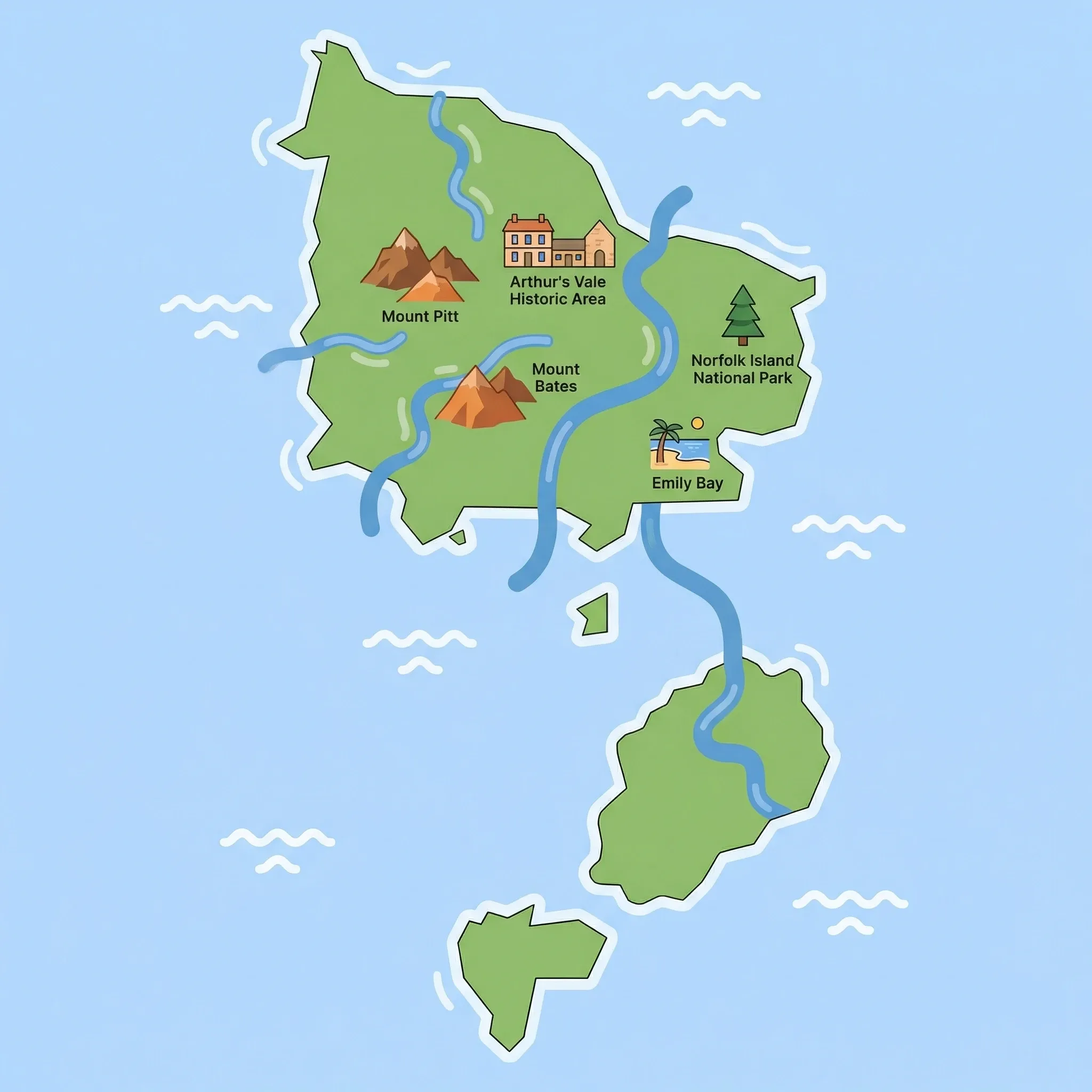
The island's crown jewel is the Kingston and Arthur's Vale Historic Area (KAVHA), a UNESCO World Heritage site that is far more than just old buildings. For families, this area is a playground of history where children can walk through the ruins of a convict jail, visit interactive museums, and play on the golden sands of Emily Bay, which sits right in front of the historic settlement. The bay itself is arguably the best family beach in the South Pacific, with calm, shallow waters and a pontoon that is perfect for jumping. Exploring the convict precinct by twilight on a ghost tour is a thrilling way for older kids to learn about the island's penal colony past.
Nature lovers must visit Norfolk Island National Park, which covers a significant portion of the island's north. A drive or hike to the summit of Mount Pitt offers 360-degree views of the entire island, a perfect spot for a family picnic. The park features a botanical garden and several manageable walking tracks suitable for children, winding through palms and giant tree ferns. At the Captain Cook Monument lookout, families can gaze out at the vast ocean and spot sea birds nesting in the cliffs below. The park is a sanctuary for the endangered Norfolk Island Green Parrot, which keen-eyed children might spot flashing through the trees.
Practical Advice
The best time to visit is between October and April when the weather is warmest for swimming, though the island is a year-round destination. Car hire is absolutely essential as there is no public transport; booking this in advance is recommended. While part of Australia, flights depart from international terminals, so leave plenty of time for airport processing. Medical facilities are limited to a small hospital, so comprehensive travel insurance including medical evacuation is crucial. The local "Norfolk Wave" (lifting a finger from the steering wheel to acknowledge passing drivers) is a local custom families should funnily adopt.
Food & Drink
Typical meal times: Breakfast is usually 7:30 am to 10:00 am, lunch 12:00 pm to 2:00 pm, and dinner 6:00 pm to 8:30 pm. Many kitchens close relatively early, so dining before 7:30 pm is advisable.
Typical meal costs: $25–45 AUD (approx. $16–29 USD / €15–27 EUR) for a main course. Food costs are higher than on the mainland due to freight charges. A casual lunch cafe meal might cost $18–25 AUD.
Dietary requirements: Gluten-free and vegetarian options are available at most clubs and cafes, but variety can be limited due to the island's remote supply chain. It is wise to bring specialized snacks if your children have strict dietary needs.
Family-friendly dining: The local RSL and Leagues clubs are excellent for families, offering relaxed atmospheres, kids' menus, and plenty of space. Picnic spots are abundant, especially around Kingston.
Signature dishes:
- Hihi Pie – A savoury pie made with periwinkles (small sea snails) found on the local rocks, a unique island delicacy often available seasonally.
- Pilhi – A traditional baked dish made from sliced sweet potato (kumara) or banana, often served as a savoury side or a sweet treat.
- Mudda – Dumplings made from grated green banana boiled in milk or cream, a dense and comforting staple of Bounty heritage cuisine.
- Norfolk Blue Beef – Locally raised, free-range beef known for its quality; steaks and burgers made from this beef are a highlight.
- Trumpeter – The most popular local fish (sweetlip), usually caught fresh daily and served simply grilled or battered with chips.
Family Travel Notice
Australian children who do not have a photo ID may use a valid Medicare card as an alternative for identification when flying from the mainland.

Norfolk Island is a relatively expensive destination due to high import costs. A family of four should budget around $350–500 AUD (approx. $230–325 USD / €215–305 EUR) per day for car hire, mid-range accommodation, and meals. Supermarket prices are significantly higher than in Australia (e.g., milk can be over $10 AUD). Self-catering breakfast and lunch helps manage the budget.
Age Suitability





Why this score?
The island offers a mix of gentle outdoor activities such as snorkeling in protected lagoons and hiking through the subtropical rainforests of the National Park. While the offshore Phillip Island provides a more rugged trekking experience with steep terrain, the main island is largely developed with good roads and safe, family-friendly environments. It lacks the extreme wilderness or physical challenges typically associated with high-adventure destinations.
Why this score?
Medical services are provided by a small hospital that offers basic emergency care and general practice with English-speaking staff and high standards of hygiene. However, the facility lacks specialized equipment and surgical capabilities, necessitating expensive and time-consuming medical evacuations to Australia for serious conditions. This isolation and limited infrastructure for complex cases place it in the mid-range for global medical accessibility.
Why this score?
Norfolk Island is a niche destination that primarily attracts between 25,000 and 30,000 visitors annually, the vast majority of whom are from Australia and New Zealand. While it possesses unique UNESCO World Heritage convict sites and beautiful lagoons, its small scale and remote location mean it has very low international visibility and visitor volume compared to global tourist hubs. The tourism infrastructure is well-established for its size but remains limited to a few key areas like Burnt Pine and Kingston.
Norfolk Island is a mid-to-high cost destination due to the expense of importing goods. Accommodation for families ranges from AUD 200–400 (approx. $130–260 USD / €120–240 EUR) per night. Supermarket groceries are significantly more expensive than on the mainland. However, many outdoor activities, such as exploring the National Park and swimming at Emily Bay, are completely free.

Getting There & Around
Getting There
- By Air – Qantas operates flights from Sydney (SYD) and Brisbane (BNE), while Air Chathams flies from Auckland (AKL). Flights from Australia depart from international terminals but are technically domestic travel.
- Entry Requirements – Australian citizens do not strictly need a passport (a driver's license suffices) but a passport is strongly recommended to avoid delays. New Zealand and other international citizens require a valid passport. Check your government website for the latest visa requirements, or use the IATA Travel Centre entry-requirements checker.
Getting Around
- Car Hire – Essential for all visitors. There is no public transport on Norfolk Island. Driving is on the left, and the maximum speed limit is 50km/h (30km/h in town). Cows have the right of way on all roads.
- Walking – Great for exploring specific areas like Kingston and Arthur's Vale Historic Area (KAVHA) or the Botanical Gardens, but the hilly terrain makes walking between towns impractical for families.
- Taxis – Available but limited and can be expensive; they generally require pre-booking and are not for casual hopping around.
Official Links

Packing List
Essential for protecting feet from sharp coral and rocks at Emily Bay and Slaughter Bay.
Street lighting is minimal to protect the dark sky; walking at night requires your own light.
There is no public transport; hiring a car is the only viable way for families to get around.
Groceries are expensive and supply ships can be delayed; bring kids' favourite snacks from home.
The ocean swell can be strong on glass-bottom boat tours or fishing trips.

Activities & Best Times

Adventure & Nature
GoodHiking, wildlife, outdoor exploration, ecotourism
While Norfolk Island has endemic species and Norfolk Island National Park, 'very good' overstates its position as a nature/adventure destination. The island has limited hiking infrastructure, no significant adventure activities industry, and competes poorly with major Pacific nature destinations (e.g., New Zealand, Fiji, Hawaii). Downgrade to 'good' reflects genuine nature appeal (national park, endemic flora/fauna, coastal scenery) without overstating international significance.
Beach & Sea
GoodBeach resorts, marine activities: diving, snorkelling, kite surfing, wind surfing, sailing
Emily Bay and Slaughter Bay provide unique, reef-protected lagoons ideal for family snorkeling in a South Pacific setting. Peak season aligns with the warmest water temperatures and calmest conditions from December to February.

City & Cultural
GoodUrban tourism, museums, historical sites, architecture
While Kingston and Arthur's Vale Historic Area is UNESCO-listed and historically significant, it represents a SINGLE heritage site on a small island with minimal other cultural infrastructure. 'Very good' cultural ratings should indicate destinations with multiple significant institutions/sites and broader cultural offerings. Downgrade to 'good' reflects that KAVHA is genuinely worth visiting but the island lacks the depth of cultural attractions to justify 'very good' status internationally.

Educational & Exploratory
GoodLearning experiences, scientific sites, historical education
Upgrade for consistency with cultural rating. Kingston and Arthur's Vale Historic Area (UNESCO convict heritage site) and Norfolk Island Museum offer substantial educational value about Pacific colonial history, convict history, and Bounty mutineer descendants. If the cultural rating is 'good', educational should match or exceed it given the strong historical/learning component of KAVHA.

Sports & Active
GoodSport tourism, fitness activities, active recreation
Features dedicated cycling and hiking routes like the Mount Pitt to Mount Bates track which are excellent for active families. Optimal conditions occur during the shoulder seasons when the humidity of summer and the rain of winter are avoided.

Road Trips & Scenic
MarginalScenic drives, countryside tours, route-based travel
Norfolk Island is only 8km x 5km (34.6 km²) and can be driven end-to-end in under an hour. While scenic, this does not constitute a meaningful 'road trip' destination by international standards. The classification should reflect that the island has scenic VIEWS accessible by car, but not substantial scenic DRIVES. Downgrade to 'marginal' - driving exists but is not a primary activity.




Public Holidays & Calendar Next 12 months
Public holidays, festivals, cultural celebrations, and seasonal natural phenomena coming up in Norfolk Island over the next 12 months.
Loading holidays and events...

Travel Advisory
All major agencies classify Norfolk Island (grouped with Australia) at their lowest risk level. Standard safety awareness is sufficient for visitors.
Safety Topics
Traveller Advice (3 groups)

Ensure comprehensive insurance includes medical evacuation, as the island's health infrastructure is not equipped for complex medical emergencies.

Australian citizens must present a valid photo ID, such as a driver's licence, for flight clearance. International visitors require a visa similar to Australian requirements. Travellers should respect the 'Norfolk Wave' tradition and be mindful of roaming livestock on roads.

Australian children who do not have a photo ID may use a valid Medicare card as an alternative for identification when flying from the mainland.
Agency Summaries
New Zealanders should maintain standard vigilance. The risk profile is consistent with the broader Australian region, though medical facilities are notably more limited.
The territory is considered a low-risk destination. Visitors are advised to follow standard safety measures and enroll in the Smart Traveler Enrollment Program (STEP).
As an external territory, Norfolk Island is a low-risk destination. Travellers from the Australian mainland are advised that while it is domestic travel, it involves international terminals and strict biosecurity checks.
No specific travel restrictions are in place. The safety environment is similar to other regions of Australia, with general guidance on health and entry requirements provided.
Travellers should maintain a standard level of safety awareness as they would in Canada. Norfolk Island is managed under the same security assessment as Australia.
The island is considered a safe destination with a security environment comparable to Ireland. Visitors should research local medical and entry conditions.
Information is provided for general guidance only and does not constitute travel, safety, medical, or legal advice. Conditions may change. Users are responsible for independently verifying information before travel.