

Norway is widely considered one of the most family-friendly destinations on Earth, offering a safe, clean, and stunningly beautiful environment for children to explore. The country’s philosophy of friluftsliv (open-air life) means that outdoor activities are deeply embedded in the culture, making it a paradise for active families. From the urban sophistication of Oslo & Eastern Norway to the dramatic peaks of the Lofoten Islands, the landscape itself serves as a gigantic playground. Parents will appreciate the high standard of living, excellent infrastructure, and the fact that children are welcomed almost everywhere. While distances can be long and costs are high, the memories of seeing reindeer in the wild or standing atop a fjord are priceless.
The geography is defined by water and stone. The western coast is carved by iconic fjords, while the interior features vast plateaus and dense forests. For families, this means endless opportunities for easy hiking, kayaking, and wildlife spotting. In summer, the sun barely sets, giving you extra hours to explore, while winter transforms the north into a snowy wonderland of dog sledding and Northern Lights hunting. Travelling here is slower than in the rest of Europe; roads wind around mountains and ferries cross fjords, turning every transit into a scenic event.
Key Attractions
Norway’s attractions often blend education with pure fun. In the capital, families should visit Akershus Fortress, which looks like a fairy-tale castle and offers plenty of space for kids to run. Just outside the city, Bjørneparken (The Bear Park) allows you to see bears, moose, and lynx in large natural enclosures, making it far superior to a standard zoo. For pure entertainment, Bø Sommarland is one of Scandinavia’s largest water parks, set naturally into the terrain.
On the west coast, Bergen & Fjords is the heart of tourist Norway. The Bergen Aquarium is fantastic for younger children, featuring penguins and sea lions, while the historic wooden buildings of Bryggen offer a maze of alleyways that feel like stepping back in time. Further south in Stavanger & Lysefjord, the Norwegian Petroleum Museum surprises many families with its kid-friendly design, including an escape chute and miniature oil rig to play on. For older children with stamina, the hike to Preikestolen (Pulpit Rock) provides one of the world's most famous photo opportunities.
Heading north to Northern Norway is an adventure in itself. The Lofotr Viking Museum in Lofoten is a highlight, where families can dress up as Vikings, row a traditional ship, and attend a chieftain’s feast. Wildlife lovers must visit the Polar Park Arctic Wildlife Center, famous for its wolf encounters, or Polaria in Tromsø to learn about Arctic ecosystems. For the ultimate journey, driving to the North Cape (Nordkapp) lets you stand at the very edge of the European continent.
Practical Advice
Best Time to Visit: June to August is best for families, offering the warmest weather and open attractions. May and September are quieter but cooler. Winter (December to March) is magical for snow sports in places like Trondheim & Central Norway, but days are short and dark.
Logistics: Norway is almost entirely cashless; cards are accepted even at hot dog stands. Public toilets are generally clean but sometimes require a card payment to enter. If driving, be aware that distances on maps are deceptive; 100km can take two hours due to winding roads and ferries.
Food & Drink
Typical meal times: Norwegians eat dinner (middag) remarkably early. Most families eat between 4:00 pm and 5:30 pm. Restaurants are busiest at 6:00 pm and many kitchens close by 9:00 pm or 10:00 pm.
Typical meal costs: Norway is expensive. A basic lunch costs 150–250 NOK (approx. $13–22 USD / €12–21 EUR). A main course at a mid-range restaurant runs 250–450 NOK (approx. $22–40 USD / €21–39 EUR). A full 3-course dinner is often 600–900 NOK (approx. $53–80 USD / €50–78 EUR). Children’s menus are usually 100–150 NOK (approx. $9–13 USD / €8–13 EUR).
Dietary requirements: Extremely easy. Allergies are well-understood, and gluten-free or lactose-free options are available in almost every restaurant and supermarket. Vegetarian options are standard, though vegan choices are slightly less common in rural areas.
Family-friendly dining: Children are welcome everywhere. Most restaurants provide highchairs (barnestol) and a children’s menu (barnemeny). Tap water is free, safe, and delicious-always ask for a jug of tap water instead of buying bottled.
Signature dishes:
- Kjøttkaker – Meatballs served with brown gravy, boiled potatoes, and pea stew. A staple family dinner that kids usually love.
- Brunost – Sweet, brown goat cheese that tastes like caramel. Served on thin slices of bread or waffles.
- Pølse i lompe – A hot dog served in a potato tortilla (lompe) instead of a bun. The ultimate Norwegian fast food.
- Vafler – Heart-shaped waffles, softer and sweeter than Belgian ones, typically eaten as a snack with jam and sour cream.
- Fårikål – The national dish, a simple stew of mutton and cabbage. It is an acquired taste for some children but culturally significant.

Norway is one of the most expensive countries in the world. A family of four should budget at least 3,500–5,000 NOK (approx. $310–445 USD / €295–420 EUR) per day for mid-range accommodation, modest meals, and activities. Car rental and fuel add significantly to this cost. However, nature is free—hiking and enjoying the scenery costs nothing.
Age Suitability




Did you know? Norway welcomes approximately 5.0 million international visitors per year. Most visitors come from Europe.

Explore Regions
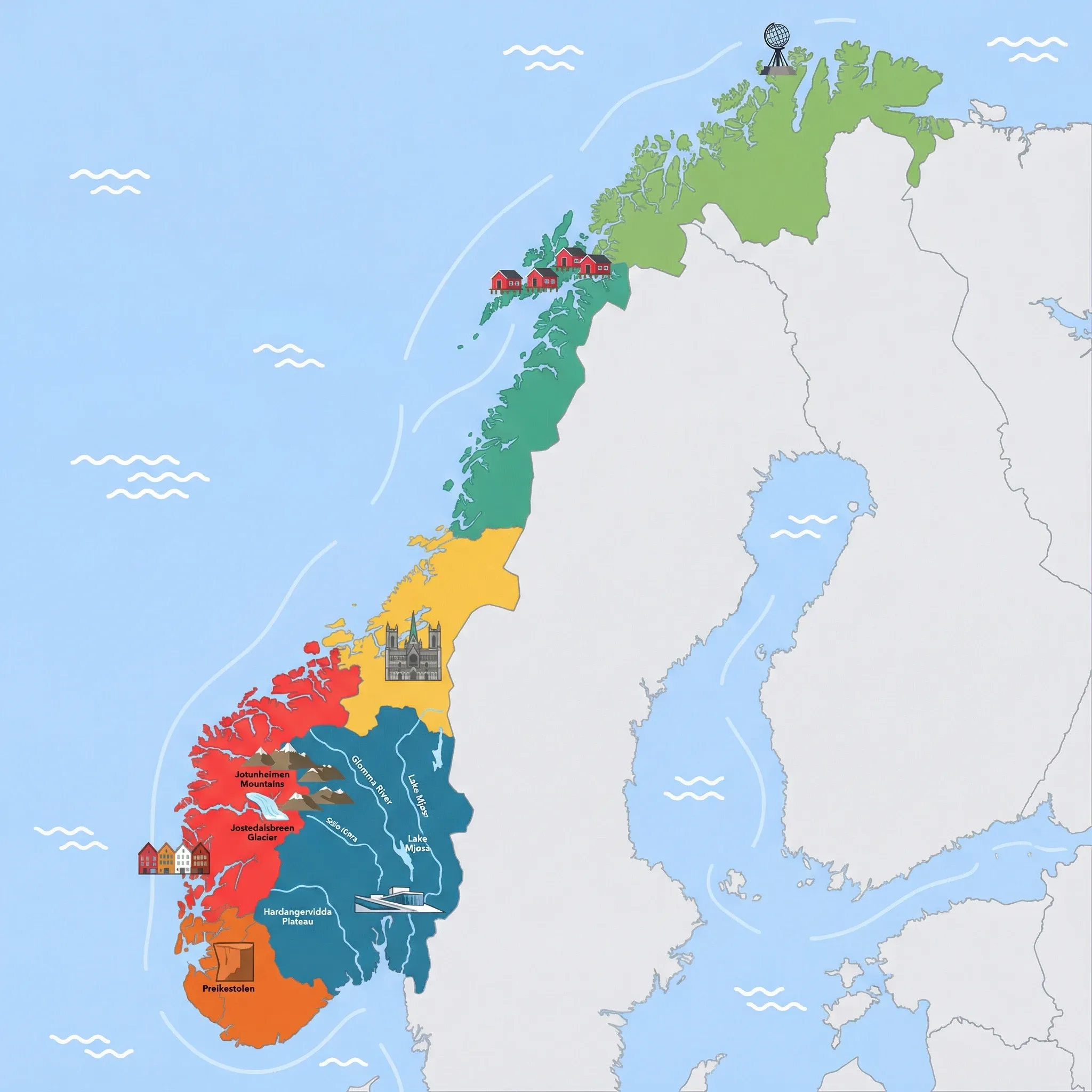
6 Regions
Bergen & Fjords (Sognefjord, Hardangerfjord, Geirangerfjord)
Where trolls hide in the mountains and waterfalls cascade into the deep blue sea 🌧️🏔️
Lofoten Islands
Arctic islands where mountains crash into the sea 🦅🌊
Northern Norway (Tromsø, North Cape)
Arctic adventures under the Aurora and Midnight Sun 🌌❄️
Oslo & Eastern Norway
Urban cool meets troll-filled forests 🏙️🌲
Stavanger & Lysefjord (Preikestolen)
Iconic hikes, white beaches, and oil history 🪨🏖️
Trondheim & Central Norway
Viking kings, musk oxen, and the world's most scenic drive ⛪🛣️
Click on a region marker to explore details. Use the dropdown to color regions by activity suitability.

Getting There & Around
Getting There
- By Air – Oslo Airport (OSL) is the main international hub, with excellent connections to Oslo & Eastern Norway via the high-speed Flytoget train. Bergen (BGO) and Stavanger (SVG) also handle international flights.
- By Train – Trains connect Oslo to Stockholm (Sweden) and Gothenburg (Sweden). Interrail/Eurail passes are valid.
- By Sea – Car ferries run from Denmark (Hirtshals/Copenhagen) and Germany (Kiel) to Oslo, Kristiansand, and Stavanger. These are like mini-cruises and very family-friendly.
- Entry Requirements – Norway is part of the Schengen Area. US, UK, Canadian, and Australian citizens do not need a visa for stays up to 90 days. Check your government website for the latest visa requirements, or use the IATA Travel Centre entry-requirements checker.
Getting Around
- Car Hire – Essential for exploring the fjords and rural areas like Lofoten Islands. Be prepared for narrow roads, frequent ferries, and strict speed limits (often 60–80 km/h). Electric vehicle charging infrastructure is world-leading.
- Trains – The rail network is limited but spectacular. The Bergensbanen between Oslo and Bergen is one of the world's most scenic journeys. Families can use the 'Vy' app for tickets; children under 6 travel free, and ages 6–17 get 50% off.
- Ferries – In Bergen & Fjords, ferries are part of the road network. They are reliable and kid-friendly, offering a break from driving.
- Domestic Flights – Necessary for covering long distances, especially to Northern Norway (e.g. Tromsø or Alta).

Packing List
The sun does not set in summer (Midnight Sun), making it very difficult for children to sleep without total darkness.
A small foam or wool mat to sit on. Every Norwegian family carries these for breaks on cold rocks or wet grass.
Essential year-round. Thin merino wool tops/leggings regulate temperature better than cotton in the changeable Nordic weather.
Ticks (flått) are common in coastal brush and grassy areas in southern Norway; having a remover handy is wise.
Tap water is glacier-pure and free. Buying bottled water is expensive and culturally frowned upon.

Activities & Best Times

Adventure & Nature
ExcellentHiking, wildlife, outdoor exploration, ecotourism
A world-class Arctic wilderness featuring dramatic peaks rising from the sea, pristine fjords, and unique maritime ecosystems. Peak summer provides 24-hour daylight for hiking and wildlife observation, while extreme winter conditions limit self-guided exploration for families.
Home to world-famous trails like Trolltunga and the Rallarvegen, this region offers peerless fjord-immersion and wilderness experiences. Peak access occurs in summer when high-altitude snow has melted and mountain services are fully operational.
The region offers iconic, world-renowned nature experiences including the Preikestolen (Pulpit Rock) and Kjeragbolten hikes overlooking the Lysefjord. These trails are best accessed during the summer months to ensure safe passage and clear visibility of the dramatic fjord landscapes.

City & Cultural
ExcellentUrban tourism, museums, historical sites, architecture
Oslo is a top-tier cultural hub with world-renowned museums like the MUNCH and National Museum, alongside unique architectural sites. Summer months are ideal for experiencing the vibrant harbor life and outdoor cultural festivals.
Home to iconic, authentic fishing villages like Nusfjord and Henningsvær, offering unique Arctic architecture and rich Viking heritage. Cultural facilities and historic sites are most active during the summer season, with many seasonal museums closing during the dark winter months.
Bergen provides an authentic, high-quality urban experience centered on the UNESCO-listed Bryggen and a sophisticated arts district including the KODE museums. The city is most vibrant during the longer, drier days of summer, though December offers charming traditional Christmas markets.

Educational & Exploratory
Very GoodLearning experiences, scientific sites, historical education
Features internationally significant facilities like the Norwegian Museum of Science and Technology, providing sophisticated engagement for curious families. Peak timing aligns with broader tourism availability and school travel windows.
High-quality facilities like the Bergen Aquarium and VilVite Science Centre provide significant engagement for families. While these are mostly indoor attractions, they follow the broader tourist seasonal pulse with expanded programming and hours during the summer peak.
Features destination-level learning centers like the Trondheim Science Centre and the Atlantic Sea-Park. These facilities offer high-quality engagement, though many outdoor-linked components are best experienced during the warmer, more accessible months.

Sports & Active
Very GoodSport tourism, fitness activities, active recreation
Features world-renowned Arctic surfing at Unstad and the unique Lofoten Links golf course, alongside major coastal cycling routes. Activity infrastructure is highly weather-dependent, with the brief Arctic summer providing the only reliable window for most organized sports.
Voss is internationally recognized as an extreme sports capital, offering world-class infrastructure for climbing, ziplining, and mountain biking. Activity is concentrated in the warmer months when the extensive outdoor adventure parks and high-alpine trails are accessible.
Offers exceptional infrastructure for mountain biking at Hafjell and iconic hiking routes like the Besseggen ridge. The season is defined by stable weather and long daylight, essential for completing these high-quality outdoor pursuits.

Theme Park & Entertainment
Very GoodAmusement parks, family entertainment venues
Boasts distinctive, high-quality attractions like Hunderfossen Eventyrpark that offer a culturally authentic alternative to generic theme parks. These venues are highly seasonal, operating primarily during the school summer holidays.
Unique cultural entertainment like Viking Valley Njardarheimr offers an authentic and immersive historical experience that stands out globally. These outdoor-focused attractions are strictly seasonal, operating primarily during the warmer months to coincide with family travel windows.
Pirbadet and local adventure parks provide decent regional entertainment for families. They lack the global scale of top-tier international theme parks, serving primarily as supplementary activities during peak summer travel.

Road Trips & Scenic
GoodScenic drives, countryside tours, route-based travel
The E10 National Scenic Route provides a globally recognized driving experience through breathtaking archipelago landscapes. Peak months offer long daylight and safe driving conditions, whereas winter months present significant hazards and limited visibility.
The region features several National Scenic Routes with world-class engineering and dramatic vistas, though accessibility is strictly seasonal. Many high mountain passes remain closed due to snow until late May, making summer the only viable period for a complete touring experience.
Provides access to celebrated National Scenic Routes such as Valdresflye, offering world-class driving through dramatic alpine plateaus. Snow closures on high mountain passes make summer and early autumn the only viable windows for touring.

Ski & Snow
GoodWinter sports, ski resorts, snow activities
Voss and Myrkdalen provide reliable, high-quality ski infrastructure with particularly snow-sure conditions compared to continental Europe. February and March offer the best balance of deep snow cover and increasing daylight hours for a premium alpine experience.
Home to premier, family-focused resorts like Trysil and Hemsedal which offer world-class infrastructure and reliable snow. February and March are peak due to the combination of deep snow bases and longer daylight hours compared to mid-winter.
Oppdal and Vassfjellet offer solid alpine and cross-country infrastructure with reliable spring snow. Peak months avoid the darkest winter weeks, offering better visibility and daylight for family skiing.

Beach & Sea
MarginalBeach resorts, marine activities: diving, snorkelling, kite surfing, wind surfing, sailing
While Lofoten's beaches are visually spectacular with turquoise waters and white sands, water temperatures remain prohibitively cold year-round (Arctic Circle location). The beaches are scenic attractions rather than swimming destinations. 'Good' implies competitive beach holiday conditions which don't exist at this latitude. Downgrade to 'marginal' for accurate international calibration.
While scenic beaches like Refviksanden exist, water temperatures remain low even in peak summer, appealing mostly to those seeking brisk, authentic coastal recreation. It lacks the infrastructure and climate typical of international beach resort destinations.
Sørenga is primarily an urban swimming facility, not a beach destination. The region has limited coastal access and cold water temperatures severely limit the swimming season. 'Good' suggests international competitiveness as a beach destination, which is misleading. Downgrade to 'marginal' to reflect that while beaches exist, conditions don't support typical beach holidays.

Festivals & Seasonal
MarginalEvents, celebrations, seasonal attractions
The Bergen International Festival and Ekstremsportveko are significant cultural and sporting events that draw an international crowd. The festival season is narrow, focused on the late spring and early summer window when the region's cultural energy peaks.
Anchored by unique international events like the Nobel Peace Prize ceremonies and the culturally rich Constitution Day celebrations. These specific windows offer authentic Norwegian traditions that appeal to sophisticated global travelers.
Anchored by the internationally significant Røros Winter Fair (Feb) and St. Olav Festival (July). These specific event windows provide authentic cultural depth, though the festival calendar is not dense year-round.

Relaxation & Wellness
MarginalSpa retreats, wellness centers, peaceful getaways

Public Holidays & Calendar Next 12 months
Public holidays, festivals, cultural celebrations, and seasonal natural phenomena coming up in Norway over the next 12 months.
Loading holidays and events...
Climate & Weather
Bergen & Fjords (Sognefjord, Hardangerfjord, Geirangerfjord)
Show Details
| Month | Temp °C | Rain | Humidity |
|---|
Lofoten Islands
Show Details
| Month | Temp °C | Rain | Humidity |
|---|
Northern Norway (Tromsø, North Cape)
Show Details
| Month | Temp °C | Rain | Humidity |
|---|
Oslo & Eastern Norway
Show Details
| Month | Temp °C | Rain | Humidity |
|---|
Stavanger & Lysefjord (Preikestolen)
Show Details
| Month | Temp °C | Rain | Humidity |
|---|
Trondheim & Central Norway
Show Details
| Month | Temp °C | Rain | Humidity |
|---|

Travel Advisory
All major agencies agree that Norway is a safe destination where standard personal security measures are sufficient. There are no significant travel warnings or regional restrictions.
Safety Topics
Traveller Advice (4 groups)

Norway is generally considered safe for solo female travelers, with low rates of harassment reported in public areas.

Norway is highly progressive regarding sexual orientation and gender identity, with strong legal protections and a generally welcoming social climate.

Maintain standard situational awareness, especially in crowded urban centers and transit hubs. Ensure you have comprehensive insurance that covers all planned activities.

When visiting remote regions like Svalbard, prepare for extreme cold and potential encounters with polar bears. Helicopter rescue services may be limited, so specialized insurance is essential for mountainous or arctic exploration.
Agency Summaries
Visitors should maintain standard safety awareness as they would in their home country, though petty crime is a risk in urban areas.
Irish citizens are advised to use standard common sense and personal security measures while traveling throughout the country.
Norway is considered very safe for international visitors, requiring only standard safety measures and awareness of local conditions.
Travelers are encouraged to stay informed of local security alerts and maintain typical vigilance in public spaces and major cities.
No specific travel restrictions are in place, though travelers should be aware of the general threat of terrorism that exists across Europe.
General safety levels are high, with a moderate national terror threat level and very low crime rates outside of seasonal petty theft.
Information is provided for general guidance only and does not constitute travel, safety, medical, or legal advice. Conditions may change. Users are responsible for independently verifying information before travel.