

Overview
Papua New Guinea is a land of immense cultural diversity and rugged natural beauty, sitting just north of Australia. It is a destination that demands respect and preparation, making it best suited for families with older children or teenagers who crave genuine adventure over poolside relaxation. The geography is dramatic, ranging from the humid coastal lowlands and coral atolls of the Islands (New Ireland, Bougainville) to the jagged, mist-covered peaks of the Highlands (Goroka, Mt Hagen). Infrastructure is limited, roads are few, and getting around often means taking small planes over impenetrable rainforests.
Culturally, it is unique in the world, home to over 800 distinct languages and tribes. For families, the highlight is often the opportunity to engage with these living cultures-witnessing the mud men of the highlands, seeing the intricate face paint at a festival, or visiting a village in the Sepik Region. While it lacks the polish of Southeast Asia, it offers an authentic connection to the natural world and human history that is disappearing elsewhere. It is a challenging but deeply rewarding classroom for young explorers.
Key Attractions
For a safe and accessible introduction to the country's wildlife, the Port Moresby Nature Park is world-class. It is the best place for children to see the bird of paradise (the national symbol) and the adorable tree kangaroo in a secure, well-maintained environment. Just outside the capital, Bomana War Cemetery offers a sobering and beautifully kept lesson in WWII history, where thousands of Australian and local soldiers are buried. For a relaxing day by the sea in the capital, Ela Beach has recently been redeveloped with family-friendly facilities, though vigilance is always required.
Venturing further afield, the Mount Tavurvur volcano near Rabaul in Kokopo & East New Britain is a thrilling sight; seeing an active volcano up close is an unforgettable geography lesson for kids. In the interior, the Kuk Early Agricultural Site is a UNESCO World Heritage gem that traces 9,000 years of human agriculture, showing how people tamed these high valleys. For the ultimate river adventure, a guided expedition on the Sepik River exposes families to the incredible 'spirit houses' and crocodile-worshipping cultures of the river tribes, although this is a serious expedition requiring an experienced guide.
Safety
Safety is the primary concern for any family trip here. Crime rates are high, including carjackings and armed robbery. Tribal fighting can flare up in the Highlands. Never walk around Port Moresby or other towns at night. Always arrange transfers through your hotel or a reputable tour company. When visiting markets or villages, go with a local guide who knows the community. Malaria is also a significant risk; antimalarial medication and strong insect repellent are essential.
Practical Advice
The best time to visit is during the dry season (May to October), which also coincides with major cultural festivals like the Goroka Show (September) or Mt Hagen Show (August). Visas are required for most nationalities and should be arranged online (e-Visa) before travel; a Digital Arrival Card must also be completed 72 hours prior. Healthcare is very basic outside the capital, so comprehensive travel insurance including medical evacuation is non-negotiable.
Food & Drink
Typical meal times: 12:00 pm to 2:00 pm for lunch, and 6:00 pm to 8:00 pm for dinner. Dinner is typically eaten early, as it is unsafe to be out late at night.
Typical meal costs: 50–100 PGK (approx. $13–26 USD / €12–24 EUR) for a casual lunch; 150–250 PGK (approx. $39–65 USD / €36–60 EUR) for a hotel dinner. Prices are high due to reliance on imports.
Dietary requirements: Vegetarian options are generally available as root vegetables and greens are staples, but vegan or gluten-free specific labeling is rare. In remote areas, you eat what is available.
Family-friendly dining: Highchairs and children's menus are rare outside of major hotels in Port Moresby. Most families will eat at their accommodation for safety and convenience.
Signature dishes:
- Mumu – The national dish, consisting of pork, sweet potatoes, rice, and greens wrapped in banana leaves and slow-cooked in an earth oven with hot stones.
- Kaukau – Sweet potato, the staple of the Highlands, often roasted or boiled and served with every meal.
- Saksak – Dumplings made from sago palm starch and bananas, wrapped in a leaf and steamed; a chewy, sweet treat kids might enjoy.
- Kokoda fish – Fresh raw fish marinated in lime juice and coconut cream, similar to ceviche, refreshing in the tropical heat.

Papua New Guinea is surprisingly expensive. A family of four should expect to spend around 2,500–3,500 PGK (approx. $650–910 USD / €600–840 EUR) per day. High costs stem from the need for private security, expensive internal flights to get anywhere, and the fact that secure, western-standard hotels charge a premium. Budget travel here is generally not safe for families.
Age Suitability





Did you know? Papua New Guinea welcomes approximately 67,000 international visitors per year. Most visitors come from East Asia and the Pacific.

Explore Regions
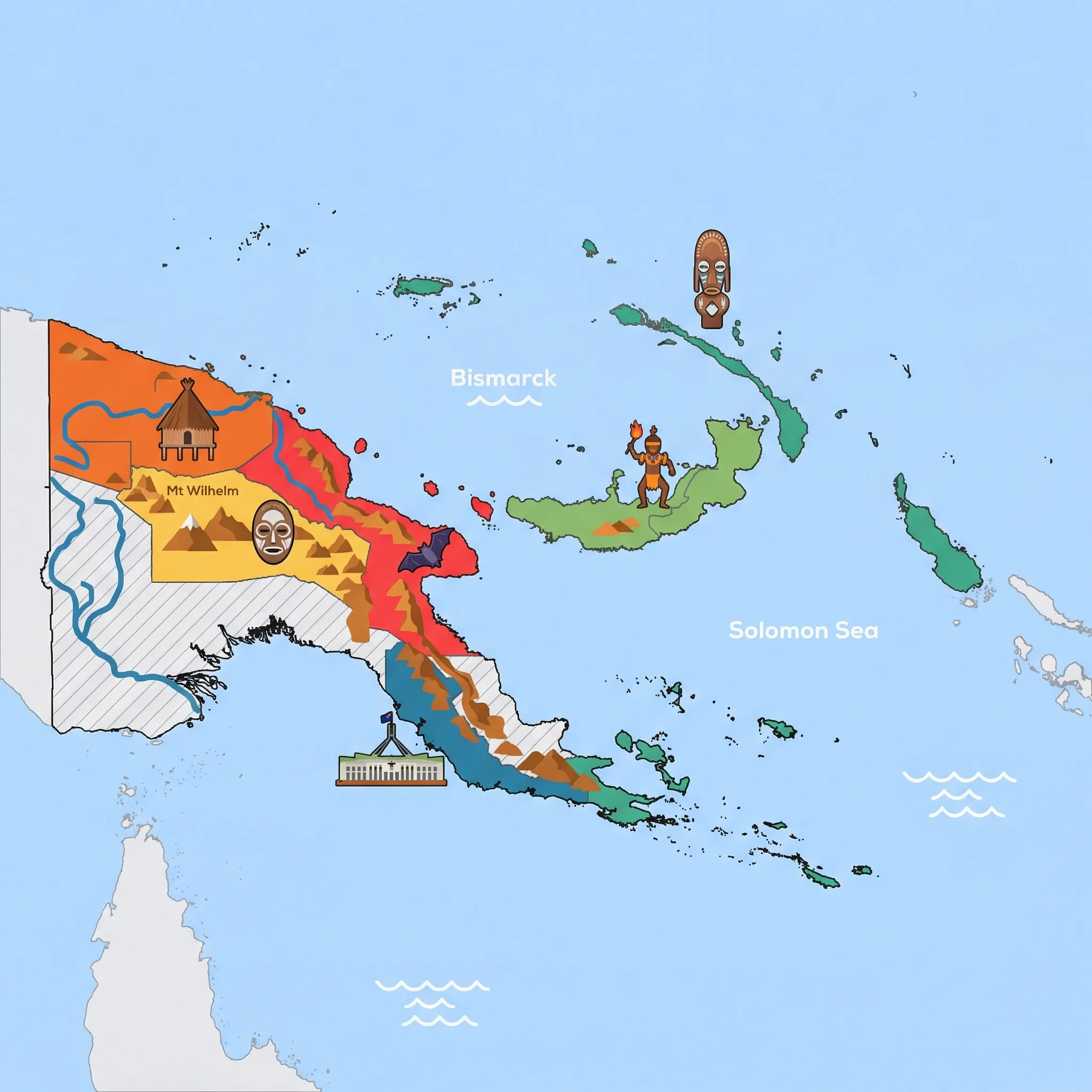
6 Regions
Highlands (Goroka, Mt Hagen)
Ancient cultures in the clouds ⛰️🎭
Islands (New Ireland, Bougainville)
Volcanoes, history, and island paradise 🌋🏝️
Kokopo & East New Britain
Tropical adventures in the shadow of volcanoes 🌋🌿
Madang & North Coast
The prettiest town in the Pacific 🌺🦇
Port Moresby & Central
The gateway to culture and wildlife 🏙️🦜
Sepik Region
River journeys into the heart of culture 🐊🛶
Click on a region marker to explore details. Use the dropdown to color regions by activity suitability.

Getting There & Around
Getting There
- By Air – Jacksons International Airport (POM) in Port Moresby is the sole international gateway. Direct flights arrive from Brisbane, Cairns, Singapore, Manila, and Hong Kong.
- By Sea – Cruise ships occasionally stop at Rabaul or Alotau, offering a safer and logistically easier way for families to see coastal areas without the need for internal flights.
- Entry Requirements – Most visitors need a visa. E-Visas are available for many nationalities (including US, UK, EU) and must be applied for online. All travelers must complete a Digital Arrival Card (DAC) within 72 hours of travel. Check your government website for the latest visa requirements, or use the IATA Travel Centre entry-requirements checker.
Getting Around
- Domestic Flights – Essential for travel. There are very few connecting roads between provinces. Air Niugini and PNG Air connect Port Moresby & Central to the Highlands and Islands.
- PMVs (Public Motor Vehicles) – These are local minibuses. While cheap, they are generally not recommended for tourists due to safety concerns and overcrowding.
- Private Drivers – The only safe way to navigate cities. Your hotel or tour operator should arrange transfers. Do not hail taxis on the street.
- Organized Tours – For regions like the Sepik Region or the Highlands, a pre-booked tour with a guide and vehicle is virtually mandatory for safety and logistics.

Packing List
School supplies (pencils, books) or balloons are appreciated if visiting tribal villages, where reciprocity is culturally important.
Power outages are frequent even in towns, and rural village stays often have no electricity at all.
You will frequently remove shoes when entering guest houses, village homes, or custom areas.
Essential for protecting feet from sharp coral and stonefish if exploring the coastal islands and beaches.
Medical facilities are basic; carrying a sterile kit is a wise precaution for remote adventure travel.
Consider buying a local string bag on arrival; it's durable, supports women, and helps you blend in slightly better.

Activities & Best Times

Adventure & Nature
Very GoodHiking, wildlife, outdoor exploration, ecotourism
Home to Mt Wilhelm and Mt Giluwe, the region offers world-class high-altitude trekking and unique mountain biodiversity. Peak visitation occurs during the drier winter months when trails are safest and cloud cover is minimal.
Active volcanology and unique ecosystems, like the megapode egg sites, provide highly authentic wilderness encounters. Treks to Mount Tavurvur are best during drier months to ensure safe footing and clear views.
World-class volcano trekking at Mount Tavurvur and historic jungle paths like the Numa Numa Track offer deep wilderness immersion. The drier months (Jun-Sep) are peak for safety and accessibility, whereas the peak monsoon season (Dec-Mar) creates challenging trail conditions.

Beach & Sea
Very GoodBeach resorts, marine activities: diving, snorkelling, kite surfing, wind surfing, sailing
Madang is PNG's premier diving destination with colorful lagoons and offshore reefs. It should be differentiated from other regions and elevated to very_good to reflect its nationally recognized status for marine tourism.
Access to Daugo and Manubada Islands offers snorkeling and coastal escapes away from the capital's bustle. These areas are best visited during the dry season when water clarity is highest and the risk of monsoon-related sea swell is minimized.
The Duke of York Islands offer pristine snorkeling and marine biodiversity, though infrastructure is rustic. Peak season aligns with the calmer seas and higher visibility of the southeast trade wind season.

City & Cultural
Very GoodUrban tourism, museums, historical sites, architecture
Home to the National Parliament House and National Museum, the region offers the country's most significant concentration of Melanesian heritage sites. Peak visitation occurs during the drier, cooler months when navigating the city and visiting the Bomana War Cemetery is most comfortable for families.
While culturally rich, the Highlands lack the urban cultural infrastructure (museums, galleries, heritage districts) that justify very_good by international standards. Good is more appropriate for authentic cultural immersion without major urban institutions.
The 'Pompeii of the Pacific' is a unique niche attraction, but international calibration for very_good city_cultural requires more comprehensive urban cultural infrastructure. Good is more appropriate.

Festivals & Seasonal
Very GoodEvents, celebrations, seasonal attractions
Goroka Show and Mt Hagen Show are internationally renowned cultural festivals that draw global travelers. These are not marginal offerings - they are world-class events that justify very_good rating.
The National Mask and Warwagira Festival in July is a world-class display of Tolai Baining fire dances and traditional culture. Outside of this specific event window, the region lacks major internationally-recognized seasonal celebrations.
The Sepik River Crocodile Festival in Ambunti is a globally unique cultural event showcasing tribal rites and traditions. The peak occurs specifically in August, with months outside this window offering very little in the way of major international festivals.

Educational & Exploratory
GoodLearning experiences, scientific sites, historical education
Kuk Early Agricultural Site is a UNESCO World Heritage Site with profound historical significance. This warrants at least 'good' rating, not marginal.
The National Museum and Art Gallery is an internationally significant repository for Pacific ethnographic artifacts. While the museum itself is indoor, the peak season reflects when general tourism conditions are safest and most accessible for visiting families.
The Volcanological Observatory provides niche scientific insight, though it serves more as a specialized stop than a primary travel motivator. Visiting is most reliable when regional tourism infrastructure is fully operational in the dry season.

Road Trips & Scenic
GoodScenic drives, countryside tours, route-based travel
The Sogeri Road drive to the Varirata Plateau provides dramatic vistas of the Owen Stanley Ranges and the Central coastline. Travel is best in the dry season to avoid road washouts and landslides common during the heavy precipitation months.
The Highlands Highway offers one of the world's most rugged and scenic driving experiences through dramatic mountain passes. Travel is restricted to the driest months to avoid frequent landslides and road washouts typical of the heavy monsoon season.
The coastal drive between Kokopo and Rabaul offers dramatic volcanic landscapes and harbour vistas on well-maintained primary routes. Peak travel occurs when dry conditions ensure the best visibility and road safety.

Sports & Active
GoodSport tourism, fitness activities, active recreation
The region features the specialized infrastructure of the Kokoda Track and the modern Taurama Aquatic Centre. The peak period aligns with the trekking window when conditions are dry enough for safe passage and organized outdoor sport.
Mount Wilhelm and Mount Giluwe provide internationally recognized high-altitude trekking routes with established trail infrastructure. Active travel is prioritized during the dry season for optimal safety and visibility on technical summit pushes.
Challenging volcanic ascents provide recognized trekking routes for active travelers seeking physical engagement. These activities are heavily seasonal, as the tropical wet season makes the volcanic ash slopes dangerously unstable.

Theme Park & Entertainment
MarginalAmusement parks, family entertainment venues

Public Holidays & Calendar Next 12 months
Public holidays, festivals, cultural celebrations, and seasonal natural phenomena coming up in Papua New Guinea over the next 12 months.
Loading holidays and events...
Climate & Weather
Highlands (Goroka, Mt Hagen)
Show Details
| Month | Temp °C | Rain | Humidity |
|---|
Islands (New Ireland, Bougainville)
Show Details
| Month | Temp °C | Rain | Humidity |
|---|
Kokopo & East New Britain
Show Details
| Month | Temp °C | Rain | Humidity |
|---|
Madang & North Coast
Show Details
| Month | Temp °C | Rain | Humidity |
|---|
Port Moresby & Central
Show Details
| Month | Temp °C | Rain | Humidity |
|---|
Sepik Region
Show Details
| Month | Temp °C | Rain | Humidity |
|---|

Travel Advisory
The majority of international agencies advise exercising a high degree of caution or increased vigilance across Papua New Guinea. While Canada and the US maintain higher 'Reconsider' ratings, the consensus baseline for the country is L1, heavily augmented by L2/L3 regional warnings for the Highlands and Bougainville.
Safety Topics
Traveller Advice (5 groups)

If trekking the Kokoda Track or other trails, always hire a guide from a reputable company. Be aware of unexploded ordnance from WWII in remote areas and monitor local security conditions for the risk of robberies at trailheads.

Do not walk alone or after dark, particularly in Port Moresby, Lae, and Mount Hagen. Use pre-arranged private transport and avoid displaying valuables or using ATMs in public areas.

Be aware of kidnapping risks for ransom or political purposes in remote regions and near industrial mining or logging sites.

Exercise extreme caution as sexual assault and harassment are significant risks. It is strongly recommended to travel in groups rather than alone.

Research local laws and cultural norms thoroughly, as social attitudes toward sexual and gender minorities can be conservative.
Agency Summaries
Maintain high vigilance across the country due to serious crime. Higher risk levels apply to the Highlands region where tribal clashes are frequent.
The security environment remains very challenging. Violent crime is a major concern in both urban centers like Port Moresby and rural provinces.
While general caution is advised nationwide, specific warnings against all but essential travel are in place for Hela, Southern Highlands, and most districts in Enga Province due to tribal violence.
Heightened safety awareness is necessary throughout PNG because of violent crime and the risk of civil disturbances. Regional warnings apply to the Hela and Enga provinces.
Travellers are urged to avoid non-essential trips to Papua New Guinea due to severe levels of violent crime, civil instability, and ethnic conflict.
Reconsider travel plans because of persistent crime, civil unrest, and maritime piracy. Particular areas, including parts of Bougainville and the Highlands, carry even higher risk levels.
Information is provided for general guidance only and does not constitute travel, safety, medical, or legal advice. Conditions may change. Users are responsible for independently verifying information before travel.