

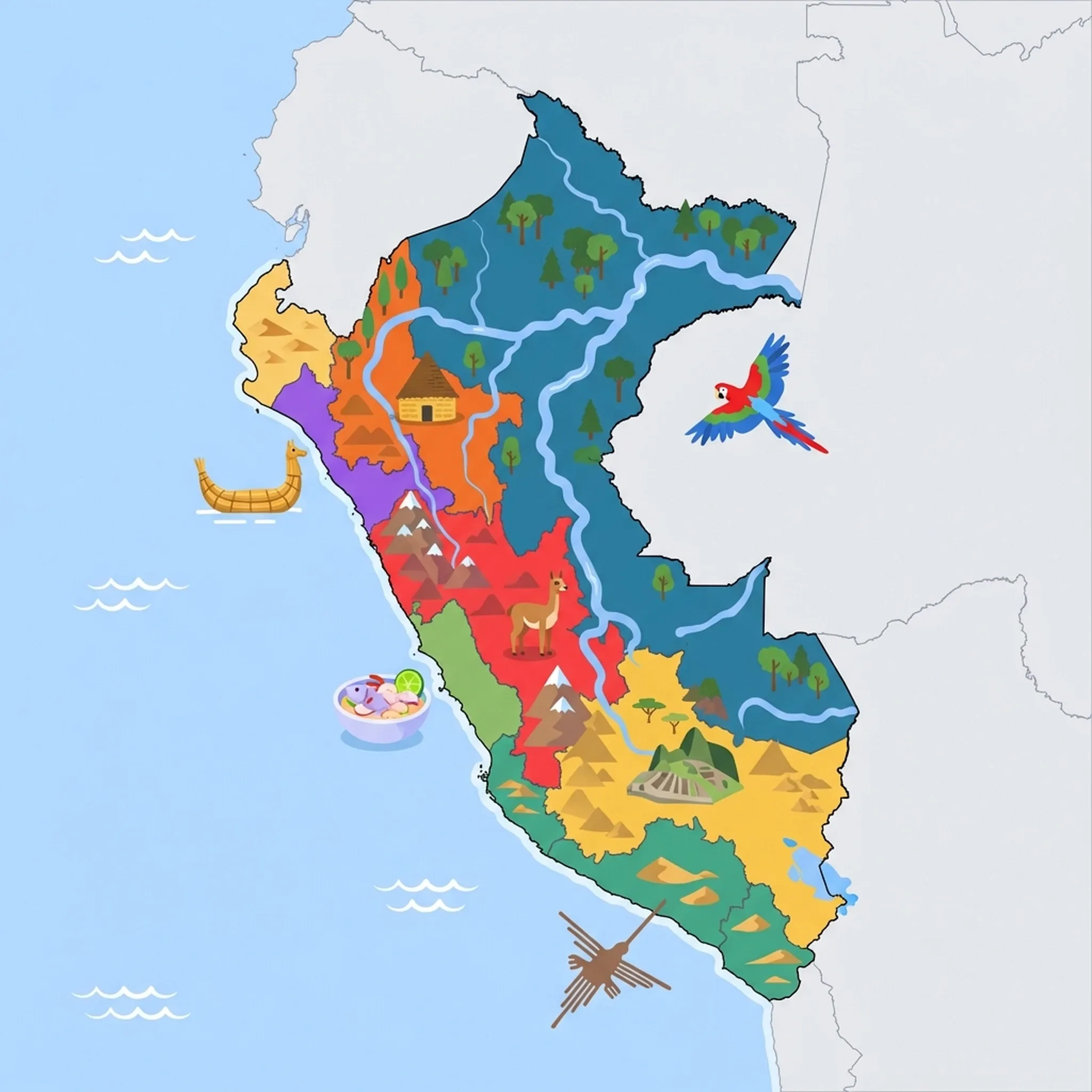
Click a region to explore
Just a few hours south of Lima, the landscape transforms into a dramatic desert that rivals the Sahara, meeting the cold, nutrient-rich Pacific Ocean. This contrast creates one of Peru's most family-friendly regions. The proximity to the capital (3–4 hours by bus) makes it an easy addition to any itinerary. The vibe here is adventurous but accessible. You have the town of Paracas, a sleepy beach resort that serves as the launchpad for marine wildlife tours, and Ica, a bustling agricultural city famous for its vineyards and the towering dunes of Huacachina.
For children, this region is pure fun. It lacks the altitude concerns of the Andes and the humidity of the Amazon. The wildlife viewing is "easy"—you sit on a boat, and the animals are right there. The Ballestas Islands are often called the "Poor Man's Galapagos" because of the sheer density of birds, seals, and penguins. Further south, the Nazca Lines offer a mystery that captures the imagination: giant drawings of monkeys, spiders, and aliens etched into the desert floor, best seen from small planes (though the flight can be bumpy, so prepare for motion sickness).
Key Attractions
The Huacachina Oasis is the visual highlight: a natural lagoon surrounded by palm trees and towering mountains of sand. The main activity here is taking a dune buggy ride and sandboarding down the slopes. Drivers are usually happy to take it "slow" for families with smaller kids if asked. In Paracas, the boat tour to the Ballestas Islands is mandatory. Seeing Humboldt penguins waddling on the rocks is a guaranteed crowd-pleaser. On the way, you'll see the Paracas Candelabra, a mysterious geoglyph carved into the hillside.
The Paracas National Reserve offers a starkly beautiful landscape where red desert meets blue ocean. It has excellent visitor centers and fossil beds that interest budding paleontologists. For a history fix, the Museo Regional de Ica Adolfo Bermúdez Jenkins holds fascinating elongated skulls and mummies that are equal parts spooky and educational.
Practical Advice
It is sunny and dry year-round. The wind (Paracas means "raining sand") picks up in the afternoons, so do boat tours in the morning (8:00 am or 10:00 am). Flights over Nazca are best done in the morning for visibility and calmer air.
Food & Drink
Typical meal times: Lunch 12:30 pm to 3:00 pm. Dinner 7:00 pm to 9:00 pm.
Typical meal costs: Moderate. A seafood lunch in Paracas costs S/ 60–100 (approx. $16–27 USD / €15–25 EUR). Ica offers cheaper local options.
Dietary requirements: Seafood is king in Paracas. In Ica, chicken and pork dominate. Vegetarians can rely on pallares (lima beans) and salads.
Signature dishes:
- Carapulcra with Sopa Seca – The flagship dish of the region (Chincha/Ica). Dehydrated potato stew (carapulcra) served alongside spaghetti cooked in a basil and spinach sauce (sopa seca). A carb-heavy comfort food kids usually love.
- Tejas – A traditional sweet from Ica: pecans or dried fruits filled with manjar blanco and covered in fondant or chocolate.
- Pallares Salad – A simple salad made with the giant local lima beans, onions, and lime.
Why this score?
The area offers good outdoor recreation such as high-speed dune buggy rides, sandboarding, and boat tours to the Ballestas Islands. While physically exciting, these activities are well-supported by commercial operators and are highly accessible to families.
Why this score?
Healthcare in Ica and Nazca is basic and can be overwhelmed during peak seasons or regional festivals. Travelers often find that local clinics lack specialized care, requiring a return to Lima for anything more than minor ailments or stabilization.
Why this score?
This region is a staple of the 'Gringo Trail,' famous for the Nazca Lines and the Huacachina Oasis. It receives a high volume of international backpackers and organized tour groups due to its proximity to Lima and its unique desert landscapes.

Good value for money. A resort hotel with a pool in Paracas costs S/ 350–600 (approx. $95–160 USD / €90–150 EUR) per night, but cheaper hostels exist. Tours (buggies, boats) are competitively priced at around S/ 50–80 per person.
Family Travel Notice
Minors residing in Peru or travelling with only one parent may be required to present notarized authorization from the non-travelling parent to leave the country; requirements should be verified with the nearest consulate before departure.

Getting Here & Around
Getting Here
- Bus – High-quality buses (Cruz del Sur, Peru Hop) run frequently from Lima to Paracas (3.5 hours), Ica (4.5 hours), and Nazca (7 hours). This is the standard way to arrive.
- Air – There is a small airport in Pisco (PIO), but commercial flights are irregular and seasonal. Most travelers drive or bus from Lima.
Getting Around
- Dune Buggy (Areneros) – The only way to navigate the dunes of Huacachina Oasis. They function as tours rather than transport.
- Boat – Essential for visiting the Ballestas Islands. These are organized group tours.
- Taxi – Easy to find in Ica and Paracas for short trips between hotels and the waterfront.
Nearby Airports (1 airport)
Coronel Fap Carlos Ciriani Santa Rosa
TCQTacna
View full flight map for Peru →
Official Links

Packing List
Essential for dune buggy rides to keep sand out of your mouth and nose.
Paracas winds are strong and cold, especially on the speedboats to the islands.
Sand glare is intense, and straps prevent them flying off during buggy rides.
Sand in the desert can be scorching hot; flip-flops will burn your feet.
Natural, widely used local remedy to help children cope with altitude sickness in Cusco.
The high-altitude Andean sun burns quickly; chapped lips are a common complaint.
Essential for paying to use public toilets, which rarely provide change or paper.
Strollers are useless on the cobblestones of Cusco and the steps of Inca ruins.
Tap water is not potable; a filter bottle saves money and reduces plastic waste.
Sudden downpours occur even in the dry season in the Andes and Amazon.

Activities & Best Times

Hiking, wildlife, outdoor exploration, ecotourism
Home to the Ballestas Islands and Paracas National Reserve, offering unique coastal desert ecosystems and marine wildlife encounters. Peak summer months provide optimal visibility, while winter 'Paracas' winds and coastal mist can disrupt boat tours and exploration.

Beach resorts, marine activities: diving, snorkelling, kite surfing, wind surfing, sailing
Offers dramatic coastal scenery and marine activities in the Paracas Reserve, though the Humboldt Current keeps water temperatures cool. Visitation peaks during the sunniest months (Jan-Mar) when air temperatures are high enough for comfortable beach recreation.

Urban tourism, museums, historical sites, architecture
Features the globally unique Nazca Lines and significant pre-Columbian archaeological sites like Cahuachi and Tambo Colorado. Peak conditions coincide with clear desert skies required for aerial viewing, though coastal fog in winter months frequently cancels flight departures.

Learning experiences, scientific sites, historical education
Significant archaeological and natural history museums, such as the Museo Regional de Ica, provide deep context for the Paracas and Nazca civilizations. These facilities are primary destinations for those seeking to understand Peru's ancient coastal heritage.

Scenic drives, countryside tours, route-based travel
The Pan-American highway and the 'Ruta del Pisco' offer iconic desert transit and high-end vineyard-hopping experiences. Best driven when visibility is high and the vineyards are active during the summer harvest and distillation window.

Sport tourism, fitness activities, active recreation
Renowned for sandboarding in the Huacachina dunes and kitesurfing in the windy Paracas Bay. Activities are best during warmer months when thermal winds are consistent and desert temperatures are manageable for high-energy pursuits.

Amusement parks, family entertainment venues
Includes several regional water and amusement parks that serve family tourists, though they lack the world-class scale of international theme park destinations. Facilities are primarily operational during the hot summer season.

Attractions (11 total)



Public Holidays & Calendar Next 12 months
Public holidays, festivals, cultural celebrations, and seasonal natural phenomena coming up in Southern Coast & Desert Valleys over the next 12 months.
Loading holidays and events...

Travel Advisory
All major agencies recommend exercising a high degree of caution or increased vigilance throughout Peru due to crime and civil unrest. While most tourist areas remain accessible, regional escalations are common.
Safety Topics
Traveller Advice (4 groups)

Visitors should maintain situational awareness in large cities and avoid any form of political demonstration. Dual nationals should verify entry and exit rules specifically applicable to their status to avoid legal complications or travel delays. Registering with national consular services is recommended to receive emergency updates during localized states of emergency.

Personnel operating in remote border regions or the VRAEM zone face significant threats from organized crime, drug trafficking, and remnants of insurgent groups; specialized security protocols are essential in these areas.

Extreme caution is advised for those participating in spiritual or traditional ceremonies involving substances like Ayahuasca or Kambo, as there have been reports of sexual assault and personal safety incidents in these settings.

Minors residing in Peru or travelling with only one parent may be required to present notarized authorization from the non-travelling parent to leave the country; requirements should be verified with the nearest consulate before departure.
Agency Summaries
Travellers should be very vigilant due to widespread crime and the potential for social unrest and industrial action. Specific regions, including the VRAEM and certain border areas, have higher restrictions.
Irish visitors are advised to avoid regional roadblocks and stay informed about local protests. Consular assistance is limited as there is no resident embassy in Peru.
Heightened vigilance is recommended because of crime, civil disturbances, and kidnapping risks. The Loreto border and VRAEM regions are designated as 'Do Not Travel' zones.
Violent crime and civil unrest are common concerns. Travellers are encouraged to avoid demonstrations and be wary of express kidnappings in urban areas.
There is a persistent threat of violent crime across the country. A state of emergency in certain metropolitan areas means a visible military and police presence is likely.
While most travel is standard, the FCDO warns against visiting specific high-risk areas near the Colombian border and within the VRAEM. Political protests may cause sudden disruptions.
Information is provided for general guidance only and does not constitute travel, safety, medical, or legal advice. Conditions may change. Users are responsible for independently verifying information before travel.