

Overview
The Pitcairn Islands represent one of the last true frontiers of family travel. Located halfway between New Zealand and Peru, this tiny volcanic outcrop is the only inhabited island in a group of four and is famous as the hiding place of the HMS Bounty mutineers in 1790. For families, a visit here is not just a holiday but an expedition into living history. The island's sheer remoteness creates a unique atmosphere where safety is absolute, doors are rarely locked, and children can roam freely in a community that functions like a large extended family.
The landscape is dramatic and rugged, with steep cliffs plunging into sapphire waters, lush subtropical valleys, and arguably the darkest skies in the world. While it lacks conventional resorts or white sandy beaches, it offers something far rarer: genuine connection. Families stay in local homes, sharing meals and stories with residents who trace their lineage back to Fletcher Christian and his Tahitian companions. It is an educational immersion into a resilient, isolated culture where sustainable living isn't a trend but a necessity.
Key Attractions
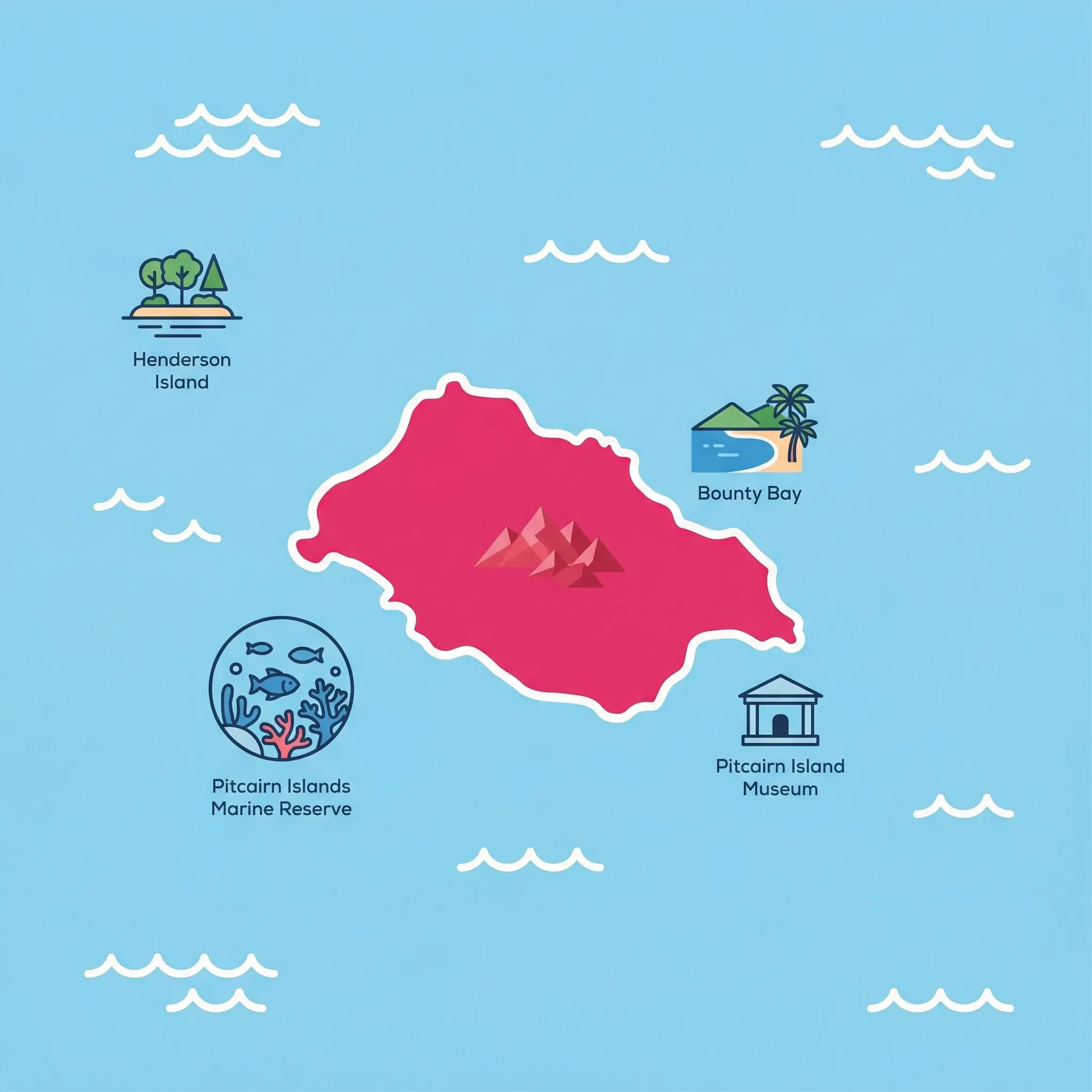
The Pitcairn Island Museum in Adamstown is the historical heart of the island. It houses the original Bounty Bible, maritime artifacts, and Polynesian stone tools found on the island, providing a tangible link to the dramatic mutiny story that children may have read about in books. A short walk away, the grave of John Adams offers a poignant history lesson about the mutineer who converted the community to Christianity.
For nature-loving families, the island is a playground of unique geology and wildlife. A boat trip to Henderson Island, a UNESCO World Heritage site nearby, reveals an untouched raised coral atoll teeming with endemic bird species and nesting sea turtles. Back on the main island, the Eco Trail leads to Christian's Cave, where the mutiny's leader would watch for approaching ships, while the stunning St. Paul's Pool offers a safe, crystal-clear tidal swimming hole separated from the crashing ocean waves by dramatic rock formations.
Practical Advice
Visiting Pitcairn requires careful planning. The only regular access is via the supply ship MV Silver Supporter, which runs on a specific schedule from Mangareva (French Polynesia). The sea journey takes approx. 32 hours and can be rough, so sea-sickness medication is essential. Medical evacuation insurance is mandatory for entry. There is no mobile phone network, but Starlink internet is now available in most homes. Power is 230V/50Hz with New Zealand/Australian style plugs.
Food & Drink
Typical meal times: Breakfast is usually 7:30 am to 8:30 am, lunch 12:00 pm to 1:00 pm, and dinner is a communal affair often served around 6:00 pm to 7:00 pm.
Typical meal costs: Most tourism is based on full-board homestays where meals are included. If purchasing separately, a casual meal might cost NZ$25–40 (approx. $15–25 USD / €14–23 EUR).
Dietary requirements: Options are limited due to isolation. Vegetarians can be catered for with fresh local produce, but specialized gluten-free or vegan products are rare; it is highly recommended to bring your own specialty snacks or supplements.
Family-friendly dining: Dining is almost exclusively within homestays, which are inherently family-friendly. Children will eat what the host family eats, often at a shared table, offering a warm, social experience.
Signature dishes:
- Fresh Wahoo or Tuna – Caught locally by the islanders and often served fried or baked within hours of leaving the ocean.
- Pitcairn Honey – Renowned worldwide for its purity and rich flavor, produced by disease-free bees in the island's pristine environment.
- Breadfruit Chips – Thinly sliced and fried breadfruit, a staple Polynesian side dish that serves as a delicious alternative to potato crisps.
- Humpback Squash – A local pumpkin variety often roasted or made into soups, sweet and popular with children.
- Pot Luck Dinner – Not a single dish, but a Friday night tradition where the entire community gathers to share dishes; a must-do cultural experience.
Family Travel Notice
For visits exceeding 14 days with children under 15, parents must obtain specific immigration clearance from the Pitcairn Island Office before departure.

While daily costs on the island are moderate, the logistics make this a high-cost destination. A mandatory shipping berth costs ~NZ$6,000 (approx. $3,700 USD / €3,400 EUR) per person return. Once there, full-board homestays cost ~NZ$240–320 (approx. $150–200 USD / €140–185 EUR) per person per day. Cash (NZD or USD) is essential for small purchases.
Age Suitability





Why this score?
The journey itself is a major expedition, requiring a two-day sea voyage from French Polynesia through often rough South Pacific waters. On the island, the terrain is characterized by steep volcanic cliffs, rugged dirt tracks navigable only by quad bikes, and the absence of any commercial tourist services. The extreme isolation and necessity of landing via longboat in Bounty Bay create a high-stakes adventure environment.
Why this score?
Medical facilities are limited to a single small health center in Adamstown staffed by a resident doctor and nurse capable of basic care only. There are no specialized facilities or surgical capabilities, and any serious emergency requires a multi-day sea evacuation to Mangareva followed by a flight to Tahiti. This makes the region high-risk for travelers with pre-existing conditions or those requiring urgent specialized intervention.
Why this score?
As one of the most remote inhabited places on Earth, Pitcairn receives fewer than 1,000 visitors annually, mostly via infrequent supply ships or expedition cruises. There is no airport, and the lack of traditional hotel infrastructure means visitors must rely on local homestays. It represents the extreme low end of global tourism volume, similar to remote Pacific atolls or uninhabited territories.
While daily living costs on the island are moderate, the cost of reaching Pitcairn is very high due to the complex logistics. A typical 3-night homestay package costs around $350–500 NZD (approx. $215–305 USD / €200–285 EUR) per person, often including meals and transfers. The return boat fare from Mangareva is roughly $5,000–6,000 NZD (approx. $3,050–3,650 USD / €2,850–3,400 EUR) per passenger.

Getting There & Around
Getting There
- By Sea – The only regular access is aboard the MV Silver Supporter, a freighter/passenger vessel. It departs from Mangareva (Gambier Islands, French Polynesia) on Tuesdays and returns on Sundays. The voyage takes approximately 32 hours each way.
- By Air – There is no airstrip on Pitcairn. You must fly to Tahiti (PPT), then take a domestic Air Tahiti flight to Mangareva (GMR) on a Tuesday to connect with the ship.
- Entry Requirements – Visitors staying under 14 days generally do not need a visa but must pay a landing fee (approx. $50 USD) and show proof of return passage. Mandatory medical evacuation insurance is strictly enforced. Check your government website for the latest visa requirements, or use the IATA Travel Centre entry-requirements checker.
Getting Around
- Walking – The primary way to explore Adamstown. The island is steep and hilly, so a reasonable level of fitness is required even for short distances.
- Quad Bikes – The main form of motorized transport. Locals drive these everywhere; visitors cannot rent them to drive self-guided but can arrange transport or tours with their hosts. Riding on the back of a host's quad bike is a highlight for older children.
- Longboat – Used to transfer from the supply ship to the jetty at Bounty Bay, and for excursions around the coast or to other islands in the Pitcairn Islands group.

Packing List
The 32-hour ocean voyage from Mangareva is frequently rough; essential even for those with 'sea legs'.
Internet is via Starlink but bandwidth can be shared/limited; bring movies for the long boat ride and evenings.
Essential for swimming at St. Paul's Pool or landing at beaches where rocks are sharp and slippery.
Credit cards are rarely accepted outside the Treasury; bring small notes for crafts, honey, and donations.
Waste water systems are sensitive on this remote island; eco-friendly soaps help protect the pristine environment.

Activities & Best Times

Adventure & Nature
Very GoodHiking, wildlife, outdoor exploration, ecotourism
Home to the pristine UNESCO-listed Henderson Island and one of the world's largest Marine Protected Areas, this region offers unparalleled wilderness immersion for experienced travelers. Peak season provides the best sea conditions for essential boat transfers between islands while avoiding the heaviest tropical downpours.

City & Cultural
GoodUrban tourism, museums, historical sites, architecture
Adamstown has unique Bounty mutineer history, but with only 50 residents and minimal cultural infrastructure (no museums, galleries, or cultural venues of scale), 'very_good' is internationally miscalibrated. 'Good' reflects the unique historical interest without overstating the cultural infrastructure.

Beach & Sea
MarginalBeach resorts, marine activities: diving, snorkelling, kite surfing, wind surfing, sailing
St. Paul's Pool offers a unique volcanic swimming experience, but the lack of traditional sandy beaches and the region's extreme isolation limits general appeal to beach-focused travelers. Peak months avoid the coolest water temperatures and the height of the summer rainy season.

Sports & Active
MarginalSport tourism, fitness activities, active recreation
While hiking trails exist (Trail of Tears, Christian's Cave), the limited infrastructure, extreme remoteness, and lack of organized sports facilities make 'good' too generous. 'Marginal' better reflects the reality that active pursuits are possible but limited.

Attractions (5 total)



Public Holidays & Calendar Next 12 months
Public holidays, festivals, cultural celebrations, and seasonal natural phenomena coming up in Pitcairn Islands over the next 12 months.
Loading holidays and events...

Travel Advisory
The country is considered exceptionally safe with no significant security threats. Standard travel common sense is sufficient.
Safety Topics
Traveller Advice (4 groups)

Visitors must arrange homestay accommodation in advance as there are no hotels. Independent travel is only possible via the supply ship Silver Supporter.

Same-sex marriage is legally recognized on the island since 2015, and the community is generally welcoming.

For visits exceeding 14 days with children under 15, parents must obtain specific immigration clearance from the Pitcairn Island Office before departure.

Hiking trails can be steep, narrow, and slippery. It is strongly recommended to hire an islander guide when visiting remote sites like Christian's Cave or Down Rope.
Agency Summaries
New Zealand maintains a low risk assessment for the islands. Because the islands use New Zealand currency and rely on NZ for supplies, the guidance focuses on logistical preparedness and medical self-sufficiency.
Ireland advises its citizens to follow standard safety measures. The islands are remote with very few residents, and consular assistance is provided via the Irish Embassy in New Zealand.
Australia classifies the islands as low-risk. Travelers are encouraged to prepare for the remote environment and ensure they have comprehensive insurance that includes medical evacuation.
The Pitcairn Islands are considered safe for visitors, but travelers are advised to maintain standard safety awareness. Due to the extreme isolation, resources and help are limited.
As a British Overseas Territory, the UK provides baseline safety guidance. Visitors are supported by the local government, as there is no British Embassy. The island is generally very safe with minimal crime.
This is the lowest advisory level. Travelers should follow standard safety protocols and be aware that the U.S. government has limited capacity to provide emergency services on the island.
Information is provided for general guidance only and does not constitute travel, safety, medical, or legal advice. Conditions may change. Users are responsible for independently verifying information before travel.