
Overview
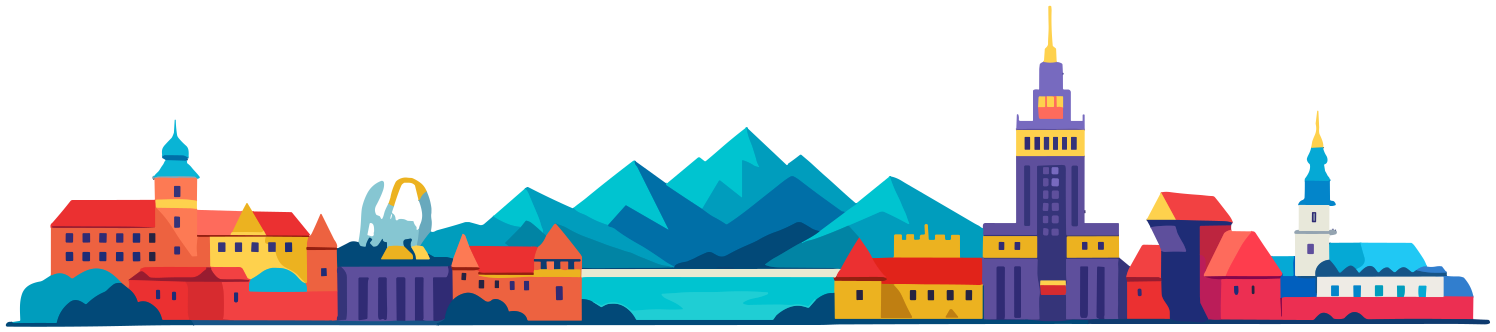
Poland is arguably Central Europe’s most underrated family destination, offering a safe, welcoming, and vibrant environment that feels both exotic and reassuringly modern. Geographically, the country is a massive playground: the north is lined with soft sandy beaches along the Baltic Sea, the center is dotted with thousands of lakes and deep forests, and the south rises into the dramatic Carpathian mountains. For families, this diversity means you can combine a city break in historic Kraków & Małopolska with relaxation by the water or hiking in the highlands, all within a manageable distance.
Culturally, Poland places huge importance on family life. Children are welcomed everywhere, from high-end restaurants to museums, and the country’s infrastructure has modernized rapidly. You will find interactive science centers, sprawling parks, and immaculate playgrounds in almost every town. The atmosphere is relaxed and unhurried, with a distinct appreciation for good food and outdoor leisure. Whether you are exploring the medieval streets of Warsaw or sailing in Masuria, the vibe is authentically warm, making it easy for parents to relax while kids explore.
Key Attractions
Poland’s attractions are world-class and surprisingly diverse. In the south, Kraków Old Town is a living storybook where children can discover the legend of the Wawel Dragon and explore the vast Cloth Hall. Just a short drive away lies Energylandia, the country's premier amusement park, boasting record-breaking rollercoasters and extensive zones for younger children. For a change of pace, families can take a traditional wooden raft down the stunning Dunajec River Gorge, drifting past limestone cliffs in a peaceful yet thrilling nature experience.
In the capital, the Copernicus Science Centre stands out as one of Europe’s best interactive museums, allowing kids to conduct their own experiments. heading west to Wrocław & Lower Silesia, the Afrykarium is an absolute must-a unique oceanarium dedicated solely to the flora and fauna of Africa, featuring underwater tunnels teeming with sharks and manatees. Nature lovers should head east to Podlasie to visit the European Bison Show Reserve, where you can safely observe the continent’s heaviest land animals in their natural habitat.
On the coast, the Gdańsk & Baltic Coast region offers the expansive Gdańsk Zoo, located in a beautiful valley, and the hands-on Experyment Science Centre in Gdynia. If you are venturing into the mountains, the funicular ride up Gubałówka Hill in Zakopane provides accessible, breathtaking panoramas of the High Tatras without the need for strenuous hiking, making it perfect for little legs.
Practical Advice
The best time to visit is from May to September when the weather is warm and outdoor attractions are fully open. Poland is part of the Schengen Area, making entry easy for many travelers. Healthcare is excellent, with well-stocked pharmacies (look for Apteka) everywhere. Tap water is generally safe to drink, though many locals still prefer bottled. Public toilets often require a small fee or a coin to enter, so keep some change handy.
Food & Drink
Typical meal times: Lunch (often called obiad, the main meal of the day) is typically served from 1:00 pm to 4:00 pm. Dinner (kolacja) is often a lighter affair eaten between 7:00 pm and 9:00 pm, though restaurants serve full meals throughout the evening.
Typical meal costs: Main courses in mid-range restaurants usually cost 40–70 PLN (approx. $10–18 USD / €9–16 EUR). A full family dinner can range from 160–250 PLN (approx. $40–65 USD / €37–58 EUR).
Dietary requirements: Poland is surprisingly vegetarian-friendly, with Warsaw often ranked among the top vegan-friendly cities in the world. Most restaurants label allergens clearly. Gluten-free options are available in cities but may be harder to find in traditional rural inns (karczma).
Family-friendly dining: Polish dining is very casual. Highchairs are standard, and many restaurants offer a "kids' corner" (kącik dla dzieci) with toys. Children’s menus usually feature chicken soup or sweet pancakes.
Signature dishes:
- Pierogi – Dumplings filled with everything from meat or cheese/potato (Ruskie) to sweet strawberries. The ultimate kid-pleaser.
- Rosół – A clear, rich chicken noodle soup served on Sundays and found on every kids' menu.
- Placki ziemniaczane – Crispy fried potato pancakes, often served with sour cream or mushroom sauce.
- Zapiekanka – A toasted open-face baguette topped with mushrooms and cheese, a popular and cheap street food snack.
- Kotlet schabowy – A breaded pork cutlet similar to schnitzel, usually served with mashed potatoes.

Poland offers excellent value for families. A family of four can travel comfortably for 600–900 PLN (approx. $150–225 USD / €140–210 EUR) per day, covering mid-range lodging, dining out, and attractions. Public transport is cheap, and grocery prices are significantly lower than in Western Europe.
Age Suitability

Did you know? Poland welcomes approximately 19.7 million international visitors per year. Most visitors come from Europe.
Explore Regions
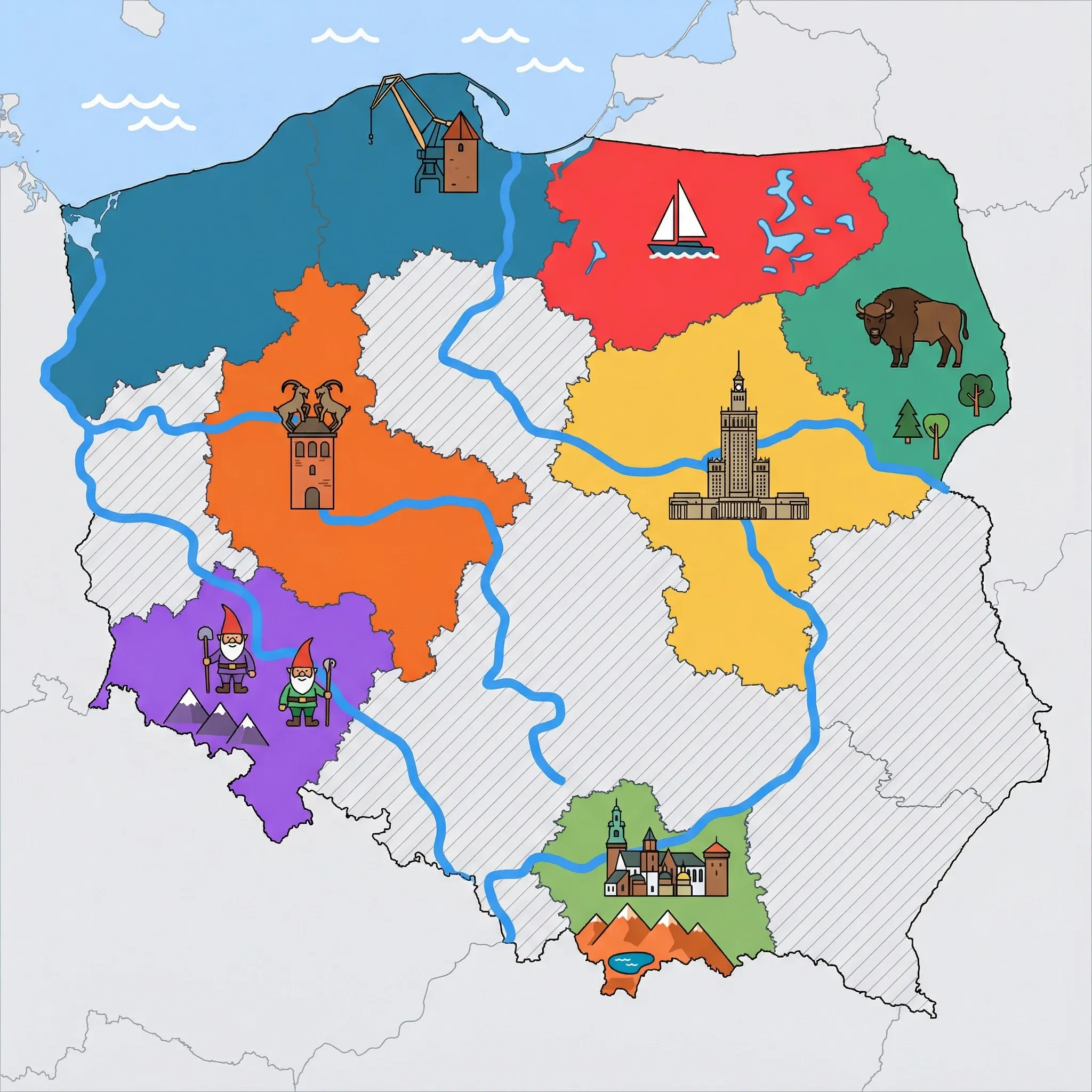
8 Regions
Gdańsk & Baltic Coast (Tricity, Sopot)
Amber beaches and Hanseatic history 🌊⚓️
Kraków & Małopolska
Dragon legends and royal history 🏰🐉
Masuria (Lakes)
Sailing, nature, and a thousand lakes ⛵️🌲
Podlasie (Białowieża Forest)
Home of the bison and wild forests 🦬🌳
Poznań & Greater Poland
Croissants, goats, and the birth of Poland 🥐🐐
Tatra Mountains (Zakopane)
Alpine peaks and thermal waters ⛰️🛀
Warsaw
Resilient history and modern science 🧜♀️🏙️
Wrocław & Lower Silesia
City of 100 bridges and hidden gnomes 🌉🧙♂️
Click on a region marker to explore details. Use the dropdown to color regions by activity suitability.

Getting There & Around
Getting There
- By Air – Warsaw Chopin (WAW) is the main hub, with direct connections worldwide. Regional airports like Kraków (KRK) and Gdańsk (GDN) are well-served by budget airlines (Ryanair, Wizz Air) and serve Kraków & Małopolska and the coast respectively.
- By Train – Reliable rail connections exist from Berlin, Vienna, and Prague. The Berlin-Warsaw Express takes under 6 hours. Night trains are available from Budapest and Vienna.
- Entry Requirements – Poland is in the Schengen Area. US, UK, and Canadian citizens do not need a visa for stays up to 90 days. Check your government website for the latest visa requirements, or use the IATA Travel Centre entry-requirements checker.
Getting Around
- Trains – The PKP Intercity network is the best way to travel between major cities like Warsaw and Kraków. Pendolino (EIP) trains are fast and modern. Look for "Bilet Rodzinny" (Family Ticket) for discounts of around 30% for groups with children.
- City Transport – Major cities have excellent tram and bus systems. Tickets are cheap and time-based (e.g., 20-minute or 75-minute). In many cities, children travel free until they start primary school (approx. age 7), but rules vary locally.
- Car Hire – Recommended if you plan to explore the Masuria lake district or smaller towns in Wrocław & Lower Silesia. Roads have improved massively, but watch for speed cameras.

Packing List
Forests and parks in Poland have a high tick prevalence; checking kids after hikes is essential.
It is customary to remove shoes when entering Polish homes; some hosts provide guest slippers.
Foreign school IDs are often rejected; an international ISIC card is needed for student transport discounts.
Public toilets in parks or stations often use coin-operated turnstiles and may not take cards.
Summer weather is changeable with sudden showers common, especially in the mountains.
Essential if visiting the Masurian Lake District or forests where bugs can be intense in summer.

Activities & Best Times

Adventure & Nature
ExcellentHiking, wildlife, outdoor exploration, ecotourism
Features the Tatra and Pieniny National Parks, offering world-class mountain trekking and scenic river rafting. High-altitude trails and the Pieniny gorge are best experienced from late spring through early autumn.
Home to the Białowieża Primeval Forest, a UNESCO World Heritage site and the last temperate primeval forest in Europe, featuring wild bison and unique biodiversity. Peak season offers optimal conditions for wildlife viewing and forest trekking, while spring and autumn provide excellent birding and foliage transitions.
Features the stunning Great Masurian Lakes District and primeval forests, offering high-quality wildlife encounters and water-based immersion. Peak summer provides the best conditions for exploring the vast lake systems and nature reserves, while shoulder months are ideal for birdwatching.

City & Cultural
ExcellentUrban tourism, museums, historical sites, architecture
Gdańsk’s meticulously restored Hanseatic Old Town and Sopot’s Belle Époque charm offer a sophisticated atmosphere for well-travelled families. The city is vibrant from May to September and during the festive Christmas market in December.
Kraków is a world-class cultural hub with UNESCO-listed medieval architecture and significant art collections like the Czartoryski Museum. Peak periods align with optimal walking weather and the festive Christmas atmosphere.
A world-class blend of meticulously reconstructed UNESCO heritage and a vibrant modern culinary scene, offering profound historical depth for discerning families. Peak visitation aligns with pleasant walking weather in late spring and early autumn, plus the festive Christmas season in December.

Sports & Active
Very GoodSport tourism, fitness activities, active recreation
A premier destination for inland sailing and long-distance cycling, featuring the extensive Masurian Cycle Loop and Green Velo infrastructure. Facilities are world-class for active families, though the season is strictly limited by the central European climate.
Boasts high-quality cycling infrastructure like the EuroVelo 10 and exceptional windsurfing conditions on the Puck Bay. Activity peaks during the warmer, windier months from May to September.
Features high-quality infrastructure like the Velo Dunajec cycling route and the Trail of the Eagles' Nests. These active routes are best utilized when the weather is stable and mild in late spring or early autumn.
Theme Park & Entertainment
Very GoodAmusement parks, family entertainment venues
Energylandia is one of Central Europe's largest theme parks with world-class roller coasters and infrastructure. It attracts international visitors specifically for this attraction. A single destination-level facility of this caliber warrants 'very_good' rating.
Boasts high-quality regional water parks like Aquasfera and thematic attractions like Mazurolandia that cater well to families. While excellent for the region, they lack the massive scale of top-tier global theme parks, making them solid secondary draws during summer.
Primarily coastal amusement parks and high-quality indoor aquaparks like Reda that cater well to children. Outdoor venues are strictly seasonal, peaking in summer, while aquaparks provide year-round alternatives.

Relaxation & Wellness
Very GoodSpa retreats, wellness centers, peaceful getaways
The classification notes describe 'world-class thermal bath complexes in the Podhale highlands' (Chochołowskie, Bukovina). If the facilities are genuinely world-class as stated, this should be 'very_good' rather than 'good'.
Sopot's historic spa tradition and the Balneological Institute represent established wellness infrastructure that exceeds 'marginal'. The region has a documented spa heritage dating to the 19th century and modern facilities. This aligns with other Polish regions offering dedicated thermal complexes rated 'good'.
The region features established historic spa towns and modern thermal complexes like Termy Cieplickie. Summer and early autumn provide the most pleasant environment for combining restorative wellness treatments with fresh mountain air.

Educational & Exploratory
GoodLearning experiences, scientific sites, historical education
Home to state-of-the-art science centers and maritime museums that offer deep engagement with history and technology. These facilities are high-quality and largely indoor, making them viable across most of the year.
Provides destination-level educational sites including the Wieliczka Salt Mine and the Polish Aviation Museum. Conditions are best in the shoulder and late peak months to avoid extreme temperatures and peak summer crowds.
The Copernicus Science Centre is a premier international discovery hub that serves as a primary motivator for educational family travel. While accessible year-round, peak interest coincides with the main summer tourism and school trip seasons.

Road Trips & Scenic
GoodScenic drives, countryside tours, route-based travel
The Gothic Castles Trail and the Great Masurian Lakes Scenic Loop provide well-structured routes through picturesque lakeside landscapes. Best driven in summer for visibility or October for the spectacular autumn foliage typical of the northeastern forests.
Highlighted by the unique drive along the narrow Hel Peninsula and the scenic routes of the Kashubian Switzerland interior. Driving conditions are best from May to September when the landscapes are lush and roads are clear of ice.
The Wooden Architecture Route and Oswald Balzer Road provide spectacular scenic driving through Carpathian landscapes and historic villages. Late spring and early autumn offer the best visibility and driving conditions.

Ski & Snow
GoodWinter sports, ski resorts, snow activities
Zakopane and Białka Tatrzańska offer solid winter sports infrastructure and authentic Goral culture. The season is most reliable in January and February, though modern snowmaking extends it into December and March.
Regional resorts like Zieleniec and Czarna Góra offer reliable snow and modern infrastructure for families. The season is relatively short, with peak conditions limited to mid-winter when the snow base is most consistent for international standards.
Traditional alpine culture with reliable snow and modern facilities at Kasprowy Wierch and Bialka Tatrzanska; the season is compact compared to the Alps but offers authentic charm.

Beach & Sea
GoodBeach resorts, marine activities: diving, snorkelling, kite surfing, wind surfing, sailing
Features the unique Hel Peninsula and Sopot's historic pier, though water temperatures remain brisk even in mid-summer. Peak season is limited to July and August when the Baltic is most swimmable and beach infrastructure is fully operational.
River-based beach culture along the Vistula offers unique urban recreation but lacks the marine biodiversity and resort scale of world-class coastal destinations. Peak summer months provide the only viable window for sunbathing and river recreation.
Limited to inland reservoir beaches like Siemianówka and Dojlidy; lacks international marine appeal but offers basic summer swimming. Season is strictly restricted to the warmest summer months when water temperatures are acceptable for family recreation.

Festivals & Seasonal
MarginalEvents, celebrations, seasonal attractions
Anchored by the centuries-old St. Dominic's Fair and the internationally renowned Open'er music festival. These major events occur in July and August, drawing significant international crowds and creating a high-energy atmosphere.
Hosts the internationally recognized Jewish Culture Festival and one of Central Europe's most authentic Christmas markets. These events offer unique seasonal windows into the city's rich multi-cultural history.
Hosts respected international events like the Chopin Music Festival and Warsaw Film Festival, drawing a discerning global audience. These events create specific peak windows, supplemented by atmospheric winter holiday lights.

Public Holidays & Calendar Next 12 months
Public holidays, festivals, cultural celebrations, and seasonal natural phenomena coming up in Poland over the next 12 months.
Loading holidays and events...
Climate & Weather
Gdańsk & Baltic Coast (Tricity, Sopot)
Show Details
| Month | Temp °C | Rain | Humidity |
|---|
Kraków & Małopolska
Show Details
| Month | Temp °C | Rain | Humidity |
|---|
Masuria (Lakes)
Show Details
| Month | Temp °C | Rain | Humidity |
|---|
Podlasie (Białowieża Forest)
Show Details
| Month | Temp °C | Rain | Humidity |
|---|
Poznań & Greater Poland
Show Details
| Month | Temp °C | Rain | Humidity |
|---|
Tatra Mountains (Zakopane)
Show Details
| Month | Temp °C | Rain | Humidity |
|---|

Travel Advisory
All major agencies maintain Poland at their lowest risk tier, recommending standard safety awareness without any country-wide elevated warnings.
Safety Topics
Traveller Advice (3 groups)

Dual citizens holding both Polish and another nationality must enter and exit the country using their Polish passport or national ID card. Failure to do so may result in travel delays or detention at the border.

While same-sex relations are legal, public displays of affection may attract negative attention or hostility in certain areas; travelers are encouraged to be discreet and aware of local attitudes.

Solo female travelers should avoid visiting bars or nightclubs alone and stick to well-lit, populated streets when walking at night.
Agency Summaries
Poland is considered a low-risk destination. Visitors are advised to follow routine safety measures, particularly in crowded tourist areas where petty crime occurs. Dual citizens must comply with specific entry and exit document requirements.
Standard precautions apply across the country. Travelers should be aware of new European Union entry/exit registration requirements and exercise caution when visiting districts adjacent to the borders with Russia, Belarus, and Ukraine.
The overall risk level is low. Travelers should remain alert to the potential for civil demonstrations in major cities and the broader moderate threat of terrorism affecting the European region.
Travelers should maintain standard safety awareness. Vigilance is specifically recommended in regions bordering Ukraine due to potential risks from stray debris or projectiles related to the ongoing conflict.
Irish citizens can travel freely for up to three months without a visa. The security environment is generally stable, though travelers are reminded that dual citizens must utilize Polish passports for border crossings.
No major travel restrictions are in place. However, authorities may restrict access to areas within 20km of the border with Ukraine without prior notice. British-Polish dual nationals should ensure they use correct documentation.
Information is provided for general guidance only and does not constitute travel, safety, medical, or legal advice. Conditions may change. Users are responsible for independently verifying information before travel.