
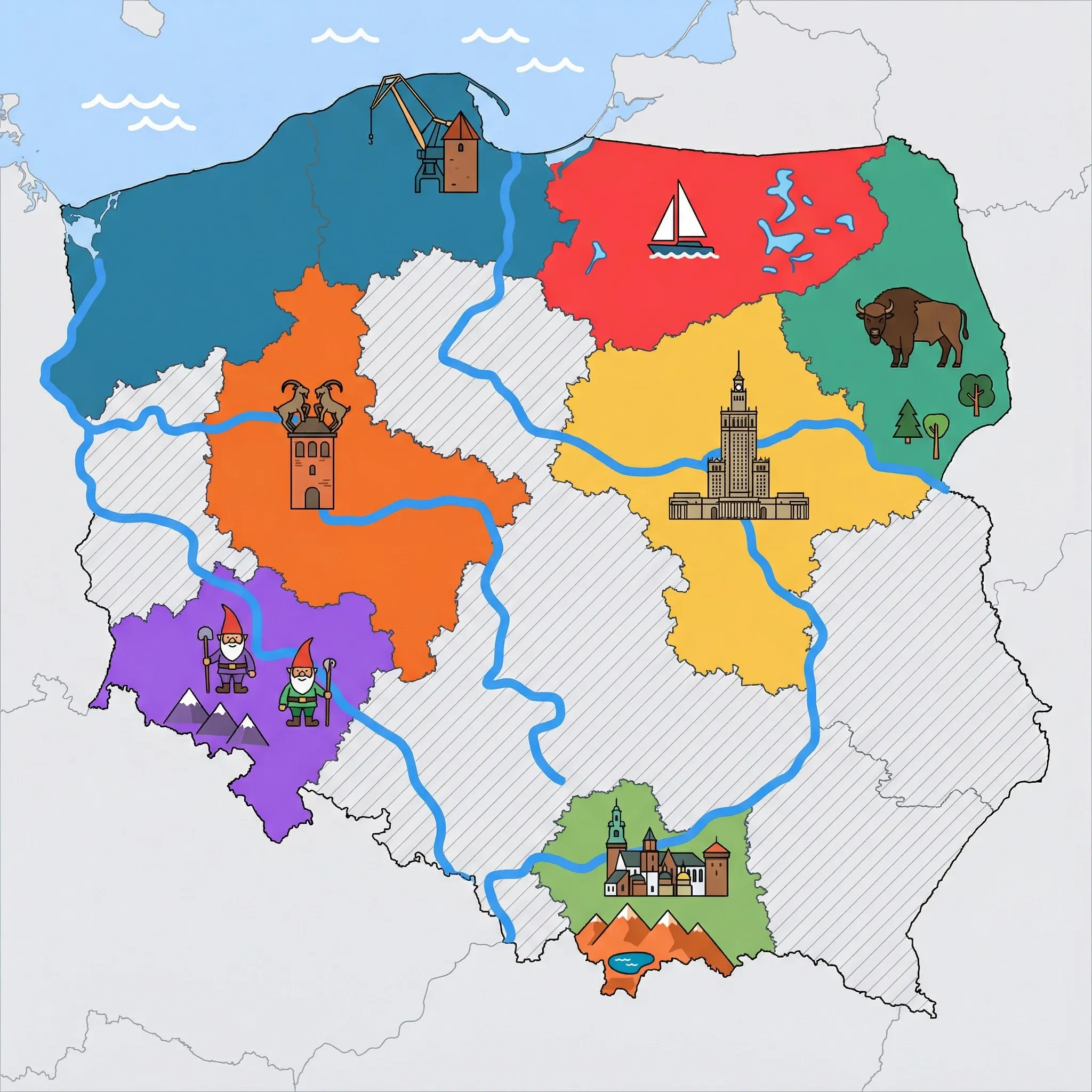
Click a region to explore
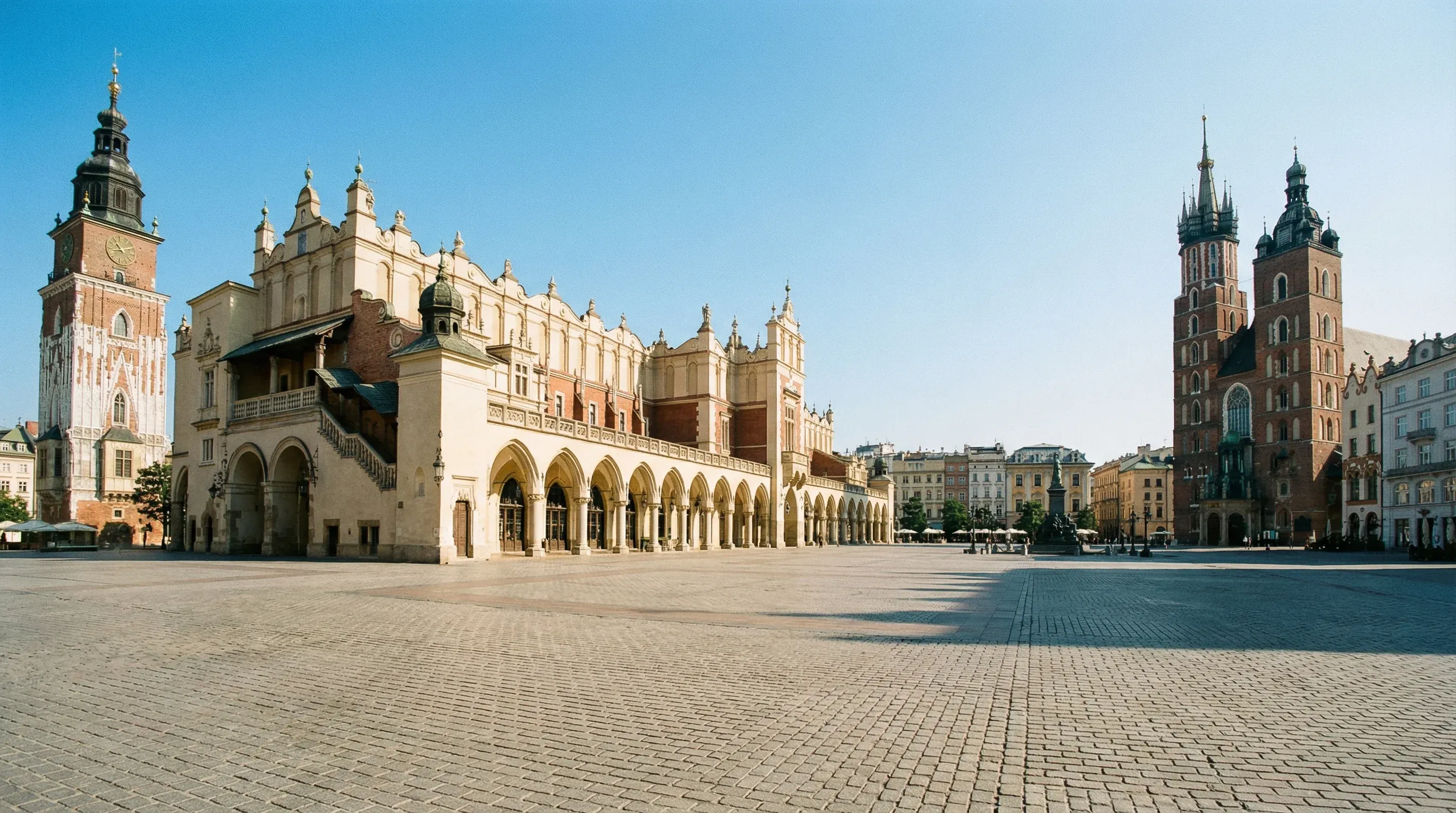
Kraków and the surrounding Małopolska (Lesser Poland) region feel like pages torn from a fairytale book, making it an instantly engaging destination for children. The city of Kraków, one of the few Polish cities to escape WWII destruction largely intact, centres around a magnificent market square where horse-drawn carriages clatter over cobblestones and a bugle call sounds from the tower every hour—abruptly stopping to commemorate a legendary trumpeter shot by a Tartar arrow. The atmosphere is thick with history, but it is accessible history; the legend of the Wawel Dragon, who lived in a cave beneath the castle, captivates even the youngest toddlers, especially when they see the metal dragon statue breathe real fire by the riverbank.
Beyond the city limits, the geography shifts dramatically. To the south, the landscape rises towards the mountains, offering valleys and streams, while nearby distinct regions like the Jura offer limestone rocks perfect for climbing. The region is compact enough that you can stay in Kraków and take easy day trips to world-class attractions. The culture here is deeply hospitable, with a slower pace than Warsaw. It is a place where folklore is alive; you might see locals in traditional dress during festivals, and the food is hearty and comforting, perfect for fuelling active families. Whether exploring underground salt cities or riding rollercoasters, Małopolska offers a density of attractions hard to match elsewhere in Europe.
Key Attractions
The beating heart of the region is the UNESCO-listed Kraków Old Town. Here, families can wander the cloth hall and chase pigeons in the massive square. A short tram ride away, Park Wodny Kraków offers a massive indoor water park experience with slides and splash zones perfect for rainy days. For a full day of adrenaline, Energylandia is a must-visit; it is a world-class theme park with zones for small children and extreme coasters for teenagers. Nature-loving families should head to Ojców National Park, a short drive away, featuring easy hiking trails through dramatic limestone canyons and caves that are manageable even for little legs.
Practical Advice
Kraków is a year-round destination, but spring (May-June) and early autumn (September-October) offer the most pleasant temperatures for walking. Winter brings severe smog at times, which can be an issue for asthmatic children.
Food & Drink
Typical meal times: Lunch is the main meal, eaten between 1:00 pm and 3:00 pm. Dinner is lighter and served from 7:00 pm onwards.
Typical meal costs: Expect to pay 40–70 PLN (approx. $10–18 USD / €9–16 EUR) for a main dish. Street food snacks are very cheap, around 10–20 PLN (approx. $2.50–5 USD / €2–4.50 EUR).
Dietary requirements: Kraków is incredibly vegan-friendly (often voted one of the best in Europe). You will find plant-based versions of traditional dishes easily.
Signature dishes:
- Obwarzanek Krakowski – A braided ring-shaped bread boiled and sprinkled with salt, poppy seeds, or sesame. Sold from blue carts everywhere; the perfect toddler snack.
- Zapiekanka – An open-faced toasted baguette topped with mushrooms and cheese, sold famously in the Jewish Quarter (Kazimierz).
- Maczanka po krakowsku – The "great-great-grandfather of the burger," a roll soaked in gravy filled with slow-roasted pork neck.
Why this score?
The region offers unique excursions like the underground Wieliczka Salt Mine and rafting in the Dunajec River Gorge. While the infrastructure is highly developed, these activities provide a distinct sense of discovery that exceeds a standard urban experience.
Why this score?
Kraków features world-class medical facilities, including specialized university hospitals and numerous private clinics catering to foreigners. The city is a hub for international-standard healthcare, ensuring that families have access to excellent emergency and routine services.
Why this score?
As Poland's top international draw, Kraków's Old Town and the nearby Auschwitz-Birkenau Museum attract millions of global visitors annually. It ranks alongside cities like Prague as a major European cultural destination, supported by a dense network of international flight connections and tourism services.

Kraków attracts millions of tourists, so prices in the Market Square are inflated. Walk two streets away for better value. A mid-range family hotel room costs 300–550 PLN (approx. $75–140 USD / €70–130 EUR). Museum tickets range from 20–50 PLN (approx. $5–12.50 USD / €4.50–11.50 EUR).

Getting Here & Around
Getting Here
- Airports – John Paul II Kraków-Balice International Airport (KRK) is well-connected and just a 20-minute train ride from the city centre.
- Train – Kraków Główny is a major rail hub. Intercity trains from Warsaw take about 2.5 hours.
- Driving – The A4 motorway connects Kraków to the west (Katowice, Wrocław) and east (Rzeszów).
Getting Around
- Walking – The Kraków Old Town and Kazimierz districts are best explored on foot, though cobblestones can be bumpy for lightweight strollers.
- Tram & Bus – extensive public transport network. Children under 4 travel free; older kids need reduced-fare tickets.
- Car – Not recommended within the city centre due to parking zones and traffic, but useful for visiting Ojców National Park.
Nearby Airports (1 airport)
Kraków John Paul II International Airport
KRKKrakow
View full flight map for Poland →
Official Links

Packing List
Old Town cobblestones are beautiful but brutal on flimsy umbrella stroller wheels.
If visiting in winter (Nov-Feb), smog levels can be high.
Valid International Student IDs unlock massive discounts at museums.
Forests and parks in Poland have a high tick prevalence; checking kids after hikes is essential.
It is customary to remove shoes when entering Polish homes; some hosts provide guest slippers.
Foreign school IDs are often rejected; an international ISIC card is needed for student transport discounts.
Public toilets in parks or stations often use coin-operated turnstiles and may not take cards.
Summer weather is changeable with sudden showers common, especially in the mountains.
Essential if visiting the Masurian Lake District or forests where bugs can be intense in summer.

Activities & Best Times

Hiking, wildlife, outdoor exploration, ecotourism
Features the Tatra and Pieniny National Parks, offering world-class mountain trekking and scenic river rafting. High-altitude trails and the Pieniny gorge are best experienced from late spring through early autumn.

Urban tourism, museums, historical sites, architecture
Kraków is a world-class cultural hub with UNESCO-listed medieval architecture and significant art collections like the Czartoryski Museum. Peak periods align with optimal walking weather and the festive Christmas atmosphere.

Spa retreats, wellness centers, peaceful getaways
The classification notes describe 'world-class thermal bath complexes in the Podhale highlands' (Chochołowskie, Bukovina). If the facilities are genuinely world-class as stated, this should be 'very_good' rather than 'good'.

Sport tourism, fitness activities, active recreation
Features high-quality infrastructure like the Velo Dunajec cycling route and the Trail of the Eagles' Nests. These active routes are best utilized when the weather is stable and mild in late spring or early autumn.
Amusement parks, family entertainment venues
Energylandia is one of Central Europe's largest theme parks with world-class roller coasters and infrastructure. It attracts international visitors specifically for this attraction. A single destination-level facility of this caliber warrants 'very_good' rating.

Learning experiences, scientific sites, historical education
Provides destination-level educational sites including the Wieliczka Salt Mine and the Polish Aviation Museum. Conditions are best in the shoulder and late peak months to avoid extreme temperatures and peak summer crowds.

Scenic drives, countryside tours, route-based travel
The Wooden Architecture Route and Oswald Balzer Road provide spectacular scenic driving through Carpathian landscapes and historic villages. Late spring and early autumn offer the best visibility and driving conditions.

Winter sports, ski resorts, snow activities
Zakopane and Białka Tatrzańska offer solid winter sports infrastructure and authentic Goral culture. The season is most reliable in January and February, though modern snowmaking extends it into December and March.

Events, celebrations, seasonal attractions
Hosts the internationally recognized Jewish Culture Festival and one of Central Europe's most authentic Christmas markets. These events offer unique seasonal windows into the city's rich multi-cultural history.

Attractions (35 total)



Public Holidays & Calendar Next 12 months
Public holidays, festivals, cultural celebrations, and seasonal natural phenomena coming up in Kraków & Małopolska over the next 12 months.
Loading holidays and events...

Travel Advisory
All major agencies maintain Poland at their lowest risk tier, recommending standard safety awareness without any country-wide elevated warnings.
Safety Topics
Traveller Advice (3 groups)

Dual citizens holding both Polish and another nationality must enter and exit the country using their Polish passport or national ID card. Failure to do so may result in travel delays or detention at the border.

While same-sex relations are legal, public displays of affection may attract negative attention or hostility in certain areas; travelers are encouraged to be discreet and aware of local attitudes.

Solo female travelers should avoid visiting bars or nightclubs alone and stick to well-lit, populated streets when walking at night.
Agency Summaries
Poland is considered a low-risk destination. Visitors are advised to follow routine safety measures, particularly in crowded tourist areas where petty crime occurs. Dual citizens must comply with specific entry and exit document requirements.
Standard precautions apply across the country. Travelers should be aware of new European Union entry/exit registration requirements and exercise caution when visiting districts adjacent to the borders with Russia, Belarus, and Ukraine.
The overall risk level is low. Travelers should remain alert to the potential for civil demonstrations in major cities and the broader moderate threat of terrorism affecting the European region.
Travelers should maintain standard safety awareness. Vigilance is specifically recommended in regions bordering Ukraine due to potential risks from stray debris or projectiles related to the ongoing conflict.
Irish citizens can travel freely for up to three months without a visa. The security environment is generally stable, though travelers are reminded that dual citizens must utilize Polish passports for border crossings.
No major travel restrictions are in place. However, authorities may restrict access to areas within 20km of the border with Ukraine without prior notice. British-Polish dual nationals should ensure they use correct documentation.
Information is provided for general guidance only and does not constitute travel, safety, medical, or legal advice. Conditions may change. Users are responsible for independently verifying information before travel.