
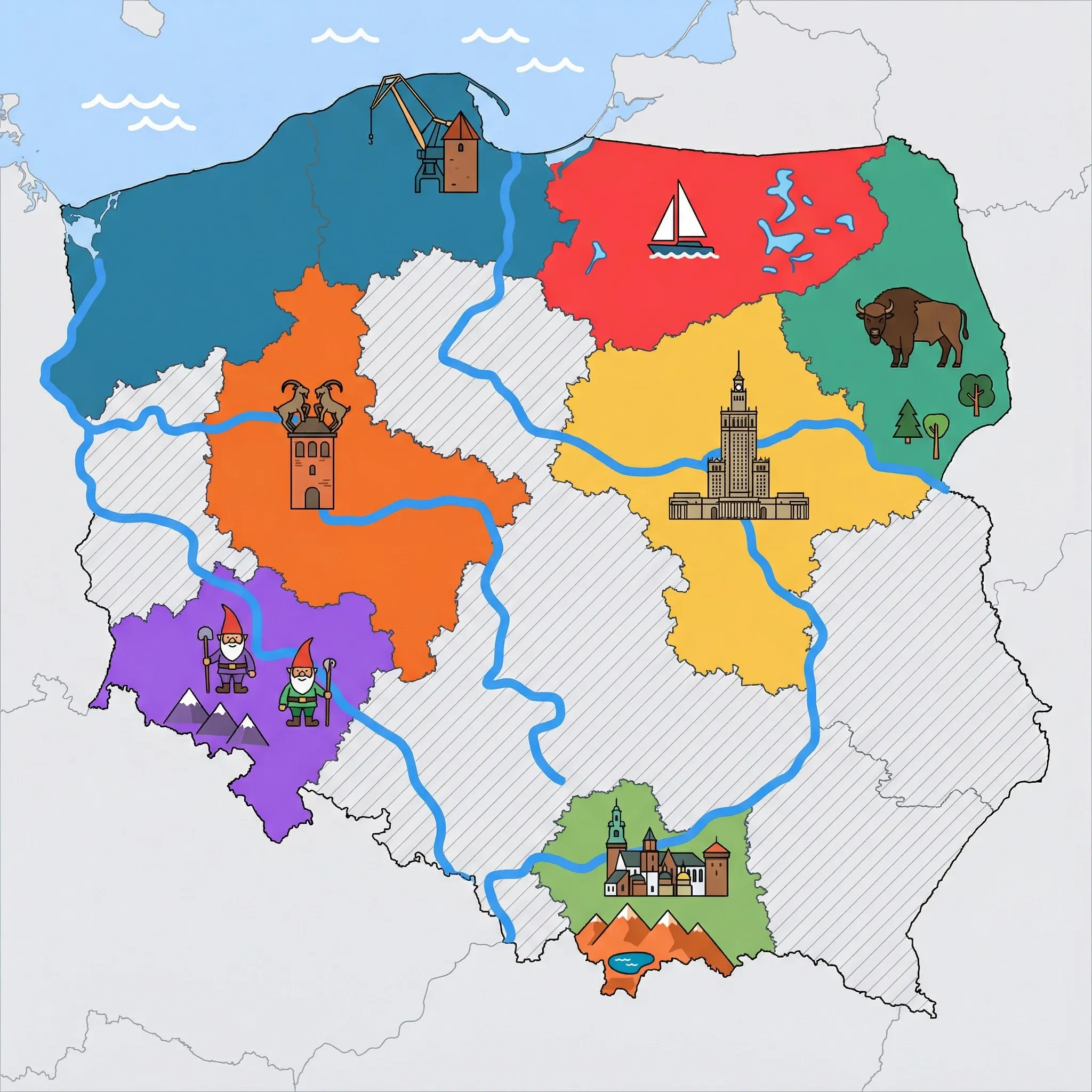
Click a region to explore
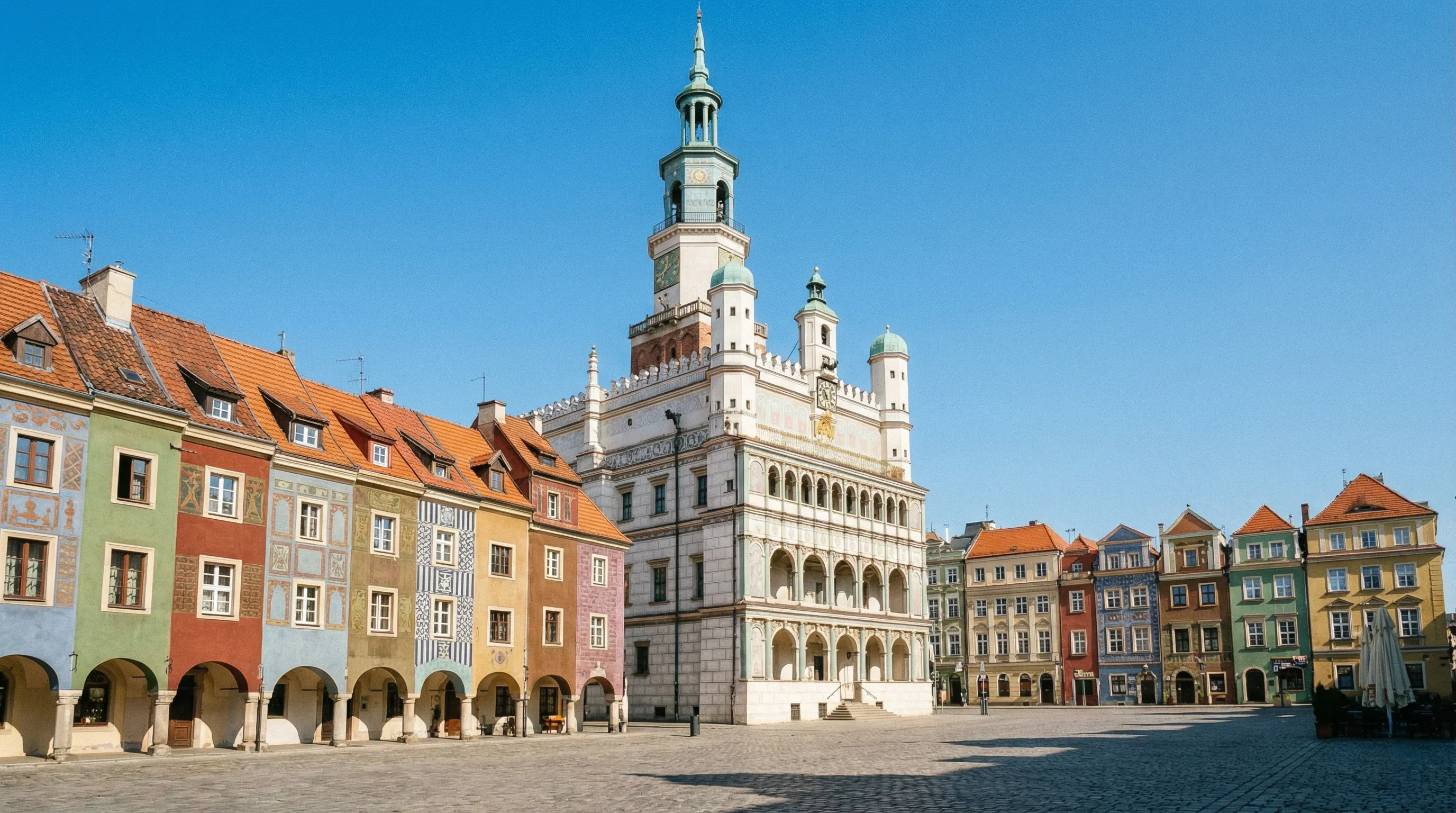
Greater Poland (Wielkopolska) is where Poland began over a thousand years ago, but for families today, it is a region of colourful energy, lakes, and delicious pastries. The capital, Poznań, is a vibrant city that is incredibly friendly to children. The centrepiece is the Renaissance Town Hall, where every day at noon, crowds gather to watch two mechanical billy goats emerge from the clock tower to butt heads—a quirky tradition that delights toddlers and adults alike. Poznań is known for its "orderliness" and excellent infrastructure, making it an easy city to navigate with strollers.
Surrounding the city are lush green belts and lakes. Lake Malta, located right in the city, is a recreation hub with a regatta course, an artificial ski slope, and a miniature railway that takes you straight to the zoo. It’s a perfect example of how the region blends urban living with outdoor fun. Further afield, the region is dotted with steam railways and open-air museums that bring the past to life. History here isn't dusty; it's about walking through reconstructed Iron Age settlements or climbing inside windmills. The terrain is flat, making it ideal for family cycling trips along the Warta River.
Key Attractions
In Poznań, start at the Poznań Old Market Square for the goat show. Then, head to Lake Malta to ride the "Maltanka" miniature railway which chugs along the lakeshore to the Nowe Zoo (New Zoo), a massive forested facility known for its elephant house and bear sanctuary. For a deep dive into history, the Brama Poznania ICHOT is a cutting-edge interactive heritage centre that tells the story of Cathedral Island in a way that engages kids with lights and sounds. Outside the city, the Biskupin Archaeological Museum is a life-size reconstruction of a prehistoric fortified settlement where children can try archery and ancient crafts.
Practical Advice
Poznań is a major trade fair city. Check the calendar for the Poznań International Fair—hotel prices skyrocket during major events. Avoid these dates if you want to save money.
Food & Drink
Typical meal times: Standard Central European hours. Lunch 12:00 pm – 3:00 pm, Dinner 6:00 pm – 9:00 pm.
Typical meal costs: Mid-range. Main dish 35–60 PLN (approx. $9–15 USD / €8–14 EUR). A St. Martin's Croissant costs about 15–25 PLN (approx. $3.75–6.25 USD / €3.50–5.80 EUR).
Dietary requirements: Poznań is very modern with plenty of vegetarian/vegan cafes. Traditional cuisine is potato and dairy heavy.
Signature dishes:
- Rogal Świętomarciński (St. Martin's Croissant) – A dense, sweet horseshoe-shaped pastry filled with white poppy seeds, nuts, and dried fruit. A protected regional product and an absolute must-eat.
- Pyry z Gzikiem – Roasted potatoes (pyry) served with a spiced cottage cheese and cream mixture (gzik). Simple, cheap, and delicious.
- Kaczka po poznańsku – Roast duck served with steam-baked dumplings and red cabbage.
Why this score?
The region is characterized by developed agricultural plains and gentle lake districts, offering low-intensity outdoor activities like cycling and lake swimming. It lacks rugged terrain or remote wilderness, making it a very comfortable but low-adventure destination.
Why this score?
Poznań is one of Poland's most important medical and academic centers, with top-tier university hospitals and private clinics. International visitors can expect high-quality care with a high prevalence of English-speaking doctors and modern diagnostic equipment.
Why this score?
Poznań is a significant business and trade fair hub that attracts a steady stream of international visitors, though leisure tourism is secondary. It is well-regarded for its historic center but typically sits on the second tier of Polish destinations for foreign vacationers.

Poznań is generally cheaper than Warsaw or Kraków. A weekend family trip is very affordable. Family hotel rooms are 250–450 PLN (approx. $63–113 USD / €58–105 EUR). Eating out, especially the potato-based dishes, offers great value.

Getting Here & Around
Getting Here
- Airports – Poznań-Ławica Airport (POZ) is close to the city centre.
- Train – Located on the main Berlin-Warsaw line. Berlin is just 2.5 hours away; Warsaw is 3 hours.
- Driving – The A2 motorway runs directly through the region, connecting it to Germany and Warsaw.
Getting Around
- Tram – Poznań has an excellent tram system. The "PEKA" card system handles fares.
- Bike – Very flat region with good cycling paths, especially around the lakes.
- Car – Good for visiting Gniezno or Biskupin, but not needed within Poznań itself.
Nearby Airports (2 airports)
Bydgoszcz Ignacy Jan Paderewski Airport
BZGBydgoszcz
Lawica
POZPoznan
View full flight map for Poland →
Official Links

Packing List
If visiting the Croissant Museum (interactive shows), it can get very loud.
The banks of Lake Malta and the Warta River are perfect for family picnics.
With steam trains (Wolsztyn) and Maltanka, kids who love trains will be in heaven.
Forests and parks in Poland have a high tick prevalence; checking kids after hikes is essential.
It is customary to remove shoes when entering Polish homes; some hosts provide guest slippers.
Foreign school IDs are often rejected; an international ISIC card is needed for student transport discounts.
Public toilets in parks or stations often use coin-operated turnstiles and may not take cards.
Summer weather is changeable with sudden showers common, especially in the mountains.
Essential if visiting the Masurian Lake District or forests where bugs can be intense in summer.

Activities & Best Times

Hiking, wildlife, outdoor exploration, ecotourism
Extensive lake districts and exceptionally preserved ethnographic parks like the Greater Poland Ethnographic Park offer authentic rural immersion. The warm summer window provides the best conditions for exploring the region's diverse parklands and nature reserves.

Urban tourism, museums, historical sites, architecture
As the cradle of the Polish state, Poznań and Gniezno offer exceptional historical depth and world-class palaces like Kórnik and Rogalin. Peak months align with the best walking weather in spring and autumn, plus the atmospheric December Christmas markets.

Sport tourism, fitness activities, active recreation
The region offers high-quality sports infrastructure, including the Warta Bike Trail and the unique year-round Malta Ski dry slope. The transitional months of spring and late summer provide optimal temperatures for long-distance cycling and organized activities.

Learning experiences, scientific sites, historical education
The region features world-class museums like the Brama Poznania and the Enigma Cipher Centre, providing sophisticated purpose-built learning experiences. These are best visited during the city's more temperate months to facilitate travel between urban heritage sites.

Spa retreats, wellness centers, peaceful getaways
Dedicated thermal bath complexes in Poznań and Tarnowo Podgórne offer high-standard wellness facilities that are particularly appealing as winter retreats. Summer months are considered the off-season for thermal tourism due to higher outdoor temperatures.

Scenic drives, countryside tours, route-based travel
The Piast Trail and the Palace Route provide well-defined, culturally rich driving itineraries through Poland's historic heartland. Driving conditions are most reliable and scenery is most vibrant from May through September, excluding the peak summer heat.

Amusement parks, family entertainment venues
Termy Maltańskie is a major aquatic attraction that meets international standards for family entertainment. Peak season is driven by summer school holidays when both indoor and outdoor facilities are most enjoyable.
Beach resorts, marine activities: diving, snorkelling, kite surfing, wind surfing, sailing
Freshwater lake beaches like Powidz and Skorzęcin offer a domestic alternative to sea resorts with sandy shores and clean waters. The season is strictly limited to the height of summer when water temperatures are suitable for swimming.

Events, celebrations, seasonal attractions
The region hosts the significant Malta Festival in June and the Poznań Ice Festival in December, providing unique seasonal highlights for travelers. Visitation is concentrated specifically around these world-class cultural and event dates.

Winter sports, ski resorts, snow activities
Small-scale local hills like Chodzież offer basic winter sports infrastructure for regional visitors. While charming, they lack the elevation and reliability required for experienced international ski tourists beyond the peak winter freeze.

Attractions (29 total)



Public Holidays & Calendar Next 12 months
Public holidays, festivals, cultural celebrations, and seasonal natural phenomena coming up in Poznań & Greater Poland over the next 12 months.
Loading holidays and events...

Travel Advisory
All major agencies maintain Poland at their lowest risk tier, recommending standard safety awareness without any country-wide elevated warnings.
Safety Topics
Traveller Advice (3 groups)

Dual citizens holding both Polish and another nationality must enter and exit the country using their Polish passport or national ID card. Failure to do so may result in travel delays or detention at the border.

While same-sex relations are legal, public displays of affection may attract negative attention or hostility in certain areas; travelers are encouraged to be discreet and aware of local attitudes.

Solo female travelers should avoid visiting bars or nightclubs alone and stick to well-lit, populated streets when walking at night.
Agency Summaries
Poland is considered a low-risk destination. Visitors are advised to follow routine safety measures, particularly in crowded tourist areas where petty crime occurs. Dual citizens must comply with specific entry and exit document requirements.
Standard precautions apply across the country. Travelers should be aware of new European Union entry/exit registration requirements and exercise caution when visiting districts adjacent to the borders with Russia, Belarus, and Ukraine.
The overall risk level is low. Travelers should remain alert to the potential for civil demonstrations in major cities and the broader moderate threat of terrorism affecting the European region.
Travelers should maintain standard safety awareness. Vigilance is specifically recommended in regions bordering Ukraine due to potential risks from stray debris or projectiles related to the ongoing conflict.
Irish citizens can travel freely for up to three months without a visa. The security environment is generally stable, though travelers are reminded that dual citizens must utilize Polish passports for border crossings.
No major travel restrictions are in place. However, authorities may restrict access to areas within 20km of the border with Ukraine without prior notice. British-Polish dual nationals should ensure they use correct documentation.
Information is provided for general guidance only and does not constitute travel, safety, medical, or legal advice. Conditions may change. Users are responsible for independently verifying information before travel.