

Overview
Romania is a destination that feels like stepping into a storybook, making it uniquely captivating for families. Geographically, it is dominated by the spectacular Carpathian Mountains, which curve through the country's heart, offering pristine forests, dramatic peaks, and some of Europe's last remaining wildernesses. In the south, the energy shifts to the bustling capital of Bucharest, while the southeast dissolves into the watery labyrinth of the Danube Delta, a UNESCO Biosphere Reserve teeming with pelicans and wild horses. For families, this diversity means you can be hiking in alpine meadows one day and navigating river channels by boat the next.
Culturally, Romania offers a rare glimpse into a way of life that has vanished from much of Europe. In regions like Maramureș and Bucovina, horse-drawn carts still share the roads with cars, and centuries-old traditions of woodcarving, weaving, and egg painting are practiced daily. Romanian hospitality is legendary; families are often welcomed warmly, and children are treated with affection everywhere. The atmosphere is safe, grounded, and slightly wild-perfect for adventurous families who want to mix history lessons with genuine outdoor exploration.
Key Attractions
No family trip to Romania is complete without visiting Bran Castle in Transylvania. perched dramatically on a rock and famously linked to the Dracula legend, it sparks children's imaginations with its winding staircases and secret passages. Nearby, the city of Brașov offers the lively Brașov Council Square, a pedestrian-friendly hub where kids can chase pigeons while parents enjoy a coffee. For a deep dive into rural history without leaving the city, the Astra National Museum Complex in Sibiu is exceptional-an immense open-air museum with over 400 traditional buildings, windmills, and workshops spread across a forest park.
Nature lovers should head to the Grigore Antipa National Museum of Natural History in Bucharest, which features world-class dioramas and a complete Deinotherium skeleton that mesmerizes young visitors. Further afield, the Merry Cemetery in Săpânța turns the concept of a graveyard on its head with colorful wooden crosses and humorous epitaphs, making it a surprisingly cheerful cultural experience. For a high-altitude thrill, a drive to Balea Lake on the Transfăgărășan highway offers breathtaking views and access to snow even in late spring.
Practical Advice
The best time to visit is late spring (May-June) or early autumn (September), when the weather is mild and the countryside is lush. Summers can be hot in the cities, while winters are snowy and ideal for skiing in Poiana Brașov. Romania is in the EU and Schengen Area (for air/sea travel, with land borders following suit), so entry is straightforward. Tap water is generally safe in major cities, but bottled water is recommended in rural areas. Public transport is extensive, but renting a car is highly recommended to reach the best fortified churches and mountain villages.
Food & Drink
Typical meal times: Lunch is the main meal, typically eaten between 12:30 pm and 3:00 pm. Dinner is served from 7:00 pm to 10:00 pm.
Typical meal costs: 40–80 RON (approx. $8.50–17.50 USD / €8–16 EUR) for a main dish in a mid-range restaurant. A full three-course meal for two costs around 180–250 RON (approx. $39–54 USD / €36–50 EUR).
Dietary requirements: Romanian cuisine is meat-heavy, but de post (fasting) dishes are widely available and vegan-friendly (often bean or eggplant based). Gluten-free awareness is growing in cities but can be limited in rural guest houses.
Family-friendly dining: Romanians love children, and most restaurants are accommodating, though specific kids' menus are less common than in the West. Highchairs are standard in cities. Portions are often huge and easily shared.
Signature dishes:
- Sarmale – Cabbage rolls stuffed with minced pork, beef, and rice, slowly simmered in tomato juice-the national comfort food.
- Mămăligă cu brânză și smântână – Soft polenta served with salty sheep cheese and sour cream, a simple, child-friendly staple.
- Papanași – Fried dough donuts smothered in sour cream and blueberry jam, a decadent dessert kids adore.
- Mici – Small, skinless grilled sausages made from a mix of meats and spices, perfect for a quick lunch.
- Ciorbă de Perișoare – A sour soup with meatballs and vegetables, flavored with lovage and often served with a hot pepper on the side for adults.
Family Travel Notice
Minors who are Romanian citizens or travelling with Romanian parents may require notarized parental consent and specific documentation to exit the country. There is also a noted history of complex international parental child abduction cases.

Romania is one of Europe's best-value destinations. A family of four can travel comfortably for 800–1,100 RON (approx. $175–240 USD / €160–220 EUR) per day, covering mid-range guesthouses, car rental, and hearty meals. Museum entries are inexpensive (often 20–40 RON), and many natural attractions are free.
Age Suitability




Did you know? Romania welcomes approximately 13.4 million international visitors per year. Most visitors come from Europe.
Explore Regions
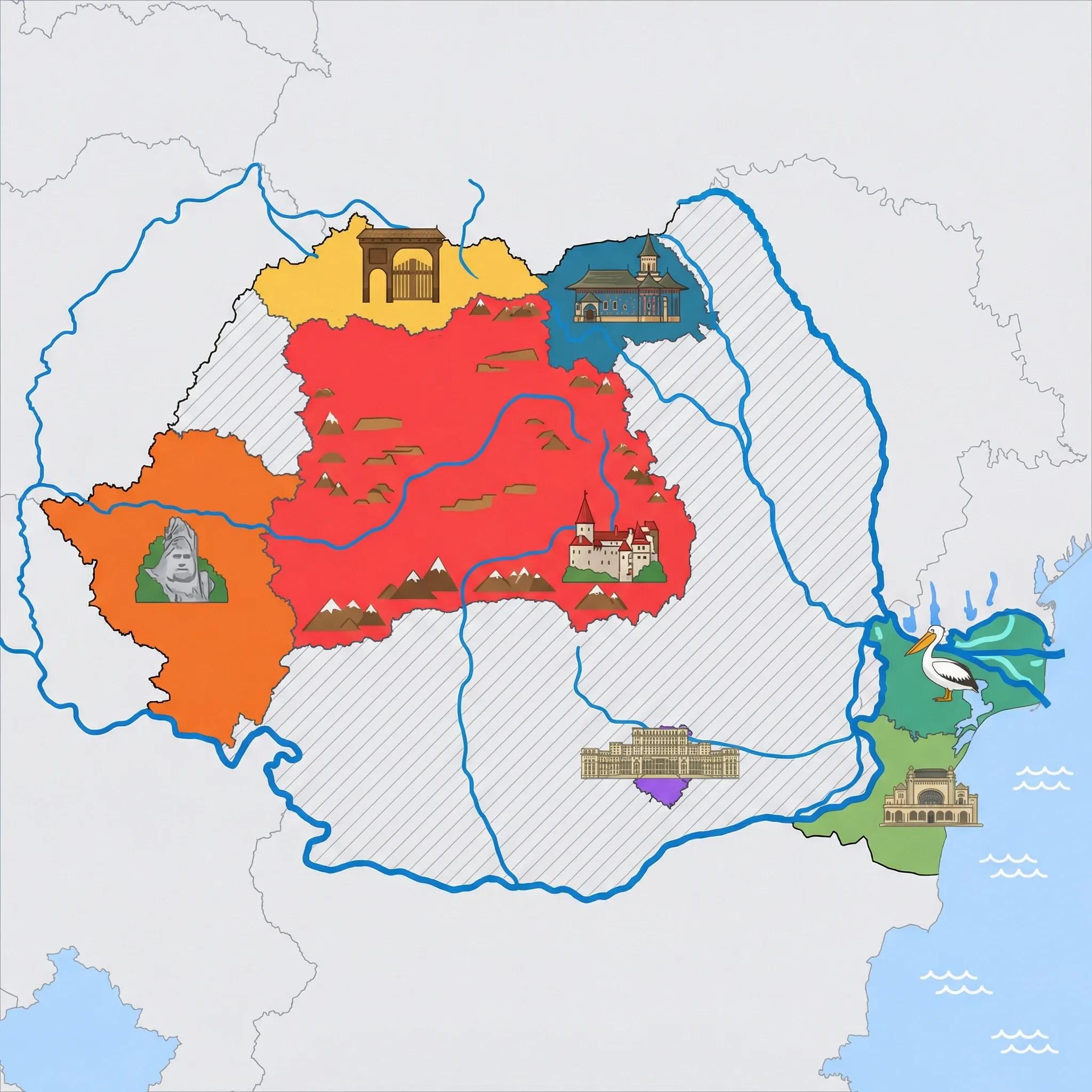
7 Regions
Banat
Where multicultural cities meet the mighty Danube 🇪🇺🌊
Black Sea Coast
Golden sands and ancient Greek ruins by the sea ☀️🐚
Bucharest
A city of grand palaces, huge parks, and urban energy 🇷🇴🏙️
Bucovina
Painted churches and rolling green hills 🎨⛪
Danube Delta
Europe's Amazon: A boat-only wildlife safari 🛶pelican
Maramureș
A fairy-tale land of wooden churches and living traditions 🌲🪵
Transylvania
Dracula's home, medieval castles, and bear sanctuaries 🏰🐻
Click on a region marker to explore details. Use the dropdown to color regions by activity suitability.

Getting There & Around
Getting There
- By Air – Henri Coandă International Airport (OTP) in Otopeni is the main hub, located 16km north of Bucharest. Cluj-Napoca (CLJ) and Timișoara (TSR) are good alternatives for accessing Transylvania or Banat.
- By Train – International overnight trains connect Bucharest with Budapest (Hungary) and Vienna (Austria). The journey through the Carpathians is spectacular.
- Entry Requirements – Romania is an EU member and part of the Schengen Area. US, UK, Canadian, and Australian citizens do not need a visa for stays up to 90 days. Check your government website for the latest visa requirements, or use the IATA Travel Centre entry-requirements checker.
Getting Around
- Car Hire – The best way to explore regions like Transylvania and Maramureș. Roads can be winding and slow (avg speed 50-60 km/h), so plan ample travel time.
- Trains – Operated by CFR Călători, trains connect major cities. They are slow but scenic and very cheap. Children under 5 travel free; 5-10 year olds get 50% off.
- City Transport – Bucharest has a reliable and cheap Metro system (5 RON per trip) and extensive bus networks. Uber and Bolt are widely available and affordable in large cities.
Official Links

Packing List
Essential for the Danube Delta and rural lakes where mosquitoes can be aggressive in summer.
Ticks are common in the Carpathian tall grass and forests; check kids after every hike.
Street lighting in rural villages is often minimal or non-existent after dark.
Mountain roads like the Transfăgărășan are incredibly winding and can affect children.
Required for women and girls to cover heads/shoulders when entering painted monasteries.
Many rural guesthouses and village shops do not accept cards; small change is vital.

Activities & Best Times

Adventure & Nature
ExcellentHiking, wildlife, outdoor exploration, ecotourism
The Carpathian Mountains offer world-class wilderness immersion and authentic trekking on routes like the Via Transilvanica. High summer provides optimal visibility and safety for mountain exploration, while snow and ice render high-altitude trails inaccessible during winter.
A globally unique UNESCO Biosphere Reserve offering world-class birdwatching and wilderness exploration in Europe's largest wetland. Peak months align with the height of bird nesting, migrations, and full accessibility of the labyrinthine canal systems.
Bucovina offers a unique blend of pristine Carpathian wilderness and authentic rural life, highlighted by traditional stud farms and hiking routes like the Via Transilvanica. Peak season aligns with the lush summer months and traditional harvest, providing ideal conditions for exploring diverse ecosystems and high-altitude trails.

City & Cultural
Very GoodUrban tourism, museums, historical sites, architecture
UNESCO-listed Saxon towns like Sibiu and Sighișoara offer exceptionally preserved medieval heritage and sophisticated museum experiences. Late spring and early autumn are preferred by discerning travelers for comfortable walking temperatures and vibrant cultural schedules.
Home to the UNESCO-listed Painted Monasteries and the Suceava Princely Fortress, the region provides a world-class cultural experience centered on Byzantine art and medieval history. Best visited from late spring to early autumn when natural light best illuminates the external frescoes and the monastic grounds are fully accessible.
Timișoara offers sophisticated Secessionist architecture and a vibrant plaza culture that rivals Central European capitals. The city is most engaging during the warmer months when street life and outdoor exhibitions are at their peak.

Road Trips & Scenic
Very GoodScenic drives, countryside tours, route-based travel
Transylvania contains both the Transfăgărășan Highway and Transalpina Highway, both rated as major attractions and considered among Europe's most spectacular scenic drives. These two routes alone make Transylvania a nationally and continentally significant road trip destination, warranting very_good.
The Dobrogea Lagoon Highway and drives to Enisala offer spectacular scenic routes through ancient landscapes and coastal wetlands. Best experienced from May to September for maximum daylight and ideal visibility of the diverse lagoon ecosystems.
The region features iconic drives such as the Transrarău (The Treasures Road) and the Painted Monasteries Loop, offering a mix of high-altitude mountain passes and cultural heritage. Peak conditions occur from May to September when mountain roads are clear and landscapes are vibrant, while winter weather frequently closes the more scenic sections.

Beach & Sea
Very GoodBeach resorts, marine activities: diving, snorkelling, kite surfing, wind surfing, sailing
While Romania's Black Sea beaches (Mamaia, Eforie) are the country's premier beach destination with modern resort infrastructure, they cannot compete internationally with Mediterranean, Caribbean, or Southeast Asian beaches in terms of water clarity, sand quality, or climate reliability. 'Good' rating overstates international appeal. 'Very_good' better reflects strong national/regional significance without implying global competitiveness.
Offers unique, wild beaches at Sulina and Sfântu Gheorghe where the river meets the sea, far removed from commercial tourism. The season is limited to the warmest summer months when the Black Sea water reaches comfortable swimming temperatures.
While lacking a coastline, Snagov Lake and Therme’s artificial sands provide managed aquatic recreation. These are highly seasonal, peaking during the hot summer months for family visitors.

Educational & Exploratory
GoodLearning experiences, scientific sites, historical education
Destination-level sites like Salina Turda and the Natural History museums offer significant geological and scientific insight. Peak timing avoids the heaviest summer crowds while ensuring full access to specialized guided tours and educational facilities.
Significant natural history and technical museums offer destination-level learning for families. These indoor facilities are best visited during temperate months to balance museum time with city walking.
The Museum of Natural Sciences Complex, including the Dolphinarium and Aquarium, provides high-quality scientific engagement for families. While indoor, these facilities align their peak programs with the summer tourist season.

Festivals & Seasonal
GoodEvents, celebrations, seasonal attractions
Untold Festival in Cluj-Napoca is one of Europe's largest and most acclaimed electronic music festivals, drawing hundreds of thousands of international visitors annually. Combined with the Sibiu International Theatre Festival, Transylvania has nationally and internationally significant festival offerings that exceed marginal calibration.
Distinguished by the elite George Enescu Festival and central Christmas markets. These specific events determine the peak visitation windows for this category.
Host to the Neversea Festival, one of Europe's largest beach-based music events, which draws significant international crowds in July. Outside of this specific window, the international festival scene is limited.

Relaxation & Wellness
GoodSpa retreats, wellness centers, peaceful getaways
The region is home to unique heliothermal and saline lakes like Bear Lake, providing authentic therapeutic experiences. The effectiveness of these natural thermal features depends on the direct summer sun for surface heating.
Historic thermal hubs like Băile Herculane offer Roman-era heritage combined with natural sulfur baths in a dramatic mountain setting. Peak season ensures all outdoor pools and surrounding scenic trails are fully accessible.
Famous for the therapeutic mud baths of Lake Techirghiol and established thermal spas in Eforie Nord. The wellness season is centered around the summer when outdoor thermal treatments are most effective and accessible.

Ski & Snow
GoodWinter sports, ski resorts, snow activities
Poiana Brașov offers reliable winter sports infrastructure and a charming alpine atmosphere for family-oriented ski trips. The core season is relatively short, with peak snow conditions in January and February and rapid melting by late March.
Vatra Dornei and Rarău provide charming, family-friendly winter sports environments with reliable snow cover and established infrastructure in mid-winter. While the facilities are smaller than Alpine counterparts, they offer an authentic and accessible experience for international families during the core winter months.
Regional ski centers such as Cavnic and Borșa offer accessible winter sports facilities with decent snow reliability for families. Peak conditions occur in mid-winter, while the shoulder months offer variable snow coverage at these relatively low-altitude resorts.

Sports & Active
GoodSport tourism, fitness activities, active recreation
High-quality infrastructure for organized adventure sports and internationally recognized cycling routes define the active tourism scene. Summer months offer the dry, stable conditions required for mountain biking and forest adventure parks.
Features dedicated cycling routes through the delta and organized rowing/kayaking infrastructure such as Centrul Rowmania. Optimal conditions occur during the dry, warm months, avoiding the winter freeze and high spring humidity.
Bucovina supports active travel through established segments of the Via Transilvanica and modern adventure parks like Mega Tiroliana La Palma. The optimal period for trekking and adventure activities is the summer when facilities are fully staffed and trails are dry, with shoulder months offering cooler conditions for endurance hiking.

Theme Park & Entertainment
GoodAmusement parks, family entertainment venues
Salina Turda provides a unique, world-class underground entertainment complex within a historic salt mine. While the mine's interior is stable, peak visitation aligns with family summer holidays and the operational dates of outdoor parks like Dino Parc.
Therme Bucharest is an internationally recognized facility, offering a massive tropical environment indoors. Peak visitation aligns with summer school holidays and the festive winter break.
Home to major regional water parks like Aqua Magic Mamaia and adventure hubs like Paradis Land. These facilities are primarily outdoor-focused and operate seasonally, with peak demand during the summer school holidays.

Public Holidays & Calendar Next 12 months
Public holidays, festivals, cultural celebrations, and seasonal natural phenomena coming up in Romania over the next 12 months.
Loading holidays and events...
Climate & Weather
Banat
Show Details
| Month | Temp °C | Rain | Humidity |
|---|
Black Sea Coast
Show Details
| Month | Temp °C | Rain | Humidity |
|---|
Bucharest
Show Details
| Month | Temp °C | Rain | Humidity |
|---|
Bucovina
Show Details
| Month | Temp °C | Rain | Humidity |
|---|
Danube Delta
Show Details
| Month | Temp °C | Rain | Humidity |
|---|
Maramureș
Show Details
| Month | Temp °C | Rain | Humidity |
|---|

Travel Advisory
All major agencies agree that Romania is generally safe for travellers, requiring only standard safety awareness and adherence to local regulations.
Safety Topics
Traveller Advice (3 groups)

Specialized safety guides are available for solo or independent female travellers to help manage general safety and personal security while visiting.

While legal, travellers should be aware of local social attitudes and refer to specialized government resources for detailed guidance on safety and rights within the country.
Minors who are Romanian citizens or travelling with Romanian parents may require notarized parental consent and specific documentation to exit the country. There is also a noted history of complex international parental child abduction cases.
Agency Summaries
No significant travel warnings are in effect. Irish citizens should ensure their passports are valid for the full length of their visit. Stays exceeding three months require formal registration with Romanian immigration authorities.
Security risks are comparable to those found in Australian cities. New European Entry/Exit System (EES) protocols require biometric registration for non-EU visitors. Standard vigilance against suspicious behavior and petty theft is recommended.
General safety conditions are stable. Travellers should be aware of seismic risks, particularly in Bucharest, which is prone to earthquakes. Legal complexities regarding dual nationality and parental child abduction cases are noted, particularly for those with Romanian heritage.
While the country is safe for visitors, awareness of the military situation in neighboring Ukraine is advised. Demonstrations occur occasionally in major cities and are typically peaceful. Petty street crime remains a concern in crowded tourist areas and on public transit.
Travellers should maintain standard safety awareness. Entry is governed by Schengen area rules, allowing 90 days of visa-free travel. Local laws require carrying valid photo identification at all times. Restrictions apply to photographing sensitive government or military sites.
General security is stable. Recent health notices advise ensuring vaccinations are up to date due to measles outbreaks. Comprehensive medical insurance that includes evacuation coverage is strongly encouraged for all visitors.
Information is provided for general guidance only and does not constitute travel, safety, medical, or legal advice. Conditions may change. Users are responsible for independently verifying information before travel.