
⚠️ SAFETY WARNING: Due to the ongoing armed conflict with Ukraine, the threat of terrorism, and the risk of arbitrary arrest or detention, government agencies (including CA, USA, UK, AU, IE, and NZ) advise travelers to avoid all travel to Russia. The security situation is unpredictable and can deteriorate without warning. Flight options are limited, and consular assistance is severely restricted. Families are strongly urged to consult their own government's official travel advisory before considering a trip, as circumstances and risk assessments vary.
Spanning eleven time zones and two continents, Russia is the largest country on Earth, offering a travel experience defined by its sheer magnitude and cultural depth. For families who do visit, it presents a landscape where fairytale architecture meets rugged wilderness. The western cities are the heart of imperial history, where children can walk the ramparts of ancient fortresses and see the settings of famous folk tales come to life. Beyond the urban centers, the country opens up into vast stretches of taiga, mountains, and unique ecosystems that feel like the edge of the world.
Cultural travel here is immersive, with world-class museums, circus traditions, and a deep appreciation for the arts that is accessible even to young visitors. While the political climate currently makes travel challenging, the underlying heritage-from the wooden architecture of the north to the distinctive cuisine-remains a source of fascination. A trip here is never casual; it requires preparation and resilience, but rewards intrepid families with sights found nowhere else, such as the deepest lake on the planet and palaces that rival Versailles in grandeur.
Key Attractions
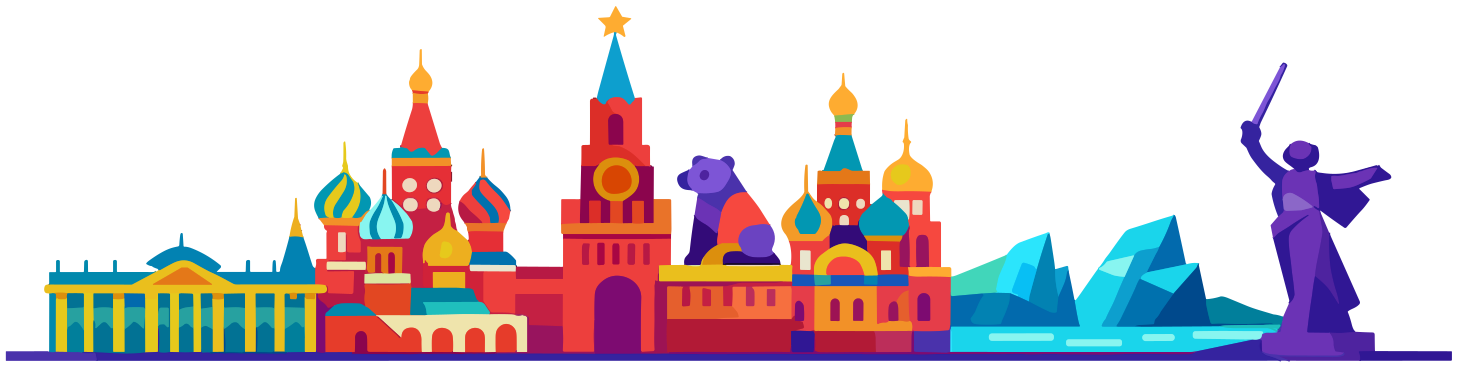
In the capital, the Moscow Kremlin is the historic core of the nation, a massive fortress complex that captivates children with its sheer scale and the Tsar Cannon. Nearby, the golden domes of the Dormition Cathedral glitter in the sun, offering a glimpse into centuries of royal coronations. For a modern family experience, Dream Island (Ostrov Mechty) is Europe's largest indoor theme park, providing weather-proof entertainment with zones dedicated to famous cartoons and fairy tales.
Moving north to St. Petersburg, the imperial capital dazzles with its canals and palaces. The Peterhof Grand Palace and Gardens is a highlight for kids, famous for its trick fountains that spray unsuspecting passersby, set against magnificent golden cascades. In the city center, the Church of the Savior on Spilled Blood looks like a giant mosaic candy house, fascinating visitors with its vibrant, multi-colored cupolas.
For those venturing into the deep interior of Siberia - Lake Baikal, the natural wonder of Lake Baikal awaits. It is the world's deepest lake and offers unique experiences like walking on crystal-clear ice in winter or spotting the endemic nerpa (freshwater seal). Further west in Kazan & Middle Volga, the white-stone Kazan Kremlin showcases the harmonious blend of Tatar and Russian cultures, featuring both a mosque and a cathedral within its ancient walls.
Practical Advice
Best Time to Visit: Late May to early September offers the warmest weather and long daylight hours (including the "White Nights" in St. Petersburg). Winter is magically snowy but requires serious cold-weather gear.
Visa & Logistics: A visa is mandatory for almost all Western travelers and must be arranged well in advance with an invitation letter. Western credit/debit cards (Visa, Mastercard, Amex) do not work in Russia due to sanctions. You must bring enough cash (USD or EUR in pristine condition) to exchange for the entire trip.
Health: Bring a full supply of any prescription medicines, as specific brands may be unavailable. Tap water is generally not potable; drink bottled or boiled water.
Food & Drink
Typical meal times: Lunch is usually served from 1:00 pm to 3:00 pm, and dinner from 7:00 pm to 9:00 pm.
Typical meal costs: ₽1,000–2,500 (approx. $10–25 USD / €9–23 EUR) for a mid-range meal per person. Business lunches are cheaper, around ₽400–700 (approx. $4–7 USD / €3.50–6.50 EUR).
Dietary requirements: Major cities have good vegetarian options, especially during Orthodox Lent when meat-free menus are common. Dill is a very common garnish; ask to omit it if your children are fussy.
Family-friendly dining: Russian culture is family-oriented. Highchairs are common, and many restaurants offer a "Detskoye menu" (kids' menu) featuring simple soups, mash, and cutlets.
Signature dishes:
- Pelmeni – Dumplings filled with minced meat, served with sour cream. A kid-friendly comfort food staple.
- Borscht – A vibrant beetroot soup, often served with a dollop of sour cream and pampushki (garlic buns).
- Blini – Thin crepes served with various fillings, from sweet condensed milk to savory caviar or salmon.
- Pirozhki – Baked or fried buns stuffed with cabbage, potato, meat, or fruit-perfect for snacking on the go.
- Chak-Chak – A sweet Tatar dessert made of deep-fried dough balls drenched in honey, famous in the Kazan region.
Safety
Due to the current geopolitical situation, travelers face significant risks. The possibility of harassment, arbitrary detention, or interrogation by security officials is elevated for Western nationals. Public demonstrations should be strictly avoided. Photography of government buildings, military personnel, or infrastructure is prohibited and enforced rigourously. GPS jamming is common in major cities like Moscow, which can disrupt phone maps and taxi apps. Always carry your passport and migration card with you, as police checks are frequent.

While local prices for food and transport are affordable for Western visitors, getting there is expensive due to limited flight routes. Western cards do not work; you must bring cash. A family can expect to spend ₽12,000–20,000 (approx. $120–200 USD / €110–185 EUR) per day for mid-range accommodation, meals, and activities.
Age Suitability




Did you know? Russia welcomes approximately 19.9 million international visitors per year. Most visitors come from Europe.
Explore Regions
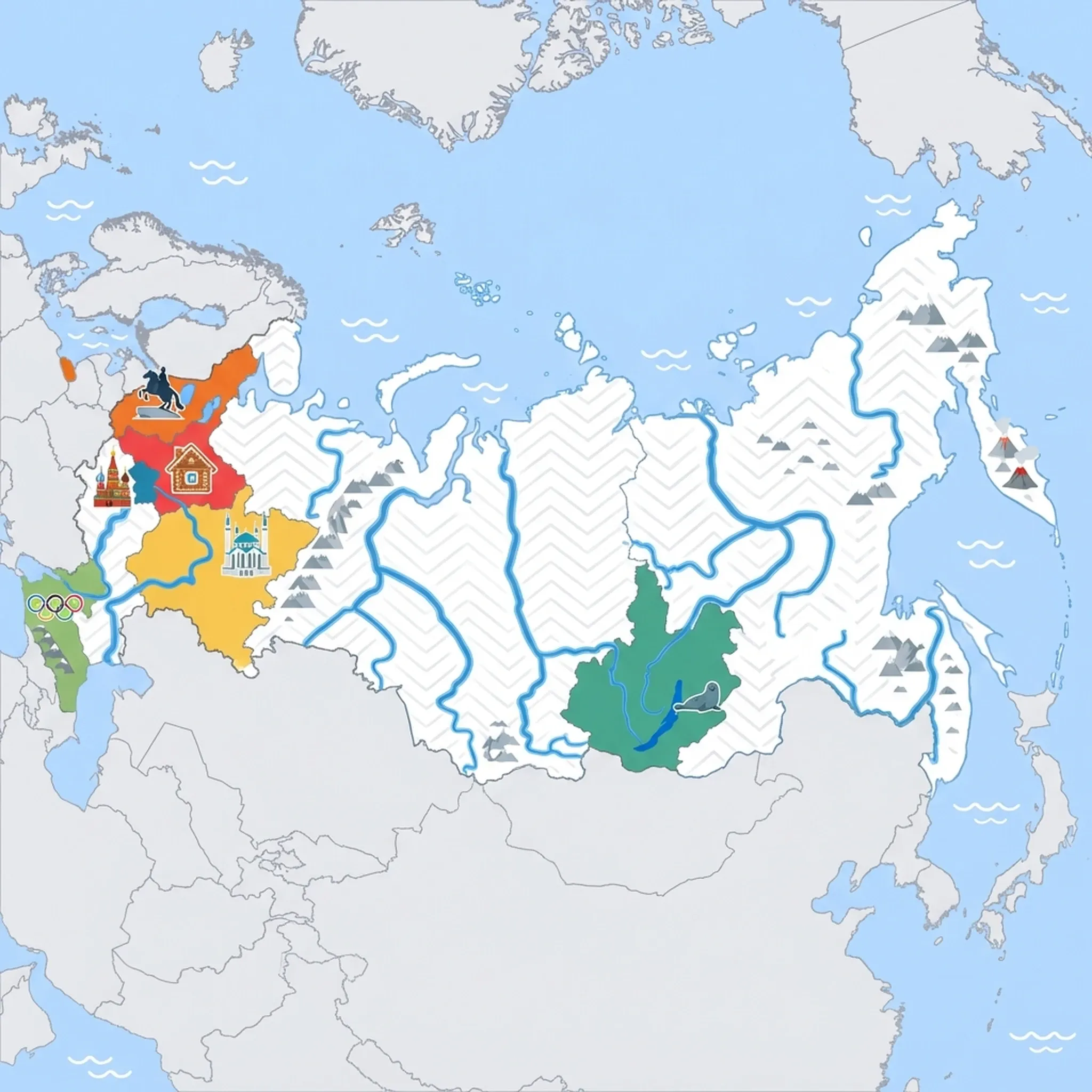
5 Regions
Golden Ring and Moscow
Where ancient citadels meet space-age dreams 🚀🏰
Kazan & Middle Volga
The crossroads of East and West 🕌⛪
Siberia - Lake Baikal
The oldest and deepest lake on Earth 🌊🌲
Sochi & Black Sea Coast
Where snowy peaks meet palm trees and the sea 🌴🏔️
St. Petersburg
Imperial grandeur and white nights ✨👑
Click on a region marker to explore details. Use the dropdown to color regions by activity suitability.

Getting There & Around
Getting There
- By Air – Direct flights from Western Europe and North America are suspended. Travelers typically connect via hubs like Istanbul (Turkey), Dubai (UAE), or Belgrade (Serbia) to reach Moscow (SVO/DME) or St. Petersburg (LED).
- By Land – Most land borders with the EU (Finland, Baltics) are closed or severely restricted to tourists. Bus services exist from Estonia, but delays can be extreme.
- Entry Requirements – A visa is strictly required for US, UK, and EU citizens. The process involves obtaining an official invitation. Check your government website for the latest visa requirements, or use the IATA Travel Centre entry-requirements checker.
Getting Around
- Metro – The Moscow and St. Petersburg metros are attractions in themselves-palatial, efficient, and very cheap. Children under 7 often travel free.
- Trains – The Golden Ring of Russia and long-distance routes are best explored by train (RZD). The high-speed Sapsan connects Moscow and St. Petersburg in 4 hours. Book tickets at the station using cash.
- Taxi – Apps like Yandex Go are essential and reliable, but you must select "cash payment" as foreign cards will not work.
- Domestic Flights – Distances are vast (e.g. to Siberia - Lake Baikal), so flying is often necessary. Aeroflot and S7 are the main carriers.
Official Links

Packing List
Western cards do not work. You must exchange cash, and banks often reject notes with even minor tears, ink marks, or folds.
Many Western websites and social media apps are blocked. VPNs are hard to download once inside the country.
GPS jamming in city centers (especially near the Kremlin) often makes phone navigation apps inaccurate or useless.
It is culturally mandatory to remove outdoor shoes in homes; they are also essential for overnight train journeys.
Cold weather drains phone batteries rapidly, and navigation/translation apps are battery-intensive.

Activities & Best Times

Adventure & Nature
ExcellentHiking, wildlife, outdoor exploration, ecotourism
Home to the world's deepest lake and endemic Nerpa seals, offering unique blue ice trekking in late winter and wilderness exploration in summer. Peak seasons reflect the globally famous crystal ice conditions in Feb-Mar and the mild hiking weather of July-Aug.
Excellent river-based nature reserves and authentic ethnographic villages like Sviyazhsk provide deep immersion into Tatar heritage. Optimal from late spring to early autumn for river navigation and hiking through the Volzhsko-Kamsky biosphere.
Offers a blend of high-end adventure parks and authentic rural experiences like Verkhnie Mandrogi village. These facilities are best enjoyed during the mild summer months when the Neva River and surrounding forests are fully accessible.

City & Cultural
ExcellentUrban tourism, museums, historical sites, architecture
Home to the Hermitage and spectacular Imperial palaces, St. Petersburg offers world-class art and architecture that rival any European capital. Peak season centers on the 'White Nights' in June, while December and January provide an authentic, albeit cold, winter experience with festive lighting and opera.
While Kazan has three UNESCO sites and unique Tatar-Russian cultural blend, it lacks the global recognition, visitor infrastructure, and density of world-class cultural institutions required for 'excellent' rating. 'Excellent' should be reserved for cities that compete internationally with Paris, Rome, Vienna - cities tourists would choose as primary European cultural destinations. Kazan is nationally exceptional but not internationally pre-eminent.
Irkutsk, the 'Paris of Siberia,' features a rare collection of 19th-century wooden architecture and a rich history linked to the Decembrist exiles. Summer months are peak for cultural immersion, as the severe Siberian winter limits walking tours and urban exploration.

Educational & Exploratory
Very GoodLearning experiences, scientific sites, historical education
Features the Baikal Museum, an internationally significant limnological research station and museum dedicated to the lake's unique ecosystem. Peak months align with general tourism windows when educational programs and nerpinarium shows are most accessible.
Internationally significant facilities like the Cosmonautics Museum and Moskvarium offer world-class scientific engagement for curious families. These indoor venues provide high-quality educational experiences throughout the year.
Several large-scale oceanariums and historical complexes provide educational engagement for families. While these are quality facilities, they typically serve as secondary activities rather than standalone international travel motivators.

Sports & Active
Very GoodSport tourism, fitness activities, active recreation
The Great Baikal Trail offers dedicated infrastructure for long-distance hiking and mountain biking along the coastline. Activity is highly seasonal, restricted to the summer months when terrain is passable and weather is conducive to high-exertion sports.
Offers dedicated infrastructure like the Velo1 cycling route and historic pilgrimage trails for active exploration. The season is best from late spring to early autumn when paths are dry and temperatures mild.
Features high-quality infrastructure at Sviyazhsk Hills for both golf and skiing, catering to active families. The season is split between the winter ski peak and the summer golf and outdoor adventure park window.

Theme Park & Entertainment
Very GoodAmusement parks, family entertainment venues
Sochi Park provides a high-quality theme park experience based on Russian folklore alongside major water parks like Zolotaya Bukhta. Facilities are fully operational during the summer school holidays, with reduced services or closures in the cold, damp winter months.
Home to Dream Island, the largest indoor theme park in Europe, offering high-standard entertainment regardless of weather. Peak periods coincide with summer and winter school holidays.
Home to the Riviera, one of Europe's largest indoor water parks, making it a viable year-round family draw. Peak visitation aligns with summer warmth and the winter school holiday period.

Relaxation & Wellness
GoodSpa retreats, wellness centers, peaceful getaways
Authentic thermal spring resorts like Khakusy provide a unique wellness experience in a remote wilderness setting. The peak experience for international travelers is bathing in hot springs during the snowy winter months for a traditional Siberian restorative ritual.
Renowned for the authentic Russian banya culture at world-famous bathhouses like Sanduny in Moscow. The experience is most appealing during the cold winter months when the thermal contrast is most pronounced.

Road Trips & Scenic
GoodScenic drives, countryside tours, route-based travel
Routes like the Baikal Tract and the 'Little Sea' road to Olkhon provide dramatic scenic drives through Taiga and Steppe landscapes. Summer is the only recommended season for road travel due to the safety of non-ice roads and maximum daylight.
The Golden Ring is an iconic scenic driving route connecting historical heartlands through a series of picturesque riverside towns. Optimal conditions for exploring these routes are found during the warm, bright months of summer.

Ski & Snow
GoodWinter sports, ski resorts, snow activities
Gora Sobolinaya offers solid alpine infrastructure with unique views of Lake Baikal. The peak season is late winter (Feb-Mar), known locally as 'velvet season,' when snow depth is maximum and extreme sub-zero temperatures begin to moderate.
Family-friendly ski centers such as Sorochany offer modern infrastructure and reliable snow for winter sports enthusiasts. The activity is strictly seasonal, peaking during the deep winter months of December through February.

Beach & Sea
MarginalBeach resorts, marine activities: diving, snorkelling, kite surfing, wind surfing, sailing
The 'Kama Sea' offers vast reservoir beaches that serve as a unique inland coastal experience during the peak of summer. Suitability is limited for international travelers due to the very short window of warm water in July and August.
While the Gulf of Finland offers scenic shoreline recreation at Peterhof and the Peter and Paul Fortress, it lacks traditional warm-water resort qualities. It serves as a pleasant coastal escape for sunbathing and walking only during the peak of summer.
Although freshwater, the sandy beaches of Olkhon Island and Peschanaya Bay offer a unique, if brief, summer beach experience. Rated marginal as water temperatures remain very cold even in peak July and August.

Festivals & Seasonal
MarginalEvents, celebrations, seasonal attractions

Public Holidays & Calendar Next 12 months
Public holidays, festivals, cultural celebrations, and seasonal natural phenomena coming up in Russia over the next 12 months.
Loading holidays and events...
Climate & Weather
Golden Ring and Moscow
Show Details
| Month | Temp °C | Rain | Humidity |
|---|
Kazan & Middle Volga
Show Details
| Month | Temp °C | Rain | Humidity |
|---|
Siberia - Lake Baikal
Show Details
| Month | Temp °C | Rain | Humidity |
|---|
Sochi & Black Sea Coast
Show Details
| Month | Temp °C | Rain | Humidity |
|---|
St. Petersburg
Show Details
| Month | Temp °C | Rain | Humidity |
|---|

Travel Advisory
All major international travel agencies currently issue their highest warning level for Russia, advising against any travel and urging those currently in the country to depart immediately. This consensus is driven by the active armed conflict with Ukraine, the threat of arbitrary detention of foreigners for political leverage, and the lack of reliable commercial transport or consular assistance.
Safety Topics
Traveller Advice (3 groups)
Media professionals are at high risk of being targeted by security services. Authorities have used espionage and 'foreign agent' laws to arrest and prosecute foreign reporters. It is extremely difficult to operate safely without being subject to intense surveillance or potential detention.

Travellers face severe legal and personal risks following the designation of the international LGBTQ+ movement as an extremist organization. New laws broadly ban any public expression or 'propaganda' of non-traditional relationships, which can lead to significant fines, jail time, or harassment.

Anyone currently in the country should prioritize leaving while commercial options are still available. Individuals with dual citizenship should be aware that Russia considers them only as Russian nationals and may prevent them from leaving or force them into military service. Avoid all political discussions in public or on social media, as these can lead to immediate arrest.
Agency Summaries
Australia warns that the security environment in Russia is dangerous and unpredictable due to the war with Ukraine. Foreigners face a high risk of being arrested or detained without clear cause. Consular support is severely restricted, and Australians are viewed as being from an unfriendly nation by local authorities.
The British government advises against visiting any part of Russia. Concerns include security incidents such as drone attacks, a lack of available return flights, and a high probability of terrorism in major urban centers. There is a significant risk that foreign nationals could be detained for political reasons.
The Canadian government recommends staying away from Russia due to the dangerous fallout from the conflict with Ukraine and a pervasive threat of terrorist activity. Security is volatile, and military actions like drone strikes have occurred even deep within the country. Financial systems are restricted, and there are few ways to leave by air.
Ireland maintains its highest warning level for Russia, citing the rapid deterioration of transport links and banking services. Irish citizens are warned that remaining in the country could leave them without a viable way home and that the embassy's ability to offer assistance is very low.
American citizens are urged to avoid all travel to Russia and those currently present should leave immediately. Major risks include the threat of wrongful detention by security services, the arbitrary use of local laws, and ongoing dangers from the war in Ukraine. The embassy has extremely limited capacity to provide help.
New Zealanders are advised against any travel to Russia as the security situation can change without warning. The conflict in Ukraine has made it difficult to access money or find flights home. There is also a continuous threat of terrorism and civil unrest that may turn violent.
Information is provided for general guidance only and does not constitute travel, safety, medical, or legal advice. Conditions may change. Users are responsible for independently verifying information before travel.