

Key Attractions
The crown jewel is Volcanoes National Park in the Volcanoes NP & Northwest (gorillas) region. While gorilla trekking has a strict minimum age of 15, families with children aged 12+ can trek to see the endangered Golden Monkeys, which are active, playful, and fascinating to watch. For younger children, the park offers nature walks and cultural village visits. In the east, Akagera National Park is the country's only Big Five savannah park. It is exceptionally family-friendly, offering boat safaris on Lake Ihema where kids can safely watch hippos and crocodiles, alongside traditional game drives to see lions, rhinos, and elephants. For a change of pace, Nyungwe National Park in the Nyungwe Forest & South region protects a vast ancient rainforest. The highlight here for families is the Canopy Walkway-a suspension bridge 70 metres above the forest floor (minimum age 6). It offers a thrilling bird’s-eye view of the jungle without the strenuous hiking required for primate tracking. afterwards, head to Lake Kivu in the Lake Kivu & West region. This massive freshwater lake is free of bilharzia and crocodiles, making it safe for swimming, kayaking, and relaxing on sandy beaches in towns like Rubavu. In Kigali, the Kigali Genocide Memorial is a must-visit for understanding the country, though it is best suited for older children (12+) due to the graphic nature of the exhibits. For a lighter cultural fix, visit the Inema Arts Center, where kids can see colourful contemporary African art and often catch dance performances.Practical Advice
The best time to visit is during the long dry season (June to September) or the short dry season (mid-December to February). Malaria prophylaxis is essential for all family members. Rwanda has a strict ban on plastic bags; any found in your luggage will be confiscated at the airport, so pack with reusable fabric bags. Yellow Fever vaccination certificates are mandatory for entry.Food & Drink
Typical meal times: Lunch is usually served from 12:30 pm to 2:30 pm, and dinner from 6:30 pm to 9:30 pm.
Typical meal costs: Main dishes in mid-range restaurants cost RWF 10,000–20,000 (approx. $7–15 USD / €6.50–13 EUR). Local buffet lunches (Melange) are excellent value at RWF 3,000–6,000 (approx. $2–4.50 USD / €2–4 EUR).
Dietary requirements: Vegetarian options are widely available, particularly beans, plantains, and potatoes. Gluten-free is harder to guarantee outside high-end hotels in Kigali. Peanuts are common in sauces.
Family-friendly dining: Look for "Melange" lunch buffets. They are quick, cheap, and allow children to visually choose what they want to eat (rice, potatoes, beans, mild sauces) without waiting for a menu.
Signature dishes:
- Brochettes – Grilled skewers of meat (usually goat or beef) or fish, often served with roasted potatoes or bananas.
- Sambaza – Small, crispy fried fish from Lake Kivu, eaten whole like whitebait-kids usually love them as a snack.
- Ugali – A stiff maize porridge that is a staple starch, traditionally eaten with the hands dipped in sauce.
- Akabenz – Roasted pork, typically marinated in a lemon and BBQ-style sauce, very popular in local bars and casual eateries.
Safety
Beyond the border warnings, Rwanda is very safe regarding violent crime. Petty theft can occur but is less common than in many other capitals. The main safety concern for families is actually road safety; traffic can be fast, and winding mountain roads can be hazardous, so always use seatbelts and avoid travelling after dark. Moto-taxis (motorcycle taxis) are ubiquitous but are not recommended for children due to high accident rates.
A family of four can expect to spend around RWF 400,000–650,000 (approx. $300–480 USD / €275–450 EUR) per day for mid-range hotels, private driver hire, and meals. Costs rise significantly if adding permit-heavy activities like Gorilla trekking ($1,500/person) or Golden Monkey trekking ($100/person).
Age Suitability




Did you know? Rwanda welcomes approximately 480,000 international visitors per year. Most visitors come from Africa.
Explore Regions
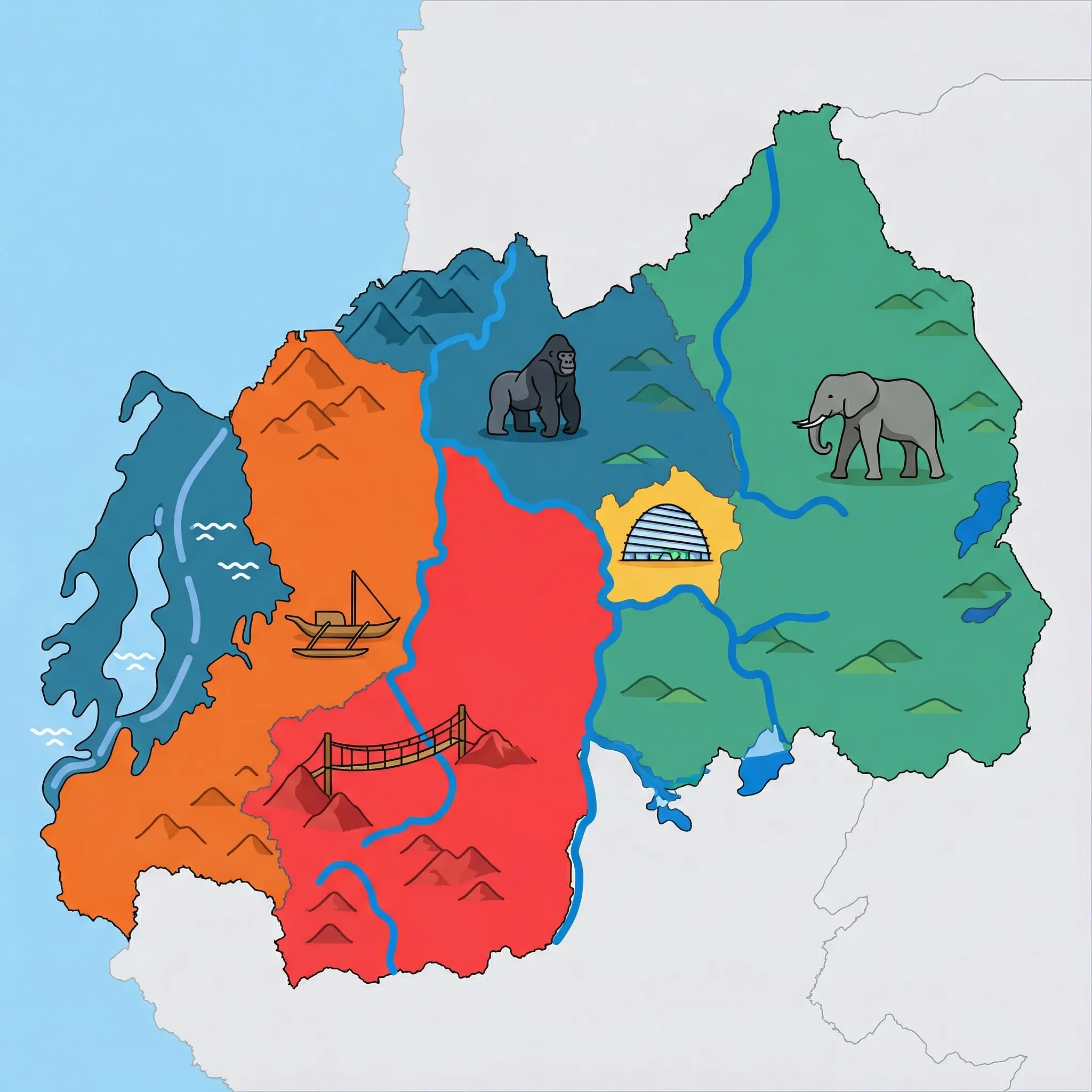
5 Regions
Akagera NP & East (safari)
Rwanda's wild savannah frontier 🦁🐘
Kigali
The vibrant heart of the Land of a Thousand Hills 🇷🇼🏙️
Lake Kivu & West
A scenic inland sea of relaxation and adventure 🏖️🚤
Nyungwe Forest & South
Ancient rainforests and royal history 🌳👑
Volcanoes NP & Northwest (gorillas)
Gorillas in the mist and dramatic peaks 🦍🌋
Click on a region marker to explore details. Use the dropdown to color regions by activity suitability.

Getting There & Around
Getting There
- By Air – Kigali International Airport (KGL) is the main hub, well-connected to Europe and the Middle East. It is a short drive from the centre of Kigali.
- By Land – The Cyanika and Gatuna borders connect to Uganda (popular for travellers doing a circuit). The Rusumo border connects to Tanzania.
- Entry Requirements – Citizens of all countries can get a visa on arrival. It is free for African Union and Commonwealth citizens; others typically pay $50 USD. The "East Africa Tourist Visa" ($100 USD) covers Rwanda, Uganda, and Kenya. Check your government website for the latest visa requirements, or use the IATA Travel Centre entry-requirements checker.
Getting Around
- Private Driver/Guide – The best option for families. A 4x4 with a driver typically costs RWF 135,000–200,000 (approx. $100–150 USD / €90–140 EUR) per day. It offers flexibility for stops and handles the winding mountain roads safely.
- Domestic Flights – RwandAir operates short flights from Kigali to Kamembe (for Nyungwe Forest & South), taking just 45 minutes compared to a 6-hour drive.
- Buses – Inter-city buses are reliable and cheap, but often cramped and run on fixed schedules, making them difficult for families with young children or lots of luggage.

Packing List
Plastic bags are strictly banned and confiscated at the airport; pack reusable totes for shopping and laundry.
Essential for grabbing stinging nettles and thorny branches during jungle treks or nature walks.
Prevents safari ants and mud from entering your boots during forest hikes in Nyungwe or Volcanoes NP.
Rwanda is the 'Land of a Thousand Hills'—roads are endlessly winding and can affect kids easily.
Mornings in the mountains (Volcanoes/Nyungwe) are surprisingly cold (10°C/50°F) despite being near the equator.
Physical proof of vaccination is often requested at the airport border control.

Activities & Best Times

Adventure & Nature
ExcellentHiking, wildlife, outdoor exploration, ecotourism
Home to one of Africa's oldest rainforests, offering world-class chimpanzee trekking and an iconic canopy walk. Peak dry seasons (June-August, Dec-Jan) ensure accessible trails and the most reliable conditions for primate sightings.
Home to the critically endangered mountain gorillas, offering one of the world's most intimate and well-regulated wildlife encounters. Peak months align with the drier seasons when hiking conditions on steep volcanic slopes are most manageable for families.
Offers a high-quality Big Five savannah experience and unique boat safaris on Lake Ihema, expertly managed by African Parks. Wildlife viewing is optimal during the dry seasons when animals congregate near permanent water sources, while heavy rain makes many tracks difficult.

City & Cultural
Very GoodUrban tourism, museums, historical sites, architecture
As one of Africa's cleanest and safest capitals, Kigali features the world-class Genocide Memorial and a vibrant contemporary art scene. Peak visitation aligns with the primary dry seasons and end-of-year holidays when the city's outdoor cafes and eco-parks are most enjoyable.
The cultural heartland of Rwanda, featuring the authentically reconstructed King's Palace at Nyanza and the high-quality Ethnographic Museum in Huye. Drier months are preferred for exploring these outdoor heritage sites and transit between the cultural hubs.
Provides authentic cultural engagement through the unique Imigongo art form and significant archaeological sites like Ryamurari. Peak visitation aligns with dry periods to ensure reliable road access to rural art centers and heritage locations for sophisticated travelers.

Sports & Active
Very GoodSport tourism, fitness activities, active recreation
Internationally recognized for the multi-day Congo Nile cycling route and the Nyungwe canopy walk. Ideal conditions for active sports require the dry grip of the non-monsoon months.
The region is an emerging cycling destination featuring the UCI World Championships Circuit and significant mountain biking trails. Activities are most accessible during the long dry season when infrastructure is most reliable and weather is conducive to high-intensity outdoor sport.
Dedicated infrastructure like the 'Walk the Line' boundary hike and Lake Muhazi cycling circuits offer high-quality active exploration. These activities are best enjoyed in the dry season to ensure safe trail conditions and clear visibility across the park's diverse topography.

Road Trips & Scenic
GoodScenic drives, countryside tours, route-based travel
Kigali serves as the essential hub for Rwanda's spectacular scenic highways leading to Musanze and the Kivu Belt. Driving is best during dry months to ensure clear mountain vistas and safe road conditions on winding highland routes.
Boasts spectacular scenic drives through high-altitude tea plantations and dense rainforest on the RN6. Dry seasons offer the safest driving conditions and the clearest vistas over Rwanda's 'thousand hills' and towards Lake Kivu.
The Kivu Belt Road is a spectacular scenic drive with world-class lake views. Travel is restricted in wet months due to high landslide risk and poor visibility on winding mountain passes.

Educational & Exploratory
GoodLearning experiences, scientific sites, historical education
The classification notes describe the Ethnographic Museum as 'nationally significant' and providing 'deep insights' into Rwandan culture. This contradicts a 'marginal' rating. A nationally significant museum warrants 'good' at minimum.
The Uwinka Visitor Center offers significant natural history education within the forest. Access is best during dry periods when educational forest walks are most viable.

Festivals & Seasonal
GoodEvents, celebrations, seasonal attractions

Relaxation & Wellness
MarginalSpa retreats, wellness centers, peaceful getaways
Features the Mashyuza Hot Springs, though facilities are basic and lack the luxury infrastructure typical of global wellness destinations. Best visited in dry months when outdoor bathing is most comfortable and accessible.
The Nyamyumba Hot Springs offer a localized natural wellness experience, though the region lacks the extensive dedicated spa infrastructure required for a higher rating. Accessible year-round, but most pleasant when not raining heavily.
Bugarama Hot Springs provides a natural, though rustic, restorative experience. Peak visitation aligns with dry months to avoid flooding or mud at the natural sites.

Public Holidays & Calendar Next 12 months
Public holidays, festivals, cultural celebrations, and seasonal natural phenomena coming up in Rwanda over the next 12 months.
Loading holidays and events...
Climate & Weather
Akagera NP & East (safari)
Show Details
| Month | Temp °C | Rain | Humidity |
|---|
Kigali
Show Details
| Month | Temp °C | Rain | Humidity |
|---|
Lake Kivu & West
Show Details
| Month | Temp °C | Rain | Humidity |
|---|
Nyungwe Forest & South
Show Details
| Month | Temp °C | Rain | Humidity |
|---|
Volcanoes NP & Northwest (gorillas)
Show Details
| Month | Temp °C | Rain | Humidity |
|---|

Travel Advisory
While half of the major agencies consider Rwanda safe for standard travel, the other half recommend increased caution due to persistent regional tensions and border risks. This split assessment suggests a need for heightened situational awareness.
Safety Topics
Traveller Advice (3 groups)

Rwanda is generally considered safe for women, including solo travellers; however, standard precautions should be taken when walking alone at night, and conservative dress is often respected in rural areas.

While consensual same-sex acts are not criminalized and discrimination is constitutionally prohibited, local society remains conservative. Public displays of affection may attract negative attention or harassment.

Visitors should always carry identification, follow local authority directives, and avoid night-time travel outside of major urban centers. It is recommended to stay informed through local media regarding border status.
Agency Summaries
Travellers should maintain standard safety awareness throughout the country, though specific border regions require significantly higher vigilance.
The general security environment is stable, though conflict in neighboring DRC may occasionally impact safety near the western border.
A high level of vigilance is advised because of the volatile situation in the wider Great Lakes region and potential for rapid changes in security.
Travellers should remain alert in public spaces and monitor border conditions which can deteriorate with little warning.
Increased caution is recommended due to potential armed violence, particularly in districts bordering the Democratic Republic of the Congo.
No country-wide warnings are in place, but visitors are advised to avoid certain border areas due to regional instability.
Information is provided for general guidance only and does not constitute travel, safety, medical, or legal advice. Conditions may change. Users are responsible for independently verifying information before travel.