

Overview
For families seeking a travel experience completely unlike any other, Saint Helena, Ascension and Tristan da Cunha represent the final frontier of accessible travel. Located halfway between Africa and South America, these islands are not just remote-they are a world apart. Saint Helena, the main hub for visitors, is a subtropical paradise of rugged cliffs, cloud forests, and Georgian heritage. It feels like a 1950s English village transported to a Jurassic Park landscape. The island is incredibly safe, with virtually no crime, allowing children a level of freedom they rarely experience elsewhere. The community is tight-knit and welcoming, known as "Saints," who wave at every passing car.
While Saint Helena is accessible by weekly flight, its sister islands are for the truly intrepid. Ascension Island is a Mars-like volcanic outpost with green turtles and space stations, while Tristan da Cunha remains the most remote inhabited archipelago on Earth, accessible only by a week-long sea voyage. For most families, Saint Helena will be the base of operations-a place to unplug (literally, as internet can be slow) and reconnect over hiking, marine wildlife, and history lessons that don't feel like school. It is not a destination for resort-lovers, but for curious families ready to explore one of the planet's most secluded communities.
Key Attractions
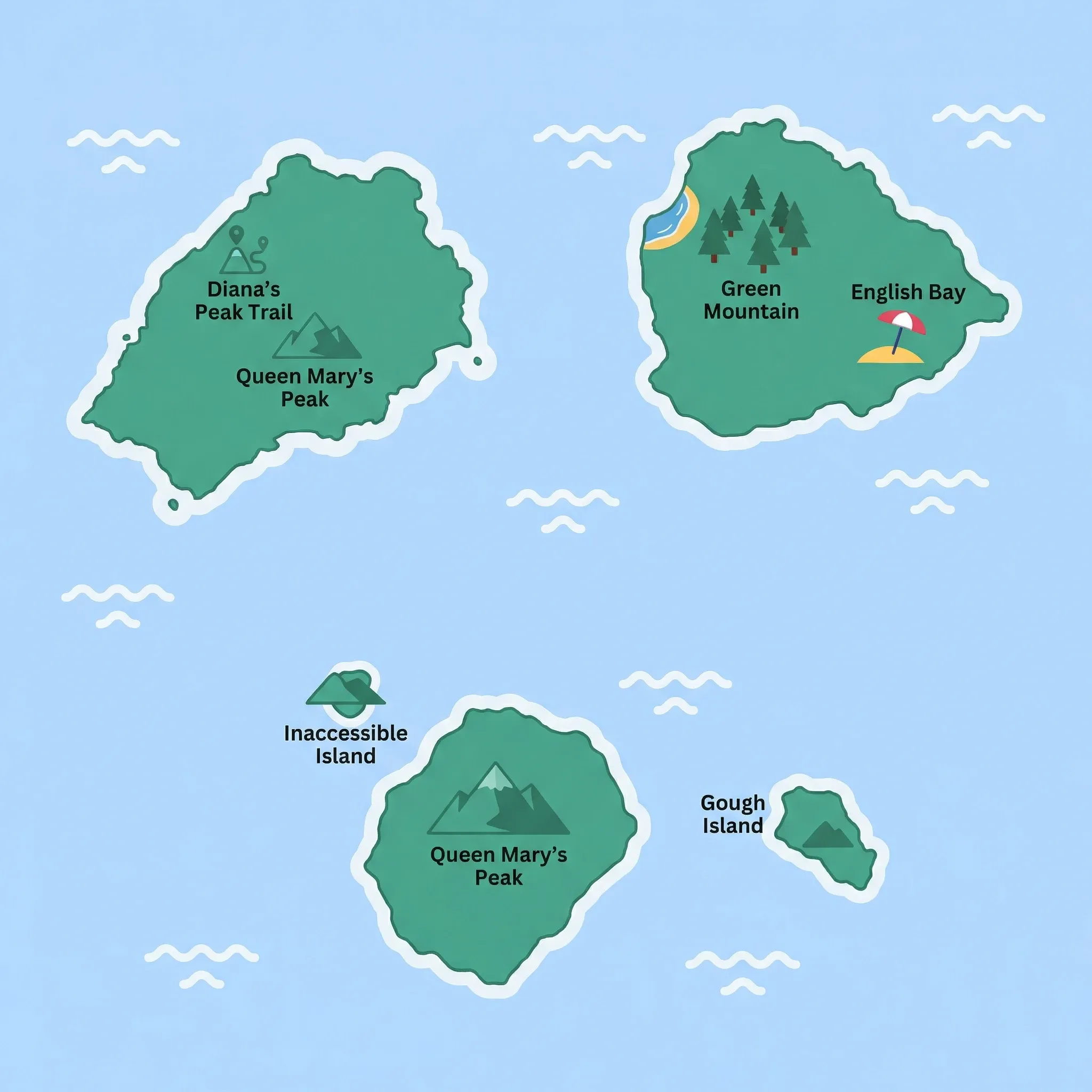
The capital, Jamestown, is a must-visit Georgian port town squeezed into a narrow volcanic valley. Its most famous feature is Jacob's Ladder, a challenging 699-step outdoor staircase that rises straight up the cliffside; kids love the challenge of earning their certificate at the museum for completing it. Just outside town, the Plantation House is home to the island's most famous resident, Jonathan the Tortoise, who was hatched in the Georgian era and is the oldest known living land animal-a gentle giant children can view from the paddock corridor.
History buffs will be fascinated by Longwood House, where Napoleon Bonaparte spent his final years in exile. The house is beautifully preserved with original furniture and gardens, offering a tangible connection to European history. For active families, the "Post Box Walks" are a network of trails ranging from easy strolls to rugged hikes, where you stamp a book at the end of the trail. On Ascension Island (accessible via the monthly inter-island flight), Green Mountain National Park offers a lush, man-made cloud forest on a volcanic peak, a terraforming experiment by Darwin and Hooker that created a jungle from scratch.
Practical Advice
Best time to visit: The summer months (December to March) offer the warmest weather and the chance to see Whale Sharks, which are a major draw for older children who can snorkel. The climate is mild year-round, but can be changeable.
Money & Connectivity: There are NO ATMs on Saint Helena. You must bring sufficient cash (British Pounds or St Helena Pounds) or download the "St Helena Tourist Card" app before arrival to pay at local merchants. Credit cards are rarely accepted directly. Internet via Starlink has recently improved connectivity, but it is still best to treat this as a digital detox trip.
Health & Entry: Proof of medical insurance covering at least £175,000 (approx. $225,000 USD) including emergency medical evacuation is a mandatory entry requirement. You will be asked to show paper proof at immigration. The hospital is good for basic needs, but serious issues require airlift to South Africa.
Food & Drink
Typical meal times: Lunch is usually 12:00 pm to 2:00 pm, and dinner is served early, typically 6:30 pm to 8:30 pm. Many places close early, so don't leave dinner until late.
Typical meal costs: £15–30 (approx. $20–40 USD / €18–35 EUR) for a main meal. Local snacks like fishcakes are cheaper, around £2–4 (approx. $2.50–5 USD). Groceries are expensive due to shipping costs.
Dietary requirements: Fresh produce relies on the supply ship, so availability varies. Vegetarian options are available but limited; vegan and gluten-free travellers should bring essential specialty snacks with them. Inform restaurants of allergies in advance as they may not be as accustomed to complex dietary needs.
Family-friendly dining: Saints are very family-oriented. Children are welcome everywhere. "Plo" (a one-pot curry rice dish) is a local favourite that most kids enjoy. Casual takeaways and coffee shops in Jamestown are easy for quick family meals.
Signature dishes:
- St Helena Fishcakes – Spicy, pan-fried cakes made from tuna or wahoo, mashed potato, and herbs-the ultimate local comfort food.
- Plo – A curry-spiced one-pot stew with rice, vegetables, and meat or fish, similar to paella or pilaf.
- St Helena Coffee – Grown on the island and world-famous for its quality; while expensive to export, it is reasonably priced to drink locally.
- Coconut Fingers – A pink-iced sponge cake coated in coconut, a favourite sweet treat for children.

While the destination is remote, on-island costs are moderate. A family of four can expect to spend around £120–180 (approx. $155–230 USD / €140–210 EUR) per day for accommodation, meals, and car hire. Flights are the biggest expense. Groceries are pricey due to imports, but local fish is affordable. Bring cash (GBP), as credit cards are rarely accepted.
Age Suitability





Why this score?
The islands offer a high degree of adventure through their rugged volcanic terrain, steep hiking trails like the 699-step Jacob's Ladder, and the logistical challenge of reaching them. Tristan da Cunha, accessible only by a multi-day boat journey, represents one of the most remote inhabited places on Earth, providing a true frontier experience.
Why this score?
Medical facilities are very limited and primarily designed for the small local population, with basic hospitals in Jamestown and Georgetown. Serious or complex medical emergencies require aeromedical evacuation to South Africa, which is exceptionally costly and can be delayed by weather or flight schedules.
Why this score?
Despite the historical fame of Napoleon's exile and unique biodiversity, these islands receive very few international visitors annually due to extreme isolation and expensive, limited transport links. While the opening of Saint Helena's airport has slightly increased accessibility, it remains a niche destination for dedicated travelers rather than a mainstream tourist hub.
Visiting is expensive due to limited flight capacity and the high cost of imported goods. Accommodation ranges from guest houses to boutique hotels, costing £100–250 (approx. $125–315 USD / €115–290 EUR) per night. Car rental is around £20–30 (approx. $25–38 USD / €23–35 EUR) per day. Groceries, particularly fresh fruit and dairy, are significantly pricier than in the UK.

Getting There & Around
Getting There
- By Air – Airlink operates a weekly flight (usually Saturdays) from Johannesburg (JNB) to St Helena (HLE). A midweek flight from Cape Town (CPT) often runs during the summer peak season (Dec–Mar). This is the only practical route for families.
- By Sea – The RMS St Helena is no longer in service. Reaching Tristan da Cunha requires a 6-day voyage on a polar research or fishing vessel from Cape Town, which must be booked months in advance and requires council permission.
- Entry Requirements – A £20 entry fee applies. Crucial: You must present printed proof of medical insurance (evacuation cover min. £175k) at immigration. Check your government website for the latest visa requirements, or use the IATA Travel Centre entry-requirements checker.
Getting Around
- Car Hire – Essential for families. There is no public transport suitable for touring. Roads are single-lane, steep, and winding, with a 20-30 mph speed limit. Driving is on the left.
- Taxis – Available but can be expensive for daily touring. Best booked in advance for airport transfers or evening meals.
- Walking – Jamestown is easily walkable, but exploring the rest of the island requires a vehicle due to the rugged terrain.

Packing List
ATMs do not exist on St Helena. You must bring cash or use the specific local 'Tourist Card' app.
Mandatory at the border. You cannot enter without paper proof of £175k+ evacuation cover.
Essential for the winding roads, whale shark boat trips, or the ferry to Tristan.
Internet can be slow or expensive; download movies and games for kids before arrival.
The 'Post Box Walks' are steep and volcanic; poles help children and parents navigate safely.

Activities & Best Times

Adventure & Nature
Very GoodHiking, wildlife, outdoor exploration, ecotourism
Features dramatic volcanic landscapes and high levels of endemism, including the unique cloud forests of Diana's Peak and the turtle nesting beaches of Ascension. Peak season offers the clearest visibility for hiking the high peaks and the most reliable weather for observing unique island biodiversity.

Beach & Sea
GoodBeach resorts, marine activities: diving, snorkelling, kite surfing, wind surfing, sailing
Ascension Island offers world-class diving and snorkeling in exceptionally clear waters with large marine life like whale sharks and green turtles. Conditions are optimal in the southern summer when sea swells are minimal and water temperatures are most comfortable for swimming and boat excursions.

City & Cultural
GoodUrban tourism, museums, historical sites, architecture
While Jamestown and Longwood House have historical significance (Napoleon's exile), the territory lacks major cultural institutions, museums, or galleries. The cultural offer is limited to colonial heritage in extremely remote settings. International calibration: 'very_good' should apply to nationally significant cultural destinations, but this is a niche historical interest rather than a comprehensive cultural experience.

Educational & Exploratory
GoodLearning experiences, scientific sites, historical education
The islands serve as an open-air laboratory for evolution and a significant historical archive for Napoleonic and maritime history. Facilities like the Museum of Saint Helena provide deep context, though access is best during the peak tourism window when guided heritage tours are most frequent.

Sports & Active
GoodSport tourism, fitness activities, active recreation
The region is renowned for its strenuous 'Post Box' walks and high-altitude hiking trails that require significant physical effort and offer remote rewards. The peak season provides the necessary dry underfoot conditions for safely traversing steep volcanic slopes and exposed ridges.

Road Trips & Scenic
MarginalScenic drives, countryside tours, route-based travel
Zero road trip/scenic drive attractions listed in database. While Jacob's Road (linking Jamestown to Diana's Peak) and the Ascension Island mountain road exist, the total road network is minimal across these tiny islands. Access restrictions (military clearance for Ascension, near-impossible access to Tristan da Cunha) further limit road trip potential. 'Marginal' better reflects the limited infrastructure and extreme remoteness.




Public Holidays & Calendar Next 12 months
Public holidays, festivals, cultural celebrations, and seasonal natural phenomena coming up in Saint Helena, Ascension and Tristan da Cunha over the next 12 months.
Loading holidays and events...

Travel Advisory
All six major agencies agree that the territory is a low-risk destination requiring only standard safety awareness.
Safety Topics
Traveller Advice (4 groups)
Infrastructure on the islands can be challenging due to rugged volcanic terrain; visitors with mobility issues should check accessibility for specific sites in advance.

General guidance is provided for solo and independent female travellers, highlighting the low-crime environment while maintaining standard safety awareness.

Social and legal norms generally reflect those of the United Kingdom; however, travellers are encouraged to review specific local guidance regarding cultural differences.

Ensure you have a confirmed return passage and proof of sufficient funds for your stay. Standard personal security and awareness of surroundings are sufficient for most visitors.
Agency Summaries
Visitors should maintain standard safety awareness. The territory is considered low-risk, though travellers are encouraged to register their trip for emergency notifications.
The risk level is low for these islands. Standard safety measures are sufficient for most visits. Ensure all entry permits are obtained prior to arrival.
The islands are safe for tourism with few security concerns. Due to the remote location, visitors must be self-sufficient and well-insured.
No specific security threats are identified for this destination. Standard personal safety vigilance is recommended throughout the islands.
This British Overseas Territory is generally safe with low crime rates. Local authorities handle emergency support as there are no foreign embassies. Travellers must have comprehensive medical insurance that includes evacuation coverage.
Safety and security conditions are stable. Crime is minimal, but visitors should be mindful of the islands' extreme isolation and limited medical facilities.
Information is provided for general guidance only and does not constitute travel, safety, medical, or legal advice. Conditions may change. Users are responsible for independently verifying information before travel.