

São Tomé and Príncipe
Democratic Republic of São Tomé and Príncipe
São Tomé e Príncipe
Overview
Floating in the Gulf of Guinea, São Tomé and Príncipe is one of Africa’s smallest and safest nations-a two-island volcanic archipelago covered in emerald rainforests and ringed by golden beaches. It feels like a lost world where time slows down. For families, this is not a resort-heavy destination with kids' clubs, but a place for genuine connection with nature. You can hike through jungle trails in Obo National Park to find hidden waterfalls, swim in crystal-clear lagoons, and explore the crumbling grandeur of colonial roças (plantations) that seem lifted from a storybook.
The vibe is incredibly laid-back (known locally as leve leve), making it stress-free for parents. While infrastructure is developing, the warmth of the Santomean people makes travel rewarding. Children will love the abundance of fresh fruit, the thrill of spotting sea turtles nesting on the beaches (seasonal), and the novelty of standing with one foot in the Northern Hemisphere and one in the Southern. It is a destination for families who love the outdoors and want to show their children a unique, untouched corner of the planet.
Key Attractions
On the main island, a trip to Ilhéu das Rolas is mandatory; taking a short boat ride to stand on the Equator line is a geography lesson kids never forget. Nearby, the Lagoa Azul (Blue Lagoon) offers safe, calm waters perfect for snorkeling with younger swimmers. For a dose of culture and history, the Museu Nacional de São Tomé e Príncipe, housed in an old fortress, provides a bite-sized introduction to the islands' past without being overwhelming.
If you venture to the smaller island of Príncipe Island-a UNESCO Biosphere Reserve-the experience is even more wild and pristine. Bom Bom Island offers picture-perfect beaches connected by a long wooden walkway that kids love to run along. A visit to Roça Sundy is essential; here, families can see where the theory of relativity was proven during an eclipse and taste incredible chocolate right where the cacao grows. In the charmingly sleepy capital of Santo António, you can wander safe streets and get a feel for island village life.
Practical Advice
Best time to visit: June to September and December to February are the driest months, ideal for hiking and beach days. Turtle nesting season (November to February) is a magical highlight for children.
Visas: Citizens of the US, UK, EU, and Canada can usually enter visa-free for up to 15 days (check current rules).
Health: Malaria is present; consult a doctor for child-safe prophylaxis before travel. Yellow Fever vaccination certificates are often required for entry.
Money: The economy is cash-based. Credit cards are rarely accepted outside top hotels. Bring plenty of Euros (EUR) in cash to exchange.
Food & Drink
Typical meal times: 12:00 pm to 2:00 pm for lunch, and 7:00 pm to 9:00 pm for dinner.
Typical meal costs: Local eateries (tascas): 100–250 STN (approx. $4.50–11 USD / €4–10 EUR). Tourist restaurants: 370–800 STN (approx. $16–35 USD / €15–32 EUR).
Dietary requirements: Vegetarians can rely on tropical fruits, root vegetables (breadfruit, matabala), and beans, but fish is central to the diet. Vegan options may require explanation. Gluten-free is relatively easy due to the reliance on rice and tubers rather than wheat.
Family-friendly dining: Service is relaxed (slow), so bring entertainment for waiting times. Most places welcome children warmly, though highchairs are rare outside major hotels. Grilled fish and rice is a safe staple for fussy eaters.
Signature dishes:
- Calulu – A rich, hearty stew made with dried fish or chicken, vegetables, and local herbs, often served with funge (mashed cassava).
- Molho no Fogo – A traditional dish from Príncipe Island featuring fish cooked in a yellow sauce of palm oil and herbs.
- Barriga de Peixe – Grilled fish belly, a smoky and tender delicacy often served as a snack or main.
- Chocolate Santomense – Not a meal, but world-class chocolate produced locally (e.g., Claudio Corallo) is a must-try treat for families.
Safety
São Tomé and Príncipe is politically stable and violent crime is rare. The main risks are medical and environmental. Medical facilities are limited; comprehensive travel insurance with medical evacuation cover is non-negotiable. Malaria is a risk, so bite prevention (nets, spray, long sleeves) is crucial. Roads can be potholed and unlit, so avoid driving at night. Street dogs are common but usually harmless. The relaxed atmosphere makes it feel very safe, but standard common sense applies.

While local food is cheap, tourism infrastructure is limited, keeping prices mid-range. A family of four can expect to spend around 6,000–8,500 STN (approx. $260–375 USD / €240–340 EUR) per day, covering mid-range accommodation, car rental, and meals. Cash is king—bring Euros.
Age Suitability





Did you know? São Tomé and Príncipe welcomes approximately 15,000 international visitors per year. Most visitors come from Europe.

Explore Regions
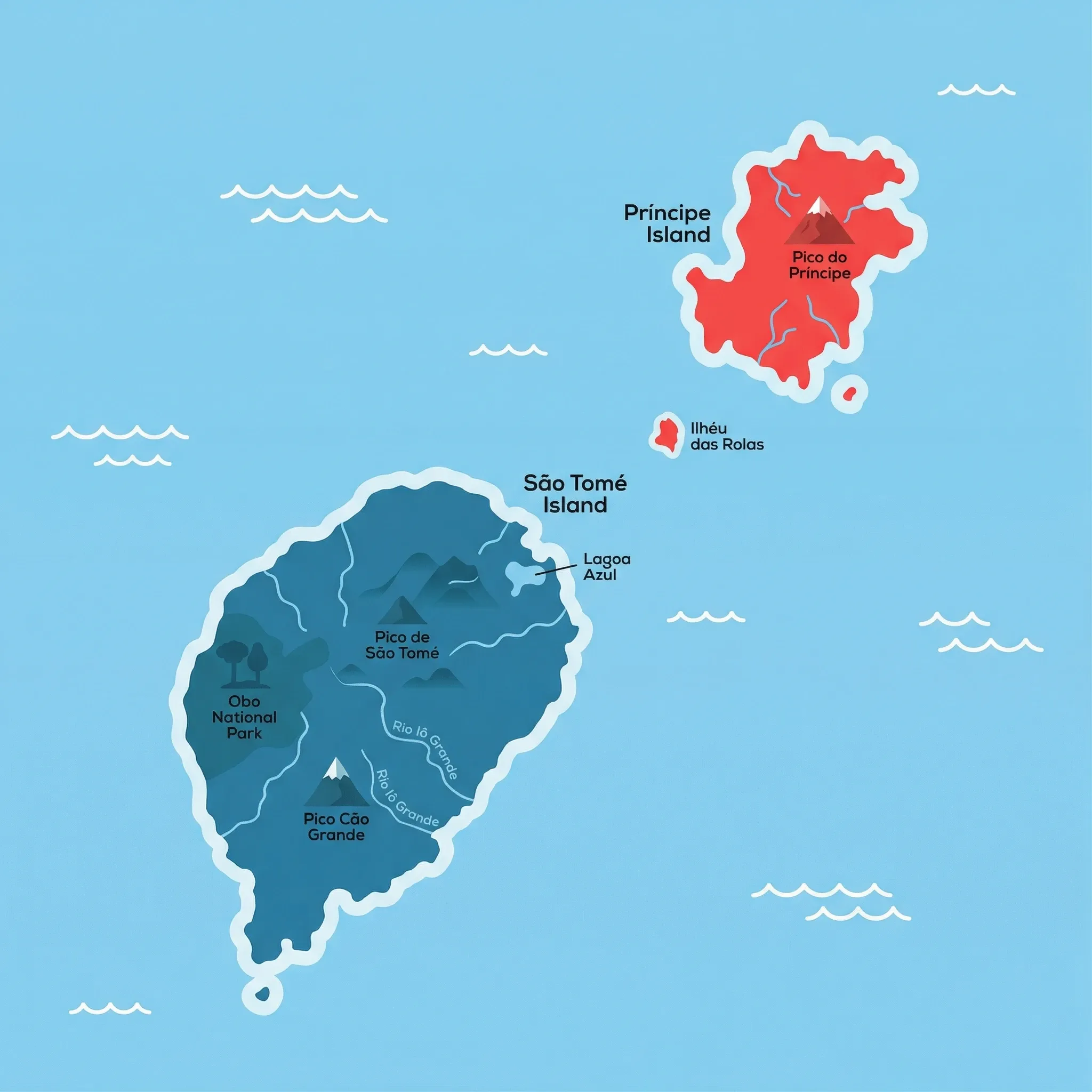
Click on a region marker to explore details. Use the dropdown to color regions by activity suitability.

Getting There & Around
Getting There
- By Air – The main gateway is São Tomé International Airport (TMS). TAP Air Portugal offers regular flights from Lisbon (LIS), which is the most common route for European and North American travelers. Afrijet connects from Gabon.
- Entry Requirements – Visitors from the US, UK, EU, and Canada can typically enter visa-free for stays of up to 15 days. An airport security fee (approx. €20) is usually payable. Check your government website for the latest visa requirements, or use the IATA Travel Centre entry-requirements checker.
Getting Around
- Car Hire – The best way to explore São Tomé Island is by renting a 4x4 (Suzuki Jimnys are popular). Roads can be rough and potholed, so a sturdy vehicle is essential.
- Taxis – Yellow shared taxis are cheap and plentiful for short hops, but less convenient for family sightseeing. Private taxi drivers can be hired for full-day excursions.
- Inter-Island Flights – To reach Príncipe Island, you must fly. Flights are operated by STP Airways or Africa's Connection (approx. 35 mins). Note that these carriers have historically faced regulatory restrictions in the EU but remain the standard, reliable method for local travel.

Packing List
ATMs often reject foreign cards and credit cards are rarely accepted; cash is essential for daily spending.
Street lighting is scarce and power cuts can occur; essential for walking back to hotels after dinner.
Many beaches have volcanic rocks and sea urchins; protects children's feet while swimming.
Essential for boat trips (like to the Equator) and sudden tropical rain showers to keep electronics safe.
Wastewater treatment is limited; helps protect the pristine river and marine ecosystems.

Activities & Best Times

Adventure & Nature
Very GoodHiking, wildlife, outdoor exploration, ecotourism
A UNESCO Biosphere Reserve offering high endemism and dramatic volcanic phonolith peaks within primary rainforest. Exploration is best during the drier gravana (June-August) and the short dry window in January to avoid impassable jungle mud.
Home to the Obo National Park and iconic volcanic plugs, the island offers raw, world-class jungle immersion and endemic biodiversity. The dry 'Gravana' season (June-September) is the only reliable time for deep forest exploration and navigating steep volcanic trails.

Beach & Sea
GoodBeach resorts, marine activities: diving, snorkelling, kite surfing, wind surfing, sailing
Features pristine, secluded beaches like Praia Banana and world-class eco-resorts with high privacy. Peak visitation aligns with dry seasons when sea conditions are calmest and underwater visibility is optimal for snorkeling.
Offers stunning, uncrowded volcanic beaches and snorkeling in crystal-clear lagoons like Lagoa Azul. Conditions are best during the two dry spells when sea visibility is at its peak and the Atlantic swell is manageable for family swimming.

City & Cultural
GoodUrban tourism, museums, historical sites, architecture
Offers a unique glimpse into the Luso-African history of the Roças (plantation estates) and the colonial charm of Santo António. Visiting during the drier months is essential for comfortable walking tours of the historic architecture.
While the Luso-African cultural fusion and roça heritage are unique and interesting, 'very_good' suggests this is a top cultural destination on a regional/international scale. The island lacks the density of cultural institutions (major museums, theaters, UNESCO World Heritage sites beyond plantation heritage) that would justify very_good when calibrated against international standards. The cultural experience is authentic and worthwhile ('good') but not nationally or regionally outstanding ('very_good').

Road Trips & Scenic
GoodScenic drives, countryside tours, route-based travel
Scenic routes connect historic Roças and remote beaches through dense jungle, providing an authentic sense of discovery. Travel is limited to the dry seasons when unpaved roads and forest tracks are safe for 4x4 vehicles.
The scenic drive south along the EN2 provides dramatic views of the rainforest meeting the ocean and the towering Pico Cão Grande. Heavy rainfall in the peak wet seasons often leads to landslides and difficult driving conditions on the interior mountain coffee routes.

Sports & Active
GoodSport tourism, fitness activities, active recreation
Rugged hiking trails to Pico Papagaio offer world-class challenges for active families. These steep, primitive routes require the sustained dry weather of the gravana (June-August) for safety and accessibility.
Serious trekking opportunities exist for the summit of Pico de São Tomé and the Lagoa Amélia crater. These high-altitude activities are highly seasonal, requiring the dry 'Gravana' weather for safety on the island's notoriously slippery volcanic mud trails.

Educational & Exploratory
MarginalLearning experiences, scientific sites, historical education
Home to Roça Sundy, the site where Eddington proved Einstein's Theory of Relativity in 1919. While a significant historical milestone, the educational infrastructure is niche and best visited during general tourism peaks.
Specific educational opportunities exist at the Bom Sucesso Botanical Garden and sea turtle conservation sites. These provide authentic insights into equatorial ecology, best visited during drier periods when accessibility to conservation centers is guaranteed.

Public Holidays & Calendar Next 12 months
Public holidays, festivals, cultural celebrations, and seasonal natural phenomena coming up in São Tomé and Príncipe over the next 12 months.
Loading holidays and events...
Climate & Weather
Príncipe Island
Show Details
| Month | Temp °C | Rain | Humidity |
|---|
São Tomé Island
Show Details
| Month | Temp °C | Rain | Humidity |
|---|

Travel Advisory
The majority of international agencies classify the country as having a stable security environment where standard safety precautions are sufficient. However, some agencies highlight specific health risks and limited medical infrastructure as reasons for increased vigilance.
Safety Topics
Traveller Advice (2 groups)

While same-sex relations are not illegal, local society is generally less tolerant than in some Western nations. Public displays of affection may lead to unwanted attention or negative reactions.

Female travellers should follow standard safety protocols and research local customs. Solo travel is generally safe but requires typical awareness of surroundings.
Agency Summaries
Increased vigilance is recommended due to significant health risks and the limited availability of medical services. Facilities for emergency care and trauma are inadequate, often requiring expensive medical evacuation for even minor conditions.
General safety levels are comparable to those in major international cities. Travellers should stay informed via local media and maintain standard personal security awareness.
Travellers are advised to follow standard safety measures similar to those in Canada. Security risks are generally low, but visitors should remain aware of their surroundings and safeguard personal property.
Due to various safety and security considerations, visitors should exercise heightened vigilance. Consular assistance is limited as there is no resident Irish diplomatic mission.
The country is generally peaceful with low crime rates. Visitors are advised to take common-sense precautions against petty theft and be aware of limited local infrastructure and medical resources.
There is currently no specific travel advisory in place, indicating a stable safety environment. Travellers are encouraged to maintain typical personal security and ensure comprehensive travel insurance is obtained.
Information is provided for general guidance only and does not constitute travel, safety, medical, or legal advice. Conditions may change. Users are responsible for independently verifying information before travel.