

⚠️ SAFETY WARNING: Exercise increased caution in Seychelles due to limited medical infrastructure on smaller islands. While generally safe, crime can occur; never leave bags unattended on beaches or in rental cars. Swimming can be dangerous due to strong currents-always obey warning flags.
Overview
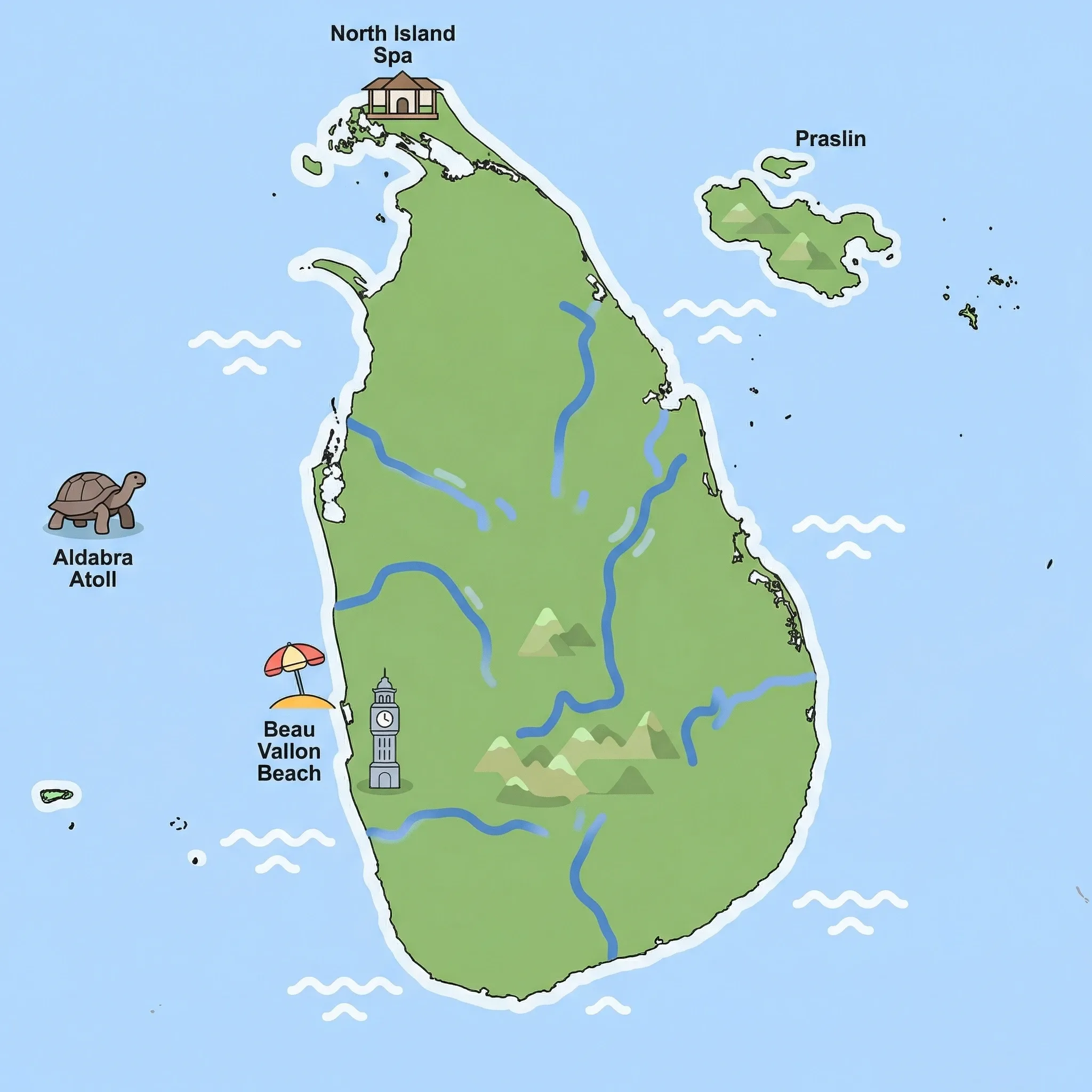
Rising from the Indian Ocean like a lost world, Seychelles is an archipelago of 115 islands that feels entirely distinct from other tropical destinations. Unlike the flat coral atolls of the Maldives, the main Inner Islands are granitic, featuring dramatic mountain peaks, lush rainforests, and the iconic smooth boulders that frame its world-famous beaches. For families, this geography provides a stunning natural playground where adventures range from easy jungle hikes to spotting rare birds and swimming with hawksbill turtles. The vibe is unhurried and deeply connected to nature, with a Creole culture that is welcoming to children and rooted in a blend of African, European, and Asian influences.
While often seen as a honeymooner's paradise, the islands are surprisingly well-suited for family travel. The main island of Mahé offers convenience and mountain trails, while Praslin is home to prehistoric forests and calm bays. La Digue, perhaps the most family-friendly of all, is largely car-free, allowing parents and kids to explore by bicycle. The climate is warm year-round, sitting outside the cyclone belt, making it a reliable destination for sun-seekers. Whether you are watching a sunset at Beau Vallon or meeting the giant tortoises that outnumber humans on some islands, Seychelles offers a safe, magical, and educational escape for children of all ages.
Key Attractions
Nature is the primary attraction here, and nowhere is this more evident than at the Vallée de Mai Nature Reserve on Praslin. This UNESCO World Heritage site is often called the "Garden of Eden" and is the best place to show children the legendary Coco de Mer-the world's largest seed, which looks comically like a human pelvis. The ancient palm forest feels like walking through a dinosaur habitat, and keen-eyed kids might spot the elusive Seychelles Black Parrot high in the canopy. It is an accessible and essential stop for any family visiting the archipelago.
On the main island of Mahé, active families can explore the Morne Seychellois National Park. This vast park covers more than 20% of the island and offers a network of trails suitable for various ability levels. The Copolia Trail is particularly good for older children, leading to a granite summit with carnivorous pitcher plants and sweeping views over the capital. Afterwards, a visit to the capital itself, Victoria, isn't complete without seeing the Victoria Clock Tower. A silver-painted replica of Little Ben in London, it sits at the busy heart of the majestic, tiny capital and serves as a quirky historical marker of the island's British colonial past.
For the ultimate wildlife adventure, the distant Aldabra Atoll is a dream destination. Although difficult to reach and requiring special permits or an expedition cruise, it is a second UNESCO World Heritage site and home to the world's largest population of giant tortoises-over 100,000 of them. For those who cannot make the long journey to Aldabra, similar encounters with free-roaming tortoises can be found on Curieuse Island (accessible by boat from Praslin) or La Digue, ensuring every child gets to meet these gentle giants.
Practical Advice
The best times to visit are the shoulder months of April–May and October–November, when the trade winds are calmest, making ferry crossings smoother and underwater visibility best for snorkeling. A mandatory Travel Authorization (TA) must be applied for online before travel. Healthcare is good on Mahé but limited on smaller islands; always travel with comprehensive insurance. Mosquitoes can be a nuisance, so pack child-safe repellent. Tap water is treated on Mahé and Praslin but bottled water is recommended for short stays.
Food & Drink
Typical meal times: Lunch is typically served from 12:00 pm to 2:30 pm, and dinner from 7:00 pm to 9:30 pm. Many local takeaways close early, around 4:00 pm or 5:00 pm.
Typical meal costs: Sit-down meals are pricey, ranging from SCR 400–800 (approx. $30–60 USD / €28–55 EUR) per person. Local "takeaways" are a budget saver, offering generous portions for SCR 75–150 (approx. $5.50–11 USD / €5–10 EUR). A local beer in a shop costs around SCR 45 (approx. $3.50 USD / €3 EUR).
Dietary requirements: Vegetarian options are available but can be limited to sides or specific curries in smaller spots. Halal food is widely available due to the diverse population. Gluten-free awareness is growing in luxury resorts but rare in local takeaways; always ask specifically about ingredients like soy sauce or batter.
Family-friendly dining: The best option for families is the ubiquitous "Creole Takeaway" box-fast, cheap, and eaten on the beach. Most hotels offer kid-friendly Western staples like pasta and burgers. Highchairs are standard in resorts but may be absent in small local eateries.
Signature dishes:
- Grilled Fish (Pwason Griye) – Freshly caught jobfish or red snapper marinated in ginger, garlic, and chili, then grilled over coconut husks.
- Octopus Curry (Curry Zourite) – A tender, creamy curry made with coconut milk and local spices; a must-try classic that isn't too spicy for adventurous kids.
- Ladob – A versatile dish that can be savory (salted fish and plantain) or sweet (banana or sweet potato boiled in coconut milk, sugar, and nutmeg).
- Breadfruit Chips – Thinly sliced and fried breadfruit; a delicious, starchy local snack that serves as a great alternative to potato crisps.
Safety
Seychelles is politically stable and generally safe, but petty crime against tourists does occur. Do not leave valuables visible in rental cars or unattended on the beach while swimming. The biggest risk for families is often the ocean; currents can be deceptively strong, especially during the southeast monsoon (May to September). Only swim at beaches with lifeguards or those designated as safe by locals, and strictly observe warning flags. On La Digue, ensure bicycles are in good condition and wear helmets, as the paths can be narrow and sandy.

Seychelles is a premium destination. While local takeaways offer meals for SCR 75–150 (approx. $5.50–11 USD / €5–10 EUR), sit-down dining and activities are expensive. A family of four should budget SCR 5,500–8,000 (approx. $400–580 USD / €370–540 EUR) per day for mid-range accommodation, car hire, and meals. Ferries between islands cost significant amounts (e.g., SCR 850+ per adult).
Age Suitability




Did you know? Seychelles welcomes approximately 332,000 international visitors per year. Most visitors come from Europe.
Why this score?
The region offers moderate adventure through island-hopping, snorkeling in marine parks like Ste Anne, and hiking the rugged granite trails of Morne Seychellois National Park. While the outer islands like Aldabra represent extreme wilderness, the vast majority of tourists stay in well-developed resort areas with accessible infrastructure. It provides a balance of outdoor recreation without the logistical challenges of more rugged adventure destinations.
Why this score?
Medical facilities are concentrated on the main islands of Mahé and Praslin, with the Seychelles Hospital in Victoria providing basic emergency and specialist care. While adequate for routine issues and minor emergencies, the system is limited for complex surgical or specialized treatments, which often require medical evacuation to Mauritius or South Africa. Private clinics exist but may have limited capacity compared to larger international medical hubs.
Why this score?
While Seychelles is world-famous as a luxury honeymoon destination, its annual visitor count of approximately 332,000 is low in absolute terms compared to global tourism hubs. It remains a niche, high-end archipelago with a focus on low-impact tourism rather than mass-market appeal. Its popularity is driven by iconic sites like Anse Source d'Argent and the Vallée de Mai, which attract a consistent flow of international travelers.
Seychelles is a high-cost destination due to most goods being imported. A mid-range family hotel or guesthouse apartment costs SCR 3,500–6,500 (approx. $260–480 USD / €240–450 EUR) per night. Luxury resorts start significantly higher. Car rental is roughly SCR 650–900 (approx. $48–67 USD / €45–62 EUR) per day. To save money, eat at local 'takeaways' where a filling box meal costs around SCR 75–120 (approx. $5.50–9 USD / €5–8 EUR).

Getting There & Around
Getting There
- By Air – Seychelles International Airport (SEZ) on Mahé is the main gateway, receiving direct flights from hubs like Dubai, Doha, and Nairobi.
- By Sea – Cruise ships occasionally dock in Victoria, allowing day-trip access to the Victoria Clock Tower and nearby beaches, but most visitors arrive by plane.
- Entry Requirements – Visitors do not need a visa but MUST obtain a Travel Authorization (TA) via the official government platform before travel. Check your government website for the latest visa requirements, or use the IATA Travel Centre entry-requirements checker.
Getting Around
- Ferries – The Cat Cocos catamaran is the main link between Mahé, Praslin, and La Digue. Crossings take 15–60 minutes. Book in advance; the ride can be choppy, so consider motion sickness meds for kids.
- Car Hire – Recommended for exploring Mahé and Praslin. Driving is on the left. Small jeeps are standard and handle the steep, winding mountain roads well.
- Bicycles – The primary mode of transport on La Digue. Renting bikes is essential for visiting beaches like Anse Source d'Argent; child seats and smaller bikes are widely available.
- Domestic Flights – Air Seychelles operates short 15-minute flights between Mahé and Praslin, offering spectacular aerial views of the Vallée de Mai Nature Reserve and surrounding reefs.

Packing List
Essential for protecting feet from sharp coral and rocks at low tide.
La Digue and smaller islands have very little street lighting after dark.
Ferry crossings between islands can be surprisingly rough.
Strictly required to protect the delicate marine ecosystems you will swim in.
Keeps electronics safe during wet boat transfers and beach days.

Activities & Best Times

Beach & Sea
ExcellentBeach resorts, marine activities: diving, snorkelling, kite surfing, wind surfing, sailing
Seychelles has internationally iconic beaches (Anse Source d'Argent, Anse Lazio) that rank among the world's best. Current 'good' rating severely underrates global significance. Beaches are the primary tourism draw and meet 'excellent' international calibration standards.

Adventure & Nature
Very GoodHiking, wildlife, outdoor exploration, ecotourism
Offers exceptional biodiversity from the Aldabra Atoll to the endemic flora of the Morne Seychellois National Park. Exploration is best during the drier SE trade wind season, as the high humidity and heavy rainfall of the wet season make trails slippery and conditions oppressive.

City & Cultural
Very GoodUrban tourism, museums, historical sites, architecture
While Seychelles has rich Creole culture and Festival Kreol, Victoria is a small capital lacking globally significant cultural institutions. 'Excellent' should be reserved for world-class cultural destinations (Paris, Rome, Kyoto). 'Very good' better reflects nationally significant but not internationally outstanding cultural offerings.

Educational & Exploratory
MarginalLearning experiences, scientific sites, historical education
Niche educational opportunities exist through marine restoration centers and pearl farming operations. These experiences are most accessible and enjoyable outside of the peak rainy season when inter-island travel is most reliable.

Sports & Active
MarginalSport tourism, fitness activities, active recreation
Includes high-quality adventure infrastructure such as ziplining and rock climbing facilities within tropical settings. Activity seasons are dictated by the drier months to ensure the safety and feasibility of outdoor climbing and canopy activities.

Attractions (16 total)



Public Holidays & Calendar Next 12 months
Public holidays, festivals, cultural celebrations, and seasonal natural phenomena coming up in Seychelles over the next 12 months.
Loading holidays and events...

Travel Advisory
The majority of international agencies classify Seychelles as a safe destination where standard travel safety precautions are sufficient. While some specific health or crime risks exist, there are no country-wide warnings against travel.
Safety Topics
Traveller Advice (3 groups)

All visitors must secure a digital Travel Authorization before arrival and should maintain basic vigilance against petty theft, especially in popular tourist zones and on beaches.

While same-sex relations are legal, local attitudes can be conservative; travelers should exercise discretion and be aware of potential discrimination in less tourist-oriented areas.

When hiking, use established trails and consider a local guide as paths may be poorly marked. Ensure marine excursion boats provide adequate safety gear and life jackets.
Agency Summaries
Travelers are encouraged to follow routine safety measures. Specific attention is drawn to the risk of petty crime, mosquito-borne illnesses, and hazardous sea conditions during certain seasons.
Safety conditions are comparable to those in New Zealand. Recommended actions include securing comprehensive travel insurance and staying informed about local environmental hazards.
Most visits are trouble-free, though travelers are advised to be cautious of petty theft on beaches and in urban centers like Victoria. No major travel restrictions are currently in place.
The overall advisory suggests increased vigilance, primarily due to health-related risks and limited medical infrastructure on islands such as Praslin and La Digue. Most areas remain safe for standard tourism.
There is no specific advisory against travel. Standard personal security practices are recommended, and travelers must comply with the mandatory electronic entry requirements.
Visitors should maintain a standard level of safety awareness as they would in their home country. While generally safe, travelers should stay alert to petty crime and follow local safety guidelines.
Information is provided for general guidance only and does not constitute travel, safety, medical, or legal advice. Conditions may change. Users are responsible for independently verifying information before travel.