

Overview
Sierra Leone, often called "Sweet Salone" by locals, is a destination of startling beauty and resilience. For families, it offers a rare opportunity to experience West Africa in its most authentic form, away from mass tourism. The geography is dramatic: the capital, Freetown, sits at the foot of lush, jungle-clad mountains that tumble directly into the Atlantic Ocean. The coast is lined with some of the finest beaches on the continent-soft, golden sands framed by palm trees and largely empty of crowds. Inland, the landscape shifts to rainforests teeming with rare wildlife, including the elusive pygmy hippo and diverse primate species.
Culturally, the country is a warm embrace. Despite a turbulent history, Sierra Leoneans are famous for their hospitality and religious tolerance. Traveling here with children opens doors; locals are extremely family-oriented and will go out of their way to welcome young visitors. While infrastructure can be challenging-roads are variable and electricity can be sporadic-the reward is a genuine connection with a vibrant culture. Families can learn about the complex history of the trans-Atlantic slave trade, hike through rainforest sanctuaries, and swim in warm, calm waters. It is a destination for adventurous families ready to trade resort comforts for meaningful experiences.
Key Attractions
The Western Area Peninsula National Park is the country's natural crown jewel. This UNESCO-tentative site protects the last remnant of the Upper Guinean rainforest in West Africa. Families can drive the scenic peninsula road, stopping at breathtaking beaches like River No. 2, where a freshwater river meets the sea, creating a safe, shallow natural pool perfect for children. Inland, the forest is home to various monkeys and birds, making it a fantastic spot for introductory nature walks.
For a powerful history lesson, a boat trip to Bunce Island is essential. Located in the Freetown harbour, this ruined fortress was a major slave trading post. Walking among the canons and crumbling walls is a somber but educational experience for older children, illustrating the deep historical ties between Sierra Leone and the Americas. Back in the capital, the site of The Cotton Tree remains a national symbol. Although the 400-year-old giant fell during a storm in 2023, the location remains the spiritual heart of the city, marking where freed enslaved people held their first thanksgiving service in 1792.
For wildlife enthusiasts, a journey east to Tiwai Island Wildlife Sanctuary offers a true jungle adventure. Located on the Moa River, this community-run sanctuary has one of the highest concentrations of primates in the world. Families can stay in basic solar-powered tents, take guided forest walks to spot colobus monkeys, and enjoy boat rides to look for pygmy hippos. It is a rustic, immersive experience that brings storybook jungle scenes to life.
Practical Advice
The best time to visit is the dry season (November to April), when roads are passable and beaches are at their best. A Yellow Fever vaccination certificate is mandatory for entry. Malaria is a serious risk; families must take prophylaxis and use mosquito nets. The journey from Lungi International Airport to Freetown requires a boat transfer (water taxi or ferry) across the estuary-an adventure in itself. Be prepared for occasional power cuts and carry cash, as credit cards are rarely accepted outside top hotels.
Food & Drink
Typical meal times: 12:00 pm to 3:00 pm for lunch, and 7:00 pm to 9:00 pm for dinner.
Typical meal costs: SLE 100–350 (approx. $4.50–15 USD / €4–14 EUR) for a main dish in a decent restaurant; street food is much cheaper.
Dietary requirements: Vegetarian options are available but limited, often involving rice with beans or cassava leaves (check for dried fish used as seasoning). Peanuts (groundnuts) are a staple ingredient, so allergy sufferers must be vigilant.
Family-friendly dining: Sierra Leonean culture loves children, so kids are welcome everywhere. Highchairs are rare. Beach restaurants offer the most relaxed environment for families, with sand for kids to play in while waiting.
Signature dishes:
- Cassava Leaf Stew – The national dish, made from pounded cassava leaves cooked with palm oil, groundnuts, and meat or fish.
- Groundnut Soup – A rich, creamy peanut stew often served with rice or fufu (pounded yam/cassava).
- Fry Fry – A popular street food assortment of fried plantains, akara (bean cakes), and fried potatoes, often served with spicy gravy.
- Jollof Rice – A spicy one-pot rice dish cooked with tomatoes, onions, and spices; Sierra Leoneans fiercely defend their version against Nigerian or Ghanaian rivals.
- Yebe – A thick, hearty stew made with cassava, yam, plantain, and palm oil, often eaten as a comfort food.
Safety
Sierra Leone is generally safe for tourists, but petty crime like pickpocketing exists in Freetown and on crowded beaches. Avoid walking alone at night and keep valuables hidden. Ocean currents can be strong; always ask locals where it is safe to swim. Road safety is a major concern; avoid travelling inter-city roads after dark due to poor lighting and vehicle conditions. Always drink bottled or filtered water.

While street food is cheap, accommodation and tourist-standard services are priced for expats and aid workers. A family of four should budget SLE 3,500–5,500 (approx. $150–240 USD / €140–220 EUR) per day for mid-range hotels, meals, and private transport. Car hire is expensive.
Age Suitability




Did you know? Sierra Leone welcomes approximately 40,000 international visitors per year. Most visitors come from Europe.
Explore Regions
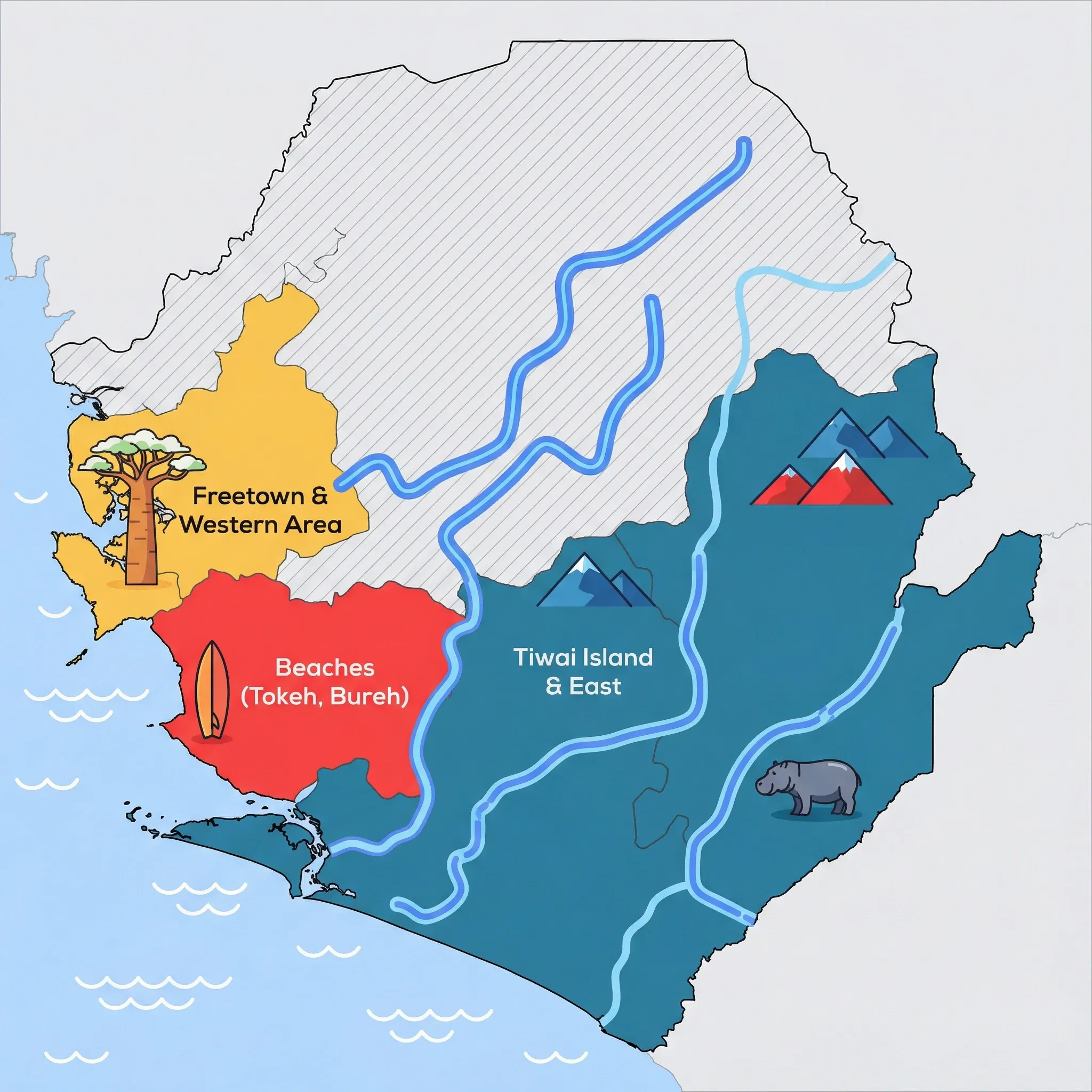
3 Regions
Beaches (Tokeh, Bureh)
Where the rainforest meets white sand 🌊🏝️
Freetown & Western Area
A vibrant city of history, hills, and hope 🇸🇱🏙️
Tiwai Island & East
A jungle island adventure for little explorers 🐒🌿
Click on a region marker to explore details. Use the dropdown to color regions by activity suitability.

Getting There & Around
Getting There
- By Air – Freetown Lungi International Airport (FNA) is the main gateway. To reach Freetown & Western Area from the airport, you must cross the estuary. The "Sea Coach Express" water taxi is the fastest option (30 mins), costing approx. SLE 1,100 ($45 USD). The public ferry is cheaper but slower.
- Entry Requirements – Most Western visitors require a visa. An Airport Security Fee ($25 USD) must be paid online via Securipass before arrival and departure. Check your government website for the latest visa requirements, or use the IATA Travel Centre entry-requirements checker.
- By Land – Border crossings from Guinea (Conakry) and Liberia (Monrovia) exist but roads can be rough and borders may close unexpectedly.
Getting Around
- Private Taxi / Car Hire – The safest and most convenient option for families. Hiring a vehicle with a driver costs approx. SLE 1,800–2,800 (approx. $80–120 USD / €75–110 EUR) per day. Essential for exploring the Beaches (Tokeh, Bureh).
- Keke – Three-wheeled motorised rickshaws (tuk-tuks) are common in cities. They are cheap-short hops cost SLE 5–10 (approx. $0.20–0.45 USD / €0.20–0.40 EUR)-and fun for older kids, but negotiate the price first.
- Poda-Poda – Minibuses that serve as public transport. They are very crowded, often driven erratically, and generally not recommended for families with young children or luggage.
- Domestic Flights – Limited, but private charters are occasionally available for travel to remote areas.

Packing List
Banks and exchanges often refuse bills with even tiny tears, ink marks, or dates older than 2009.
Power cuts are frequent even in hotels; street lighting is rare outside main roads.
High-risk zone; medication is essential, not just bug spray.
Digital copies are not always accepted or easy to show if phone battery dies or internet fails.
Essential for the airport water taxi transfer to keep luggage dry from sea spray.

Activities & Best Times

Adventure & Nature
Very GoodHiking, wildlife, outdoor exploration, ecotourism
Home to the world-renowned Tacugama Chimpanzee Sanctuary and the lush Western Area Peninsula National Park. The dry season is essential for navigating jungle trails and observing wildlife without the logistical challenges of Sierra Leone's extreme rainfall.
The rare intersection of tropical rainforest and coastline in the Western Area Peninsula National Park provides exceptional hiking and wildlife viewing. Trails are best navigated during the dry season to avoid heavy monsoon rains and ensure safe passage.
Tiwai Island and Gola Rainforest offer exceptional primate viewing and rare pygmy hippo sightings in an authentic, low-density setting. The dry season (Nov-Mar) is essential for navigable trails and optimal wildlife spotting before the heavy monsoon rains begin.
Beach & Sea
GoodBeach resorts, marine activities: diving, snorkelling, kite surfing, wind surfing, sailing
Breathtaking white-sand beaches like River No. 2 and Tokeh offer an authentic, uncrowded alternative to mainstream resorts. The dry season provides ideal conditions with calm, clear waters and sunny skies for families seeking high-quality natural beauty.
Features stunning, undeveloped white-sand beaches like River No. 2 and Tokeh Beach which offer authentic tropical beauty. Peak season aligns with the dry months when the Atlantic is calm and crystal clear, whereas the monsoon rains make coastal activities impractical.

City & Cultural
GoodUrban tourism, museums, historical sites, architecture
Historic Krio villages like York and Kent offer a profound, uncommercialized look into West African heritage and post-abolition history. These sites are best explored during the dry season when village walking tours are most comfortable and accessible.
Freetown offers a deep historical narrative through sites like Bunce Island and the Cotton Tree, reflecting the city's unique Krio heritage. Tourism is concentrated in the drier, slightly cooler months when boat transfers to historic islands are safest and urban walking tours are comfortable.
Kenema provides a glimpse into the regional diamond trade and local Mende culture, though urban infrastructure remains basic for international standards. Visit during the peak dry months of December and January to avoid extreme humidity and travel-disrupting rainfall.

Road Trips & Scenic
GoodScenic drives, countryside tours, route-based travel
The Western Area Peninsula Circular Route is a celebrated scenic drive connecting rainforest-backed beaches. Travel is highly seasonal, as the rainy season can significantly degrade road conditions and obscure the dramatic mountain-and-sea views.
The Peninsula Road provides a scenic drive between the mountains and the sea, connecting various historic coastal villages. While beautiful, the limited route length makes it a secondary activity best enjoyed when visibility is high and roads are dry.

Sports & Active
GoodSport tourism, fitness activities, active recreation
Offers authentic community-based surfing at Bureh Beach and scenic cycling loops around the peninsula. Outdoor activities are highly weather-dependent, making the dry season the peak for families wanting reliable conditions for surfing and trail sports.
Bureh Beach is a growing hub for international surfing, while Sugar Loaf Mountain offers challenging hiking trails. Peak conditions occur in the dry season when waves are consistent for beginners and trails remain firm and accessible.
The region features rugged trails for hiking and primate trekking through dense rainforest and hilly terrain. These routes are effectively impassable for active tourism during the peak rainy season due to deep mud and high river levels.

Educational & Exploratory
MarginalLearning experiences, scientific sites, historical education
Dedicated research stations at Tiwai and Gola offer specialized insights into tropical conservation and rare species monitoring. These facilities are most accessible and active during the dry season when field work is at its peak.
The National Railway Museum provides a unique window into West African colonial history, though it is a niche attraction. It serves as a meaningful stop for families during the dry season when integrated into broader cultural itineraries.

Theme Park & Entertainment
MarginalAmusement parks, family entertainment venues

Public Holidays & Calendar Next 12 months
Public holidays, festivals, cultural celebrations, and seasonal natural phenomena coming up in Sierra Leone over the next 12 months.
Loading holidays and events...

Climate & Weather
Beaches (Tokeh, Bureh)
Show Details
| Month | Temp °C | Rain | Humidity |
|---|
Freetown & Western Area
Show Details
| Month | Temp °C | Rain | Humidity |
|---|
Tiwai Island & East
Show Details
| Month | Temp °C | Rain | Humidity |
|---|

Travel Advisory
Consensus among major agencies indicates that while travel is possible, visitors must exercise a high degree of vigilance due to prevalent violent crime, political volatility, and inadequate infrastructure.
Safety Topics
Traveller Advice (3 groups)

Follow conservative dress and behavior standards to align with local social traditions and minimize the risk of harassment.

Do not travel outside of the Freetown peninsula after dark due to extreme safety risks. Always carry identification and keep vehicle doors locked and windows closed while in transit.

Be aware that same-sex relationships are illegal in Sierra Leone. Public displays of affection could lead to legal repercussions or social hostility.
Agency Summaries
The risk of violent crime such as armed robbery is elevated, especially after dark. Political tensions may lead to protests, and medical services are extremely limited.
Visitors are advised to check local security and health guidelines. Key focus areas include safety protocols, mandatory entry fees, and differing local legal standards.
Increased vigilance is suggested because of the risk of demonstrations and violent crime. Travellers must adhere to strict entry requirements, including a security fee and vaccination proofs.
Heightened awareness is required because of frequent violent crime, including assault and robbery, alongside potential civil unrest. Healthcare facilities are considerably below Western standards.
Travellers should remain highly vigilant due to significant crime rates and safety concerns on the roads. Movement outside the capital after sunset is discouraged because of hazardous driving conditions and limited emergency support.
Caution is recommended due to the threat of violent crime and civil disturbances. New health screening measures for Mpox have been implemented at entry points.
Information is provided for general guidance only and does not constitute travel, safety, medical, or legal advice. Conditions may change. Users are responsible for independently verifying information before travel.