

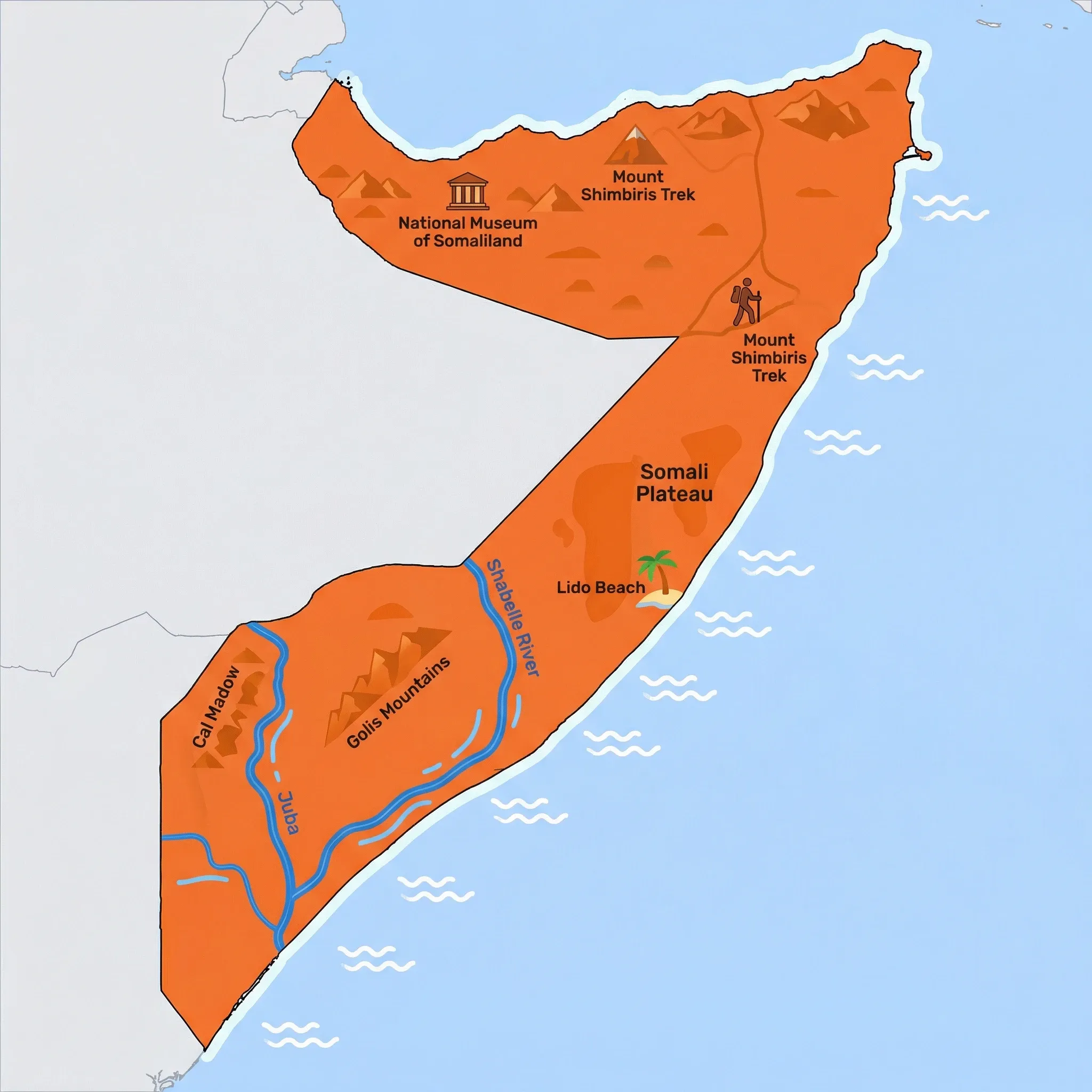
⚠️ SAFETY WARNING: Due to political volatility, high rates of violent crime, and limited medical infrastructure, government agencies (including the US, UK, and Canada) advise travelers to avoid all travel to this country. The security situation can change rapidly, and consular support is severely limited or non-existent. Families are strongly urged to consult their own government's official travel advisory before considering a trip, as circumstances and risk assessments vary.
Overview
Situated on the sharp point of the Horn of Africa, Somalia is a land of stark beauty, ancient history, and profound resilience. While the southern regions, including Mogadishu, remain extremely volatile, the northern self-declared republic of Somaliland offers a comparatively stable (though still high-risk) window into the region's culture. Geographically, it boasts the longest coastline on mainland Africa, stretching from the Gulf of Aden to the Indian Ocean, fringed by white sands and turquoise waters that remain largely unseen by the outside world.
Culturally, this is the "Nation of Poets," where oral storytelling and poetry are woven into the fabric of daily life. For the very few families who visit-often those with diaspora roots or extreme adventure experience-the appeal lies in witnessing a way of life that balances traditional nomadic camel herding with rapid urban modernisation. The atmosphere is undeniably intense but also incredibly hospitable; guests are treated with immense honour. Children will be fascinated by the ubiquitous camels, the bustling markets, and the tangible sense of living history.
Key Attractions
The undisputed highlight for any visitor is Laas Geel. Located on the outskirts of Hargeisa, this complex of caves contains some of the best-preserved rock art in Africa, dating back over 5,000 years. The vivid paintings of cattle and herders are incredibly clear, allowing children to see a prehistoric storybook painted directly onto the stone. It is a world-class heritage site that rivals anything in Europe or the Americas, yet you will likely have it entirely to yourselves.
In the capital of the north, Hargeisa, the National Museum of Somaliland (Sarya Museum) offers a cultural grounding. It houses a modest but poignant collection preserving the heritage of the region, from ethnographic artifacts to remnants of the struggle for independence. Nearby, the famous Hargeisa Camel Market provides a sensory overload where families can watch thousands of camels, goats, and sheep being traded-a spectacle that has remained largely unchanged for centuries.
Practical Advice
Best time to visit: The cooler months from November to February are the most bearable. The summer months (June to August) are extremely hot and windy (the Kharif wind).
Visas: Entry requirements are complex. The federal government has an e-visa system, but Somaliland (where most tourists go) issues its own visas, often on arrival at Hargeisa airport or via its missions abroad. Always verify with the specific representative office relevant to your entry point.
Health: Malaria prophylaxis is essential. Medical facilities are very basic; comprehensive travel insurance with medical evacuation cover is non-negotiable.
Food & Drink
Typical meal times: Lunch is the main meal, typically served from 1:00 pm to 2:30 pm. Dinner is lighter and eaten late, often from 8:00 pm to 10:00 pm.
Typical meal costs: £3–12 (approx. $4–15 USD / €3.50–14 EUR). A simple local meal of rice and meat is very cheap, while western-style meals in secure hotels cost more.
Dietary requirements: The cuisine is 100% Halal. Vegetarian options are limited to pasta, rice, and beans, as meat (camel, goat) is central to almost every dish. Gluten-free travelers may struggle as flatbreads are a staple.
Family-friendly dining: Eating is traditionally communal and done with the right hand, which children often find fun. Restaurants are informal, and children are welcomed warmly everywhere.
Signature dishes:
- Canjeero – A spongy, fermented pancake similar to Ethiopian injera but smaller and eaten for breakfast with tea and sesame oil.
- Bariis Iskukaris – Fragrant Somali rice cooked with spices (cloves, cardamom), raisins, and often served with goat or lamb.
- Suqaar – Small cubes of beef, goat, or camel meat sautéed with vegetables and spices, often eaten with pasta or bread.
- Camel Meat – A local delicacy, often served fried or grilled; it is leaner than beef and a unique taste of the region.
- Sambusa – Triangular fried pastries filled with spiced minced meat and onions, a favourite snack for children.
Safety
Security is the primary concern. In Somaliland, all foreigners traveling outside major cities like Hargeisa must be accompanied by an armed SPU (Special Protection Unit) guard; this is a legal requirement and hotels will arrange it. In Mogadishu, movement is typically restricted to the "Green Zone" or requires a private security detail in an armoured vehicle. Kidnapping remains a threat. Photography of government buildings, soldiers, or police is strictly prohibited and can lead to arrest.

While local food is cheap, the logistical cost of safety makes travel expensive. Hiring a 4x4 vehicle with a driver and the mandatory armed SPU guard (in Somaliland) typically costs $150–250 USD (approx. €140–230 EUR / £120–200 GBP) per day. Hotel rooms in secure compounds range from $50–150 USD (approx. €45–140 EUR / £40–120 GBP) per night. Cash US Dollars are essential.
Age Suitability




Why this score?
Traveling through Somalia is considered expedition-level adventure, often requiring armed security escorts and complex logistical planning. The terrain is rugged and wild, featuring the Golis Mountains and vast semi-arid plains, providing an environment that is physically and mentally demanding for even the most experienced travelers.
Why this score?
Medical infrastructure is extremely underdeveloped and often lacks basic supplies, reliable electricity, and specialized equipment. In the event of a serious illness or injury, international standard care is unavailable locally, making emergency aero-medical evacuation to Nairobi or Dubai a necessity for foreigners.
Why this score?
International leisure tourism is virtually non-existent due to decades of civil unrest and 'Do Not Travel' advisories from most global governments. While the self-declared state of Somaliland sees a tiny stream of intrepid travelers visiting sites like Laas Geel, the country as a whole lacks the infrastructure and safety required for regular international visitor flow.
While local food is inexpensive, the cost of visiting is driven up by necessary security logistics. A secure, mid-range hotel in Hargeisa costs SOS 3,400,000–6,800,000 (approx. $60–120 USD / €55–110 EUR) per night. Hiring a 4x4 vehicle with a driver and mandatory SPU armed guard for excursions typically costs SOS 8,500,000–11,400,000 (approx. $150–200 USD / €140–185 EUR) per day.

Getting There & Around
Getting There
- By Air – Hargeisa (HGA) is the primary gateway for tourists, well-connected by Ethiopian Airlines from Addis Ababa and flydubai from Dubai. Mogadishu (MGQ) is served by Turkish Airlines and Ethiopian Airlines.
- By Land – The border crossing at Wajaale (from Ethiopia) is open and commonly used by overlanders visiting Somalia (Somaliland side), but check the security situation immediately before travel.
- Entry Requirements – Visas are mandatory. Somaliland issues its own visas (often on arrival for many nationalities, or via London/Addis Ababa missions). Federal Somalia visas are separate. Check your government website for the latest visa requirements, or use the IATA Travel Centre entry-requirements checker.
Getting Around
- Private 4x4 with Driver – The only safe and practical way to travel outside cities. In Somaliland, you must also hire an armed SPU (Special Protection Unit) guard to accompany the vehicle when leaving Hargeisa.
- Domestic Flights – Essential for skipping dangerous road routes. Flights connect Mogadishu, Hargeisa, and other regional hubs reliably.
- Taxis – In Hargeisa, marked taxis are generally available for short hops within the city, but families should rely on hotel-arranged transport for safety.

Packing List
ATMs are rare/unreliable for foreign cards. Bring crisp, new notes dated 2009 or later.
Essential for women and girls to respect strict local Islamic dress codes.
Power cuts are frequent in hotels and street lighting is minimal at night.
Dehydration risk is high due to heat; medical supplies are scarce.
Digital copies of visas/permits are often not accepted at checkpoints.

Activities & Best Times

City & Cultural
Very GoodUrban tourism, museums, historical sites, architecture
Laas Geel Rock Art is described as 'world-class Neolithic rock art' and is genuinely of international significance (5,000-11,000 year old cave paintings, exceptionally well-preserved). This site is comparable to other globally famous rock art sites. Combined with Historic Mogadishu's medieval Islamic architecture and Zeila Historic Port, the region deserves 'very_good' for cultural tourism. The current 'good' rating significantly undervalues Laas Geel's importance.

Adventure & Nature
GoodHiking, wildlife, outdoor exploration, ecotourism
The region offers unique biodiversity in the Daallo Forest and dramatic landscapes like the Golis Mountains, providing authentic wilderness experiences. Peak visiting aligns with the dry Jilaal season (Dec-Feb) when temperatures are most comfortable for trekking; rainy seasons (Apr-May and Oct-Nov) create difficult terrain.

Beach & Sea
MarginalBeach resorts, marine activities: diving, snorkelling, kite surfing, wind surfing, sailing
Boasts stunning natural beaches such as Lido and Jazeera with high authenticity, though it lacks the international resort infrastructure required for higher ratings. Optimal conditions occur during the dry seasons when sea visibility is best and the heat is manageable for families.

Relaxation & Wellness
MarginalSpa retreats, wellness centers, peaceful getaways
Natural hot springs like Biyo Guure provide restorative experiences, though facilities do not yet meet global luxury wellness standards. These sites are most enjoyable during the cooler months to offset the heat of the thermal waters.

Road Trips & Scenic
MarginalScenic drives, countryside tours, route-based travel
The route through the Sheikh Pass offers dramatic mountain scenery and technical driving that appeals to adventurous travelers. Clear visibility and safe road conditions are most consistent during the dry winter period, avoiding the unpredictable Gu and Deyr rains.

Sports & Active
MarginalSport tourism, fitness activities, active recreation
Offers niche trekking opportunities on Mount Shimbiris and the Daallo Escarpment for families seeking rugged, non-commercialized active holidays. Activity is best limited to the coolest months of the year to avoid heat exhaustion and seasonal trail washouts during rainy periods.




Public Holidays & Calendar Next 12 months
Public holidays, festivals, cultural celebrations, and seasonal natural phenomena coming up in Somalia over the next 12 months.
Loading holidays and events...

Travel Advisory
All major agencies maintain their highest possible risk level for this country, citing extreme danger from terrorism, kidnapping, and armed conflict.
Safety Topics
Traveller Advice (4 groups)

Female travellers should be aware of severe cultural restrictions and risks related to harassment or forced marriage in certain regions.

Aid workers are frequently viewed as high-value targets by militant and criminal groups for kidnapping, physical assault, and murder.

Media professionals face severe risks of arbitrary arrest, targeted violence, and kidnapping by various armed factions across the country.

Same-sex relationships are illegal under local statutes and sharia law, with potential penalties including public flogging and the death penalty.
Agency Summaries
The Canadian government warns against any travel to the country because of the extremely volatile security environment and the persistent threat of domestic terrorism. Consular help is not available in the region.
Australia maintains its highest risk rating for the country due to the danger of armed conflict, kidnapping, and violent crime. Those in the country should consider departing as soon as it is safe.
The FCDO recommends against any travel to the majority of the territory due to militant groups and ongoing violence. Only specific western regions of Somaliland have a lower restriction level, though travel there is still discouraged.
New Zealanders are told to avoid all travel to the country and its coastal waters. The risk from terrorist attacks and kidnapping is significant across all regions, including major cities.
The Irish government strongly advises against any entry into the country because of the highly unpredictable security situation and the extreme risk of domestic terrorism.
U.S. authorities advise against all travel due to pervasive crime, terrorism, civil unrest, and piracy. Consular services are essentially non-existent, and government personnel are confined to the airport complex in Mogadishu.
Information is provided for general guidance only and does not constitute travel, safety, medical, or legal advice. Conditions may change. Users are responsible for independently verifying information before travel.