

South Korea is a dazzling mix of the ultra-modern and the deeply traditional, offering families a travel experience that is both safe and culturally distinct. Geographically, it is a peninsula of rugged mountains and jagged coastlines, with four distinct seasons ranging from humid, green summers to crisp, snowy winters. For families, the appeal lies in the convenience: 24-hour amenities are everywhere, the streets are exceptionally safe, and the public transport is arguably the best in the world. While the language barrier can be a challenge, the helpful nature of locals and the prevalence of English signage in major hubs make it navigable.
Culturally, Korea is a powerhouse. Kids likely already know it for K-Pop, gaming, and cartoons, but they will be equally fascinated by the colourful changing of the guard ceremonies at ancient palaces and the unique etiquette of bowing. It is a fast-paced society that cherishes its history, allowing you to sleep in a traditional hanok house one night and visit a robot museum the next. The country is particularly child-friendly, with "Kid Cafes" (elaborate indoor play centres) found in every neighbourhood and family restrooms widely available.
Key Attractions
Start in the capital, where Gyeongbokgung Palace offers a massive open space for kids to explore; renting traditional hanbok clothing here grants free entry and makes for unforgettable photos. Just north of the river, Bukchon Hanok Village lets families wander through winding alleys of historic wooden homes. For pure fun, Everland is South Korea’s answer to Disney, a massive theme park with a zoo and wooden rollercoasters that sits just outside the city.
Ideally, families should head south to Gyeongju (historic), the "museum without walls." Here, you can roam the grassy royal mounds of the Daereungwon Tomb Complex and visit the stunning Bulguksa Temple, a UNESCO World Heritage site that introduces Buddhist architecture in a peaceful setting. If you visit in summer, the coastal city of Busan offers Haeundae Beach, famous for its energetic vibe and soft sands, and the colourful hillside alleys of Gamcheon Culture Village.
For nature lovers, Jeju Island is a volcanic wonderland perfect for adventurous kids. You can explore the massive lava tubes of Manjanggul Cave or hike the easier trails around Hallasan National Park. The island is relaxed, easy to drive around, and packed with quirky museums that appeal to younger travellers, such as the Jeju Aerospace Museum.
Practical Advice
Spring (April–June) and Autumn (September–November) are the best times to visit, offering mild weather and beautiful foliage. Winters can be bitterly cold, while summers are hot and humid with a monsoon season in July. A crucial tip for families is to download the Naver Map or KakaoMap apps before arrival, as Google Maps does not work well in South Korea for walking or driving directions due to local data laws.
Food & Drink
Typical meal times: Lunch is strictly 12:00 pm to 1:00 pm; restaurants are packed then, so aim for 11:30 am or 1:30 pm. Dinner is typically 6:00 pm to 8:00 pm.
Typical meal costs: ₩10,000–15,000 (approx. $7.50–11.00 USD / €7.00–10.50 EUR) for a standard lunch; ₩20,000–40,000 (approx. $15–30 USD / €14–28 EUR) for a BBQ dinner per person.
Dietary requirements: Vegetarianism is challenging as fish sauce and meat broth are bases for many "vegetable" dishes. However, temple cuisine restaurants are strictly vegan. Nut allergies are understood but cross-contamination can occur; always carry a translated card.
Family-friendly dining: Korean restaurants are very welcoming to children. Most provide highchairs and toddler cutlery. "Kid Cafes" serve decent food for parents while children play in supervised zones.
Signature dishes:
- Bibimbap – A rice bowl topped with vegetables, egg, and meat. It can be ordered without the spicy gochujang sauce for children.
- Bulgogi – Thinly sliced, marinated grilled beef that is sweet, savoury, and universally loved by kids.
- Samgyeopsal – Grilled pork belly BBQ cooked at your table; a fun, interactive family meal where you wrap meat in lettuce leaves.
- Hotteok – Sweet pancakes filled with brown sugar, cinnamon, and nuts, sold as a popular street snack.
- Tteokbokki – Chewy rice cakes usually in spicy sauce, but look for Gungjung Tteokbokki (Royal Court style), which uses a non-spicy soy sauce glaze.

South Korea offers good value for families compared to Japan or Western Europe. While accommodation in Seoul is pricey, dining is affordable. A family of four can expect to spend around ₩250,000–350,000 (approx. $180–260 USD / €165–240 EUR) per day for 3-star hotels, mid-range meals, and transport.
Age Suitability





Did you know? South Korea welcomes approximately 16.4 million international visitors per year. Most visitors come from East Asia and the Pacific.

Explore Regions
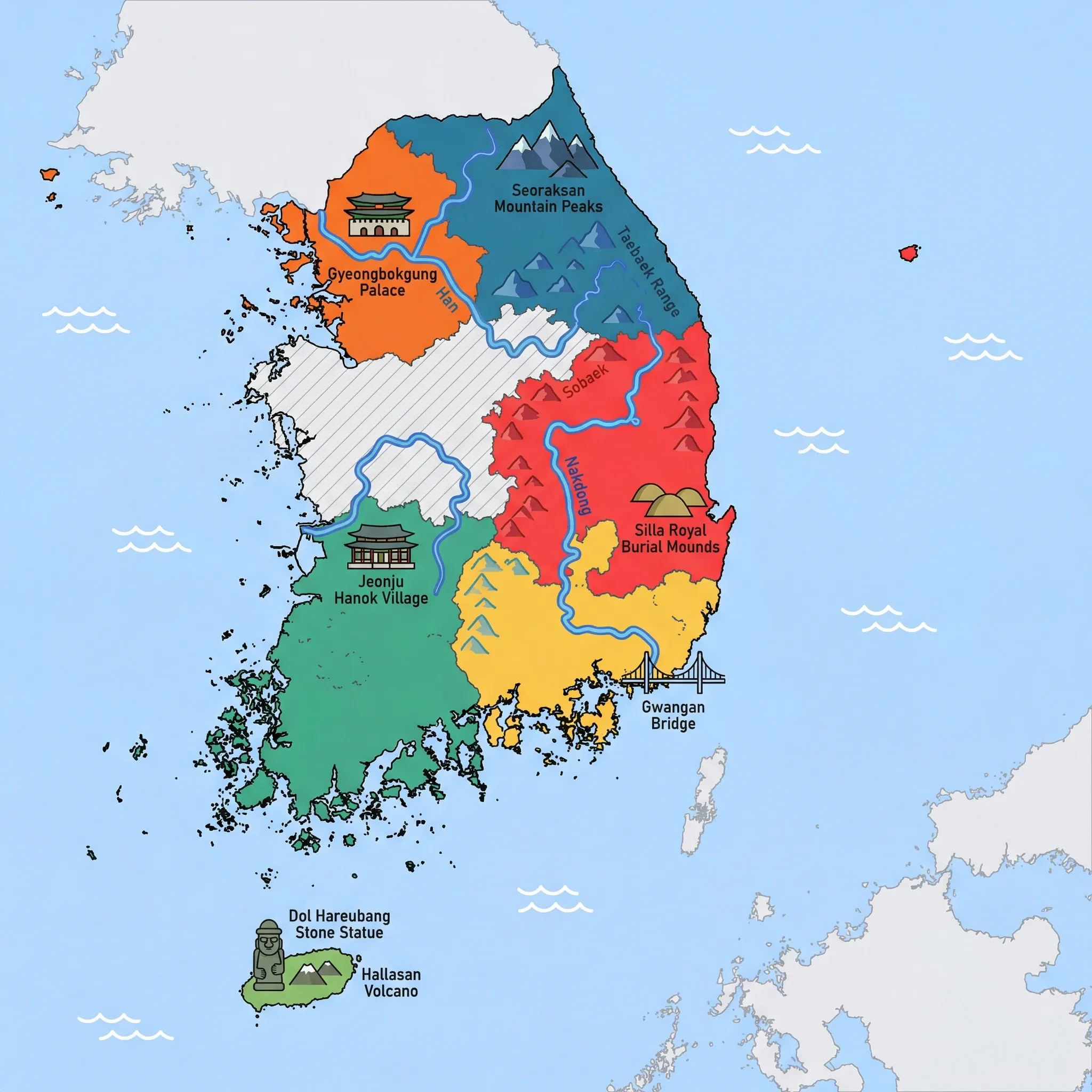
6 Regions
Busan & Southeast
City lights, sandy toes, and seaside adventures 🌊🏙️
Gangwon (skiing, nature)
Snowy peaks, deep forests, and ocean sunrises ⛷️🌲
Gyeongju (historic)
Where ancient kings rest and history comes alive 👑🚲
Jeju Island
Volcanic wonders, mandarin groves, and island vibes 🍊🌋
Jeonju & Southwest
The taste of Korea, wrapped in tradition and nature 🍲🌿
Seoul & Gyeonggi
24-hour energy, royal palaces, and neon lights 🏯✨
Click on a region marker to explore details. Use the dropdown to color regions by activity suitability.

Getting There & Around
Getting There
- By Air – Incheon International Airport (ICN) is one of the world's best airports, serving Seoul & Gyeonggi. It has showers, nap zones, and cultural craft centres to keep kids entertained.
- By Sea – Ferries connect Busan to Fukuoka (Japan), a popular route for families combining both countries.
- Entry Requirements – Many citizens (US, UK, CA, AU) are temporarily exempt from the K-ETA (travel authorization) until Dec 31, 2026, though you may still apply to skip the arrival card queue. If not applying for K-ETA, you MUST complete a mandatory e-Arrival Card before entry. Check your government website for the latest visa requirements, or use the IATA Travel Centre entry-requirements checker.
Getting Around
- Trains – The KTX (high-speed train) is fast, clean, and the best way to travel between Seoul, Busan, and Gyeongju (historic). Book tickets a month in advance for weekends.
- Subway – Seoul and Busan have world-class subway systems. Buy a T-Money card at any convenience store-it works on subways, buses, and even taxis nationwide.
- Car Hire – Recommended only for Jeju Island or rural areas like Gangwon (skiing, nature). An International Driving Permit (IDP) is mandatory.
- Taxis – Taxis are relatively cheap and safe. The "Kakao T" app allows you to hail rides without speaking Korean (requires a foreign card set up or payment to the driver).

Packing List
Public bins are extremely rare; locals carry their own rubbish home to sort.
You will remove shoes frequently at temples, traditional restaurants, and some guesthouses.
Public restrooms often lack paper towels or hand dryers.
Hotels are legally restricted from providing free single-use toiletries and will charge for them.
Difficult to find strong antiperspirants in local stores as many locals do not use them.

Activities & Best Times

Adventure & Nature
ExcellentHiking, wildlife, outdoor exploration, ecotourism
A premier region for coastal trekking and mountainous terrain, highlighted by the Haeparang Trail and Nakdong River delta. Spring and autumn offer the most comfortable temperatures and clear visibility for wilderness exploration, while summer humidity and winter cold are less ideal.
Features Seoraksan National Park, one of Asia's most spectacular granite mountain ranges, alongside unique high-altitude pastoral landscapes at Daegwallyeong. Peak months avoid the heavy July-August monsoons and freezing winter, highlighting the world-famous autumn foliage in October.
The region features iconic trails like Namsan and Tohamsan that blend deep wilderness with ancient Buddhist relics. Optimal conditions occur in spring and autumn, whereas the summer monsoon and sub-zero winter temperatures degrade the hiking experience.

City & Cultural
ExcellentUrban tourism, museums, historical sites, architecture
The region features a sophisticated mix of urban dynamism and deep heritage, including the UNESCO-listed Haeinsa Temple. Optimal visiting periods avoid the harsh winter and the oppressive summer heat, allowing for authentic engagement with local markets, art galleries, and historic sites.
Known as the museum without walls, Gyeongju offers world-class UNESCO heritage sites and authentic Silla Dynasty history. Spring cherry blossoms and autumn foliage provide the most atmospheric conditions, while summer humidity and winter cold are less ideal for walking the historic sites.
Seoul is a world-class cultural hub featuring multiple UNESCO World Heritage sites and a vibrant, modern urban atmosphere. Peak visitation occurs during the temperate spring and autumn months when historical palaces and gardens are at their most visually stunning.

Educational & Exploratory
Very GoodLearning experiences, scientific sites, historical education
The National Maritime Museum and National Busan Science Museum are world-class, purpose-built facilities that serve as significant learning destinations. These indoor venues are popular during school vacation periods, providing a high-standard experience regardless of external weather.
The region hosts internationally significant aquariums and science museums that serve as primary motivators for family learning. These indoor facilities are particularly popular during school holiday breaks and periods of extreme outdoor weather.
The island hosts destination-level facilities like Aqua Planet Jeju and the Aerospace Museum, which offer substantial scientific engagement for families. These indoor venues are most popular and accessible during standard international and domestic vacation windows.

Ski & Snow
Very GoodWinter sports, ski resorts, snow activities
Home to 2018 Winter Olympic venues like Yongpyong and Phoenix Pyeongchang, offering world-class infrastructure and consistent snow making. The season is strictly defined by winter temperatures, with February providing the best combination of base depth and daylight.
Eden Valley offers a accessible but limited winter sports experience compared to northern South Korea or Japan. The season is short and highly dependent on artificial snow, making it a secondary activity for international families rather than a primary motivator.
The region offers functional ski resorts like Jisan and Konjiam that are convenient for families, though they lack the scale of international alpine destinations. The season is tightly constrained to the core winter months with reliable snow-making temperatures.

Sports & Active
Very GoodSport tourism, fitness activities, active recreation
Offers exceptional infrastructure for active families, including the East Coast National Bike Path and challenging trekking routes on Daecheongbong Peak. Conditions are optimal during the dry, mild transitional seasons, as summer humidity and winter ice pose safety risks on mountain trails.
Dedicated infrastructure like the Skyline Luge and the extensive Nakdong River Bike Path support high-quality active tourism. Activity is best in the mild shoulder seasons of spring and autumn, as extreme temperatures in winter and summer limit outdoor exertion.
With purpose-built infrastructure like Luge World and the Hwarang Village, the region caters well to active families seeking organized outdoor activities. These facilities are best enjoyed during mild transitional seasons to avoid the physical strain of high humidity or bitter cold.

Beach & Sea
GoodBeach resorts, marine activities: diving, snorkelling, kite surfing, wind surfing, sailing
Offers unique coastal features like the columnar jointing and the underwater tomb of King Munmu, providing an authentic mix of nature and history. The peak window is narrow, limited to the warm summer months when sea temperatures are suitable for recreation.
East Sea beaches are scenic but suffer from cold water temperatures and a very short swimming season. Not internationally competitive as a beach destination.
While Haeundae and Gwangalli are high-quality urban beaches, the East Sea's cold water temperatures (18-22°C even in summer) and short swimming season (July-August) don't meet international 'good' standards when compared to Southeast Asia or Mediterranean destinations. The beaches are scenic and well-maintained but fundamentally limited by climate.

Relaxation & Wellness
GoodSpa retreats, wellness centers, peaceful getaways
Authentic thermal spring experiences at Choksan and Pillye offer restorative benefits deeply rooted in local culture. These are best experienced in winter when the contrast between cold mountain air and hot mineral waters is most pronounced.
Home to Heosimcheong, one of Asia's largest natural hot spring complexes, offering an authentic Korean spa culture. This is a primary draw during the colder months when the thermal baths provide a restorative escape from the winter chill.
A robust culture of traditional mineral springs and modern thermal bathhouses provides an authentic restorative experience. This is most rewarding as a sanctuary from the intense cold of the Korean winter.

Road Trips & Scenic
GoodScenic drives, countryside tours, route-based travel
Scenic coastal drives along National Route 7 and mountain passes like Hangyeryeong offer breathtaking vistas of the East Sea and Taebaek Mountains. Travel is best in May and October for maximum visibility and safety, avoiding winter snow and summer rain.
The scenic East Sea Road and coastal routes like Dalmaji-gil provide stunning maritime vistas on well-maintained infrastructure. Spring blossoms and autumn foliage make these the peak months for driving tours, while summer rain can impede the coastal views.
Scenic coastal drives and mountain passes like Mount Toham offer spectacular views, particularly during the cherry blossom and fall foliage peaks. Driving is best in these dry, clear months, as summer rains and winter ice can make navigating the winding mountain roads less pleasant.

Theme Park & Entertainment
GoodAmusement parks, family entertainment venues
Legoland Korea and major water parks like Ocean World provide high-quality international entertainment standards for families. Outdoor operations are highly seasonal, with peak demand during school holidays and the warm summer months.
Lotte World Adventure Busan and significant water parks provide reliable family entertainment with modern standards. Summer and school holiday windows see the highest demand, though outdoor queues become uncomfortable during the mid-winter months.
Home to major parks like Gyeongju World and high-end water parks, providing quality family entertainment. Peak season aligns with summer when aquatic facilities are fully operational, while many outdoor attractions are less comfortable during the cold winter months.

Festivals & Seasonal
MarginalEvents, celebrations, seasonal attractions
The Hwacheon Sancheoneo Ice Festival is a major international draw in January, while the UNESCO-listed Danoje Festival occurs in June. Suitability is highly concentrated around these specific cultural dates.
The Busan International Film Festival and Jinhae Gunhangje (Cherry Blossom) Festival are internationally significant events. These specific windows in April and October are the primary drivers for festival-focused tourism in the region.
The Gyeongju Cherry Blossom Festival is a significant international draw during the brief spring bloom. Outside of this peak and the autumn festival window, there are fewer major events that would draw international families specifically for festivals.

Public Holidays & Calendar Next 12 months
Public holidays, festivals, cultural celebrations, and seasonal natural phenomena coming up in South Korea over the next 12 months.
Loading holidays and events...
Climate & Weather
Busan & Southeast
Show Details
| Month | Temp °C | Rain | Humidity |
|---|
Gangwon (skiing, nature)
Show Details
| Month | Temp °C | Rain | Humidity |
|---|
Gyeongju (historic)
Show Details
| Month | Temp °C | Rain | Humidity |
|---|
Jeju Island
Show Details
| Month | Temp °C | Rain | Humidity |
|---|
Jeonju & Southwest
Show Details
| Month | Temp °C | Rain | Humidity |
|---|
Seoul & Gyeonggi
Show Details
| Month | Temp °C | Rain | Humidity |
|---|

Travel Advisory
All major global agencies consistently rate South Korea as a low-risk destination where standard safety awareness is sufficient for travelers. While regional political tensions and occasional protests exist, they do not currently elevate the country-wide risk level.
Safety Topics
Traveller Advice (4 groups)

Exercise caution when visiting crowded nightlife and entertainment districts such as Itaewon and Hongdae. Instances of sexual harassment and assault have been reported in these areas, particularly late at night; traveling in groups is recommended.

While generally safe, travelers may find it useful to review general safety guidance for sexual and gender minorities before arriving.

Monitor regional news for updates on North Korean military activities and peninsula tensions. Be aware that civil defense drills are held periodically throughout the country and require cooperation with local authorities.

The UK provides dedicated guidance for travelers with accessibility needs visiting the region; infrastructure in major cities is generally modern but can vary.
Agency Summaries
Travelers should exercise standard safety measures. Large public gatherings, particularly in Seoul, are frequent and may disrupt transport; staying informed through local media is advised. Australians benefit from a temporary visa waiver exemption for short visits until late 2026.
General safety levels are high. Irish visitors are currently exempt from electronic travel authorization requirements for short-term stays until the end of 2026. Travelers should monitor local news for any significant changes in the regional security situation.
The overall security environment is stable, though the risk of escalation in peninsula tensions persists. Visitors are advised to stay away from political gatherings and protests. British nationals of Korean descent should be aware of potential compulsory military service requirements.
The country maintains a very low crime rate, making it safe for most visitors. Travelers are cautioned to avoid political protests and reminded that foreign nationals are legally prohibited from participating in local political activities.
South Korea is generally safe, but travelers should remain alert to the unpredictable security situation on the Korean Peninsula. While crime against visitors is low, petty theft and instances of sexual harassment occur in popular nightlife districts. Registration with the government is recommended to stay informed about sudden developments.
Standard safety precautions are advised. Travelers should be aware that political demonstrations can occur without warning and that tensions with North Korea remain a factor in the regional security landscape. Participation in local civil emergency drills is encouraged when they occur.
Information is provided for general guidance only and does not constitute travel, safety, medical, or legal advice. Conditions may change. Users are responsible for independently verifying information before travel.