

⚠️ SAFETY WARNING: Due to ongoing armed conflict, high rates of violent crime, and the risk of kidnapping, government agencies (including the US, UK, Canada, and Australia) advise travelers to avoid all travel (Level 4) to South Sudan. The security environment is extremely volatile, and consular assistance is severely limited. Families are strongly urged to consult their own government's official travel advisory before considering a trip, as circumstances and risk assessments vary.
Overview
South Sudan is a land of powerful contrasts, where the White Nile weaves through vast savannahs and ancient cultural traditions endure in the 21st century. As the world's youngest sovereign state, gaining independence only in 2011, it offers a travel experience that is raw, unfiltered, and devoid of commercial gloss. For the rare family that visits-typically those with professional ties or extreme adventure credentials-it is a place of humbling beauty. The landscape ranges from the lush Eastern Highlands to the endless horizons of the northern floodplains.
The cultural tapestry here is rich and complex, woven from over 60 ethnic groups including the Dinka, Nuer, and Azande. Life revolves around cattle camps and the rhythms of the river, offering children a perspective on human civilization that is radically different from the West. While infrastructure is basic and comfort is hard to find, the warmth of the South Sudanese people and the sheer scale of the wilderness in regions like the Sudd Wetlands & Boma–Badingilo create memories of a wilder, older Africa.
Key Attractions
The crown jewel of South Sudan's natural heritage is the Sudd Wetlands. Spanning a massive area in the Sudd Wetlands & Boma–Badingilo region, this is one of the world's largest tropical wetlands. It is a birdwatcher's paradise, home to the elusive shoebill stork and millions of migratory birds. For families, a boat trip here offers a chance to see hippos and elephants adapted to the semi-aquatic environment, although such expeditions require careful security planning.
Further east, the wildlife spectacle continues with the great mammal migration. Millions of white-eared kob and tiang antelope move across the plains of Boma and Badingilo National Parks, a phenomenon that rivals the famous migrations of Tanzania and Kenya but remains virtually unknown to the outside world. In the south, the White Nile Corridor hosts Nimule National Park, where the river rushes through the Fula Rapids. It is one of the more accessible parks, offering opportunities to see herds of elephants and Uganda kobs against a backdrop of stunning riverine scenery.
Practical Advice
Best time to visit: The dry season (December to April) is crucial for travel, as heavy rains render unpaved roads impassable and increase the risk of malaria during the wet months. Visas: A visa is mandatory for almost all visitors and must often be arranged in advance via the e-visa portal or an embassy. Health: A Yellow Fever vaccination certificate is strictly required for entry. Malaria prophylaxis is essential. Medical facilities are severely limited, so comprehensive evacuation insurance is non-negotiable.
Food & Drink
Typical meal times: Breakfast is typically eaten from 7:00 am to 9:00 am, lunch from 12:00 pm to 2:00 pm, and dinner from 7:00 pm to 9:00 pm.
Typical meal costs: 25,000–65,000 SSP (approx. $20–50 USD / €18–45 EUR) for a meal in a secure hotel or restaurant. Street food is much cheaper but generally unsafe for travelers.
Dietary requirements: Vegetarian food is relatively easy to find, with dishes based on beans, okra, and greens (sukuma wiki) being common. Gluten-free travelers can rely on maize-based dishes but should be wary of cross-contamination. Peanuts are a common ingredient.
Family-friendly dining: Highchairs and children's menus are virtually non-existent outside of top-tier international hotels in Juba. Hotel restaurants are the safest bet for families, offering familiar western dishes alongside local staples.
Signature dishes:
- Kisra – A thin, fermented flatbread made from sorghum flour, similar to Ethiopian injera but thinner. It is the national staple used to scoop up stews.
- Asida – A stiff, dough-like porridge made from sorghum or maize, eaten by hand and dipped into varying sauces or okra stews.
- Combo – A rich vegetable stew often made with spinach, peanut butter, and tomatoes, sometimes including meat. It is hearty and mild, suitable for children.
- Ful Sudani – Peanut-based snacks or cookies, highlighting the local abundance of groundnuts.
- Mandazi – Sweet, fried dough triangles often spiced with cardamom, popular as a breakfast item or snack.
Safety
South Sudan remains a conflict zone. Travel outside Juba usually requires a specialized permit and often an armed escort. Checkpoints are frequent, and soldiers can be aggressive; never photograph them or government buildings. A strict curfew applies to UN and NGO staff, and travelers should follow suit, staying indoors after dark. Do not walk alone at night. Secure, guarded transport is the only safe way to move around.

While local wages are low, the cost of safe travel is extremely high due to security logistics and reliance on imported goods. A secure hotel room in Juba costs 200,000–400,000 SSP (approx. $150–300 USD / €140–280 EUR) per night. Hiring a 4x4 with a driver and fuel can cost 260,000–400,000 SSP (approx. $200–300 USD / €185–280 EUR) per day.
Age Suitability





Explore Regions
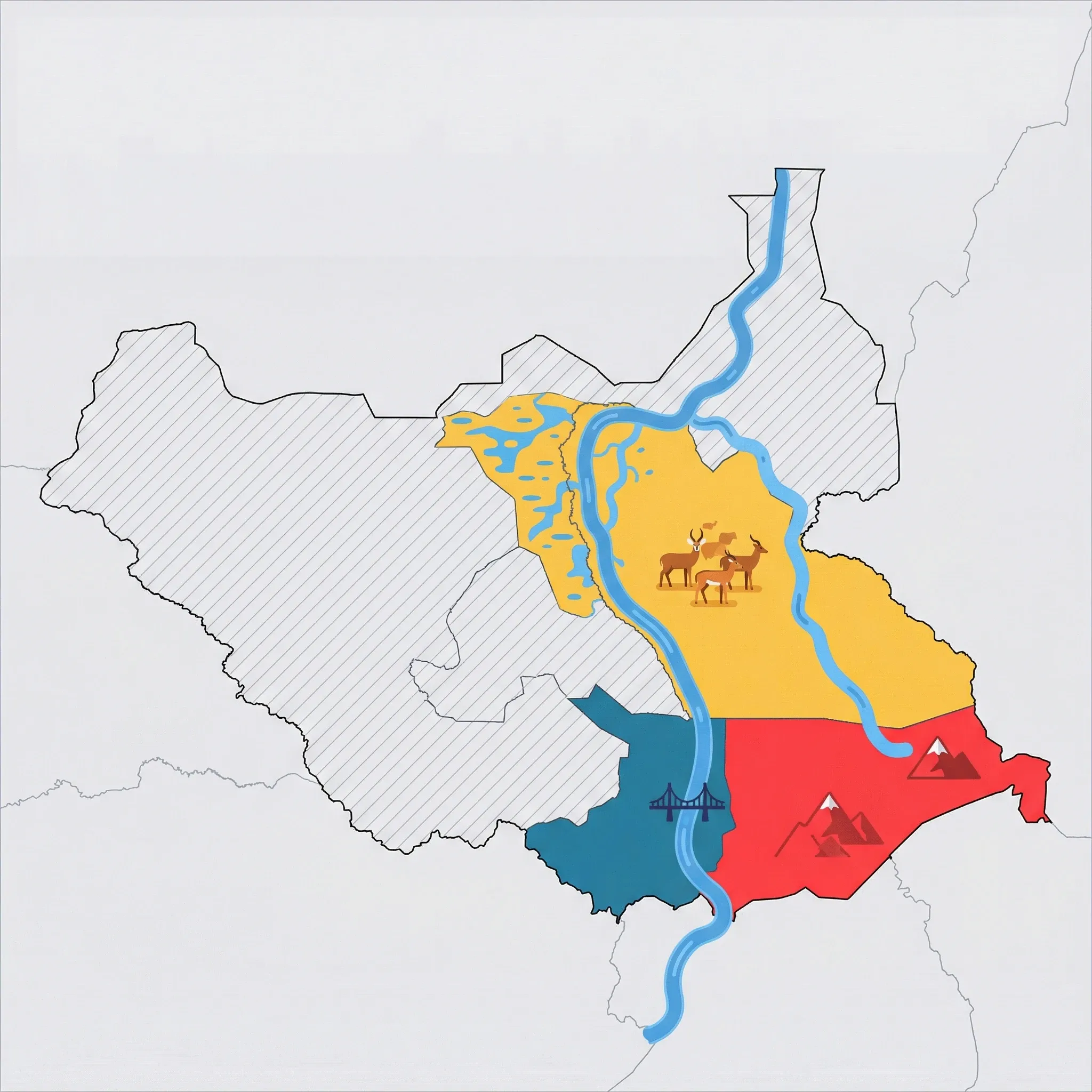
3 Regions
Eastern Highlands (Eastern Equatoria State)
Rugged mountains and vibrant tribal culture on the savannah edge
Sudd Wetlands & Boma–Badingilo (Jonglei)
A vast water wilderness hosting one of nature's greatest migrations
White Nile Corridor (Central Equatoria State)
The bustling heart of the nation along the legendary Nile
Click on a region marker to explore details. Use the dropdown to color regions by activity suitability.

Getting There & Around
Getting There
- By Air – Juba International Airport (JUB) is the primary gateway, with connections from Addis Ababa, Nairobi, Dubai, and Cairo. It serves as the entry point for the White Nile Corridor.
- By Land – Border crossings are extremely dangerous and frequently closed. The Juba-Nimule highway to Uganda is the main supply route but is prone to ambushes; travel here is not recommended for families.
- Entry Requirements – All visitors require a visa, often obtained via the online portal or an embassy. A Yellow Fever certificate is mandatory. Check your government website for the latest visa requirements, or use the IATA Travel Centre entry-requirements checker.
Getting Around
- Private 4x4 – The only viable option for families. Renting a sturdy vehicle with an experienced local driver is essential for navigating poor roads and checkpoints in regions like the White Nile Corridor.
- Charter Flights – Essential for reaching remote areas like the Sudd Wetlands & Boma–Badingilo safely. Commercial domestic flights exist but safety standards vary widely.
- City Transport – Boda-bodas (motorcycle taxis) and matatus (minibuses) are unsafe for tourists due to high accident rates and crime. Avoid them.

Packing List
Credit cards rarely work; cash is king, but bills must be new and unblemished to be accepted.
Mobile networks are unreliable outside Juba; essential for safety and emergency communication.
Power outages are frequent and prolonged; keeps essential devices charged when the grid fails.
Mandatory for entry; you will be refused borders entry without physical proof of vaccination.
Street lighting is non-existent in most areas; critical for navigating safely after sunset.

Activities & Best Times

Adventure & Nature
GoodHiking, wildlife, outdoor exploration, ecotourism
Features authentic wilderness and wildlife at Nimule National Park and hiking at Jebel Kujur, though infrastructure is basic. The dry season (Dec-Feb) is peak for wildlife visibility and trail access before the heavy rains of May-Oct.
This region offers a raw and authentic wilderness experience, featuring one of the world's largest mammal migrations and the vast Sudd wetlands. Visitation is strictly seasonal, as peak dry months (Dec-Feb) allow for wildlife tracking and navigation, while heavy rains (May-Oct) make the region's black cotton soil roads entirely impassable for families.
While the Imatong Mountains offer genuine ecological significance and unique montane biodiversity, the rating should be 'good' rather than 'very_good' when calibrated internationally. Very_good ratings should be reserved for adventure destinations with established infrastructure, guiding services, and international recognition. The lack of tourism infrastructure and limited accessibility prevents this from reaching very_good on a global scale.

City & Cultural
MarginalUrban tourism, museums, historical sites, architecture
Juba has historical significance as South Sudan's capital, but a 'good' city_cultural rating internationally requires established museums, galleries, cultural institutions, and heritage sites. The current rating over-estimates Juba's cultural infrastructure when compared to globally recognized 'good' cultural cities. Marginal is more appropriate for a developing capital with emerging cultural offerings.
Offers raw and authentic cultural immersion into Toposa and Lotuko traditions in areas like Kapoeta and Illieu. Visitation is restricted to the peak dry months (Dec-Feb) when remote unpaved tracks remain passable for international travelers seeking authentic heritage.

Road Trips & Scenic
MarginalScenic drives, countryside tours, route-based travel

Sports & Active
MarginalSport tourism, fitness activities, active recreation
Jebel Kujur and Fulla Rapids provide established routes for hiking and walking, representing the region's primary active infrastructure. These trails are optimal during the dry months when surfaces are firm and safe for families.
Centered on the challenging trek to the summit of Mount Kinyeti, South Sudan's highest peak. Optimal trekking occurs during the driest months (Dec-Feb) to ensure safe trail conditions and visibility; the monsoon season creates hazardous, slippery terrain and dense cloud cover.

Public Holidays & Calendar Next 12 months
Public holidays, festivals, cultural celebrations, and seasonal natural phenomena coming up in South Sudan over the next 12 months.
Loading holidays and events...

Climate & Weather
Eastern Highlands (Eastern Equatoria State)
Show Details
| Month | Temp °C | Rain | Humidity |
|---|
Sudd Wetlands & Boma–Badingilo (Jonglei)
Show Details
| Month | Temp °C | Rain | Humidity |
|---|
White Nile Corridor (Central Equatoria State)
Show Details
| Month | Temp °C | Rain | Humidity |
|---|

Travel Advisory
Unanimous consensus across all major international agencies indicates an extreme risk environment. Travel is strongly discouraged due to active armed conflict, pervasive violent crime, and the inability of foreign governments to provide emergency assistance.
Safety Topics
Traveller Advice (3 groups)

There is a significant threat of sexual assault and gender-based violence, particularly in areas of conflict or rural locations. Independent travel is strongly discouraged.

Humanitarian staff have been frequently targeted in attacks and kidnappings. Organizations must employ professional security details and maintain strict contingency plans for emergency evacuation.

Media professionals face high risks of harassment, arrest, and violence. It is mandatory to obtain official accreditation from the Media Authority; working without proper documentation is illegal and extremely dangerous.
Agency Summaries
The United States warns that the risk of abduction, violent crime, and armed warfare is critical throughout the country. Federal assistance is extremely limited, and government staff are restricted by curfews and must use armored transport for movement.
The FCDO recommends against all travel to the nation due to the severe threat of criminality and armed violence. The political landscape is volatile, and embassy support for British nationals is severely constrained.
Australia warns of a dangerous security situation with a high risk of armed conflict and violence. Consular services are very difficult to access, and the situation can worsen without any notice.
Canada strongly advises against visiting South Sudan due to a highly unstable security environment characterized by persistent civil conflict, ethnic violence, and extreme crime rates. Citizens currently in the country should depart while commercial options remain available.
New Zealand cites ongoing warfare and high levels of violent crime as primary reasons for its do-not-travel advisory. Law and order are not maintained in many regions, posing significant personal risk.
Ireland maintains its highest level of warning, advising citizens to avoid the country entirely and leave immediately if safe to do so. Security is fragile, and the embassy has limited power to assist.
Information is provided for general guidance only and does not constitute travel, safety, medical, or legal advice. Conditions may change. Users are responsible for independently verifying information before travel.