

⚠️ SAFETY WARNING: Due to ongoing intense military conflict, civil unrest, and a critical lack of medical and consular infrastructure, government agencies (including CA, USA, UK, AU, IE, and NZ) advise travelers to avoid all travel to Sudan. The security situation is extremely volatile with active fighting in Khartoum and other regions. Families are strongly urged to consult their own government's official travel advisory before considering any trip, as circumstances and risk assessments vary.
Overview
Sudan is a destination of stark beauty and deep historical significance, dominated by the majestic flow of the Nile River as it winds through the Sahara Desert. Geographically, it bridges the African tropics and the Arab world, creating a unique cultural tapestry. The landscape ranges from the red sands of the Nubian Desert in the north to the Red Sea coast in the east. For families interested in history, the country offers an unparalleled window into the ancient Kingdom of Kush, with archaeological sites that remain largely crowd-free and atmospheric. The Sudanese people are renowned for their warmth and generosity, often inviting visitors for tea and conversation, though the current conflict has severely impacted daily life and tourism infrastructure.
A journey here-when conditions allow-is an expedition into the heart of ancient civilization. Children with a passion for exploration can see history firsthand without the barriers often found at more commercialized destinations. The silence of the desert at sunset and the sight of steep pyramids rising from the dunes create memories that last a lifetime. While the capital area of Khartoum & Confluence is the traditional meeting point of the Blue and White Niles, the northern regions offer the most accessible and impressive ancient ruins, providing a vast open-air museum experience under the African sky.
Key Attractions
The crown jewel of Sudan's heritage is undoubtedly the Pyramids of Meroe in the Nubian Nile Valley. Unlike their Egyptian counterparts, these steep-sided pyramids are clustered closely together in the open desert, allowing families to walk amongst them in relative solitude. It is a hauntingly beautiful site where kids can safely explore the exteriors of royal tombs that date back over 2,000 years. Nearby, the holy mountain of Jebel Barkal offers a relatively easy climb for active families, rewarding hikers with panoramic views of the Nile loop and the temple ruins at its base.
For a complete change of pace, the Red Sea Coast offers world-class marine environments. The Sanganeb Marine National Park is a UNESCO World Heritage site known for its unique atoll structure and pristine coral reefs, teeming with dolphins and colourful fish. Just south of the port city lies the Old City of Suakin, a once-thriving coral-built port that is now a crumbling, atmospheric ghost town. Walking through its ruined streets offers a tangible lesson in history and architecture that fascinates older children and teenagers.
Practical Advice
Best Time to Visit: The only comfortable window for travel is the winter season, from November to February, when daytime temperatures are manageable (around 25–30°C / 77–86°F). The rest of the year brings extreme heat and dust storms (haboobs).
Visa Basics: Obtaining a visa is notoriously bureaucratic. All visitors require a visa in advance, and an "Entry Permit" from the Ministry of Foreign Affairs is often needed before the embassy will issue the stamp. Registration within 3 days of arrival is mandatory.
Health & Logistics: Malaria prophylaxis is essential. Medical facilities are currently severely limited due to the conflict; comprehensive travel insurance that includes medical evacuation is critical, though likely invalid under current "Do Not Travel" advisories.
Food & Drink
Typical meal times: Breakfast is eaten late, around 9:00 am to 11:00 am, often followed by a substantial lunch between 2:00 pm and 4:00 pm. Dinner is a lighter affair served late, from 8:00 pm to 10:00 pm.
Typical meal costs: Prices are volatile due to inflation. A basic local meal costs roughly 3,000–6,000 SDG (approx. $5–10 USD / £4–8 GBP). Higher-end dining in hotels (when operating) ranges from 12,000–24,000 SDG (approx. $20–40 USD / £15–30 GBP).
Dietary requirements: Sudanese cuisine relies heavily on bread, beans, and meat. Vegetarians will find plenty of fava bean dishes (ful) and falafel (ta'amiya), but gluten-free options are scarce as bread is the primary utensil. Nut allergies are rare but sesame oil is common.
Family-friendly dining: Eating is communal and often done with hands, which children tend to enjoy. Restaurants are informal, and children are welcomed everywhere. Fresh fruit juices (mango, guava, lemon-mint) are widely available and safe if no tap water is added.
Signature dishes:
- Ful Medames – A hearty stew of fava beans, oil, cumin, and sometimes cheese, eaten with bread for breakfast or dinner.
- Kisra – Thin, fermented sorghum crepes that serve as both food and utensil, used to scoop up stews.
- Gurasa – A thick, spongy wheat pancake common in the north, similar to Ethiopian injera but not sour, served with meat sauce.
- Jabana – Traditional Sudanese coffee spiced with ginger and cardamom, brewed in a clay pot and served in tiny cups (a cultural ritual).
Safety
Current travel to Sudan is extremely dangerous. The conflict between the Sudanese Armed Forces (SAF) and the Rapid Support Forces (RSF) has resulted in airstrikes, artillery shelling, and street fighting in Khartoum, Omdurman, and Darfur. The airport in Khartoum is closed to civilian traffic. Crime rates, including carjacking and armed robbery, have spiked due to the security vacuum. Essential services like water, electricity, and internet are unreliable. There is a high threat of terrorism and kidnapping in border regions. Families should not travel to Sudan at this time.

Travel costs in Sudan are generally low by Western standards, though high inflation makes the local currency volatile. A family can expect to spend around 30,000–60,000 SDG (approx. $50–100 USD / £40–80 GBP) per day for basic accommodation, food, and transport. You must bring all cash in USD (pristine notes post-2013) as international credit cards and ATMs do not work.
Age Suitability





Did you know? Sudan welcomes approximately 836,000 international visitors per year. Most visitors come from Middle East.

Explore Regions
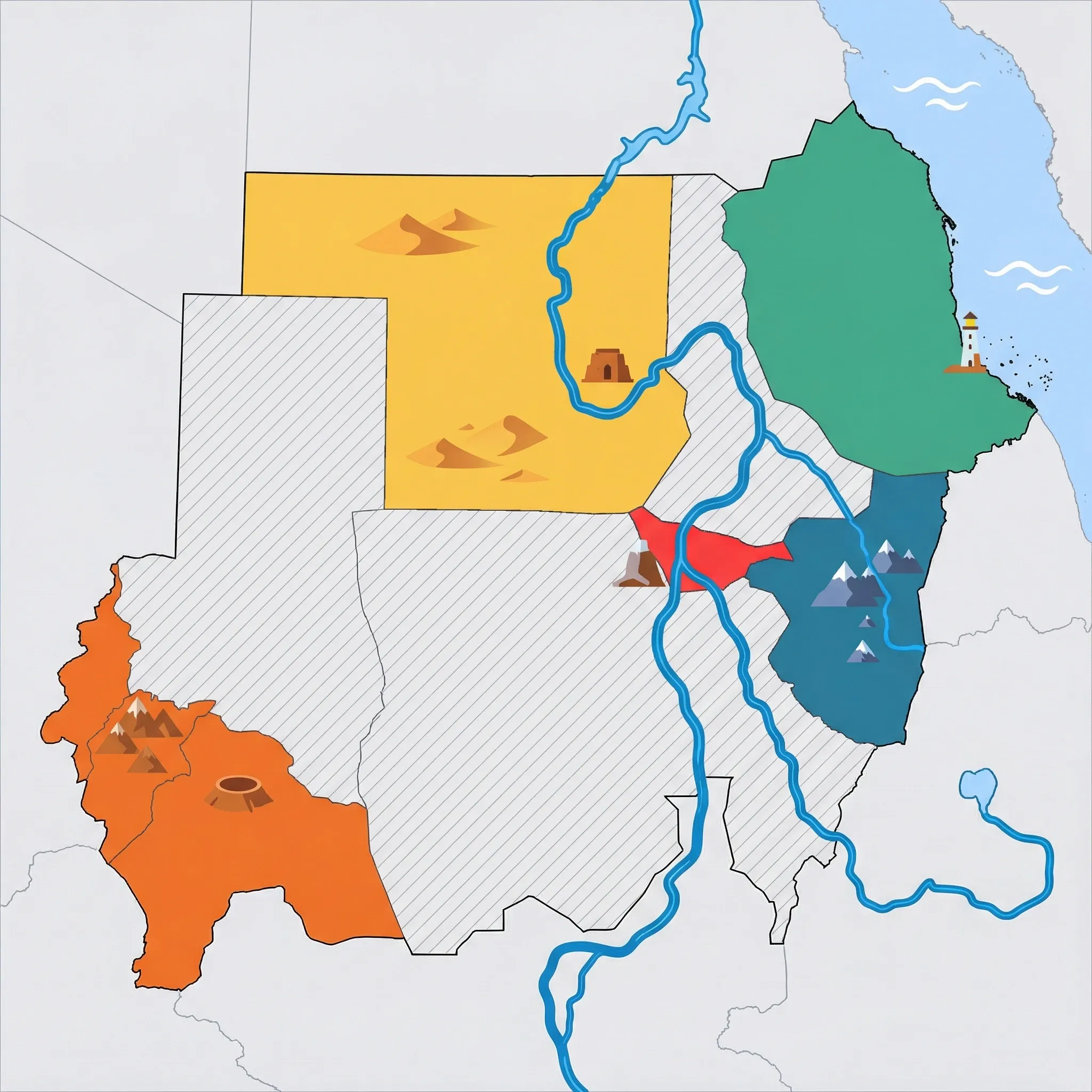
5 Regions
Darfur Highlands (Central Darfur State)
Volcanic peaks and ancient traditions in the west 🌋
Eastern Sudan Highlands (Kassala State, Gedaref State)
Granite peaks and coffee culture on the border ☕
Khartoum & Confluence (Khartoum State)
Where the two Niles meet 🌊
Nubian Nile Valley (Northern State)
Ancient pyramids and golden dunes along the Nile 🐫
Red Sea Coast (Red Sea State)
Coral reefs and Ottoman ruins by the sea 🐠
Click on a region marker to explore details. Use the dropdown to color regions by activity suitability.

Getting There & Around
Getting There
- By Air – Khartoum International Airport (KRT) is currently closed to standard commercial traffic due to the conflict. Limited flights operate via Port Sudan (PZU) from hubs like Cairo, Jeddah, and Dubai.
- By Land – Border crossings with Egypt (Qustul and Argeen) are open but can be chaotic, with long processing times. Borders with Chad, Libya, and Ethiopia are extremely dangerous and often closed.
- Entry Requirements – Visas are required for almost all nationals and must be obtained in advance. Permits are also needed for photography and inter-city travel. Check your government website for the latest visa requirements, or use the IATA Travel Centre entry-requirements checker.
Getting Around
- Car Hire – Self-drive is not recommended due to security checkpoints and difficult terrain. Renting a 4WD vehicle with an experienced local driver is the only viable way to visit remote sites like the Nubian Nile Valley.
- Buses – Intercity buses connect major towns like Port Sudan and Kassala, but they can be crowded and safety standards are low. Travel permits are often required to move between regions.
- Domestic Flights – Commercial flights are severely disrupted. Limited services may operate from Port Sudan (PZU) to safe regional hubs, but schedules are erratic and cancellations common.

Packing List
ATMs and cards do not work; notes must be post-2013 and unblemished to be exchanged.
Electricity cuts are frequent and can last for many hours or days.
Street lighting is non-existent in many areas and power outages are common.
Essential protection against sandstorms and dust, especially in the northern deserts.
Clean bottled water can be scarce in remote areas; tap water is generally unsafe.

Activities & Best Times

Adventure & Nature
Very GoodHiking, wildlife, outdoor exploration, ecotourism
The region offers profound desert immersion through UNESCO-listed landscapes like Jebel Barkal and the Bayuda Desert. Winter months provide the only safe window for trekking and exploration, as the Saharan heat between April and September presents significant physical risk.
The Taka Mountains (Jebel Kassala) offer iconic, jagged granite peaks that provide a visually stunning and authentic wilderness experience for adventurous families. Peak visitation occurs during the cooler winter months, while the monsoon season (July-September) offers a unique greening of the desert landscape despite higher humidity.
The unique confluence of the Blue and White Niles and the traditional agricultural life of Tuti Island offer authentic riverine exploration. Winter months provide the only comfortable window for exploration, as the summer brings extreme Saharan heat and seasonal dust storms.

City & Cultural
Very GoodUrban tourism, museums, historical sites, architecture
Home to the world-class Pyramids of Meroe and Nuri, these sites offer a unique, non-commercialized window into ancient Kushite civilization. Peak visitation occurs from November to February when the desert climate is mild; extreme summer heat makes the sites virtually inaccessible for comfortable exploration.
While Khatmiyya Mosque is architecturally unique and the traditional markets are vibrant, a single distinctive mosque and souqs do not meet the threshold for 'very_good' (internationally outstanding cultural density). This represents nationally significant but not globally exceptional cultural offerings. Downgrade to 'good' for international calibration consistency.
The historic coral city of Suakin offers a unique and authentic cultural heritage site, though it requires a high degree of travel independence. Visiting these ruins and the markets of Port Sudan is best during the cooler season to avoid the oppressive desert heat.

Road Trips & Scenic
GoodScenic drives, countryside tours, route-based travel
The Nubian Desert Circuit and Bayuda Desert Route offer spectacular, high-standard desert driving for experienced overlanders. These routes are seasonally restricted by extreme heat, with the November-February window providing necessary safety for long-distance desert travel.
Khartoum is the gateway for the iconic desert drive to the Pyramids of Meroë and features the scenic Sharia Al-Nil corniche. Peak season avoids the dangerous heat of the desert summer and the limited visibility caused by Haboob dust storms.
Dramatic routes like the Sinkat Pass offer spectacular desert and mountain vistas as you ascend from the coast. The winter months provide the necessary visibility and safe operating temperatures for vehicles traversing these remote and arid landscapes.

Sports & Active
GoodSport tourism, fitness activities, active recreation
Includes internationally recognized long-distance cycling segments and established hiking trails around the pyramids of Karima and Meroe. Physical activity is concentrated in the cooler months to avoid the life-threatening peak summer temperatures common in the Northern State.
The historic Blue Nile Sailing Club provides a unique, though basic, venue for river-based recreation in a desert environment. Activity is strictly seasonal, as outdoor exertion is physically taxing during the intense heat of the April to September period.
Challenging hiking and scrambling routes on Jebel Kassala and Jebel Totil provide rugged physical activity for fit families. These routes are best tackled in the winter; they are dangerously hot in the spring and becomes treacherous during the summer rains when granite surfaces are slippery.

Beach & Sea
GoodBeach resorts, marine activities: diving, snorkelling, kite surfing, wind surfing, sailing

Relaxation & Wellness
MarginalSpa retreats, wellness centers, peaceful getaways

Public Holidays & Calendar Next 12 months
Public holidays, festivals, cultural celebrations, and seasonal natural phenomena coming up in Sudan over the next 12 months.
Loading holidays and events...

Climate & Weather
Darfur Highlands (Central Darfur State)
Show Details
| Month | Temp °C | Rain | Humidity |
|---|
Eastern Sudan Highlands (Kassala State, Gedaref State)
Show Details
| Month | Temp °C | Rain | Humidity |
|---|
Khartoum & Confluence (Khartoum State)
Show Details
| Month | Temp °C | Rain | Humidity |
|---|
Nubian Nile Valley (Northern State)
Show Details
| Month | Temp °C | Rain | Humidity |
|---|
Red Sea Coast (Red Sea State)
Show Details
| Month | Temp °C | Rain | Humidity |
|---|

Travel Advisory
All monitored agencies have issued their highest level of warning, advising against all travel due to extreme safety risks including active military conflict and severe civil instability.
Safety Topics
Traveller Advice (4 groups)

Personnel working for international aid organizations are being specifically targeted for violence and kidnapping; extreme caution and professional security coordination are mandatory.

There are disturbing reports of gender-based and sexual violence occurring within the context of the active military conflict.

Media professionals face a significant threat of detention, harassment, and arrest by various armed groups who view them as high-value targets.

Anyone currently in the country should consider immediate departure via safe commercial routes while they are still accessible. Individuals remaining should maintain an extensive supply of food, water, and essential medicine for prolonged periods of sheltering in place.
Agency Summaries
The Canadian government advises against any travel to the country due to the ongoing and violent military conflict, widespread civil disturbances, and a highly unstable safety environment.
New Zealanders are warned to completely avoid travel because of the high threat posed by armed conflict, kidnapping risks, and the near-total lack of official assistance.
U.S. authorities warn against all travel for any purpose because of extreme dangers including armed warfare, violent crime, kidnapping, terrorism, and significant health risks.
Irish citizens are directed not to travel to the country at this time, as the security environment is considered extremely volatile due to active military clashes and violence.
British officials strictly advise against visiting any part of the nation because of the hazardous military situation and the lack of diplomatic support available to citizens.
Australia urges its citizens to avoid all travel to the region, citing an extremely dangerous security climate characterized by armed hostilities and a high likelihood of civil unrest.
Information is provided for general guidance only and does not constitute travel, safety, medical, or legal advice. Conditions may change. Users are responsible for independently verifying information before travel.