

Overview
Tanzania offers the quintessential African family adventure, blending the drama of the savannah with the relaxation of the coast. Geographically, it is a land of giants, home to Africa's highest mountain, deepest lake, and most famous national parks. For families, the "Northern Circuit" is the primary draw, a well-trodden route that delivers reliable wildlife sightings in a safe, tourist-friendly infrastructure. The culture is warm and welcoming to children-"Karibu" (welcome) is a word you will hear constantly-though conservative values mean families should dress modestly in towns.
What makes Tanzania specifically special for kids is the sheer accessibility of its nature. Unlike some destinations where animals are distant specks, here you can often see elephants, giraffes, and zebras from the safety of your jeep just minutes after entering a park. Beyond the game drives, the Zanzibar archipelago offers a distinct Swahili cultural experience with shallow, warm waters perfect for young swimmers. While distances between parks can be long and roads bumpy, the payoff is an educational journey that textbooks simply cannot match.
Key Attractions
The crown jewel for any family visit is Serengeti National Park. Famous for the Great Migration, this vast ecosystem offers children the chance to see nature's greatest spectacle. Seeing thousands of wildebeest on the move is a life-changing memory, though even outside migration season, the predator density here keeps game drives exciting for teenagers with short attention spans.
Nearby, the Ngorongoro Crater is arguably the best spot for first-time young safari-goers. As an enclosed volcanic caldera, it acts as a natural fishbowl for wildlife; you are almost guaranteed to see lions, hippos, and potentially the rare black rhino in a single morning drive. For families wanting a break from the vehicle, the Momella Route (Mount Meru) in Arusha National Park offers gentle walking safaris where you can see giraffes on foot-a thrilling but safe perspective for older kids.
On the coast, history comes alive at Bagamoyo Stone Town, a former capital with crumbling German colonial buildings that tell the story of the spice and slave trades. For a unique "bush meets beach" experience, Saadani National Park is the only wildlife sanctuary in East Africa bordering the ocean, allowing you to see elephants wandering onto the sand. Adventurous families with older teens might consider the remote western circuit to track chimpanzees at Gombe Stream National Park Beach, famously associated with Jane Goodall.
Practical Advice
The best time to visit is the long dry season from June to October, when wildlife is easiest to spot and malaria mosquitoes are fewer. A tourist eVisa is required for most nationalities and should be applied for online at least a month in advance. Malaria prophylaxis is essential for the whole family; consult a travel doctor. Yellow Fever vaccination certificates are often checked at entry points, especially if arriving from other African countries.
Safety
Due to current advisories, safety requires active management. Avoid walking in cities like Dar es Salaam or Arusha at night; take registered taxis rather than motorcycle taxis (boda-bodas). Be aware that Tanzania has very strict anti-LGBTQ+ laws, and discretion is legally required. In crowded areas like markets or ferry terminals, keep a close hold on bags and children. Always book safaris through established, licensed operators.
Food & Drink
Typical meal times: Lunch is typically served from 12:30 pm to 2:00 pm, and dinner from 7:00 pm to 9:30 pm. Safari lodges often have set buffet times.
Typical meal costs: Local street food costs TZS 5,000–12,000 (approx. $2–4.50 USD / €1.80–4.20 EUR). Tourist restaurants and lodge meals range from TZS 25,000–65,000 (approx. $10–25 USD / €9–23 EUR).
Dietary requirements: Tourist lodges are excellent at catering to gluten-free, vegetarian, and allergy-specific needs if notified in advance. Local food relies heavily on maize, rice, and beans, making it naturally gluten-friendly, though cross-contamination can occur in street stalls.
Family-friendly dining: "Chipsi Mayai" (french fry omelette) is a ubiquitous street food that children universally love. Lodges almost always offer kid-friendly staples like pasta and grilled chicken alongside local dishes.
Signature dishes:
- Ugali na Nyama Choma – A stiff maize porridge eaten by hand with grilled goat or beef-the national staple and a fun, tactile eating experience for kids.
- Chipsi Mayai – A french fry omelette, often sold at street stalls, which serves as Tanzania's unofficial comfort food.
- Zanzibar Pizza – A unique savoury or sweet stuffed crepe-like dough fried on a griddle, famous in the Zanzibar night markets.
- Mishkaki – Marinated beef or chicken skewers grilled over charcoal, safe and delicious for picky eaters.
- Ndizi Nyama – A hearty stew made with green bananas (plantains) and meat, popular in the Kilimanjaro region.

While local costs are low, a family safari is a significant investment. Expect to spend TZS 520,000–1,300,000 (approx. $200–500 USD / €185–460 EUR) per person per day for mid-range safari packages including park fees, transport, and lodging. Zanzibar beach holidays are cheaper, around TZS 260,000–520,000 (approx. $100–200 USD / €90–185 EUR) per person per day.
Age Suitability





Did you know? Tanzania welcomes approximately 1.5 million international visitors per year. Most visitors come from Africa.
Explore Regions
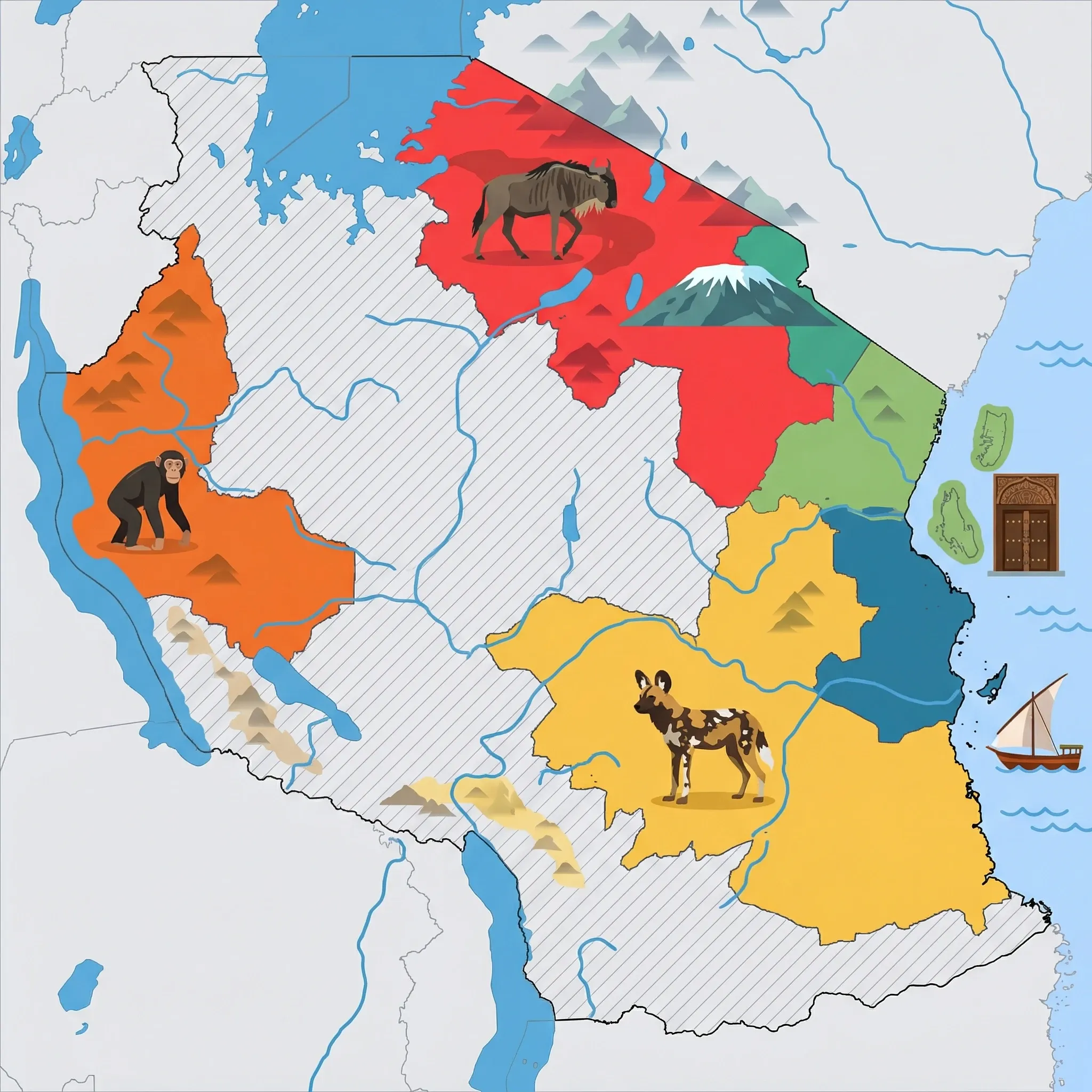
6 Regions
Dar es Salaam & Coast
Where ancient Swahili history meets the bustling Indian Ocean coast 🌊🇹🇿
Kilimanjaro region
Adventure awaits at the foot of Africa's highest peak 🏔️☕
Serengeti & Northern Circuit (Serengeti, Ngorongoro, Lake Manyara)
The world's most famous wildlife stage, where the Great Migration roars to life 🦁🦓
Southern Parks (Selous/Nyerere, Ruaha)
Wild, remote, and crowd-free: the frontier of African safaris 🐘🚤
Western Tanzania (Mahale, Gombe - chimps)
Face-to-face with chimpanzees on the shores of the world's longest lake 🦍🌿
Zanzibar
Spice-scented alleys and turquoise waters on the Swahili Coast 🏝️⛵
Click on a region marker to explore details. Use the dropdown to color regions by activity suitability.

Getting There & Around
Getting There
- By Air – Kilimanjaro International Airport (JRO) is the best gateway for safaris in the Kilimanjaro region and Northern Circuit. Julius Nyerere International Airport (DAR) serves Dar es Salaam & Coast. Abeid Amani Karume International Airport (ZNZ) serves Zanzibar directly.
- By Land – The Namanga border crossing connects Arusha to Nairobi (Kenya). Shuttle buses like the Riverside Shuttle are reliable for this route.
- Entry Requirements – Most visitors require a visa. Check your government website for the latest visa requirements, or use the IATA Travel Centre entry-requirements checker.
Getting Around
- Safari Vehicles – The standard way to explore the Serengeti & Northern Circuit is in 4x4 Land Cruisers with pop-up roofs. These are booked as part of tour packages.
- Domestic Flights – Small bush planes (e.g., Coastal Aviation, Auric Air) connect national parks to Zanzibar. They are fast but have strict soft-bag luggage limits (usually 15kg).
- Ferries – High-speed ferries connect Dar es Salaam to Zanzibar in about 2 hours. They are comfortable and modern.
- Dala-dalas – Local minibuses are extremely cheap (cents) but often overcrowded and driven erratically. Not recommended for families with luggage or small children.

Packing List
Bush planes to Zanzibar/Serengeti often refuse hard-shell suitcases; soft bags are mandatory.
Tsetse flies are attracted to dark blue and black; khaki or tan colors keep you hidden and bite-free.
Safari vehicles are open-sided; dust is intense in the dry season and will cover your face.
Lodges have few outlets and limited generator hours; charge all family devices at once.
Roads in national parks are extremely bumpy; essential for kids prone to car sickness.
Keeps children engaged during game drives so they don't have to wait for the adult pair.

Activities & Best Times

Adventure & Nature
ExcellentHiking, wildlife, outdoor exploration, ecotourism
A world-class destination for primate encounters, specifically famous for wild chimpanzee trekking in Mahale Mountains and Gombe Stream. The dry season (June-October) is optimal as chimpanzees move to lower slopes near the lake, while the wet season makes forest terrain difficult and slippery.
The Serengeti-Ngorongoro ecosystem is one of the top 3-5 safari destinations globally. The Great Migration, Ngorongoro Crater (UNESCO World Heritage Site), and exceptional wildlife density make this a primary international destination for wildlife experiences. This region competes with Botswana's Okavango Delta and South Africa's Kruger - it deserves 'excellent' calibration.
Nyerere National Park (formerly Selous Game Reserve) is a UNESCO World Heritage Site and Africa's largest game reserve. Ruaha National Park is Tanzania's largest national park with exceptional elephant populations. This deserves 'very_good' given the international significance and wilderness quality.

City & Cultural
Very GoodUrban tourism, museums, historical sites, architecture
Home to the historic Bagamoyo Stone Town and the National Museum, this region offers a deep dive into Swahili culture and colonial history. Peak months coincide with the dry season when walking tours of the Old Boma and ruins are most comfortable; heavy rains in April and May significantly hinder urban exploration.
Kigoma offers a unique glimpse into colonial history and African Great Lakes culture, featuring the significant Livingstone Memorial at Ujiji. Access to these historic sites is easiest during the dry months, while the heaviest rains in March and April can make urban exploration muddy and difficult.
Stone Town is a UNESCO World Heritage Site with exceptional Swahili architectural heritage, historic slave market, House of Wonders, and Old Fort. This is more than 'marginal' - it's a significant cultural destination with international recognition.

Beach & Sea
Very GoodBeach resorts, marine activities: diving, snorkelling, kite surfing, wind surfing, sailing
Zanzibar's beaches (Nungwi, Kendwa, Paje) are internationally recognized and attract beach tourists globally. Mnemba Atoll offers world-class diving. While not Caribbean-level, this is a nationally significant beach destination that draws international beach tourists specifically to this region.
Accessible coastal escapes like Mbudya and Bongoyo Islands provide high-quality marine recreation with clear waters. Peak periods align with the Kaskazi and Kusi wind shifts which offer the best visibility for snorkeling; the long rains from March to May create rougher seas and reduced water clarity.

Road Trips & Scenic
GoodScenic drives, countryside tours, route-based travel
The Northern and Southern Coastal Highways offer scenic routes connecting historic Bagamoyo and Saadani. Driving is best enjoyed during the dry months when road conditions are stable and visibility is high; seasonal rains can occasionally affect unpaved access roads to natural attractions.
The region offers high-quality scenic drives including the Moshi-Marangu route and the West Kilimanjaro wilderness drive, providing iconic views of Mount Kilimanjaro. Peak visitation aligns with dry seasons for optimal mountain visibility and road accessibility, while heavy rains in April and May make many rural routes challenging.
The Western Safari Circuit offers a rugged and remote driving experience for highly adventurous families, though infrastructure is limited. Travel is only recommended during the peak dry months as many tracks become impassable during the rainy seasons.

Sports & Active
GoodSport tourism, fitness activities, active recreation
Offers demanding high-altitude trekking such as the Mount Kungwe summit and various steep forest trails for experienced hikers. These activities are safest and most rewarding in the dry season when visibility is high and trails are stable.
Features significant high-altitude trekking on Mount Meru and the challenging Oldoinyo Lengai volcanic ascent. These routes are best tackled during the dry winter months when volcanic ash tracks are stable and visibility is high; seasonal rains make these steep, unpaved routes dangerous.
The challenging elevation gains of the Mwanihana Peak and Sanje Waterfall trails provide world-class trekking infrastructure for physically active families. Conditions are most favorable during the cooler dry season, with the intense humidity and rain of March-April making steep technical trails hazardous.

Educational & Exploratory
MarginalLearning experiences, scientific sites, historical education

Theme Park & Entertainment
MarginalAmusement parks, family entertainment venues

Public Holidays & Calendar Next 12 months
Public holidays, festivals, cultural celebrations, and seasonal natural phenomena coming up in Tanzania over the next 12 months.
Loading holidays and events...

Climate & Weather
Dar es Salaam & Coast
Show Details
| Month | Temp °C | Rain | Humidity |
|---|
Kilimanjaro region
Show Details
| Month | Temp °C | Rain | Humidity |
|---|
Serengeti & Northern Circuit (Serengeti, Ngorongoro, Lake Manyara)
Show Details
| Month | Temp °C | Rain | Humidity |
|---|
Southern Parks (Selous/Nyerere, Ruaha)
Show Details
| Month | Temp °C | Rain | Humidity |
|---|
Western Tanzania (Mahale, Gombe - chimps)
Show Details
| Month | Temp °C | Rain | Humidity |
|---|
Zanzibar
Show Details
| Month | Temp °C | Rain | Humidity |
|---|

Travel Advisory
The majority of international agencies recommend exercising a high degree of caution or increased vigilance. This assessment reflects significant concerns regarding street crime, the potential for political unrest after recent elections, and localized terrorism threats, particularly near the southern border.
Safety Topics
Traveller Advice (3 groups)

Female travellers may experience verbal harassment and unwanted attention. Dressing conservatively and avoiding solo travel at night can help mitigate these risks.

When visiting national parks like the Serengeti or climbing Mount Kilimanjaro, be aware of reports of armed banditry. Using reputable tour operators and travelling in groups is strongly recommended.

Same-sex relationships are illegal and highly stigmatized. Public displays of affection can lead to harassment, arrest, or imprisonment. High levels of discretion are required as authorities have been known to target individuals based on sexual orientation.
Agency Summaries
Heightened safety awareness is necessary because of the frequency of violent crime and the potential for civil disturbances. Specific regions in the southeast carry a much higher risk due to militant activity.
Travellers should maintain a high level of vigilance due to prevalent crime and the risk of terrorism. Stricter warnings apply to the southern border areas near Mozambique where armed groups are active.
The risk level was recently elevated due to political instability and civil unrest following national elections. Violent crime, terrorism, and the specific targeting of marginalized groups also contribute to the higher warning level.
The political environment is currently stable but can shift quickly. Visitors are encouraged to avoid large gatherings and monitor local news carefully while adhering to strict entry requirements.
Safety concerns exceed those of typical Western countries, primarily due to violent street crime and the threat of extremist attacks. Road safety and ferry travel also present significant hazards.
While general travel is permitted, the authorities advise against visiting areas within 20km of the Mozambique border. Visitors should stay informed about the political climate following the late 2025 elections.
Information is provided for general guidance only and does not constitute travel, safety, medical, or legal advice. Conditions may change. Users are responsible for independently verifying information before travel.