

Overview
Thailand is a sensory wonderland that perfectly balances chaotic excitement with serene beauty, making it a top-tier destination for families. Geographically, it spans from the misty, jungle-clad mountains of Northern Thailand to the limestone karsts and emerald waters of the south. The climate is tropical and humid, with three distinct seasons, but it remains warm enough for beach days year-round. What truly sets Thailand apart for parents is the culture; Thai people adore children, and you will find your little ones welcomed with warmth and smiles everywhere from luxury hotels to street stalls.
For families, the travel experience is incredibly diverse. You can start with a cultural immersion in the bustling capital, where modernity meets tradition, then head north for nature trails and ethical wildlife encounters. Finally, relaxing on the Andaman Coast or the Southern Gulf offers some of the best beach holidays in the world. The infrastructure is well-developed for tourism, meaning you can easily find western amenities, international hospitals, and comfortable transport, yet the cost remains significantly lower than in Europe or North America.
Key Attractions
Thailand's attractions for families are legendary. In the capital, Bangkok, you can escape the heat at SEA LIFE Bangkok Ocean World, one of the largest aquariums in Southeast Asia, or explore the sprawling Safari World. For a dose of history that feels like an adventure, a day trip to the Ayutthaya Historical Park allows kids to wander among ancient ruins and headless Buddha statues that look like they belong in a movie set.
Heading north to Chiang Mai, nature lovers should not miss the Elephant Nature Park, a sanctuary where families can observe rescued elephants in a respectful environment-a profound experience for older children. Nearby, Doi Suthep-Pui National Park offers cooler air and stunning temple views. If you are seeking sun and sand, the south is unbeatable. Railay Beach in Krabi offers accessible adventure with its dramatic cliffs and monkey-filled trails, while a boat trip to Ao Phang Nga National Park (famous for James Bond Island) provides a spectacular lesson in geology.
Practical Advice
Best time to visit: The cool, dry season from November to February is ideal for families, with pleasant temperatures and little rain. The shoulder months of March and October can also be good, though hotter. Visa basics: Many Western nationalities receive a visa exemption on arrival (typically 60 days, though rules can fluctuate, so always check). Health: Dengue fever is a risk, so diligent mosquito protection is essential. Tap water is not safe to drink; stick to bottled or filtered water. Pharmacies are excellent and widely available.
Food & Drink
Typical meal times: Lunch is typically served from 11:30 am to 2:00 pm, and dinner from 6:00 pm to 9:00 pm. However, in major tourist areas and cities, street food and restaurants are often available all day.
Typical meal costs: 80–250 THB (approx. $2.30–7.20 USD / €2.10–6.60 EUR) for street food or casual dining; 400–900 THB (approx. $11.50–26 USD / €10.50–24 EUR) for mid-range restaurant meals.
Dietary requirements: Vegetarian and vegan food is widely available, thanks to Buddhist influences. Tofu is a common ingredient. Gluten-free can be harder due to soy sauce usage, so carry a translation card. Nut allergies require extreme caution as peanuts are common in dishes like Pad Thai.
Family-friendly dining: Thai dining is communal and very family-oriented. Highchairs are increasingly common in restaurants but rare at street stalls. Most places will happily customize dishes to be "mai pet" (not spicy) for children.
Signature dishes:
- Pad Thai – Stir-fried rice noodles with eggs, peanuts, tofu, and bean sprouts (sweet and savoury, a hit with kids).
- Tom Kha Gai – A mild, creamy coconut milk soup with chicken and galangal, far less spicy than Tom Yum.
- Khao Niew Mamuang – Mango sticky rice, a beloved dessert made with fresh mango, glutinous rice, and sweet coconut milk.
- Massaman Curry – A rich, relatively mild curry influenced by Persian cuisine, typically containing potatoes, peanuts, and chicken.
- Som Tum – Green papaya salad (usually spicy, so ask for a non-spicy version for kids).
Safety
Thailand is generally very safe for tourists. The most common risks are road accidents; always wear helmets if renting scooters (though cars are safer for families) and use reputable transport providers. Be cautious of scams in tourist hubs, such as tuk-tuk drivers claiming temples are "closed" to divert you to gem shops. Stray dogs can be aggressive, so instruct children not to pet them.

Thailand offers exceptional value for families. A family of four can expect to spend around 5,000–8,500 THB (approx. $145–245 USD / €130–225 EUR) per day for a comfortable trip including mid-range hotels, meals, and activities. Street food meals can cost as little as 60–100 THB (approx. $1.70–2.90 USD / €1.60–2.60 EUR), while luxury resorts are a fraction of Western prices.
Age Suitability





Did you know? Thailand welcomes approximately 511,000 international visitors per year. Most visitors come from Europe.

Explore Regions
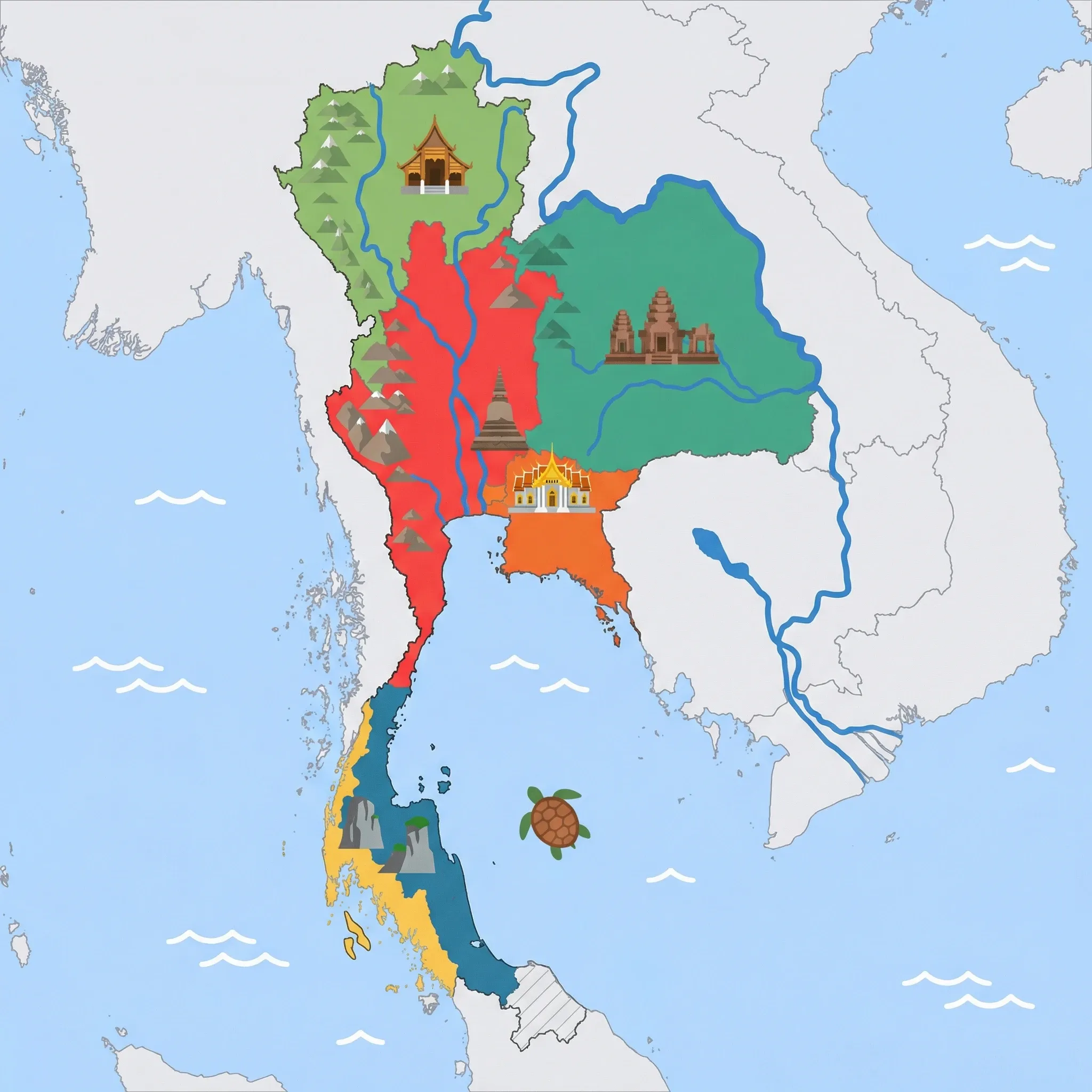
6 Regions
Andaman Coast (Phuket, Krabi, Phi Phi)
towering limestone cliffs meets emerald waters 🏝️🛶
Bangkok
A city of temples, tuk-tuks, and tasty treats 🇹🇭🏙️
Central Thailand (Ayutthaya, Sukhothai)
Ancient ruins and jungle waterfalls 🚲🌿
Isan (Northeast)
Dinosaurs, spicy food, and unseen Thailand 🌶️🦕
Northern Thailand (Chiang Mai, Chiang Rai)
Misty mountains, ethical elephants, and Lanna culture 🐘⛰️
Southern Gulf (Koh Samui, Koh Phangan, Koh Tao)
Island hopping in the Gulf of Thailand 🏝️🐢
Click on a region marker to explore details. Use the dropdown to color regions by activity suitability.

Getting There & Around
Getting There
- By Air – Suvarnabhumi Airport (BKK) is the main international hub, located about 30km from central Bangkok. Don Mueang (DMK) largely serves budget and domestic carriers. Direct flights connect major global cities to Phuket International Airport (HKT) for direct access to the Andaman Coast.
- By Train – The State Railway of Thailand connects Bangkok to borders with Malaysia and Laos. The sleeper train to Chiang Mai is a popular family adventure.
- Entry Requirements – Many Western citizens (including US, UK, EU) typically enter visa-free (often for 30–60 days depending on current policy). An Electronic Travel Authorization (ETA) system may be in effect; check requirements before travel. Check your government website for the latest visa requirements, or use the IATA Travel Centre entry-requirements checker.
Getting Around
- City Transport – In Bangkok, the BTS Skytrain and MRT Metro are clean, air-conditioned, and the best way to beat traffic. Children under a certain height often travel free.
- Tuk-tuks – Iconic three-wheeled taxis found nationwide. They are fun for short trips but rarely the cheapest option; always negotiate the fare before getting in.
- Ride-Hailing – The Grab app is widely used, safe, and convenient for families who want fixed prices and car seats (GrabFamily option available in some cities).
- Domestic Flights – Low-cost carriers like AirAsia and Nok Air make hopping between Bangkok and regions like Northern Thailand or the islands very affordable.
- Ferries & Speedboats – Essential for island hopping in the Andaman Coast. Life jackets are mandatory; ensure the operator provides child sizes.

Packing List
You must remove shoes at every temple and many shops/homes; laces become very annoying.
Strictly enforced in National Marine Parks to protect coral; standard brands may be confiscated.
Essential for long-tail boat trips to keep phones and spare clothes dry from splashes.
Dehydration hits fast in the humidity; local pharmacies sell them, but having a kid-friendly flavour helps.
Stickers for clothes are a great non-chemical alternative for young children to ward off dengue-carrying mosquitoes.
Versatile for covering shoulders at temples, as a beach sheet, or a light blanket on air-conditioned buses.

Activities & Best Times

Adventure & Nature
ExcellentHiking, wildlife, outdoor exploration, ecotourism
Boasts a dense concentration of high-quality jungle adventure parks and pristine marine national parks. Peak visitation aligns with dry weather for safe trekking and island exploration; summer months are hampered by heavy rainfall and trail mud.
The region offers world-class jungle trekking, mountain scenery, and authentic farm experiences like tea plantations. Peak conditions occur in the cool, dry winter, while the burning season (March-April) and peak monsoon (July-September) present health risks or trail accessibility issues.
Home to the UNESCO-listed Khao Yai and dramatic sandstone plateaus like Phu Kradueng, offering authentic wilderness experiences and wildlife spotting. Peak visiting occurs during the cool, dry winter months; peak monsoon rain and extreme pre-monsoon heat make exploration difficult or dangerous.

Beach & Sea
ExcellentBeach resorts, marine activities: diving, snorkelling, kite surfing, wind surfing, sailing
The Andaman Coast features globally iconic beaches (Railay, Maya Bay), world-class diving (Similan Islands), and limestone karst scenery that rivals anywhere in the world. This is an internationally recognized premier beach destination that warrants 'excellent' rating.
Koh Tao is globally recognized for diving (one of the world's top PADI certification destinations), and the region offers consistent high-quality beach experiences. While not quite 'excellent' tier (lacks the iconic karst scenery of Andaman), it deserves 'very_good'.
Offers unique freshwater river beaches and sand dunes along the Mekong and local reservoirs, though they lack the infrastructure and water clarity of international oceanic resorts. Peak conditions occur in the late dry season when water levels recede to expose the most dramatic sandy formations.

City & Cultural
ExcellentUrban tourism, museums, historical sites, architecture
A world-class hub of living culture, featuring authentic markets, historic temples on Rattanakosin Island, and prestigious galleries like BACC and MOCA. The cooler, drier months from November to February offer ideal conditions for exploring the city's vibrant street life and architecture.
Chiang Mai and Chiang Rai are premier cultural hubs featuring historic old cities and globally recognized contemporary art museums. While rainy months are acceptable for urban exploration, the extreme heat and smoke haze of March and April significantly degrade the experience for families.
Features UNESCO World Heritage sites Ayutthaya and Sukhothai, offering world-class archaeological and historical depth that rivals global heritage destinations. The cool, dry season (Nov-Feb) is peak for exploring these expansive outdoor ruins; the monsoon season (Jun-Sep) can lead to site flooding and oppressive humidity.

Educational & Exploratory
GoodLearning experiences, scientific sites, historical education
High-quality aquariums offer engaging marine education focused on Andaman biodiversity. While these indoor facilities provide year-round interest, the broader regional travel experience is best during the drier months.
SEA LIFE Bangkok Ocean World is Southeast Asia's largest aquarium, plus Bangkok National Museum and Jim Thompson House provide world-class educational experiences. This warrants 'good' not 'marginal'.
Features significant inland aquariums and paleontological museums that highlight the region's unique Mekong biodiversity and dinosaur heritage. These facilities offer solid learning opportunities for children, though they are secondary attractions rather than standalone international travel motivators.

Sports & Active
GoodSport tourism, fitness activities, active recreation
Specialized infrastructure for zip-lining and canopy adventures offers structured activity for active families. Peak months provide the safest and most comfortable conditions for outdoor circuits, while heavy rains mid-year may limit availability.
Features major organized activity centers like Safari World and Siam Amazing Park that provide world-class facilities for active families. These outdoor venues are best enjoyed outside the peak monsoon months of September and October to avoid heavy rain and flooding.
Active travelers can enjoy purpose-built infrastructure for football golf and canopy zip-lining across the jungle canopy. These activities require stable weather for safety, making the drier first half of the year the premium time for participation.

Theme Park & Entertainment
GoodAmusement parks, family entertainment venues
Features internationally recognized water parks and large-scale cultural spectacles that appeal to well-travelled families. Operations are most reliable during the dry season, with potential weather-related interruptions during the summer monsoon.
Safari World is a major attraction with international recognition. Pororo Aqua Park and other venues provide solid family entertainment. This exceeds 'marginal' threshold.
A range of regional-scale adventure and water parks provide reliable family entertainment. Visitation peaks align with international school holidays, though outdoor operations are frequently disrupted during the peak monsoon months.

Public Holidays & Calendar Next 12 months
Public holidays, festivals, cultural celebrations, and seasonal natural phenomena coming up in Thailand over the next 12 months.
Loading holidays and events...

Climate & Weather
Andaman Coast (Phuket, Krabi, Phi Phi)
Show Details
| Month | Temp °C | Rain | Humidity |
|---|
Bangkok
Show Details
| Month | Temp °C | Rain | Humidity |
|---|
Central Thailand (Ayutthaya, Sukhothai)
Show Details
| Month | Temp °C | Rain | Humidity |
|---|
Isan (Northeast)
Show Details
| Month | Temp °C | Rain | Humidity |
|---|
Northern Thailand (Chiang Mai, Chiang Rai)
Show Details
| Month | Temp °C | Rain | Humidity |
|---|
Southern Gulf (Koh Samui, Koh Phangan, Koh Tao)
Show Details
| Month | Temp °C | Rain | Humidity |
|---|

Travel Advisory
All major agencies maintain an assessment of elevated risk for Thailand. While the country is a primary tourism destination, ongoing political instability, sporadic civil unrest in urban areas, and significant regional conflicts near the Cambodian and Malaysian borders require travellers to maintain a high degree of vigilance.
Safety Topics
Traveller Advice (4 groups)

The social environment is generally tolerant and welcoming towards sexual and gender minorities. However, visitors should still remain aware of local cultural sensitivities regarding public displays of affection.

Solo female travellers should exercise extra vigilance in nightlife districts and on public transport. Dress conservatively when visiting religious sites and be cautious of unwanted attention or drink-spiking incidents in popular tourist hubs.

Travellers must carry a valid passport at all times as local police frequently perform identity checks. It is essential to respect local customs and refrain from making any critical comments about the monarchy, even on social media, to avoid severe legal penalties.

Recent visa reforms allow many nationalities to perform short-term or urgent business tasks under the standard 60-day visa exemption. Those planning longer stays or specific employment must secure the appropriate work permits to avoid detention or deportation.
Agency Summaries
Heightened caution is advised throughout the country because of potential civil unrest and insurgent activities. Travellers are specifically warned to avoid the provinces of Yala, Pattani, and Narathiwat, as well as the border region with Cambodia where military clashes have occurred.
A high degree of caution is recommended due to the persistent threat of terrorism in major cities and tourist centres. Additionally, ongoing conflict along the border with Cambodia and civil unrest in southern provinces present significant safety risks that require avoiding those specific regions.
Irish citizens are urged to be highly cautious due to terrorism risks and recent military clashes along the border with Cambodia. Travel to the southernmost provinces of Narathiwat, Pattani, and Yala is discouraged due to the risk of violence and insurgent activity.
Visitors should maintain a high level of vigilance across the country due to political instability and sporadic public demonstrations. Specific high-risk zones, including the far southern provinces and areas within 50km of the Cambodian border, should be avoided entirely due to active conflict and regional tensions.
While most of the country is safe for visitors, the government advises against travel to the deep southern provinces near the Malaysian border and specified zones near the Cambodian border. Authorities warn of strict regulations regarding cannabis and electronic cigarettes.
Heightened security awareness is necessary because of the potential for civil unrest and the ongoing threat of terrorism. New Zealanders are advised against travelling to the far south and border areas with Cambodia, where military conflict and landmines pose extreme risks.
Information is provided for general guidance only and does not constitute travel, safety, medical, or legal advice. Conditions may change. Users are responsible for independently verifying information before travel.