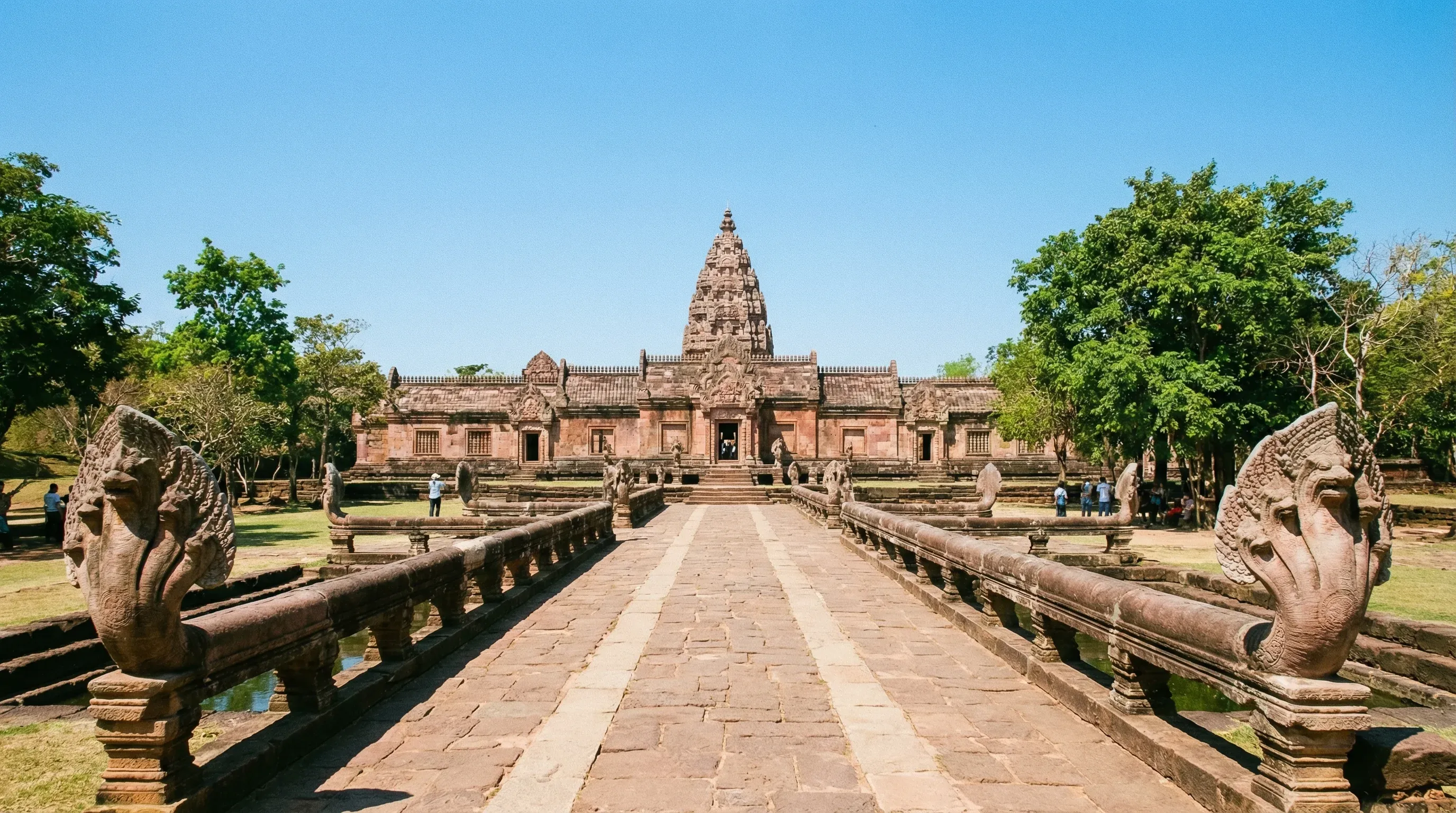

Isan (Northeast)
Dinosaurs, spicy food, and unseen Thailand 🌶️🦕
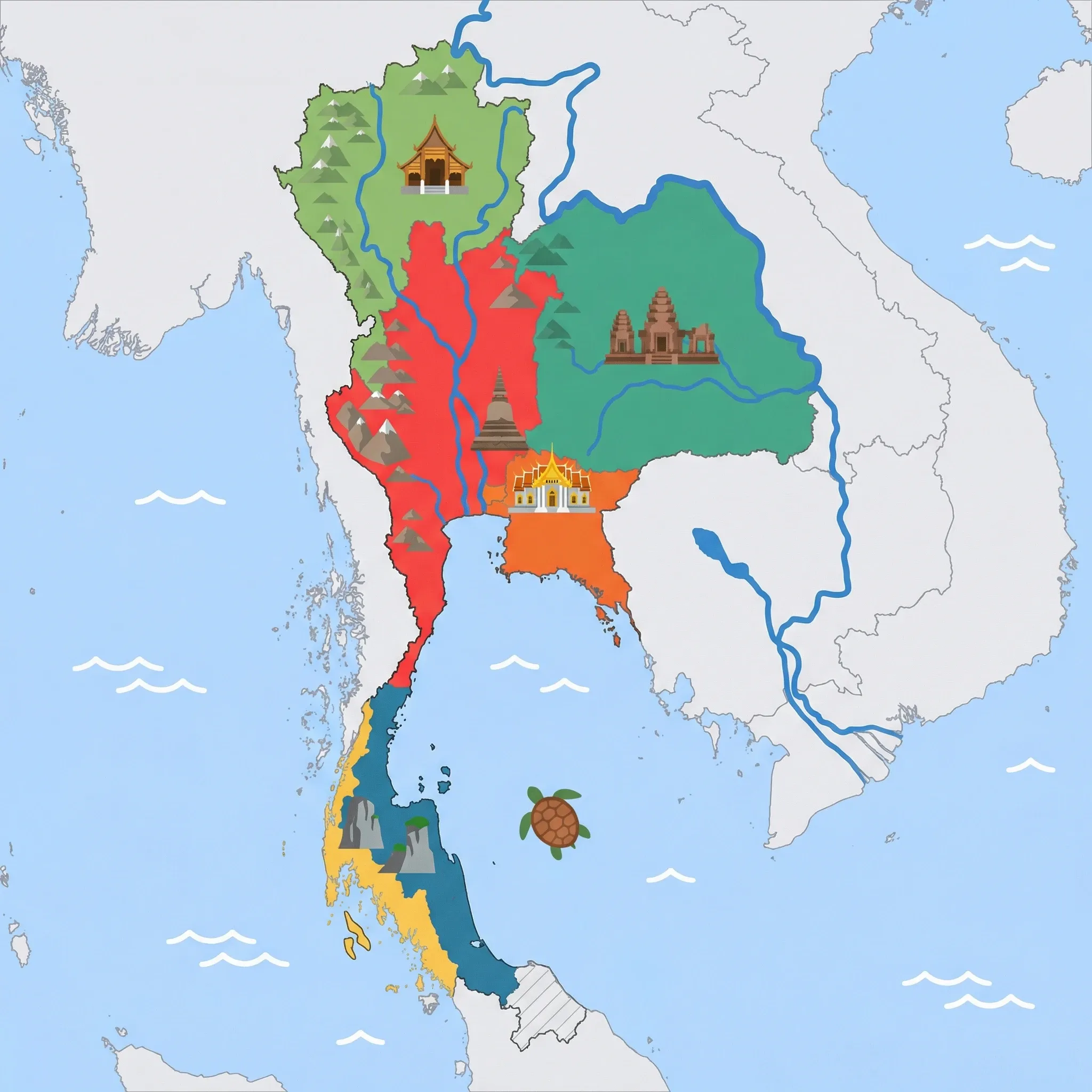
Click a region to explore
Isan (the Northeast) is the least visited region by international tourists, which makes it a treasure trove for families seeking an authentic experience off the beaten path. Culturally, it shares much with neighboring Laos, from the dialect to the sticky rice that accompanies every meal. The landscape is vast and agricultural, dotted with water buffalo and raised wooden houses. For children, Isan has a surprising and thrilling draw: Dinosaurs. This region is the paleontological center of Thailand, with world-class fossil sites and museums that rival those in the West.
Geographically, it acts as a bridge between the central plains and the Mekong River. The vibe here is incredibly laid back. The people of Isan are famous for their friendliness and music. While English is spoken less here than in Phuket, the genuine welcome makes up for the language barrier. Families can explore ancient Khmer ruins that resemble Angkor Wat but without the crowds, and visit National Parks where wild elephants still roam freely. It is a region for road-trippers and those willing to trade luxury resorts for genuine cultural connection.
Key Attractions
The gateway to the region is Khao Yai National Park, a UNESCO World Heritage site. It is one of the few places where you have a genuine chance of seeing wild elephants, gibbons, and hornbills. The park has easy hiking trails and stunning waterfalls like Haew Suwat (famous from the movie 'The Beach').
Further into the plateau, Phimai Historical Park offers a stunning example of Khmer architecture. It is compact and easy to navigate with children, offering a history lesson on the ancient highway that once connected this town to Angkor. For a unique natural spectacle, the Red Lotus Lake (Talay Bua Daeng) in Udon Thani is magical in the cool season (December-February), where boats glide through millions of pink lotus flowers. Dinosaur lovers must visit the museums in Khon Kaen and Kalasin (near the excavation sites), though the Nakhon Ratchasima Zoo is also a great family stop with a water park inside.
Practical Advice
You need your own transport here; renting a car is highly recommended. The best time to visit is the cool season (November to February), as Isan gets incredibly hot and dry in April. Hotels are often "apartment style" and very good value.
Food & Drink
Typical meal times: Early risers. Breakfast is 6:00 am to 8:00 am. Lunch 11:30 am. Dinner 6:00 pm to 7:30 pm.
Typical meal costs: extremely cheap. A feast for four can cost THB 400–600 (approx. $11–17 USD / €10–15 EUR).
Dietary requirements: Isan food is famous for being the spiciest in Thailand. Always say "mai pet" (no spicy). Sticky rice is the staple carb here (not steamed rice), which kids love eating with their hands.
Signature dishes:
- Som Tum (Papaya Salad) – The world-famous salad originated here. It's refreshing and crunchy (order without chilies for kids).
- Gai Yang – Marinated grilled chicken, usually cooked over charcoal on the roadside. Mild and delicious.
- Sai Krok Isan – Fermented pork sausage balls served with ginger and cabbage. Uniquely sour and savory.
Why this score?
This region is the most 'off-the-beaten-path' in Thailand, offering a more rugged and authentic experience through its vast plateau and Mekong River border. While not extreme wilderness, the limited tourist infrastructure and language barriers create a sense of exploration. National parks like Phu Kradueng offer more challenging hikes that are popular with local adventurers.
Why this score?
Healthcare exists in major cities like Khon Kaen and Nakhon Ratchasima, but international-standard facilities with English-speaking staff are scarce. Rural areas rely on basic government clinics which may not meet the expectations of foreign families for complex issues. It is one of the more challenging regions in Thailand for accessing high-end medical care quickly.
Why this score?
Isan remains a niche destination with relatively few international tourists compared to the rest of Thailand. It is primarily a domestic tourism hub known for its rural charm and Khmer ruins, often overlooked by first-time foreign visitors. The lack of major international airports and beach resorts keeps visitor numbers significantly lower than in other regions.

Isan is the cheapest region in Thailand for tourists. You rarely pay "tourist prices" here. A comfortable air-conditioned hotel room costs THB 600–1,000 (approx. $17–28 USD / €15–26 EUR). Street food is often THB 40–50 (approx. $1.10–1.40 USD / €1–1.30 EUR). Car rental will be your biggest expense.

Getting Here & Around
Getting Here
- Airports – Udon Thani (UTH) and Khon Kaen (KKC) have frequent low-cost flights from Bangkok (1 hour).
- Train – The Northeast line splits at Korat; one line goes to Udon Thani/Nong Khai, the other to Ubon Ratchathani. Sleeper trains are comfortable.
- Driving – A 3-hour drive from Bangkok to Khao Yai National Park makes it an easy weekend escape.
Getting Around
- Car Rental – Almost essential for families. Distances are large and public transport between attractions is sparse.
- Samlor – Three-wheeled pedal tricycles are still common in Isan towns; a slow, fun way to see a market.
Nearby Airports (8 airports)
Buri Ram
BFVBuri Ram
Khon Kaen
KKCKhon Kaen
Nakhon Phanom
KOPNakhon Phanom
Loei Airport
LOELoei
Roi Et
ROIRoi Et
Sakon Nakhon Airport
SNOSakon Nakhon
Ubon Ratchathani
UBPUbon Ratchathani
Udon Thani
UTHUdon Thani
View full flight map for Thailand →
Official Links

Packing List
English is not widely spoken in rural Isan; Google Translate offline mode is essential.
Restrooms at rural petrol stations and parks often do not provide paper.
If visiting in Dec/Jan, morning temperatures can drop to 10°C (50°F), surprisingly cold.
You must remove shoes at every temple and many shops/homes; laces become very annoying.
Strictly enforced in National Marine Parks to protect coral; standard brands may be confiscated.
Essential for long-tail boat trips to keep phones and spare clothes dry from splashes.
Dehydration hits fast in the humidity; local pharmacies sell them, but having a kid-friendly flavour helps.
Stickers for clothes are a great non-chemical alternative for young children to ward off dengue-carrying mosquitoes.
Versatile for covering shoulders at temples, as a beach sheet, or a light blanket on air-conditioned buses.

Activities & Best Times

Hiking, wildlife, outdoor exploration, ecotourism
Home to the UNESCO-listed Khao Yai and dramatic sandstone plateaus like Phu Kradueng, offering authentic wilderness experiences and wildlife spotting. Peak visiting occurs during the cool, dry winter months; peak monsoon rain and extreme pre-monsoon heat make exploration difficult or dangerous.

Urban tourism, museums, historical sites, architecture
Features world-class Khmer archaeological sites at Phanom Rung and Phimai that rival Angkor Wat for authenticity and architectural significance. The cool season is ideal for exploring these outdoor heritage sites, while the extreme heat of March to May can be physically taxing for families.

Beach resorts, marine activities: diving, snorkelling, kite surfing, wind surfing, sailing
Offers unique freshwater river beaches and sand dunes along the Mekong and local reservoirs, though they lack the infrastructure and water clarity of international oceanic resorts. Peak conditions occur in the late dry season when water levels recede to expose the most dramatic sandy formations.

Learning experiences, scientific sites, historical education
Features significant inland aquariums and paleontological museums that highlight the region's unique Mekong biodiversity and dinosaur heritage. These facilities offer solid learning opportunities for children, though they are secondary attractions rather than standalone international travel motivators.

Sport tourism, fitness activities, active recreation
Facilities like Scenical World provide organized active entertainment and adventure sports infrastructure suitable for families. The cooler winter months provide the only comfortable window for these high-energy outdoor activities, as summer humidity and heat are prohibitive.

Amusement parks, family entertainment venues
Regional-scale water parks and family fun centers provide entertainment for domestic travelers but lack the scale and immersion of global theme park destinations. Visitation peaks during the hottest months when water-based cooling is most desirable, despite high temperatures.

Attractions (17 total)



Public Holidays & Calendar Next 12 months
Public holidays, festivals, cultural celebrations, and seasonal natural phenomena coming up in Isan (Northeast) over the next 12 months.
Loading holidays and events...

Travel Advisory
All major agencies maintain an assessment of elevated risk for Thailand. While the country is a primary tourism destination, ongoing political instability, sporadic civil unrest in urban areas, and significant regional conflicts near the Cambodian and Malaysian borders require travellers to maintain a high degree of vigilance.
Safety Topics
Traveller Advice (4 groups)

The social environment is generally tolerant and welcoming towards sexual and gender minorities. However, visitors should still remain aware of local cultural sensitivities regarding public displays of affection.

Solo female travellers should exercise extra vigilance in nightlife districts and on public transport. Dress conservatively when visiting religious sites and be cautious of unwanted attention or drink-spiking incidents in popular tourist hubs.

Travellers must carry a valid passport at all times as local police frequently perform identity checks. It is essential to respect local customs and refrain from making any critical comments about the monarchy, even on social media, to avoid severe legal penalties.

Recent visa reforms allow many nationalities to perform short-term or urgent business tasks under the standard 60-day visa exemption. Those planning longer stays or specific employment must secure the appropriate work permits to avoid detention or deportation.
Agency Summaries
Heightened caution is advised throughout the country because of potential civil unrest and insurgent activities. Travellers are specifically warned to avoid the provinces of Yala, Pattani, and Narathiwat, as well as the border region with Cambodia where military clashes have occurred.
A high degree of caution is recommended due to the persistent threat of terrorism in major cities and tourist centres. Additionally, ongoing conflict along the border with Cambodia and civil unrest in southern provinces present significant safety risks that require avoiding those specific regions.
Irish citizens are urged to be highly cautious due to terrorism risks and recent military clashes along the border with Cambodia. Travel to the southernmost provinces of Narathiwat, Pattani, and Yala is discouraged due to the risk of violence and insurgent activity.
Visitors should maintain a high level of vigilance across the country due to political instability and sporadic public demonstrations. Specific high-risk zones, including the far southern provinces and areas within 50km of the Cambodian border, should be avoided entirely due to active conflict and regional tensions.
While most of the country is safe for visitors, the government advises against travel to the deep southern provinces near the Malaysian border and specified zones near the Cambodian border. Authorities warn of strict regulations regarding cannabis and electronic cigarettes.
Heightened security awareness is necessary because of the potential for civil unrest and the ongoing threat of terrorism. New Zealanders are advised against travelling to the far south and border areas with Cambodia, where military conflict and landmines pose extreme risks.
Information is provided for general guidance only and does not constitute travel, safety, medical, or legal advice. Conditions may change. Users are responsible for independently verifying information before travel.