

Safety
⚠️ SAFETY WARNING: Exercise increased caution in Tunisia due to the potential threat of terrorism and civil unrest. While major coastal tourist resorts and the capital are generally considered safe and frequented by millions of visitors, travel to border regions (especially near Algeria and Libya) and certain mountainous areas (such as Mount Chaambi) is strictly advised against by most Western governments. Always stay in established tourist zones, follow local advice, and avoid protests.
Tunisia is arguably North Africa's most family-friendly destination, packing an incredible variety of landscapes into a compact, accessible country. For families, it offers a gentle introduction to the Arab-Berber world, where Mediterranean charm blends with the mystery of the Sahara. The north is green and fertile, dotted with ancient ruins and the blue-and-white beauty of Tunis & North, while the south opens up into vast desert vistas that will captivate children's imaginations. The local culture is deeply family-oriented, and children are welcomed everywhere with genuine warmth.
Beyond the beach resorts, the country is a living history lesson. Kids can scramble over some of the best-preserved Roman ruins in the world, explore troglodyte underground homes that look like they belong on another planet, and haggle for souvenirs in colourful medinas. Whether you are exploring the island vibes of Djerba Island or taking a 4x4 expedition into the dunes, Tunisia offers high-adventure experiences at a fraction of the cost of European equivalents.
Key Attractions
For a "Gladiator" style experience without the crowds of Rome, the Amphitheatre of El Jem is a must-visit; kids can explore the underground tunnels where lions were once kept. In the south, the Mos Espa (Star Wars Set) remains one of the country's biggest draws for families, allowing fans to walk through the actual streets of Tatooine. Nearby, the Douz Market and Great Dune serves as the "Gateway to the Sahara," offering camel treks that range from one hour to overnight camping adventures.
In the north, the picture-perfect village of Sidi Bou Said Village offers stunning views and famous bambalouni (sugar doughnuts) that children will love. History comes alive at the Archaeological Site of Carthage, while the Bardo National Museum houses world-class mosaics that depict ancient life in vivid color. For a change of pace, the open-air art museum of Djerbahood on Djerba island turns a traditional village into a vibrant canvas of street art.
Practical Advice
The best time to visit is spring (March to May) or autumn (September to November) when temperatures are pleasant for exploring ruins and the desert. Summer can be scorching inland, though coastal breezes help. Dress modestly when leaving beach resorts; shoulders and knees should be covered in medinas and rural towns. Haggling is part of the culture in souks-treat it as a friendly game.
Food & Drink
Typical meal times: Lunch is typically served from 12:30 pm to 2:30 pm, and dinner from 7:30 pm to 9:30 pm. In tourist areas, restaurants often serve continuously.
Typical meal costs: 20–45 TND (approx. $6.50–15 USD / €6–13.50 EUR) for a casual meal; 80–150 TND (approx. $26–49 USD / €24–45 EUR) for a mid-range family dinner.
Dietary requirements: Vegetarian options like couscous with vegetables and ojja (without sausage) are common, but veganism is less understood. Bread is served with everything, so gluten-free travelers should be cautious. Nut allergies are generally well-managed, though almonds and pistachios are common in desserts.
Family-friendly dining: Tunisian culture loves children, and they are welcome in almost all restaurants. Highchairs are available in resort hotels but less common in local eateries. "French fries" and grilled chicken are universally available for fussy eaters.
Signature dishes:
- Couscous – The national dish, steamed semolina served with vegetables and meat or fish; unlike Moroccan versions, it is often reddish from tomato paste.
- Brik – A crispy, deep-fried pastry triangle usually filled with egg, parsley, and tuna-a fun finger food for older kids (watch out for the runny egg!).
- Tunisian Tajine – Completely different from the Moroccan stew, this is a thick, baked egg and cheese frittata, similar to a Spanish tortilla or quiche.
- Bambalouni – A traditional sweet Tunisian doughnut ring, fried fresh and dipped in sugar, famous in Sidi Bou Said.

Tunisia is very affordable for Western families. A family of four can expect to spend around 250–400 TND (approx. $80–130 USD / €75–120 EUR) per day, covering mid-range accommodation, meals, and private transport. Street food and local transport are incredibly cheap, while imported goods and alcohol in resorts will cost closer to European prices.
Age Suitability




Did you know? Tunisia welcomes approximately 6.4 million international visitors per year. Most visitors come from Middle East.
Explore Regions
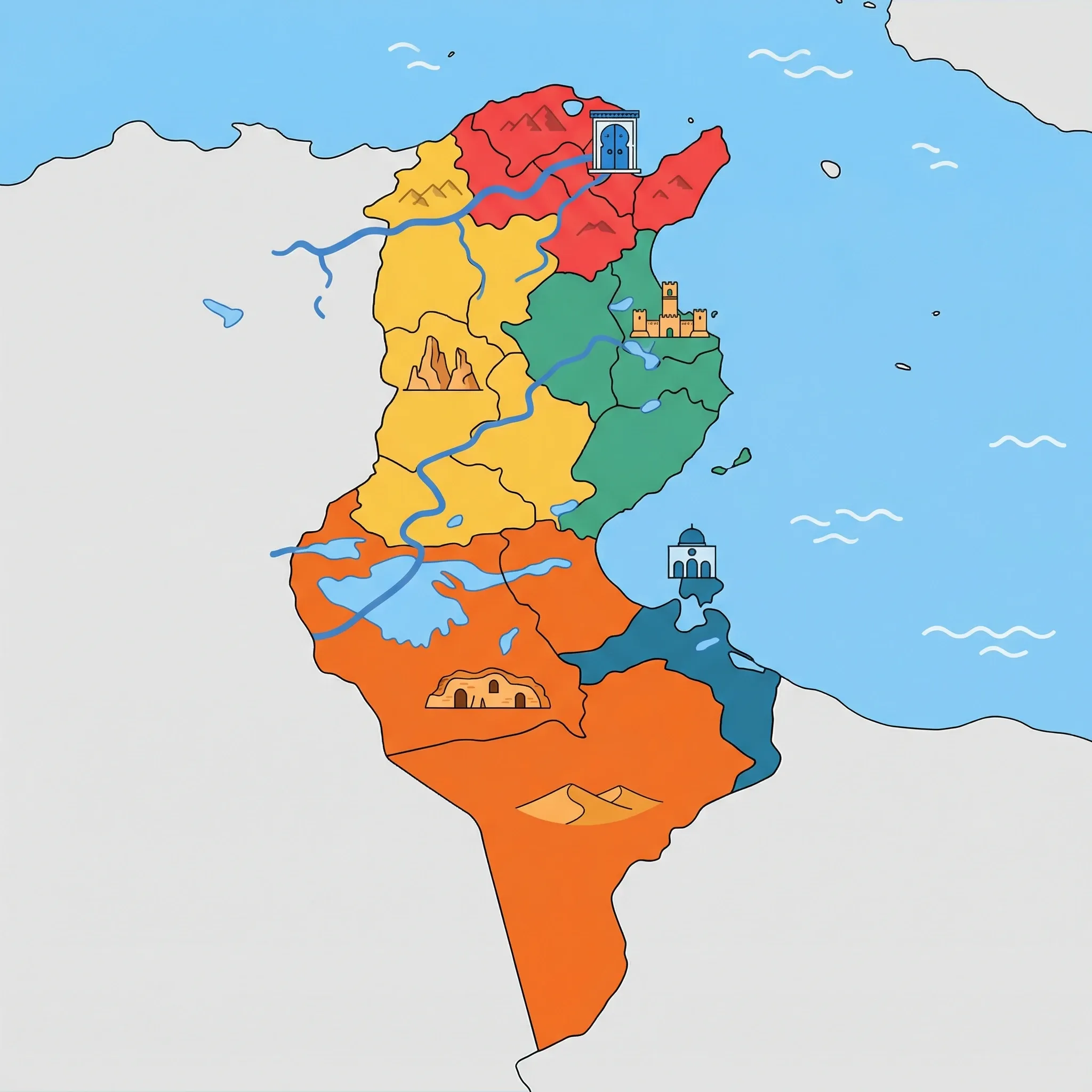
5 Regions
Djerba Island
☀️ Sun, street art, and Star Wars stories on a laid-back island
Northern Mountains (Tabarka)
🌲 Where green mountains meet the coral coast
Sahara & South (Douz, Tozeur, Matmata)
🐪 Star Wars sets, cave dwellings, and golden dunes
Sousse & Sahel Coast
🏖️ Roman ruins, pirate ships, and endless beaches
Tunis & North (Carthage, Sidi Bou Said)
🏛️ Ancient ruins, blue villages, and city buzz
Click on a region marker to explore details. Use the dropdown to color regions by activity suitability.

Getting There & Around
Getting There
- By Air – Tunis-Carthage International Airport (TUN) is the main hub, located near the capital. For beach holidays, Monastir (MIR) and Enfidha-Hammamet (NBE) serve the Sousse & Sahel Coast resorts directly with many charter flights from Europe.
- By Sea – Ferries operate regular routes from Marseille (France), Genoa (Italy), and Palermo (Sicily) to the port of La Goulette in Tunis. This allows families to bring their own vehicle.
- Entry Requirements – US, UK, and EU citizens generally do not need a visa for stays up to 90 days. Check your government website for the latest visa requirements, or use the IATA Travel Centre entry-requirements checker.
Getting Around
- Louages (Shared Taxis) – The backbone of local travel. These white vans with color-coded stripes connect major towns efficiently. They are cheap-approx. 5–10 TND (approx. $1.60–3.20 USD / €1.50–3 EUR) for medium trips-but depart only when full, which can be testing with impatient toddlers.
- Car Hire – The most flexible option for families wanting to visit diverse sites like Sahara & South. Major roads are generally good, but driving can be aggressive in cities. A GPS is essential.
- Trains – The SNCFT network connects Tunis & North with the coast, including Sousse & Sahel Coast. Trains are cheap and scenic but can be slow and occasionally crowded. First-class tickets are recommended for families for guaranteed seats.
- Taxis – Abundant and yellow in cities. Always insist on the meter ("compteur") being used. Short city hops rarely cost more than 5–10 TND (approx. $1.60–3.20 USD / €1.50–3 EUR).

Packing List
English is not widely spoken outside major hotels; French is the primary second language and essential for local interactions.
Multipurpose: essential for covering shoulders/hair when visiting holy sites and useful for protection against desert dust.
Roman sites like Carthage and El Jem have uneven, rubble-strewn ground that is difficult to navigate in flip-flops.
Public restrooms outside of high-end hotels and restaurants frequently lack toilet paper.
Taxi drivers and small shopkeepers in the souks rarely have change for large bills; keep plenty of 1, 5, and 10 Dinar coins/notes.

Activities & Best Times

City & Cultural
ExcellentUrban tourism, museums, historical sites, architecture
Home to the UNESCO-listed Medina of Tunis, the ruins of Carthage, and the world-class Bardo Museum, this region offers exceptional historical depth. Peak months avoid the oppressive July-August heat, which makes exploring the dense urban quarters and archaeological sites uncomfortable.
Home to the world-renowned Djerbahood street art village and the historic El Ghriba Synagogue, offering a sophisticated blend of Jewish and Arab heritage. Avoid the peak summer heat and winter lull to best enjoy the authentic atmosphere of Houmt Souk and the Guellala pottery traditions.
Bulla Regia features unique subterranean Roman villas that are world-class archaeological sites, complemented by the Genoese Fort in Tabarka. Best visited in spring or autumn to avoid the punishing summer heat of the interior plains.

Adventure & Nature
Very GoodHiking, wildlife, outdoor exploration, ecotourism
Home to the rare cork oak forests of El Feidja National Park, this region provides Tunisia's most authentic mountain wilderness experience. Peak visiting times are spring and autumn when temperatures are ideal for trekking through the Kroumirie range.
Ichkeul National Park and the Jebel Zaghouan massifs provide significant biodiversity and hiking opportunities of international interest. Spring is ideal for birdwatching and mild temperatures, whereas the peak summer heat and mid-winter rains create challenging conditions.
Authentic Sahara trekking in the Grand Erg Oriental and unique troglodyte experiences in Matmata provide world-class nature immersion. Peak seasons offer comfortable trekking temperatures, while the extreme summer heat makes the desert dangerous for exploration.

Beach & Sea
Very GoodBeach resorts, marine activities: diving, snorkelling, kite surfing, wind surfing, sailing
Djerba is internationally recognized as Tunisia's premier beach island with 20km+ of high-quality Mediterranean beaches (Sidi Mahres). While not Caribbean-level, it meets Mediterranean standards for very_good. The current 'good' rating undervalues its reputation as a top beach destination.
Tabarka offers unique coastal landscapes with the Les Aiguilles rock formations and coral reefs popular for diving. The season is strictly summer-focused as the northern coast is significantly cooler and wetter than the south during winter.
The region features the well-developed marina complex of Port El Kantaoui and the expansive white sands of Mahdia, offering reliable Mediterranean resort experiences. Peak visitation occurs during the hot summer months when sea temperatures are ideal for swimming, while the mild winters are too cool for beach-centric tourism.

Sports & Active
Very GoodSport tourism, fitness activities, active recreation
Dedicated infrastructure like the TransTunisia Trail and the Beni M'Tir outdoor centers cater to high-standard hiking and cycling. Activity is best in the shoulder seasons to avoid both the intense summer sun and the muddy, wet winter conditions.
Dedicated cycling circuits and equestrian ranches like Ranch Adada offer structured active experiences across the island's flat terrain. Active tourism peaks in the shoulder seasons when the climate is mild enough for sustained physical activity.
Dedicated infrastructure for karting and established coastal cycling and hiking loops around Cap Africa cater well to active families. Spring and autumn are the peak periods for these activities, providing moderate temperatures and favorable conditions that are not present during the oppressive summer heat.

Relaxation & Wellness
GoodSpa retreats, wellness centers, peaceful getaways
Natural desert hot springs like Ksar Ghilane offer a highly authentic and restorative experience in a remote setting. The winter months are peak as the cool air temperatures make the thermal waters much more enjoyable than during the scorching summer.
Known for its thalassotherapy centers and traditional hammams like Sidi Brahim, providing a restorative escape during the cooler months. The wellness season peaks when temperatures are mild, making the heat of summer less conducive to traditional spa treatments.
Hammam Bourguiba is an established thermal spa destination where international travelers seek restorative treatments in a mountain setting. The peak season is winter when the contrast between the cold mountain air and hot springs is most restorative.

Road Trips & Scenic
GoodScenic drives, countryside tours, route-based travel
The P7 mountain pass between Tabarka and Ain Draham offers spectacular winding forest roads and scenic vistas unique to Tunisia. Winter months are often avoided due to frequent fog and high rainfall in the Kroumirie highlands.
Scenic coastal routes between Sousse and Mahdia and the cliff roads of Hergla offer beautiful Mediterranean vistas and access to traditional villages. Peak driving conditions occur in spring and early autumn when visibility is high and the glare and congestion of the peak summer season are absent.
The Cap Bon Peninsula and coastal routes to Bizerte offer scenic driving with well-maintained infrastructure and cultural stops. Best driven in spring or autumn to enjoy the Mediterranean landscape in clear light and comfortable temperatures.

Theme Park & Entertainment
GoodAmusement parks, family entertainment venues
The region hosts prominent water parks and amusement centers like Acqua Palace and Hannibal Park, which are popular for high-standard family entertainment. These facilities operate at peak capacity during the summer holidays, while they are largely closed or less appealing during the cooler off-season.
Regional entertainment facilities like Djerba Park provide family-oriented fun during the summer holiday window, though they lack international destination-level status. Operating hours and activity levels are highest during the primary beach tourism months.
Regional parks like Dah Dah provide localized family entertainment but do not meet the standards of major global theme park destinations. They are most vibrant during the summer school holidays and warmer evenings.

Educational & Exploratory
MarginalLearning experiences, scientific sites, historical education
The El Feidja Ecomuseum provides specialized insight into the unique Maghrebian ecosystem and endemic species like the Barbary stag. Its appeal is largely tied to the accessibility of the surrounding national park.
The Palais des Sciences de Monastir provides a significant purpose-built discovery center for families interested in scientific engagement. It is best visited during the academic year when cooling temperatures facilitate travel, whereas the heat of mid-summer is generally avoided by educational tourists.
Facilities like Tunis Science City provide educational engagement, though they lack the global significance of top-tier international museums. These indoor sites are accessible year-round, but summer heat makes the transition between city sites difficult.

Festivals & Seasonal
MarginalEvents, celebrations, seasonal attractions
The Carthage International Festival and Carthage Film Festival attract global talent, making mid-summer the peak for event-driven travel. Outside of these specific festival windows, there are few events that would motivate international family travel.
The region hosts internationally recognized events like the International Festival of the Sahara in Douz, showcasing nomadic culture and equestrian skills. These events are strictly seasonal, typically occurring between October and December.

Public Holidays & Calendar Next 12 months
Public holidays, festivals, cultural celebrations, and seasonal natural phenomena coming up in Tunisia over the next 12 months.
Loading holidays and events...
Climate & Weather
Djerba Island
Show Details
| Month | Temp °C | Rain | Humidity |
|---|
Northern Mountains (Tabarka)
Show Details
| Month | Temp °C | Rain | Humidity |
|---|
Sahara & South (Douz, Tozeur, Matmata)
Show Details
| Month | Temp °C | Rain | Humidity |
|---|
Sousse & Sahel Coast
Show Details
| Month | Temp °C | Rain | Humidity |
|---|
Tunis & North (Carthage, Sidi Bou Said)
Show Details
| Month | Temp °C | Rain | Humidity |
|---|

Travel Advisory
While most tourist areas remain open, all major agencies recommend increased vigilance due to the threat of terrorism and regional instability. Specific border and mountainous zones carry extreme risk and should be avoided.
Safety Topics
Traveller Advice (3 groups)

Ensure you have comprehensive travel insurance that covers medical evacuation. Always carry a copy of your passport and monitor local media for news of protests or security incidents.

Homosexual acts are illegal in Tunisia and can lead to imprisonment. Public displays of affection should be avoided to prevent legal issues or harassment.

Female travellers may experience unwanted attention or verbal harassment, particularly when travelling alone. Dressing modestly and exercising discretion in public can help mitigate these risks.
Agency Summaries
Irish citizens should maintain a strong level of security awareness. Terrorism remains a primary concern, particularly following historical attacks on tourist infrastructure. Avoid demonstrations and border regions.
New Zealanders should be aware of significant security concerns, including terrorism and the possibility of violent protests. Foreigners have previously been targeted, and border areas carry a risk of kidnapping.
A heightened level of caution is necessary because of the risk of terrorist attacks and potential civil unrest. Protests can occur without warning, and the security environment near international borders is volatile.
Travellers are advised to maintain vigilance throughout the country due to the ongoing threat of terrorism. Extremely strict warnings are in place for areas near the borders with Libya and Algeria, where travel should be completely avoided.
The government warns against all travel to border regions with Libya and Algeria due to security operations and militant activity. While major tourist resorts are generally accessible, visitors must stay informed of shifting security conditions.
Increased caution is recommended due to potential terrorist activity. High-risk zones, including specific mountainous regions in the west and border zones, are designated as Level 4 areas where travel is prohibited for embassy personnel and discouraged for citizens.
Information is provided for general guidance only and does not constitute travel, safety, medical, or legal advice. Conditions may change. Users are responsible for independently verifying information before travel.