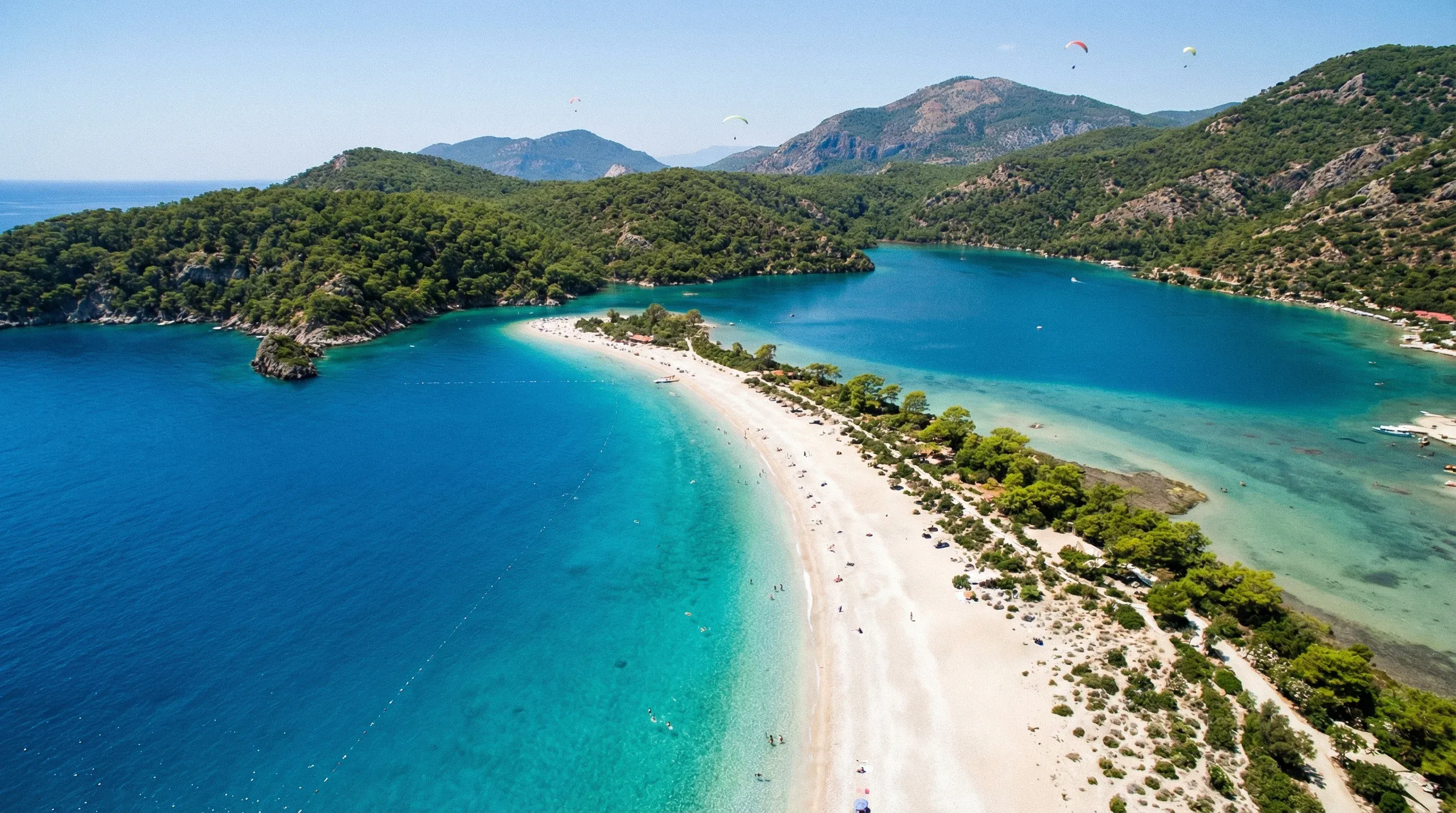

Turquoise Coast / Mediterranean (Lycian Coast)
Sun, sea, and sunken cities ☀️🐢
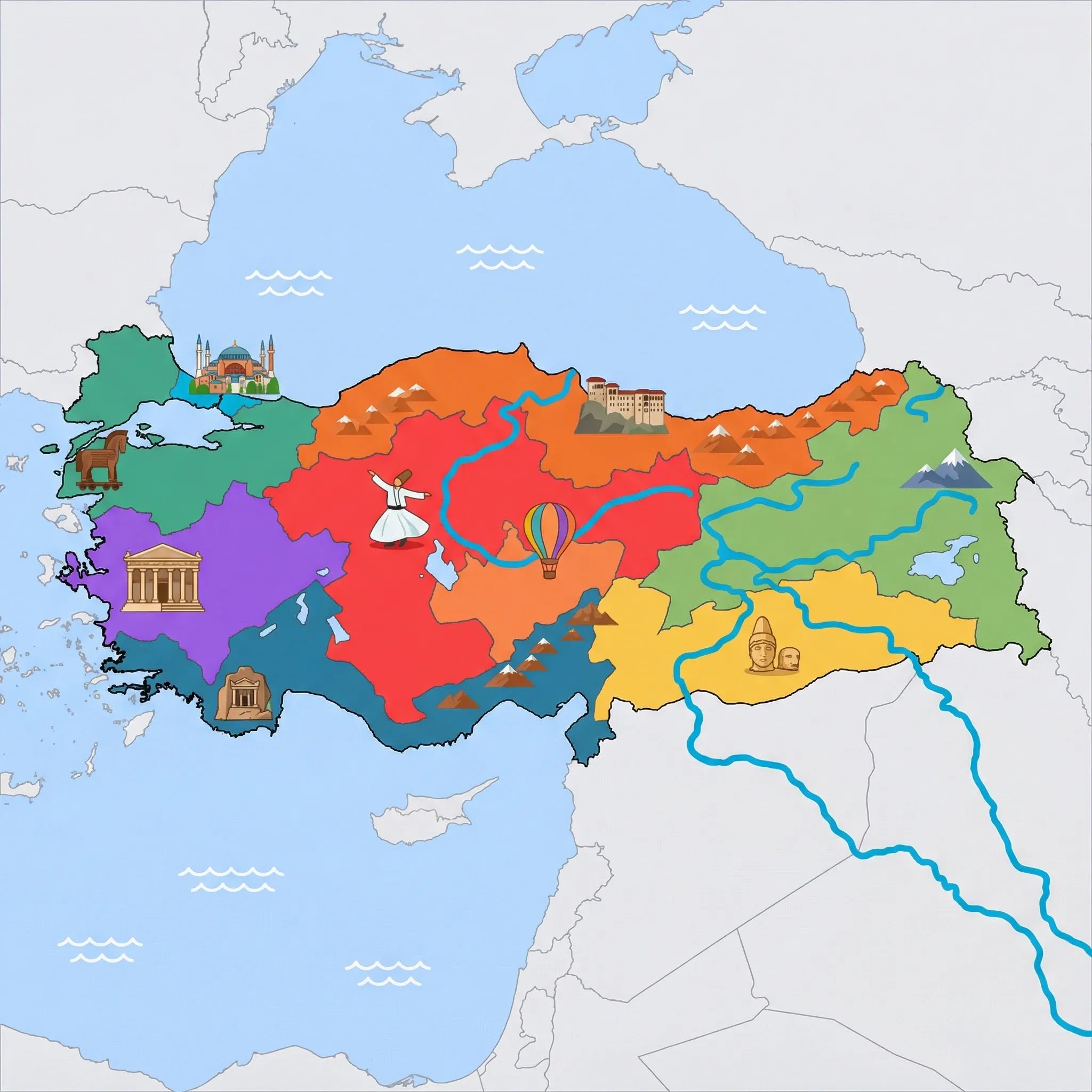
Click a region to explore
This is the holiday capital of Turkey, and for good reason. The Mediterranean coast (often called the Turquoise Coast or Turkish Riviera) offers a spectacular combination of high Taurus Mountains and crystal-clear sea. For families, it covers every base: there are massive all-inclusive resorts in Antalya with endless kids' clubs, but also bohemian bungalow villages in Olympos and chic villas in Kalkan. The water here is warmer and saltier than the Aegean, extending the swimming season from April well into November.
What sets this region apart is how accessible the history is. You don't have to drag kids to a museum; the ruins are often right on the beach. You can snorkel over sunken walls in Kekova or swim past Lycian sarcophagi. Adventure is everywhere—from paragliding in Ölüdeniz (tandem flights suitable for brave kids) to walking the shallow waters of Saklıkent Gorge. The vibe is purely vacation-focused, meaning English is spoken everywhere, and every possible amenity for children—from water parks to playgrounds—is readily available.
Key Attractions
Antalya is the main hub, and the Antalya Aquarium is a world-class facility with the world's biggest tunnel aquarium—a guaranteed hit. Just outside the city, the Köprülü Canyon National Park offers family-friendly rafting (gentle enough for kids). For a history fix, the Aspendos Ancient Theater is the best-preserved Roman theater in the world; climbing the steep steps gives kids a sense of gladiator scale. Further west, Patara Beach and Dunes is an 18km stretch of sand that never feels crowded. It is part of the Patara Ancient City, so you walk through Roman arches to get to the sea. The Saklıkent National Park is a dramatic gorge where you walk through freezing cold water between soaring cliffs—an unforgettable adventure for hot days. For a view from the clouds, the Olympos Teleferik cable car whisks you to the summit of Mount Tahtalı.
Practical Advice
Summers (July-August) are excessively hot (40°C+) and humid. June and September are perfect. If staying in a resort, check if the beach is sand or pebble—many in Konyaaltı and Kemer are pebbly. Renting a car allows you to escape the crowds and find hidden bays.
Food & Drink
Typical meal times: Lunch 12:30 pm to 2:30 pm. Dinner is late, often 8:00 pm to 10:00 pm.
Typical meal costs: Varies wildly. Tourist traps are pricey. Local spots: 1,500–2,500 TRY (approx. $45–75 USD / €40–68 EUR) for a family.
Dietary requirements: Very easy. Resorts cater to everything. Fresh fruit (oranges, pomegranates) is exceptional here.
Signature dishes:
- Piyaz (Antalya style) – A white bean salad with a tahini, garlic, and vinegar sauce. Totally different from the version elsewhere.
- Burnt Ice Cream (Yanıksı Dondurma) – Goat milk ice cream with a distinct smoky/burnt flavor, unique to Antalya.
- Gözleme – Savory pancakes filled with spinach, cheese, or potato, cooked by ladies sitting on the floor in many roadside cafes.
Why this score?
The region offers a balance of developed resort life and outdoor activities like paragliding in Babadağ, canyoning in Köprülü, and hiking the Lycian Way. While these offer thrills, they are supported by a very professional and safety-conscious tourism infrastructure.
Why this score?
Antalya is a major hub for medical tourism, specifically for dental and cosmetic procedures, meaning hospitals are very well-equipped for foreigners. Private clinics along the coast in Fethiye and Kaş are accustomed to treating international tourists and usually have English-speaking staff.
Why this score?
Antalya and the surrounding coast constitute a top-tier international destination, often ranking as one of the most visited beach regions globally. With thousands of hotels, massive international airport capacity, and famous sites like Ölüdeniz, it is a primary hub for European and Russian holidaymakers.

Prices depend on your style. All-inclusive resorts can be great value for families. Dining out in chic towns like Kalkan or Göcek is expensive (European prices). A mid-range hotel is 3,000–5,000 TRY (approx. $90–150 USD / €80–135 EUR). Beach access is often free or cheap.

Getting Here & Around
Getting Here
- Airports – Antalya (AYT) is the massive hub. Dalaman (DLM) serves the western part (Fethiye/Kaş).
- Bus – Comfortable overnight buses run from everywhere in Turkey to Antalya.
Getting Around
- Car – The coastal D400 road is one of the world's most scenic drives. Essential for independent families.
- Dolmuş – Minibuses run constantly between resorts and main towns.
- Boat – Water taxis and 'Gulet' day cruises are a standard way to see the coast.
Nearby Airports (6 airports)
Antalya Airport
AYTAntalya
Bodrum - Milas
BJVBodrum
Cukurova International Airport
COVMersin
Dalaman
DLMDalaman
Gazipasa Airport
GZPGazipasa
Isparta Süleyman Demirel Airport
ISEIsparta
View full flight map for Turkey →

Packing List
Many beaches (like Konyaaltı) are large pebbles which hurt little feet.
The water is incredibly clear; renting gear daily adds up quickly.
You will likely be on boats, rafts, or in the sea constantly.
The midday sun is relentless and there is often little shade at archaeological sites.
You will frequently remove shoes when entering mosques and private homes; laces become a hassle.
Essential for women and girls to cover heads/shoulders when visiting mosques (men may need to cover knees too).
Strollers struggle on the uneven cobblestones of historic centers and ancient ruins; a carrier is far more practical.
Public restrooms outside major hotels often lack toilet paper; carrying your own supply is a must.
The morning call to prayer is beautiful but loud and starts very early (around 5 am); helpful for light sleepers.

Activities & Best Times

Hiking, wildlife, outdoor exploration, ecotourism
Home to the world-renowned Babadağ paragliding site and Köprülü Canyon, offering elite-level nature immersion and wilderness exploration. May to October provides stable conditions for canyoning and mountain activities, while winter precipitation limits mountain accessibility.

Urban tourism, museums, historical sites, architecture
Features internationally significant heritage sites like Aspendos and the Antalya Museum, reflecting deep Lycian and Roman history. High summer heat and winter rainfall make the transitional spring and autumn months the most comfortable for exploring archaeological sites.

Learning experiences, scientific sites, historical education
The Antalya Aquarium and Science Center provide world-class, purpose-built educational environments for families. While these are indoor facilities, they align with the broader tourism peak and shoulder seasons when regional infrastructure is fully operational.

Sport tourism, fitness activities, active recreation
Supported by specialized infrastructure for paragliding and active outdoor centers at Babadağ and Olympos. The season is dictated by wind stability and clear skies, with winter months posing safety risks due to unpredictable Mediterranean storm systems.
Amusement parks, family entertainment venues
Offers quality regional entertainment venues including Sealanya Dolphinpark and Aktur Park which are highly appealing for family leisure. These venues primarily operate during the warm tourism season, with significant operational reductions or closures during the cooler, wetter winter months.

Attractions (22 total)



Public Holidays & Calendar Next 12 months
Public holidays, festivals, cultural celebrations, and seasonal natural phenomena coming up in Turquoise Coast / Mediterranean (Lycian Coast) over the next 12 months.
Loading holidays and events...

Travel Advisory
All major agencies maintain a consensus that travelers should exercise a high degree of vigilance country-wide. This assessment is driven by persistent terrorism risks and potential for civil unrest. Extreme regional risks (L3) exist near the borders, but the national level remains L1.
Safety Topics
Traveller Advice (4 groups)

Climbing Mount Ararat requires a special military permit obtained months in advance. Trekking in remote areas of the southeast is dangerous due to ongoing security operations and the risk of being caught in military zones.

Homosexuality is not illegal, but social acceptance varies widely. Public events like pride marches are frequently banned by local authorities, and travelers may encounter discrimination or social stigma.

Female travelers have reported incidents of harassment and sexual assault in tourist zones. It is recommended to remain alert when traveling alone and to dress modestly, particularly in rural areas or when visiting religious sites.

Ensure passports are valid for at least six months from the date of entry. Maintain a high level of situational awareness in crowded public spaces, transportation hubs, and locations frequented by Westerners.
Agency Summaries
Heightened vigilance is recommended because of terrorism concerns and the risk of arbitrary detentions. Security forces have previously held foreign nationals on politically motivated grounds. Avoid the border regions with Syria and Iraq entirely, as well as the provinces of Sirnak and Hakkari.
There is a heightened risk of terrorism in major cities and tourist locations. Travelers should stay informed of local events and avoid protests. Extreme caution or avoidance is necessary for southeastern provinces and areas bordering Syria.
Vigilance is required throughout the country, particularly in major urban centers like Istanbul and Ankara, where terrorist attacks have occurred. The situation in the southeast is serious, and travel to within 10km of the Syrian border is strongly discouraged.
Travelers should remain vigilant across the country due to the threat of terrorist activity and the potential for public demonstrations. Particular danger exists in the southeastern provinces, especially near the borders with Syria and Iraq, where all travel is discouraged due to volatile security and military activity.
While most of the country is accessible, there is a significant risk of terrorism and regional instability. Specific warnings are in place for the Syrian border area. Recent regional escalations in the Middle East have led to increased security monitoring and potential travel disruptions.
An elevated level of caution is advised due to the persistent threat of terrorism. Travelers should monitor regional tensions following military actions in the Middle East, as these can affect flight availability and security. Avoid large gatherings and demonstrations which may turn violent.
Information is provided for general guidance only and does not constitute travel, safety, medical, or legal advice. Conditions may change. Users are responsible for independently verifying information before travel.