

⚠️ SAFETY WARNING: Due to the ongoing full-scale Russian invasion and active military conflict, government agencies (including the US, UK, CA, AU, IE, and NZ) advise travelers to avoid all travel (Level 4/Do Not Travel) to Ukraine. Missile and drone strikes occur nationwide, including in major cities and civilian areas. The security situation is volatile and can deteriorate without warning. Consular assistance is severely limited or non-existent. Families are strongly urged to consult their own government's official travel advisory before considering a trip, as circumstances and risk assessments vary.
Ukraine is the largest country entirely within Europe, a land of vast steppes, dense forests, and deep spiritual roots. Geographically, it bridges East and West, anchored by the mighty Dnipro River which slices through the landscape, separating the rolling hills of the west from the industrial plains of the east. For families, the country offers a poignant lesson in history and resilience. The golden domes of orthodox cathedrals glint against blue skies, while the Carpathian Mountains in the west offer pristine nature, folklore, and a slower pace of life.
Culturally, Ukraine is defined by its hospitality. Even amidst conflict, the spirit of volya (freedom/will) permeates daily life. Visitors who do make the journey-often for family reasons, volunteering, or journalism-find a society that cherishes its children and traditions. From the coffee-scented streets of Lviv to the grand boulevards of Kyiv, the atmosphere is one of defiance and normalcy intertwined. While traditional tourism is currently paused for most, the country remains a repository of Slavic heritage, vibrant folk art, and incredible cuisine that forms the soul of the nation.
Key Attractions
Despite the war, many cultural sites remain operational, serving as sanctuaries for locals and visitors alike. In the capital, the Mezhyhirya Residence is a must-visit. Formerly a private presidential estate, it is now a sprawling national park often called the "Museum of Corruption." Families can explore the opulent grounds, visit the on-site petting zoo, rent bicycles to ride along the Kyiv Sea, and see the famous classic car collection. Nearby, Holosiivskyi National Nature Park offers a vast urban forest refuge with lakes and walking trails, providing a peaceful escape from the city's tension.
Traveling south towards the coast in Odesa & Black Sea Coast, the unique Kuyalnik Mud Clinic sits on the shores of a hypersaline estuary. Known as Ukraine's "Dead Sea," its shallow, pink-hued waters are fascinating for children, and the historic mud baths are legendary. In Central Ukraine (Dnipro), history comes alive at the Poltava Battlefield State Cultural Heritage Reserve, commemorating the pivotal 1709 battle. The site includes a museum and preserved redoubts that explain the shaping of modern Europe. For a break in nature amidst the industrial heartland, the Kryvyi Rih Botanical Garden offers magnificent floral displays and quiet paths.
Practical Advice
Best time to visit: Late spring (May-June) and early autumn (September) offer the most pleasant weather. Summers can be hot, especially in the south. Visa & Entry: Citizens of the EU, US, UK, and Canada typically enjoy visa-free entry for up to 90 days, but martial law can affect entry rules unexpectedly. Strict document checks occur at borders and checkpoints. Health: Medical infrastructure is under strain. Bring a comprehensive medical kit. Travel insurance that covers war risks is mandatory for entry.
Food & Drink
Typical meal times: Breakfast is usually 8:00 am to 10:00 am. Lunch is the main meal, served from 1:00 pm to 3:00 pm. Dinner is typically eaten between 7:00 pm and 9:00 pm, though curfew restrictions (often starting at 11:00 pm or midnight) mean restaurants close early, usually by 9:00 pm or 10:00 pm.
Typical meal costs: Meals are very affordable by Western standards. A hearty lunch in a cafeteria (Puzata Hata style) costs 200–350 UAH (approx. $5–8.50 USD / €4.50–8 EUR). A three-course dinner for two in a mid-range restaurant costs 1,000–1,800 UAH (approx. $24–44 USD / €22–40 EUR).
Dietary requirements: Ukrainian cuisine relies heavily on meat, dairy, and wheat, but vegetarian options are common during religious fasting periods (Lent). Varenyky (dumplings) often come with potato, cabbage, or cherry fillings suitable for vegetarians. Vegan and gluten-free options are increasingly available in major cities like Kyiv and Lviv.
Family-friendly dining: Ukrainians love children, and most restaurants are family-friendly. "Milk bars" and cafeteria-style eateries offer quick, healthy, and cheap food that appeals to picky eaters.
Signature dishes:
- Borsch – The world-famous beetroot soup, served hot with sour cream and garlic buns (pampushky). Every family has their own secret recipe.
- Varenyky – Boiled dumplings filled with savory potato, cheese, cabbage, or sweet cherries, served with butter or sour cream.
- Chicken Kyiv – Breaded chicken breast rolled around cold garlic butter and herbs, a crispy and messy delight for kids.
- Banosh – A Carpathian specialty of cornmeal porridge cooked with sour cream and topped with salty sheep cheese and mushrooms.
- Uzvar – A traditional dried fruit compote drink, sweet and rich in vitamins, often served as a healthy alternative to soda.
Safety
Safety is the primary concern. Air Raid Sirens are frequent; you must download the "Air Alert" app and immediately seek shelter (metro stations, basements) when they sound. Curfews are strictly enforced nationwide; being outside during curfew hours is illegal and dangerous. Mines are a severe threat in liberated areas and forests; never stray from paved paths or designated zones. Photography of military checkpoints, personnel, or equipment is strictly prohibited and can lead to detention.

Despite the conflict, daily costs for travelers remain low due to currency devaluation. A family of four can expect to spend around 3,000–5,000 UAH (approx. $75–125 USD / €70–115 EUR) per day for mid-range accommodation, hearty meals, and transport. Basic items like coffee cost 50–80 UAH (approx. $1.20–2.00 USD), while museum entries are often under 200 UAH ($5 USD). Cash is essential as terminals may not work during power outages.
Age Suitability





Did you know? Ukraine welcomes approximately 2.5 million international visitors per year. Most visitors come from Europe.
Explore Regions
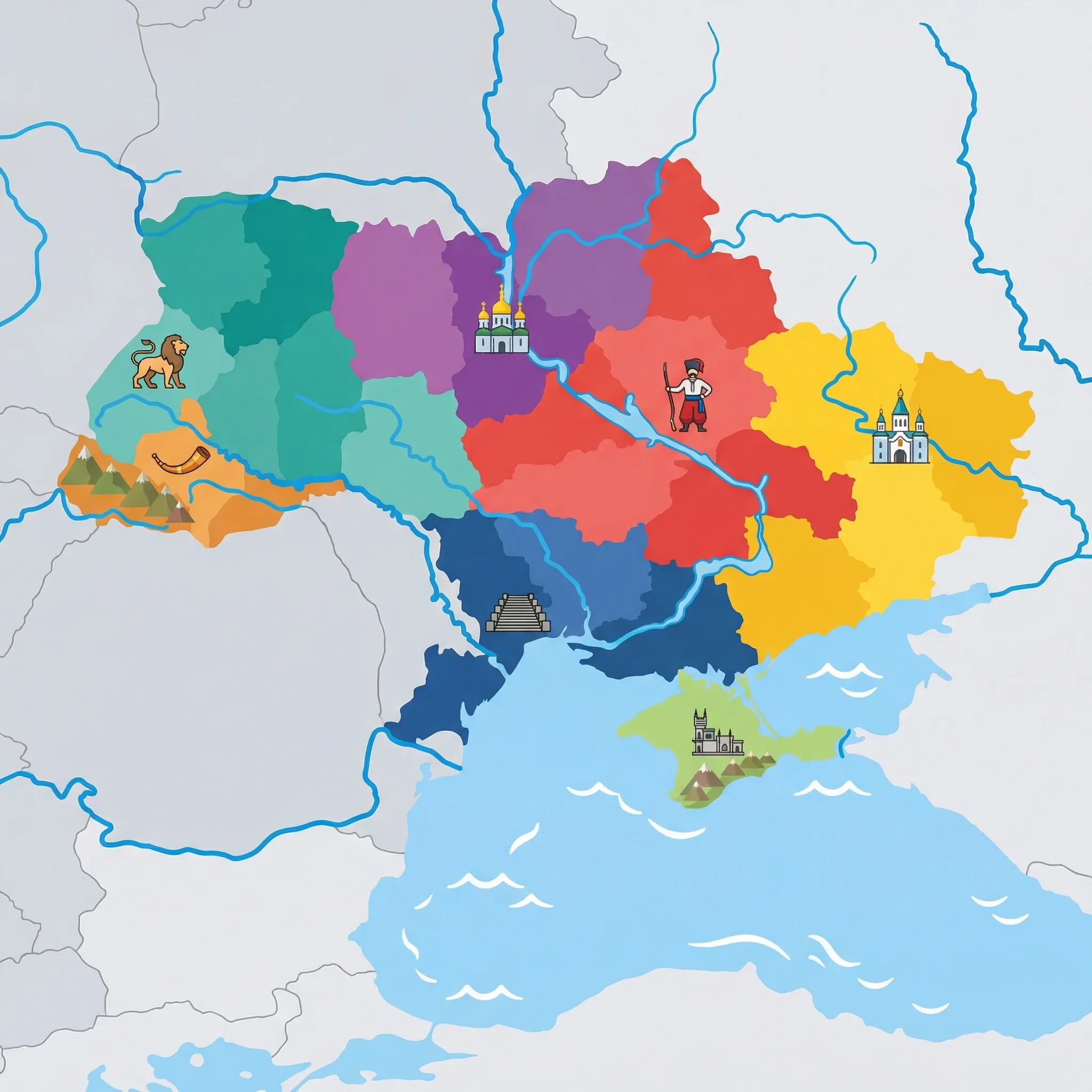
7 Regions
Carpathian Mountains
Where ancient legends echo through misty peaks 🌲⛰️
Central Ukraine (Dnipro)
The mighty river heartland of Cossack history 🌊⚔️
Crimea (currently occupied; not accessible)
A beautiful peninsula currently closed to the world 🚫🌊
Eastern regions (conflict zone; check advisories)
A region of industrial giants and vast steppes 🏭🌾
Kyiv
The brave capital of golden domes and chestnut trees 🌰🇺🇦
Lviv & Western Ukraine
The cultural soul of Ukraine with a taste of coffee ☕🦁
Odesa & Black Sea Coast
The pearl of the Black Sea with a spirit of humor ⚓🌊
Click on a region marker to explore details. Use the dropdown to color regions by activity suitability.

Getting There & Around
Getting There
- By Train – This is the most reliable entry method. Direct overnight trains run from Poland (Warsaw, Chełm, Przemyśl), Hungary (Budapest), and Austria (Vienna) to Kyiv and Lviv. Tickets sell out weeks in advance.
- By Bus – Operators like FlixBus and Ecolines connect major European cities to Ukraine. Border crossings can take 4–12 hours due to strict checks.
- By Air – Civilian airspace is closed. The nearest airports are in Poland (Rzeszów, Kraków, Lublin), Moldova (Chișinău), or Romania (Suceava), from where you must continue by land.
- Entry Requirements – Passports must be valid. Visa-free entry applies to US, EU, and UK citizens for 90 days. Proof of insurance covering military risks is mandatory. Check your government website for the latest visa requirements, or use the IATA Travel Centre entry-requirements checker.
Getting Around
- Trains – Ukrzaliznytsia is the backbone of the country, operating reliably even during war. Sleeper trains are safe, efficient, and the best way to move between Kyiv, Lviv, and Odesa. Book tickets online in advance.
- City Transport – Kyiv, Kharkiv, and Dnipro have efficient metro systems that double as bomb shelters. Fares are extremely cheap (approx. 8–10 UAH). Trams and trolleybuses operate in most cities but may stop during air raids.
- Taxi/Rideshare – Apps like Uklon, Bolt, and Uber work well in major cities. They are affordable and safer than flagging down cars. Note that finding a ride during curfew hours is impossible.
- Car Hire – Possible but challenging due to numerous military checkpoints and fuel constraints. Driving near frontline areas or off-road in Eastern regions is extremely dangerous due to mines.

Packing List
Frequent power outages due to infrastructure attacks make backup power essential for phones.
Street lights are often turned off for camouflage or energy saving; essential for walking at night.
Visibility is poor in unlit streets; drivers cannot see pedestrians without reflective gear.
Mobile internet can be unstable or jammed; offline navigation is a critical backup.
ATMs and card terminals often fail during blackouts; cash is king in emergencies.
Air raid sirens are extremely loud and frequent, often disrupting sleep.

Activities & Best Times

City & Cultural
Very GoodUrban tourism, museums, historical sites, architecture
Home to the world-class constructivist Derzhprom building and the historic Holy Mountains Lavra, offering a unique blend of Soviet-era architecture and deep religious heritage. Late spring and early autumn avoid the extremes of continental heat and freezing winters.
Offers a unique blend of industrial heritage, Jewish culture at the Menorah Center, and Zaporizhzhian Cossack history on Khortytsia Island. Best experienced in late spring and early autumn to avoid the intense summer heat and harsh continental winters.

Relaxation & Wellness
GoodSpa retreats, wellness centers, peaceful getaways

Adventure & Nature
GoodHiking, wildlife, outdoor exploration, ecotourism
The region features unique chalk cliffs in the Holy Mountains National Park and distinctive river-based ecosystems. Peak months provide mild temperatures ideal for trekking the Donets Ridge, while winter months are too cold for meaningful nature immersion.
Centered on the Khortytsia National Reserve and the Dnipro River's unique island ecosystems, providing authentic hiking and wildlife viewing. The summer window is optimal for exploring these riverine landscapes and ecoparks.
Kyiv offers significant green corridors and national parks like Holosiivskyi and Mezhyhirya, which provide expansive forest landscapes and river-basin ecosystems for family-friendly exploration. The peak visitation occurs from late spring through early autumn when lush vegetation and pleasant temperatures support extensive hiking and outdoor activities.

Educational & Exploratory
GoodLearning experiences, scientific sites, historical education
Features internationally significant aerospace history as the 'Rocket City' of the former USSR, with dedicated science museums and planetariums. Facilities are largely indoor, but the overall experience is best when paired with pleasant city walking conditions.
The Nemo Oceanarium offers specialized educational experiences, though it serves more as a supplementary attraction rather than a primary global travel motivator. Best visited alongside city cultural highlights during temperate months.
The Oceanarium Lviv provides a modern educational experience that serves as a significant indoor attraction, though it lacks the global uniqueness to be a primary travel motivator for experienced international families. Peak months reflect the region's main tourism season and the festive December period, while late autumn and winter offer less favorable conditions for family visits.

Road Trips & Scenic
GoodScenic drives, countryside tours, route-based travel
Themed routes like the Cossack Heritage and Industrial Heartland tours offer distinctive narratives through the Ukrainian steppe. Peak months offer the best visibility and driving conditions across the region's vast landscapes.
The Holy Mountains Scenic Drive offers attractive landscapes through the steppe and river valleys, particularly during the October autumn colors. Poor road conditions in winter and early spring mud (bezdorizhzhia) make touring difficult outside the warmer seasons.

Ski & Snow
GoodWinter sports, ski resorts, snow activities
Bukovel is Eastern Europe's largest ski resort with 60+ slopes and modern infrastructure. Rating of 'marginal' is inappropriate for a resort that competes regionally with Alpine destinations. Calibration: 'good' is correct for a strong regional resort that isn't world-class.
Limited to small-scale urban ski centers like Kharkiv Switzerland which offer basic winter sports for domestic enthusiasts. These lack the infrastructure and verticality of international resorts, with a very short reliable season in mid-winter.
Small local hills provide basic winter sports facilities for domestic visitors, but infrastructure does not meet international alpine standards. The short season is highly dependent on sub-zero temperatures and artificial snow production.

Sports & Active
GoodSport tourism, fitness activities, active recreation
Established mountain biking loops in Kharkiv Lisopark and adventure centers like S-Park provide solid infrastructure for active families. These outdoor facilities are most enjoyable during the dry, mild periods of spring and fall.
Strong focus on river-based activities like kayaking around Khortytsia and specialized cable parks. Activity is strictly seasonal, tied to the warm water temperatures of the Dnipro River during peak summer.

Theme Park & Entertainment
GoodAmusement parks, family entertainment venues
Kharkiv Central Park is recognized as a top-tier regional amusement destination with high-quality facilities. Peak demand aligns with summer school holidays, though indoor water parks and festive events provide some shoulder season appeal.
Features several regional-scale amusement and water parks which provide family entertainment but lack the world-class status of major international chains. Seasonal operation of aquatic centers limits peak suitability to the summer months.

Public Holidays & Calendar Next 12 months
Public holidays, festivals, cultural celebrations, and seasonal natural phenomena coming up in Ukraine over the next 12 months.
Loading holidays and events...

Climate & Weather
Carpathian Mountains
Show Details
| Month | Temp °C | Rain | Humidity |
|---|
Central Ukraine (Dnipro)
Show Details
| Month | Temp °C | Rain | Humidity |
|---|
Crimea (currently occupied; not accessible)
Show Details
| Month | Temp °C | Rain | Humidity |
|---|
Eastern regions (conflict zone; check advisories)
Show Details
| Month | Temp °C | Rain | Humidity |
|---|
Kyiv
Show Details
| Month | Temp °C | Rain | Humidity |
|---|
Lviv & Western Ukraine
Show Details
| Month | Temp °C | Rain | Humidity |
|---|

Travel Advisory
Extreme risk; travel strongly discouraged or prohibited due to ongoing full-scale military invasion and country-wide security threats.
Safety Topics
Traveller Advice (3 groups)

While the desire to help is recognized, the environment is too dangerous for individual volunteers. It is recommended to support established humanitarian organizations from abroad rather than traveling to the conflict zone.

All foreign nationals are strongly urged to avoid entering the country and to depart immediately if they are currently present. Safety cannot be guaranteed in any region due to the risk of indiscriminate strikes and active ground combat.

Media professionals are at extreme risk of injury, kidnapping, or death in combat zones. Proper military accreditation is mandatory for anyone attempting to report from the field, and the risk of being targeted is high.
Agency Summaries
United States authorities advise against all travel to Ukraine because of the active war. While some western regions are technically classified as Level 3 (Reconsider Travel), the national alert remains at the highest level. Citizens are warned of the risk of being targeted by security officials in occupied zones and the limited ability of the embassy to provide emergency assistance.
Australia continues to warn its citizens to avoid Ukraine entirely due to the volatile security environment and active military conflict. The advisory stresses that the security situation can change without notice and that the Australian Embassy in Kyiv is unable to provide advance warnings of attacks or in-person consular services.
New Zealand advises its citizens against all travel to Ukraine due to the invasion and military aggression. The government notes a real risk to life from heavy fighting and unexploded ordnance. Those currently in the country should seek shelter in secure locations until it is safe to depart via land borders.
Ireland maintains its highest warning level for Ukraine, advising against all travel for any purpose, including surrogacy arrangements. Citizens are told to leave immediately if they can do so safely, as drone and missile strikes occur almost daily and target civilian infrastructure like hotels and residential buildings.
British officials recommend against all travel to most of Ukraine, with only highly essential travel suggested for certain western regions. The warning highlights a significant increase in drone and missile attacks over the past year, resulting in high civilian casualties. Nationals are advised to stay alert to air raid sirens and be prepared to seek immediate shelter.
The Canadian government strongly advises against any travel to Ukraine due to the ongoing full-scale military invasion by Russia. Safety is at extreme risk throughout the country from missile and drone strikes targeting both government and civilian areas. Canadians currently present are urged to leave if safe and are warned that consular help is highly restricted.
Information is provided for general guidance only and does not constitute travel, safety, medical, or legal advice. Conditions may change. Users are responsible for independently verifying information before travel.