

Overview
The United States is a destination of overwhelming variety, where a single country encompasses the climatic and cultural diversity of a continent. For families, it is perhaps the most convenient and accessible adventure on Earth. From the sub-tropical wetlands of the Deep South & Gulf Coast to the rugged coastlines of New England, the sheer scale of the US encourages exploration. The quintessential American experience is the road trip: renting a car and driving through changing landscapes, stopping at roadside diners, motels, and national parks that are perfectly set up for children.
Culturally, the US is incredibly welcoming to children. It is a society built on convenience, meaning highchairs, changing tables, and children's menus are standard almost everywhere. While the big cities like New York and Chicago offer world-class museums and vertical excitement, the country's greatest assets are its outdoors. The National Park system is the envy of the world, offering families safe, well-managed access to spectacular wilderness. Whether you are exploring the California & Pacific Coast or the deserts of the Southwest Deserts & Canyonlands, you will find a travel infrastructure designed to make family journeys easy and memorable.
Key Attractions
The US is home to some of the world's most iconic natural and cultural sites. In the Southwest, Arches National Park offers a surreal landscape of sandstone bridges that kids love to scramble around, while the slot canyons of Antelope Canyon provide a magical, easy-to-access photography adventure. For a different kind of natural wonder, Badlands National Park in South Dakota features dramatic fossil-rich rugged terrain that feels like another planet. On the East Coast, Acadia National Park provides accessible coastal hiking and carriage roads perfect for family cycling.
In the cities, the educational opportunities are unmatched. New York's American Museum of Natural History is a sprawling treasure trove of dinosaur fossils and cultural artifacts that can captivate children for days. On the West Coast, a boat trip to Alcatraz Island combines a thrilling ferry ride with a fascinating (and spooky) history lesson that captivates older children and teens. For science lovers, the California Science Center in Los Angeles houses the Space Shuttle Endeavour, a guaranteed hit for aspiring astronauts.
Even far-flung territories offer unique family experiences; in Hawaii, watching the sunrise from the summit of Haleakala National Park is a bucket-list moment. Meanwhile, art-loving families in the Midwest shouldn't miss the Art Institute of Chicago, where the miniature rooms and armor collections often surprise and delight younger visitors.
Practical Advice
The US is vast, so manage your itinerary carefully-distances on a map often translate to days of driving. The best time to visit depends on the region: spring and autumn are ideal for the national parks, while summer is perfect for coastal beach trips. Healthcare is exceptionally high quality but astronomically expensive; comprehensive travel insurance is non-negotiable. Tipping is a mandatory cultural norm; expect to tip 18–22% in restaurants and $1–2 per bag for porters. For entry, most visitors from eligible countries need an approved ESTA (Electronic System for Travel Authorization) at least 72 hours before flying.
Food & Drink
Typical meal times: Breakfast is served from 7:00 am to 10:30 am, lunch from 11:30 am to 2:00 pm, and dinner typically from 5:30 pm to 9:00 pm. In major cities, dining options are available much later.
Typical meal costs: $15–35 (approx. €14–33 EUR / £12–28 GBP) per person for a standard sit-down meal. Fine dining and major cities will be significantly higher.
Dietary requirements: The US is a world leader in dietary accommodation. Vegetarian, vegan, gluten-free, and keto options are widely available, even in fast-food chains. Menus are often clearly labeled, and servers are generally very knowledgeable about allergens.
Family-friendly dining: Excellent. Almost all casual restaurants offer "kids' menus" (usually $8–12) with crayons and coloring sheets. Highchairs and booster seats are universally available, and staff are accustomed to accommodating young children.
Signature dishes:
- Barbecue Ribs – Slow-cooked pork or beef ribs, smothered in regional sauces (sweet in the South, tangy in the Carolinas), and eaten with your hands.
- New England Clam Chowder – A thick, creamy soup made with clams, potatoes, onions, and salt pork, often served in a sourdough bread bowl.
- Buffalo Wings – Deep-fried chicken wings tossed in a vinegar-based cayenne pepper hot sauce and melted butter, served with celery and blue cheese dip.
- Key Lime Pie – A sweet and tart dessert tart made with Key lime juice, egg yolks, and sweetened condensed milk, famous in the Deep South & Gulf Coast.
- S'mores – A campfire classic consisting of a roasted marshmallow and a layer of chocolate sandwiched between two pieces of graham cracker.

A family of four can expect to spend around $350–500 per day (approx. €330–470 EUR / £280–400 GBP) for a mid-range road trip including accommodation, car hire, and casual dining. Tipping (20%) significantly increases food costs. National Park passes ($80 annual per vehicle) offer exceptional value.
Age Suitability





Did you know? United States welcomes approximately 72.4 million international visitors per year. Most visitors come from Americas.

Explore Regions
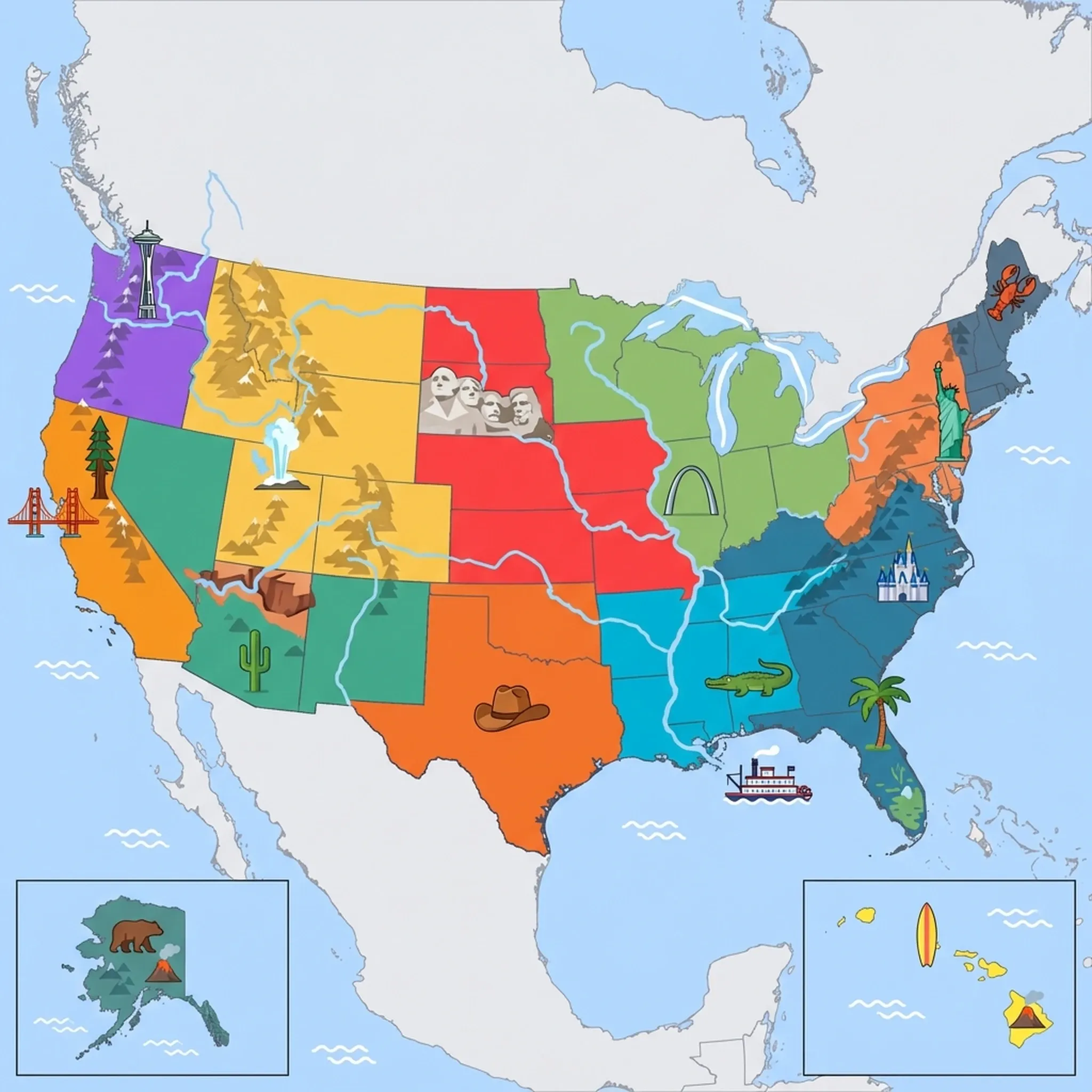
13 Regions
Alaska
The Last Frontier: Wildlife, glaciers, and midnight sun 🐻🏔️
California & Pacific Coast
Sun, surf, and cinema magic 🌊🎬🌴
Deep South & Gulf Coast
Where music, history, and soul food meet 🎷🍤🎸
Great Plains & Prairie States
Big skies and buffalo roaming free 🦬🌾
Hawaii
Aloha spirit, volcanoes, and rainbow skies 🌺🌈🐢
Mid-Atlantic Corridor
Big cities, bright lights, and the birth of a nation 🏙️🇺🇸🔔
Midwest & Great Lakes
Great Lakes, friendly faces, and heartland fun 🎡🍕🛶
Mountain West & Rockies
Where the mountains touch the sky 🏔️⛷️🦅
New England
History, lobsters, and autumn gold 🦞🍁⚓
Pacific Northwest
Coffee, clouds, and emerald forests 🌲☕🌧️
Southeast & Atlantic Coast
Theme parks, peaches, and pristine beaches 🎢🍑🏖️
Southwest Deserts & Canyonlands
Red rocks, neon lights, and ancient canyons 🌵🏜️🎰
Texas & Southern Plains
Everything is bigger here, especially the adventures 🤠🚀🥩
Click on a region marker to explore details. Use the dropdown to color regions by activity suitability.

Getting There & Around
Getting There
- By Air – Major gateways include JFK (New York), LAX (Los Angeles), ORD (Chicago), and MCO (Orlando). These hubs connect directly to regions like California & Pacific Coast and the Midwest & Great Lakes.
- By Land – The US shares long borders with Canada and Mexico. Crossing by car is common, but ensure your rental agreement allows international travel.
- Entry Requirements – Most citizens of the EU, UK, Australia, and NZ can enter via the Visa Waiver Program (ESTA), which costs $21–40 and is valid for two years. Check your government website for the latest visa requirements, or use the IATA Travel Centre entry-requirements checker.
Getting Around
- Car Hire – The only practical way to see most of the US, especially national parks like Badlands National Park. Gas is cheaper than in Europe, but distances are vast.
- Domestic Flights – Essential for covering long distances, such as traveling from the Mid-Atlantic Corridor to the West Coast. Book well in advance for better rates.
- Trains – Amtrak is useful primarily in the Northeast Corridor (Boston–NYC–DC). Long-distance routes like the California Zephyr are scenic experiences rather than efficient transport.
- City Transport – Major cities like NYC, Chicago, and DC have excellent metros. In most other places, public transport is limited and a car is necessary.

Packing List
Essential for road trips to keep drinks/snacks cold; most hotels provide free ice machines.
Restaurant portions are huge; carry leftovers or stash snacks for the kids easily.
Aggressive air-conditioning indoors and dry desert air in the West cause dry skin quickly.
Tap water is safe and free almost everywhere; fountains are common in parks and museums.
Still required for some parking meters and hotel laundry machines in rural areas.
Older motels often lack sufficient outlets for a family's worth of devices.

Activities & Best Times

Adventure & Nature
ExcellentHiking, wildlife, outdoor exploration, ecotourism
Boasting vast wilderness areas like the Great Lakes shorelines and significant wildlife centers, the region offers deep immersion in diverse ecosystems. Peak season spans the warm summer and early autumn, while harsh winters and spring mud seasons limit access to trails.
Diverse ecosystems from Yosemite's granite peaks to Death Valley; peak summer months avoid snow closures in the Sierra Nevada high country.
Home to world-class temperate rainforests and volcanic national parks like Olympic and Mt Rainier, offering unparalleled wilderness immersion. Peak visitation occurs in late summer when high-altitude trails are snow-free and weather is driest.

Beach & Sea
ExcellentBeach resorts, marine activities: diving, snorkelling, kite surfing, wind surfing, sailing
Hawaii's beaches are globally iconic and set international standards. Waikiki Beach and Hanauma Bay are among the world's most famous beaches. The marine biodiversity, year-round swimming conditions, and international reputation justify an 'excellent' rating under proper calibration.
The region features the unique 'inland seas' of the Great Lakes with massive dunes and clear waters at Pictured Rocks and Sleeping Bear. July and August are peak for swimmable water temperatures, while frigid lake conditions make most of the year unsuitable.
Offers a diverse coastal range from the iconic, energetic vibe of South Beach to the raw, natural beauty of Cape Hatteras. Summer provides the warmest water temperatures, while spring and autumn avoid the peak heat but may be cooler in northern sections.

City & Cultural
ExcellentUrban tourism, museums, historical sites, architecture
Chicago and St. Louis offer world-class architecture, diverse neighborhoods, and premier cultural institutions like the Missouri Botanical Garden. Late spring and autumn provide ideal walking weather, whereas the extreme winter cold significantly detracts from the urban experience.
San Francisco and Los Angeles provide world-class museums and landmarks like Alcatraz; peak season offers the most consistent weather for urban exploration.
Honolulu provides a unique blend of Polynesian heritage and modern urban luxury, anchored by significant sites like Iolani Palace and Pearl Harbor. Cultural engagement is high year-round, though visitor numbers peak during the summer and year-end festivities.

Educational & Exploratory
Very GoodLearning experiences, scientific sites, historical education
Chicago hosts internationally significant facilities such as the Field Museum and Museum of Science and Industry that are destination-level draws for families. While indoor-focused, peak visitation aligns with school holiday windows in spring and summer.
Boasts world-class facilities like Kennedy Space Center and the Georgia Aquarium which serve as standalone travel motivators for families. These indoor attractions are accessible year-round, though visitation peaks during major family holiday windows.
Features globally significant facilities like the Monterey Bay Aquarium and California Academy of Sciences; peak season aligns with global family travel periods.

Sports & Active
Very GoodSport tourism, fitness activities, active recreation
Extensive trail systems like the Katy Trail and Superior Hiking Trail provide high-quality infrastructure for long-distance cycling and hiking. Optimal conditions occur in the temperate windows of late spring and early autumn, avoiding the peak summer humidity and winter snow.
Exceptional infrastructure for golf, whitewater sports, and long-distance hiking (Appalachian Trail) makes this a premier active destination. The transitional seasons of spring and autumn offer the best conditions for outdoor physical exertion.
Offers premier hiking on the Pacific Crest Trail and world-class surfing; peak months provide the safest and most accessible conditions for outdoor sport tourism.

Theme Park & Entertainment
Very GoodAmusement parks, family entertainment venues
The region is a global hub for coaster enthusiasts, headlined by Cedar Point’s world-record-breaking attractions. Parks operate primarily in summer, with shoulder seasons offering themed events like Halloweekends before complete winter closures.
Orlando is a global hub for immersive entertainment, featuring world-leading facilities like Disney and Universal. Peak travel aligns with school holidays and seasonal events, while August and September are avoided due to extreme heat and hurricane risk.
Home to the original Disneyland and Universal Studios Hollywood; peak periods align with international school holiday windows and major seasonal events.

Festivals & Seasonal
GoodEvents, celebrations, seasonal attractions
Hosts internationally recognized events like Art Basel Miami and the Spoleto Festival, which draw sophisticated global audiences. Travel is highly event-specific, with March (Ultra Music Festival) and December (Art Basel) being major cultural peaks.
Host to globally recognized events like Comic-Con and Coachella; peak months correspond directly to these high-profile festival dates.
Hosting globally recognized events like the Ironman World Championship, Merrie Monarch, and Pipeline Pro. Peak months are dictated specifically by the scheduling of these major international cultural and sporting events.

Relaxation & Wellness
GoodSpa retreats, wellness centers, peaceful getaways
Known for coastal retreats and unique hot springs like Glen Ivy; peak months offer ideal outdoor conditions for restorative spa and wellness experiences.
Natural thermal springs like Bagby provide rustic but authentic restorative experiences in forest settings. Accessibility to these remote locations is highly dependent on seasonal road and trail conditions.
Renowned for historic natural thermal complexes like Glenwood Hot Springs, providing a unique restorative experience. Winter visits offer a magical contrast between hot water and snow, while summer is peak for family wellness travel.

Road Trips & Scenic
GoodScenic drives, countryside tours, route-based travel
Iconic routes like the North Shore Scenic Drive and the start of Route 66 offer spectacular lake views and historic Americana. Autumn is the premier season for fall foliage, while winter weather creates hazardous driving conditions on scenic byways.
Features iconic drives such as the Blue Ridge Parkway and the Overseas Highway, offering spectacular scenery from mountains to coral keys. October is peak for autumn foliage in the north, while spring offers clear skies and pleasant driving conditions across the region.
Includes the legendary Pacific Coast Highway; peak months ensure the best visibility and access to mountain passes like Tioga Road.

Ski & Snow
GoodWinter sports, ski resorts, snow activities
Home to reputable resorts like Lutsen and Boyne Mountain, the region provides dependable mid-winter conditions for skiing and snowboarding. January and February offer the most reliable snowpack, though the hills lack the verticality of major international alpine destinations.
High-altitude resorts like Mammoth and Palisades Tahoe offer world-class infrastructure; peak winter ensures reliable snow and full mountain access.
Major resorts like Crystal Mountain and Mt Bachelor offer substantial vertical drops and deep maritime snowpacks. The season peaks in mid-winter with the most reliable base, while spring offers sunshine but softer conditions.

Public Holidays & Calendar Next 12 months
Public holidays, festivals, cultural celebrations, and seasonal natural phenomena coming up in United States over the next 12 months.
Loading holidays and events...
Climate & Weather
Alaska
Show Details
| Month | Temp °C | Rain | Humidity |
|---|
California & Pacific Coast
Show Details
| Month | Temp °C | Rain | Humidity |
|---|
Deep South & Gulf Coast
Show Details
| Month | Temp °C | Rain | Humidity |
|---|
Great Plains & Prairie States
Show Details
| Month | Temp °C | Rain | Humidity |
|---|
Hawaii
Show Details
| Month | Temp °C | Rain | Humidity |
|---|
Mid-Atlantic Corridor
Show Details
| Month | Temp °C | Rain | Humidity |
|---|

Travel Advisory
The majority of international agencies classify the United States as a destination requiring standard safety awareness, though several highlight specific risks related to gun violence and terrorism.
Safety Topics
Traveller Advice (4 groups)

Legal protections and social acceptance for LGBTQ+ individuals can vary significantly between different states and regions. Research local attitudes before traveling.

Ensure you have comprehensive medical insurance that covers high costs in the U.S. healthcare system. Obtain necessary electronic entry permits like ESTA well in advance of departure.

Infrastructure and accessibility for travelers with disabilities are generally well-developed across public transport and tourist sites.

Maintain standard personal safety precautions as you would elsewhere. Be cautious when walking alone in unfamiliar urban areas after dark.
Agency Summaries
Due to concerns regarding terrorism, civil unrest, and a significantly higher rate of gun-related violent crime than New Zealand, an increased level of vigilance is recommended for all visitors.
The general safety environment is stable, but violent crime and gun-related incidents are more common than in Australia. Travelers should avoid areas of protest and stay informed of local safety drills.
Most trips are successful and safe. However, there is a persistent threat from terrorism and a higher incidence of violent crime, specifically gun crime, compared to the United Kingdom.
Citizens should secure appropriate entry authorization like ESTA before traveling. It is important to stay away from demonstrations and monitor local media for potential security updates.
While travel is generally safe, visitors should remain alert to the higher frequency of gun violence and mass shootings compared to Canada. Seasonal natural disasters like hurricanes and wildfires also pose risks.
Information is provided for general guidance only and does not constitute travel, safety, medical, or legal advice. Conditions may change. Users are responsible for independently verifying information before travel.