

Overview
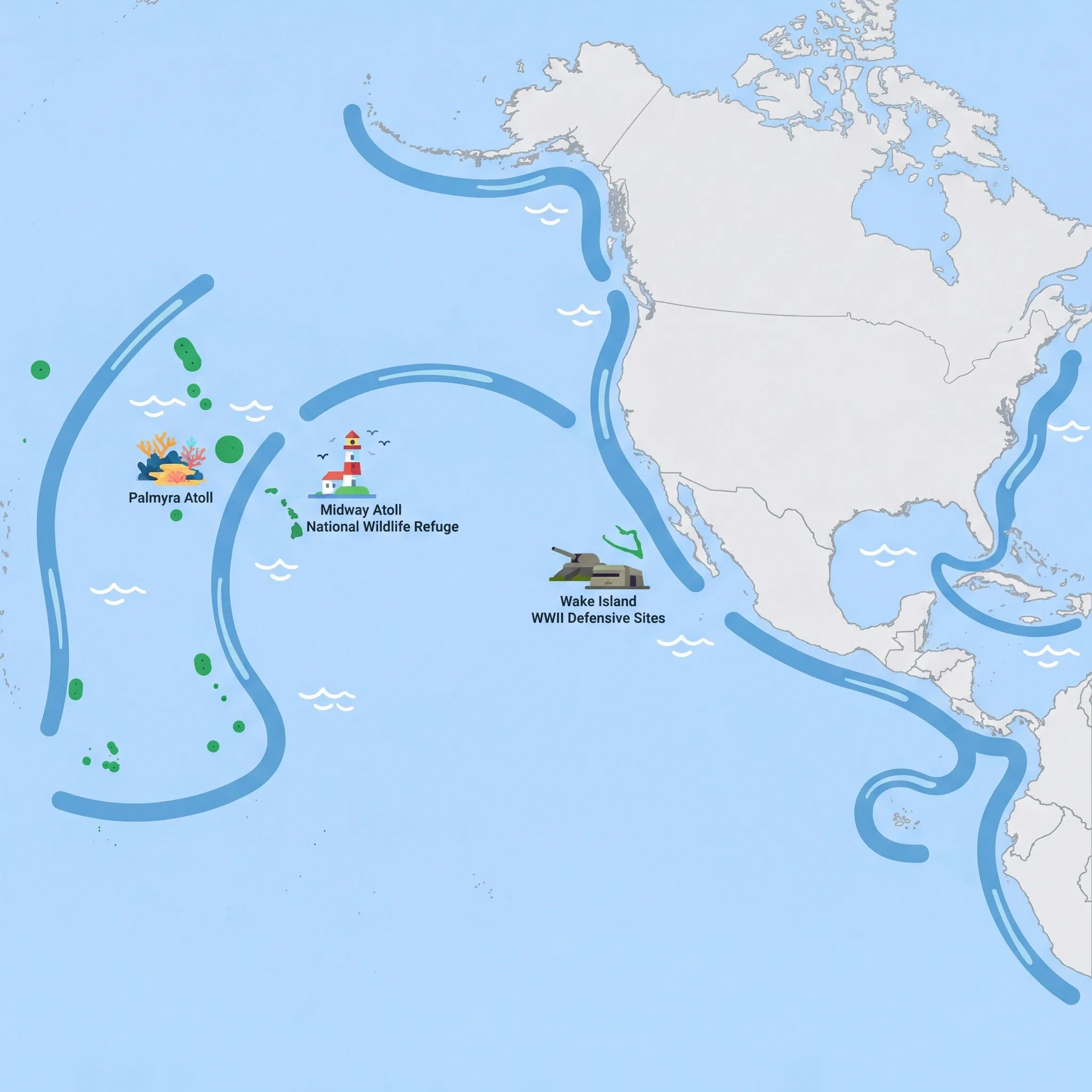
Spanning thousands of miles across the Pacific Ocean, the United States Minor Outlying Islands are a collection of nine territories that serve as time capsules of nature and history. They are not a single destination but a series of isolated specks of land, including Midway Atoll, Wake Island, and Palmyra Atoll. For families, these islands are less about beach resorts and more about the privilege of witnessing the planet's wildest corners. The islands are mostly uninhabited, save for rotational scientists, military personnel, and millions of seabirds.
Visiting here is an expedition, not a vacation. The few families who manage to visit-usually via eco-cruises or historical tours-experience a world where nature rules supreme. Children will see skies darkened by albatross flocks, beaches crowded with endangered monk seals, and lagoons teeming with sharks and manta rays. The cultural experience is deeply tied to World War II history, particularly on Midway and Wake, where rusted artillery and memorials stand as silent witnesses to pivotal battles. It is a destination for the intrepid, the history-obsessed, and those seeking to educate their children about conservation in its purest form.
Key Attractions
Midway Atoll National Wildlife Refuge is the crown jewel of the group, famous for the decisive Battle of Midway in 1942. While currently closed to independent tourism, some cruise ships offer "scenic cruising" passes or occasional authorized landings. Families can witness the world's largest colony of Laysan Albatross-nearly three million birds call this atoll home. The combination of military bunkers and nesting birds creates a surreal landscape where history and nature intertwine.
Palmyra Atoll, managed by The Nature Conservancy, offers a pristine wilderness experience for those with the means to visit (typically via private yacht or donor trip). It is one of the few places left with a fully intact marine predator ecosystem. Snorkeling here reveals untouched coral gardens patrolled by grey reef sharks, while the islet forests are home to the massive Coconut Crab, the largest land-living arthropod in the world-a creature that looks like it crawled out of a dinosaur movie, sure to fascinate older children.
Wake Island is a rugged coral atoll and active airfield known for the heroic defense by U.S. Marines in WWII. While generally closed to civilians, Military Historical Tours occasionally organizes charter trips for veterans and history enthusiasts. Visitors can tour the 98 Rock memorial and see the remains of Japanese blockhouses. It is a somber, educational site best suited for families with teenagers interested in military history rather than young children.
Practical Advice
Best time to visit: The dry season (May to October) offers calmer seas for crossing. Albatross nesting season on Midway peaks from November to July. Visas & Permits: U.S. citizens do not need visas, but everyone needs a permit. Allow 3–6 months to arrange access if applying for a private vessel permit. Health: There are no hospitals. Medical evacuation can take days. Comprehensive medical insurance including air ambulance coverage is non-negotiable. Logistics: Pack absolutely everything you need. There are no shops, pharmacies, or hotels for the public.
Food & Drink
Typical meal times: Dining options are non-existent for the general public. Visitors on organized tours or at research stations follow strict mess hall schedules, typically breakfast at 6:30 am, lunch at 12:00 pm, and dinner at 5:30 pm.
Typical meal costs: $15–30 (approx. €14–28 EUR / £12–24 GBP) per meal if paying at a mess hall, though food is almost always included in the overall cost of an expedition or cruise ticket ($500+ per day).
Dietary requirements: Extremely limited. Mess halls serve set menus (often heavy on frozen/canned goods due to remoteness). Vegetarians can usually be accommodated, but specialized vegan or gluten-free options may not be available unless you bring your own supplies.
Family-friendly dining: There are no restaurants. Families will likely eat "picnic style" or in communal mess halls. Highchairs and child menus do not exist.
Signature dishes:
- Fresh Pelagic Fish – On sailing expeditions or permitted fishing trips, fresh tuna or mahi-mahi caught sustainably from the surrounding ocean is a staple.
- Mess Hall Chili – A classic comfort food served to contractors and military personnel, famous for being hearty and filling after a long day in the sun.
- Hawaiian-style Poke – Due to the connection with Honolulu, raw fish salad seasoned with soy sauce and sesame oil is common when supplies arrive.
Safety
The primary dangers are environmental. The sun is intense, and dehydration is a rapid threat. Unexploded ordnance from WWII is still found on some islands; children must never dig in the sand or stray from marked paths. In the water, currents are powerful, and shark populations are healthy and aggressive-swimming is often restricted to designated areas. There is no mobile phone signal; communication is via satellite phone only.

Visiting is exceptionally expensive due to the logistics of reaching remote atolls. Families should expect to spend $10,000–25,000 (approx. €9,200–23,000 EUR / £7,800–19,500 GBP) per person for a specialized 10-14 day cruise or charter expedition. Private yacht visits require significant self-sufficiency costs. There is no budget travel option.
Age Suitability





Why this score?
Visiting these atolls is the definition of a true expedition, often requiring chartered vessels to cross thousands of miles of open ocean. The lack of any human support services and the raw, untouched nature of the ecosystems provide a level of ruggedness and isolation matched only by the most extreme wilderness areas on the planet.
Why this score?
There is virtually no accessible medical care for civilians, as these islands lack hospitals, clinics, and permanent civilian residents. In the event of a medical emergency, the only option is a complex and extremely expensive multi-day sea or air evacuation to major hubs like Honolulu or Guam.
Why this score?
These islands are almost entirely closed to the general public, with no commercial flights, hotels, or standard tourism infrastructure. Annual visitor counts are negligible and primarily restricted to scientific researchers or military personnel, placing them at the absolute bottom of global tourism flow.
Visiting is theoretically impossible for most, but if a specialized eco-tour or donor trip is available (e.g., to Palmyra), it is exceptionally expensive. Expect to pay $10,000–15,000 USD (approx. €9,200–13,800 EUR / £7,800–11,800 GBP) per person for a week-long expedition, covering charter flights and logistical support. There is no budget option.

Getting There & Around
Getting There
- By Air – Access to Wake Island and Midway is generally by military or government charter flight from Honolulu (HNL). These are not bookable by the public unless part of a specific tour group.
- By Sea – The most common way for families to "see" the islands is aboard a trans-Pacific repositioning cruise (e.g., Holland America, Scenic) that sails past Midway. Actual landings are rare and weather-dependent.
- Private Vessel – Private yachts may visit Palmyra Atoll or Midway with a pre-approved Special Use Permit. This requires strict hull inspections for invasive species and holding tanks for waste.
- Entry Requirements – While U.S. territory, these are restricted zones. A standard U.S. visa is not enough; you need a specific agency permit. Check your government website for the latest visa requirements, or use the IATA Travel Centre entry-requirements checker.
Getting Around
- Walking – On the small land areas accessible to visitors (like Sand Island at Midway), walking is the primary mode of transport. Paths are flat but can be hot and exposed.
- Golf Carts & Bicycles – Used by staff and occasionally available to visitors on organized tours at Midway or Wake. A fun way for families to see the airstrips and bird colonies without exhaustion.
- Small Boats (Zodiacs) – Essential for moving between islets or going from a cruise ship to the shore. Life jackets are mandatory for all children.

Packing List
Strictly enforced to protect coral; chemical sunscreens are often banned or highly discouraged.
Essential for cutting glare to spot sharks, turtles, and manta rays in the lagoon shallows.
Ocean crossings to these remote atolls can be extremely rough; no pharmacies are available.
To protect cameras and electronics during wet landings on beaches via small Zodiac boats.
The sheer density of rare seabirds makes a physical guide invaluable for curious children.
The equatorial sun is punishing, and you will be snorkeling for hours with no shade nearby.

Public Holidays & Calendar Next 12 months
Public holidays, festivals, cultural celebrations, and seasonal natural phenomena coming up in United States Minor Outlying Islands over the next 12 months.
Loading holidays and events...

Travel Advisory
The territories are considered safe for travel under standard precautions, though the primary barrier to entry is administrative and legal rather than security-related. Most of these islands are restricted-access zones.
Safety Topics
Traveller Advice (2 groups)

Most of these islands, including Baker, Howland, and Jarvis, are closed to the public. For those few areas that may allow visitors, such as Palmyra Atoll, you must obtain prior authorization and permits from the U.S. Fish and Wildlife Service or relevant authorities.

These are remote locations with no commercial infrastructure, medical facilities, or regular transportation. Travellers must be entirely self-sufficient and prepared for extreme isolation and lack of emergency services.
Agency Summaries
The Australian government considers the United States and its territories as a low-risk destination. While no specific warnings are issued for the Minor Outlying Islands, travellers are reminded that entry requirements are strict and many of these remote atolls are not open to commercial tourism.
Ireland advises its citizens to follow standard safety measures when visiting the United States and its associated territories. There is no specific advisory for the Minor Outlying Islands due to their status as mostly uninhabited and restricted nature reserves.
The UK Foreign Office does not maintain a dedicated page for the Minor Outlying Islands, but includes US territories under its general guidance for the United States. British nationals are advised that standard safety precautions apply, while acknowledging that many of these remote islands are off-limits to visitors.
The Canadian government provides no specific standalone advisory for the United States Minor Outlying Islands, treating them under the general classification for the United States. Travellers are advised to maintain standard security awareness, though it is noted that these territories are largely uninhabited and access is highly restricted for the general public.
As these are domestic territories of the United States, the Department of State does not issue a foreign travel advisory for them. However, they are statistically grouped as the Minor Outlying Islands. Most locations are managed as national wildlife refuges or military zones where public access is prohibited or requires specific federal permits.
New Zealand maintains a slightly higher baseline caution level for all US jurisdictions due to concerns regarding crime and civil unrest in major population centres. While these risks are not present on the uninhabited Minor Outlying Islands, the territory falls under this general classification.
Information is provided for general guidance only and does not constitute travel, safety, medical, or legal advice. Conditions may change. Users are responsible for independently verifying information before travel.