
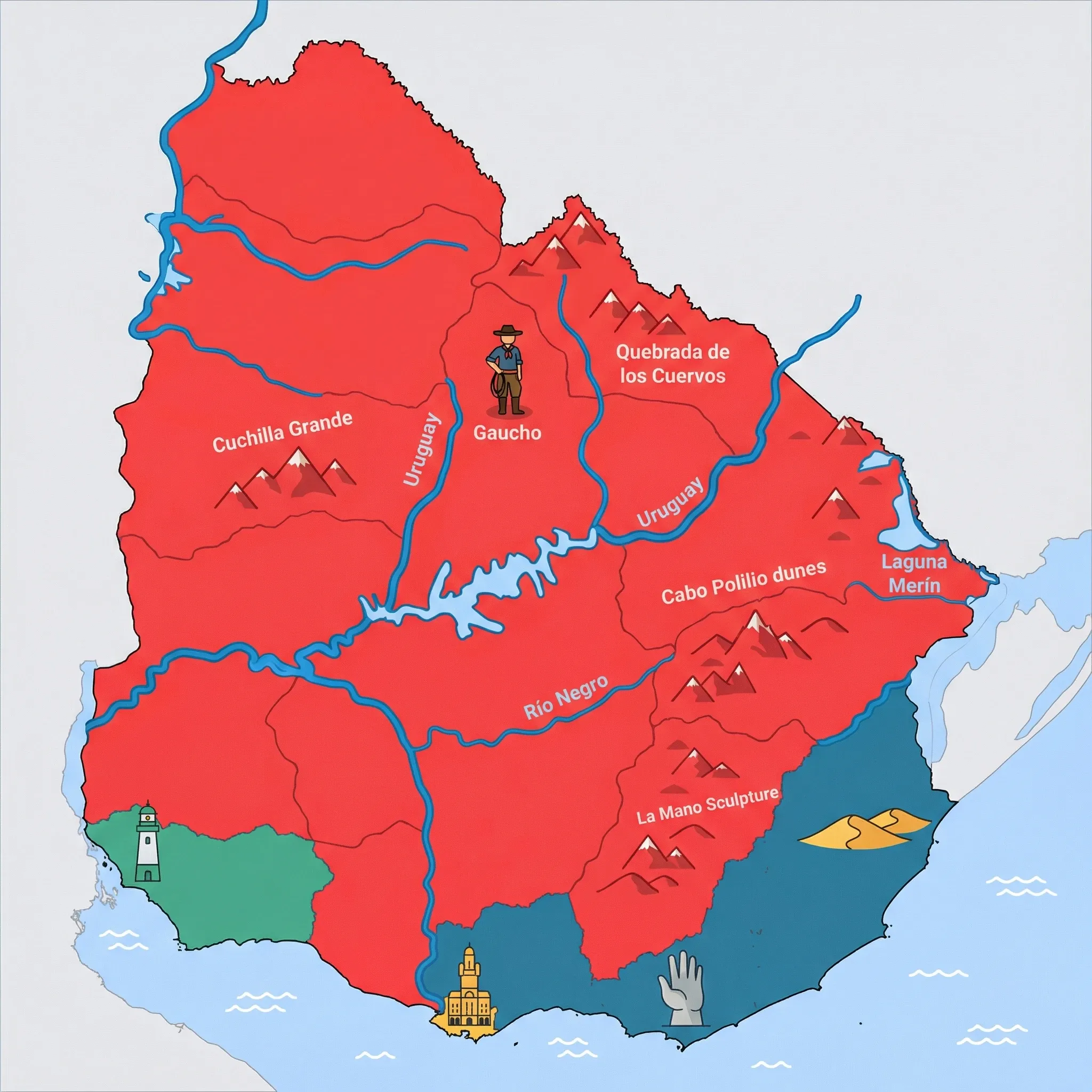
Click a region to explore
Overview
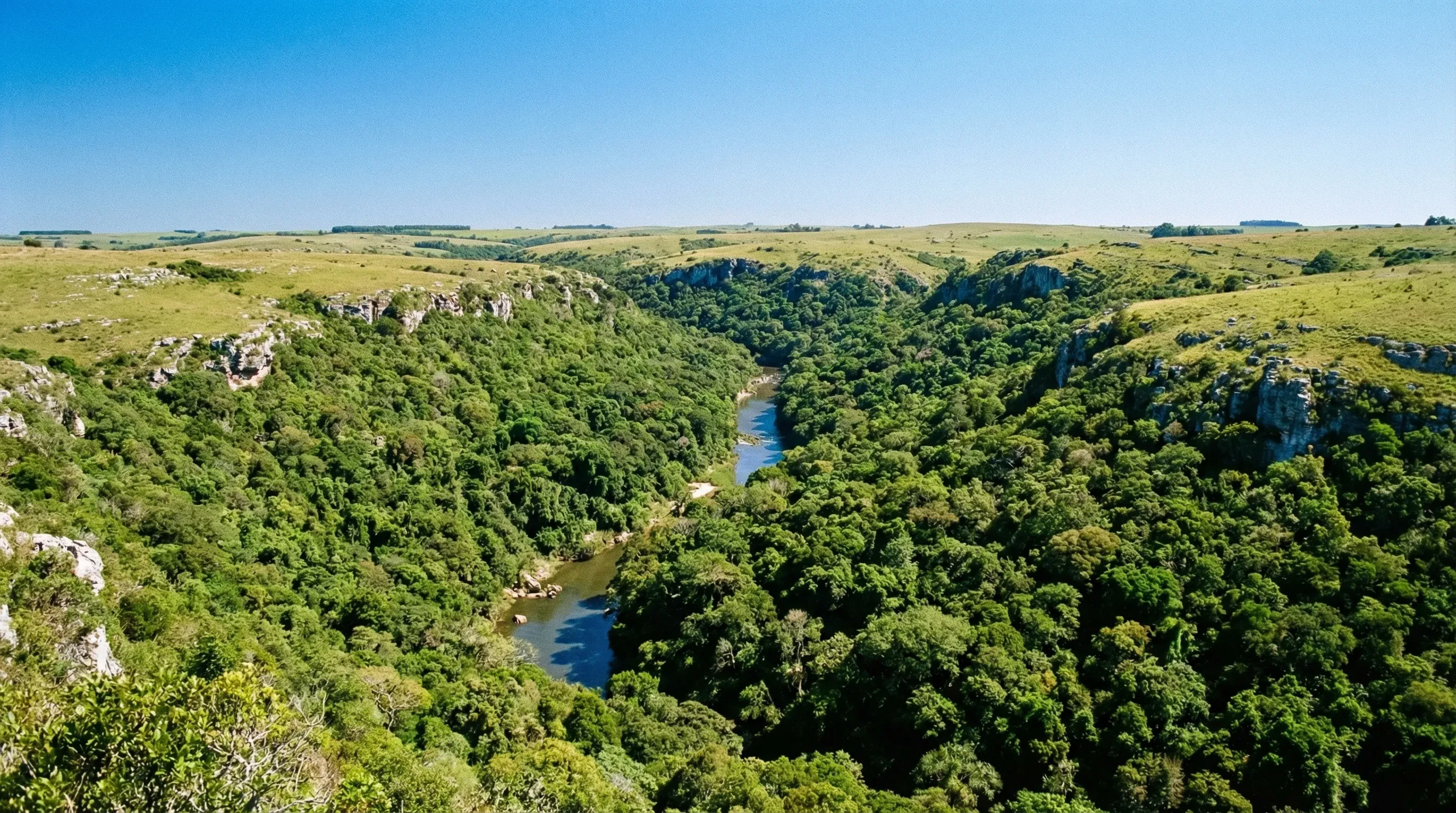
While the coast draws the crowds, the Interior of Uruguay captures the soul of the country. This vast region of rolling green plains (pampas), rocky outcrops, and wetlands offers a completely different vacation pace. For families, the primary draw here is the Rural Tourism (Turismo Rural) experience. Staying at a working estancia (ranch) allows children to disconnect from screens and reconnect with nature. They can watch sheep shearing, help milk cows, or learn to ride horses with genuine gauchos. The landscape is gentle but beautiful, dominated by the Cuchilla de Haedo and Cuchilla Grande hill ranges, which provide accessible hiking for little legs.
The culture here is deeply rooted in tradition. Tacuarembó, in the north, is the capital of gaucho culture, hosting massive festivals that celebrate rural skills. In the department of Lavalleja, the energy shifts to mysticism and geology, with the Buddhist temple in the hills and the energy points of Villa Serrana. The climate is slightly more extreme than the coast—hotter in summer and colder in winter—so packing layers is essential. It is a safe, quiet, and incredibly hospitable region where the night sky offers some of the best stargazing in South America due to the complete lack of light pollution.
Key Attractions
Estancia Stays are the headline attraction. Properties range from rustic working farms to luxury lodges, but all focus on the equestrian lifestyle. Salto del Penitente in Lavalleja is a highlight for active families; it features a beautiful waterfall and an adventure park with zip lines and rock climbing suitable for older children. Nearby, Villa Serrana is a quirky village designed by architect Julio Vilamajó that feels lost in time, perfect for hiking and exploring the peculiar stone dam.
Further north, the Valle del Lunarejo offers a dramatic landscape of ravines and waterfalls that feels prehistoric. For families interested in geology, the Palace Cave (Gruta del Palacio) in Flores department is a UNESCO Global Geopark site featuring ancient rock columns. The Quebrada de los Cuervos (Gorge of the Crows) offers more challenging hiking trails for teenagers, leading into a lush, subtropical microclimate deep within the canyon.
Practical Advice
Spring (September–November) is ideal for the interior, as the fields are green and wildflowers are in bloom. Summer (December–February) can be very hot inland, so ensure your accommodation has a pool. Renting a car is almost mandatory here, as public transport between rural towns is infrequent.
Food & Drink
Typical meal times: Lunch is a major event, often a BBQ, served 12:30 pm to 2:30 pm. Dinner is lighter and served late, from 8:30 pm onwards.
Typical meal costs: Prices are generally lower than the coast. A hearty family lunch costs around $2,000–3,200 UYU (approx. $50–80 USD / €45–75 EUR). Estancia stays often include full board.
Dietary requirements: This is cattle country. Vegetarian options can be scarce in rural parrilladas (salad and cheese are the main options). Vegans may struggle and should pack snacks. Gluten-free awareness is growing but low in remote areas.
Signature dishes:
- Asado con Cuero – A very traditional method where the cow is barbecued with the hide still attached to keep the meat incredibly juicy and tender.
- Pastel de Carne – A Uruguayan shepherd's pie, often slightly sweet due to raisins or sugar sprinkled on top, a favorite comfort food for kids.
- Arroz con Leche – Rice pudding, the quintessential rural dessert, usually flavored with cinnamon and lemon zest.
Why this score?
This region offers a moderate level of adventure through its gaucho culture, involving activities like horse riding across open plains and staying on working cattle ranches. Areas like Quebrada de los Cuervos provide more rugged hiking opportunities and canyon exploration. While not extreme wilderness, it requires more physical engagement than the coastal or urban regions.
Why this score?
Healthcare in the rural interior is restricted to basic medical outposts and small-town clinics with limited equipment. Emergency response times can be significant due to the distances between estancias and major towns. Foreign visitors will find very little English-speaking staff and may face challenges with complex medical insurance processing in these remote areas.
Why this score?
The vast interior of Uruguay remains largely off the radar for international tourists, catering instead to a small number of niche agritourism visitors and domestic travelers. Beyond the specific 'estancia' stays, there is very little tourism infrastructure or globally recognized landmarks. It remains a quiet, rural landscape with minimal foreign foot traffic.

While rural dining is cheap, accommodation varies wildly. A rustic farm stay might be $3,000 UYU (approx. $75 USD / €70 EUR) per night, while a luxury tourist estancia can charge $10,000–16,000 UYU (approx. $250–400 USD / €230–370 EUR) per person, usually including all meals and riding activities.

Getting Here & Around
Getting Here
- Driving – The only practical way to explore. Major routes like Route 5 (north-south) and Route 8 (northeast) are paved and in good condition.
- Bus – Long-distance buses connect Montevideo to departmental capitals like Minas or Tacuarembó, but you will need a taxi to reach rural estancias.
- Train – Virtually non-existent for passengers in the interior.
Getting Around
- Car – Essential. Rural roads off the main highways can be gravel (balastro), so a vehicle with higher clearance is helpful but not strictly necessary.
- Horseback – Within the estancias and national parks, horses are often the best way to see the landscape.
Nearby Airports (1 airport)
Nueva Hesperides International
STYSalto
View full flight map for Uruguay →

Packing List
The interior is a birdwatching paradise with rheas, screamers, and parrots.
Even in summer, jeans or jodhpurs are essential to prevent chafing during horse rides.
Rural areas have zero street lighting; essential for navigating estancia grounds at night.
Cellular signal (LTE) is spotty or non-existent in deep valleys and remote hills.
Uruguay uses a mix of sockets, including the 3-pin Italian style (Type L) which is rare elsewhere in the Americas.
The ozone layer is thinner in this region; UV index can be extreme even on mild days. Sunburn happens fast.
Coastal winds (the 'Sudestada') can be strong and chilly even in summer; essential for beach walks.
Uruguay charges for plastic bags and has a strong culture of using reusable grocery totes.
Essential if visiting estancias or riverside areas in the interior, where mosquitoes can be aggressive.

Activities & Best Times

Scenic drives, countryside tours, route-based travel
Characterized by authentic estancia culture and scenic rural drives through the departments of Tacuarembó, Lavalleja, and Florida. These countryside routes offer sophisticated families a genuine taste of Gaucho heritage during the temperate transition seasons.

Hiking, wildlife, outdoor exploration, ecotourism
The region features the Quebrada de los Cuervos gorge and Cuchilla de Haedo hills, providing authentic hiking and wilderness experiences for families. Spring and autumn provide the most pleasant temperatures for outdoor exploration, avoiding the summer heat and winter dampness.

Public Holidays & Calendar Next 12 months
Public holidays, festivals, cultural celebrations, and seasonal natural phenomena coming up in Interior & Estancias over the next 12 months.
Loading holidays and events...

Travel Advisory
The majority of international agencies classify Uruguay as a safe destination where standard travel safety precautions are sufficient, though increased vigilance is noted for Montevideo.
Safety Topics
Traveller Advice (3 groups)

Uruguay is among the most progressive countries in the region regarding sexual orientation and gender identity. Same-sex marriage is legal and anti-discrimination laws are in place.

Accessibility infrastructure for those with disabilities, including pavements and building access, remains limited in many areas outside of modern districts.

Standard personal safety measures should be followed, such as avoiding isolated or poorly lit areas when walking alone at night, particularly in downtown Montevideo.
Agency Summaries
No specific elevated security threat is identified for the country, but New Zealanders should maintain standard situational awareness and carry comprehensive insurance.
Uruguay is considered safe for Irish visitors, though basic precautions against opportunistic theft and bag snatching are advised.
Travellers should use common sense and follow standard safety routines. While violent crime exists, the overall security situation is stable for the average tourist.
Heightened vigilance is recommended across the country due to rising crime rates, including homicides and armed robberies which can impact visitors.
Uruguay is generally safe, though travellers should maintain standard security awareness. There is a specific regional warning to exercise a high degree of caution in Montevideo due to a higher prevalence of crime.
Most visits are trouble-free, though street crime and petty theft occur, particularly in the capital city of Montevideo.
Information is provided for general guidance only and does not constitute travel, safety, medical, or legal advice. Conditions may change. Users are responsible for independently verifying information before travel.