
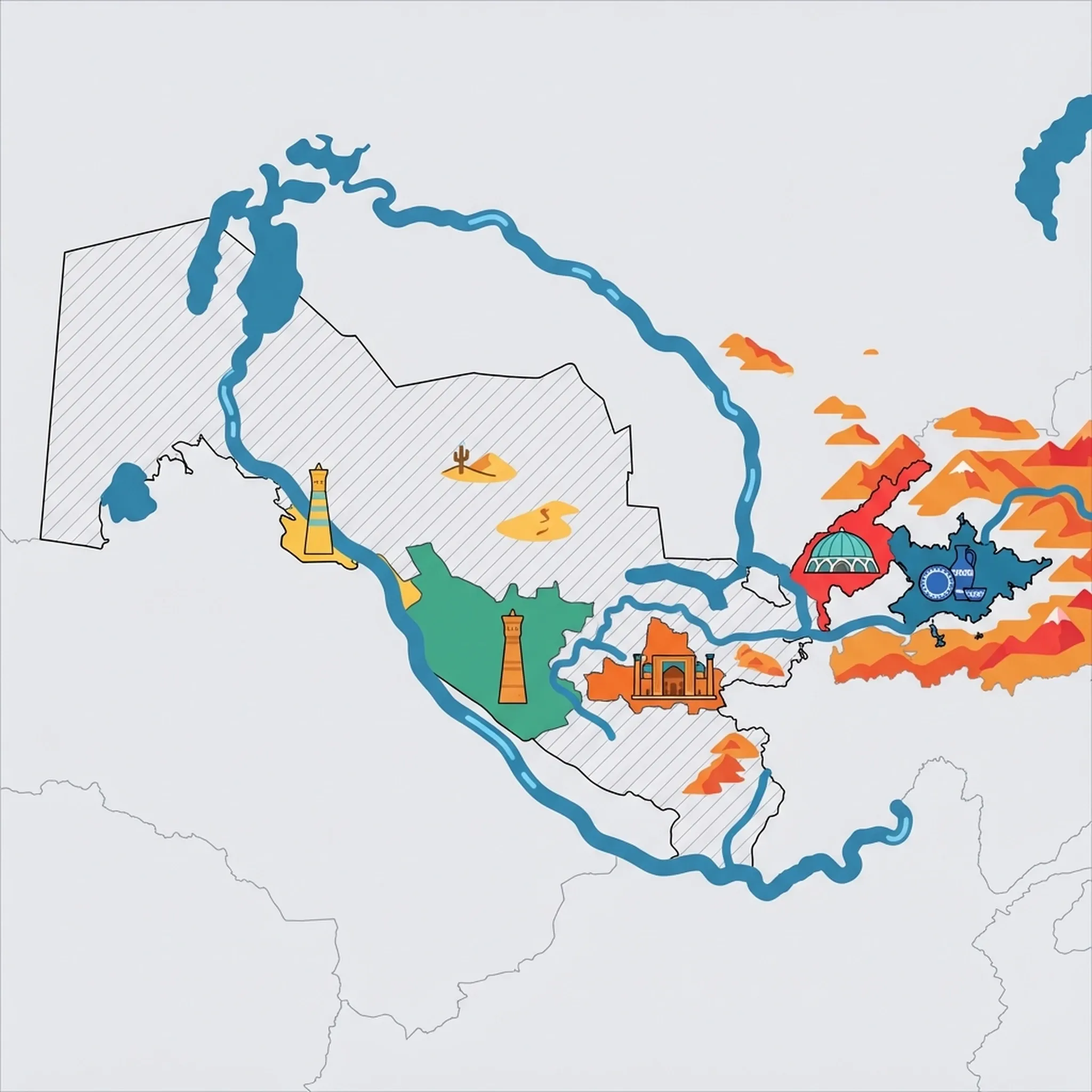
Click a region to explore
Overview
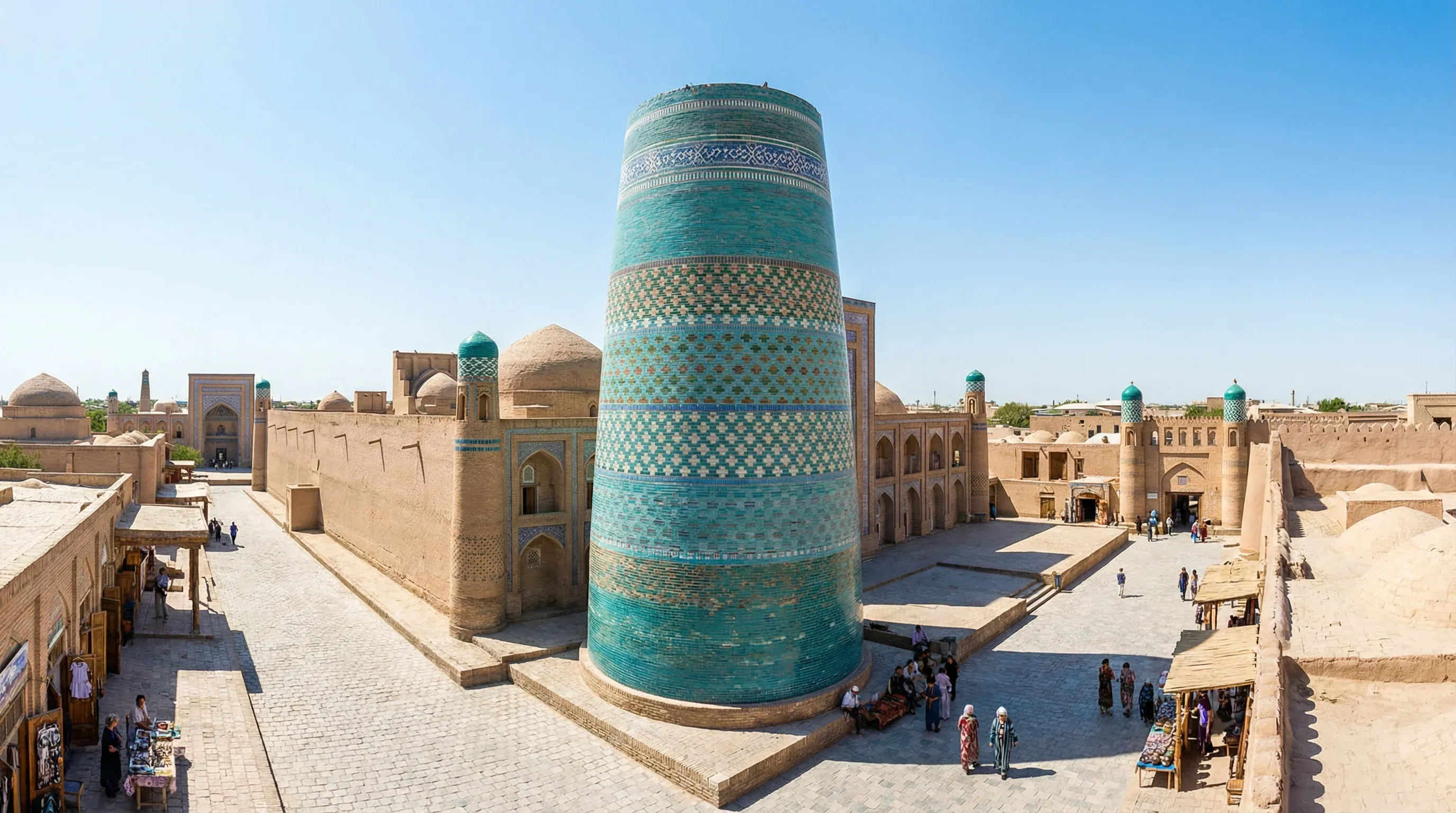
Khiva feels less like a city and more like a film set or a theme park dedicated to the Silk Road. For families, this is a huge advantage. The historic centre, known as Ichan-Kala, is completely enclosed by massive mud-brick walls and is largely pedestrianised. Parents can let children walk relatively freely without worrying about fast cars. The city is compact enough to see in a day or two, but the real magic happens at sunrise and sunset when the day-trippers leave, and the silhouettes of minarets turn purple against the desert sky.
Geographically, Khiva is isolated in the western deserts, making it an adventure to reach. Once there, the arid climate preserves the stunning turquoise tiles and sand-coloured architecture perfectly. While it can be very hot in summer and freezing in winter, the shoulder seasons offer perfect exploring weather. The city has a fairy-tale quality that resonates with children—it's a maze of minarets, palaces, and dungeons that sparks the imagination of knights and caravans. The 'museum city' status means it is extremely clean and well-maintained, with plenty of souvenir stalls selling fur hats and wooden toys that kids adore.
Key Attractions
The Ichan-Kala Walls are the highlight; families can actually climb up and walk along sections of the ramparts, offering great views and a sense of adventure. The Kalta Minor Minaret, short, fat, and covered in exquisite turquoise tiles, is the city's icon and fascinating to look at. The Juma Mosque is unique because of its forest of 213 wooden columns, which creates a cool, shadowy place for a game of hide-and-seek (quietly, of course).
For a view over the whole city, the Kuhna Ark watchtower is a must-climb, though steep. In the evenings, local rope walkers often perform in the main squares, a traditional entertainment that captivates children. The city is also full of woodcarving workshops where kids can watch intricate Quran stands and doors being chiseled by hand.
Practical Advice
Because Khiva is far from Tashkent, it usually requires a domestic flight to Urgench or a long train ride. Plan to stay at least two nights to justify the travel. The cobblestones here are rough; a heavy-duty stroller or baby carrier is essential. Tap water is salty and not potable—always use bottled water, even for brushing teeth.
Food & Drink
Typical meal times: Lunch is generally 12:00 pm to 2:00 pm. Dinner runs from 7:00 pm to 9:00 pm. Restaurants inside the walls close earlier than in Tashkent.
Typical meal costs: Prices inside the Ichan-Kala are inflated for tourists. Expect to pay 300,000–500,000 UZS (approx. $24–40 USD / €22–37 EUR) for a family dinner. Outside the walls, prices drop significantly.
Dietary requirements: The local specialty is dill-infused pasta and fish (from the Amu Darya river). Vegetarians can find pumpkin samosas and eggplant salads. Gluten-free is difficult due to the bread and noodle culture.
Signature dishes:
- Shivit Oshi – The region's most famous dish: bright green noodles (colored with dill) served with a stew of beef, potatoes, and carrots, topped with sour cream.
- Tuhum Barak – Square dumplings filled with egg, resembling ravioli, often served with yogurt. A mild flavor that kids usually accept easily.
- Khiva Non – The local bread is thinner, flatter, and more cracker-like than the fluffy loaves found in Tashkent or Samarkand.
Why this score?
The journey across the vast Kyzylkum Desert to reach Khiva provides a sense of remote adventure for families. Once inside the Ichan-Kala walls, the experience is safe and pedestrianized, though the surrounding environment remains harsh and relatively isolated.
Why this score?
Khiva has very limited medical infrastructure suitable for foreign visitors, with only basic local clinics available for minor issues. Most emergencies would require a journey to the nearby city of Urgench or a flight back to the capital for adequate care.
Why this score?
Khiva is a globally recognized UNESCO site, though its remote location in the far western desert keeps its absolute visitor numbers lower than Samarkand. It functions primarily as a specialized stop for organized tour groups completing the full trans-Uzbekistan route.

Accommodation inside the walls commands a premium. A family room in a boutique hotel inside Ichan-Kala costs 700,000–1,200,000 UZS (approx. $55–95 USD / €50–90 EUR). Food inside the walls is tourist-priced; a simple lunch can cost 60,000–100,000 UZS (approx. $4.80–8.00 USD / €4.40–7.40 EUR) per person.
Family Travel Notice
Minors, including dual citizens, must have notarized written permission from their parent or guardian to travel into or out of the country alone or with a third party.

Getting Here & Around
Getting Here
- Airports – You must fly into Urgench International Airport (UGC), which is a 30-40 minute drive from Khiva. Flights arrive from Tashkent and some international hubs.
- Train – The train station in Khiva connects to Bukhara, Samarkand, and Tashkent. The overnight sleeper train from Tashkent is an adventure but takes 14+ hours.
- Driving – It is a long drive from Bukhara (6-7 hours) through the desert. Private drivers can be hired for this route.
Getting Around
- Walking – Inside the Ichan-Kala (walled city), walking is the only real option. It is small enough to cross on foot in 15 minutes.
- Taxi – Used only to get from the airport/train station to the city gates, or to visit restaurants in the 'new city' outside the walls.
- Bicycle – Some guesthouses offer bikes, which are fun for exploring the outer walls but useless on the inner cobblestones.
Nearby Airports (1 airport)
Urgench Airport
UGCUrgench
View full flight map for Uzbekistan →

Packing List
The combination of desert wind and sand can be very irritating to children's eyes.
The dry desert air causes chapped lips very quickly.
The old city can be very dark at night, and power cuts are not uncommon.
To combat the extremely dry, dusty air which can cause congestion.
Many hotel and guesthouse sinks in Central Asia lack plugs; essential for washing fruit or baby clothes.
You will take shoes off constantly at mosques, mausoleums, and traditional restaurants with tapchan seating.
The dry desert heat and unfamiliar bacteria can cause dehydration quickly; local options are limited.
Essential for sticky hands after eating plov (often with fingers) and using public squat toilets.
Long train journeys and days out exploring vast architectural complexes drain batteries fast.

Activities & Best Times

Urban tourism, museums, historical sites, architecture
Khiva has 5 database attractions including UNESCO World Heritage Itchan Kala Old Town. Rating of 'marginal' is severely inconsistent with Samarkand (good, 7 attractions) and Bukhara (good, 7 attractions). UNESCO heritage status alone justifies very_good rating for internationally significant Silk Road city.

Spa retreats, wellness centers, peaceful getaways
The historic Anushakhan Hammam provides an atmospheric and authentic traditional bath experience dating back to the 17th century. It is most suitable during mild to cool months when the transition from the thermal bath to the outdoor desert environment is most comfortable.



Public Holidays & Calendar Next 12 months
Public holidays, festivals, cultural celebrations, and seasonal natural phenomena coming up in Khiva over the next 12 months.
Loading holidays and events...

Travel Advisory
While the country is broadly stable and safe, a significant number of major agencies advise increased vigilance due to the persistent threat of terrorism, petty crime, and regional volatility near international borders.
Safety Topics
Traveller Advice (3 groups)

Minors, including dual citizens, must have notarized written permission from their parent or guardian to travel into or out of the country alone or with a third party.

Homosexual acts are illegal under local law and can lead to prosecution. Travellers should exercise discretion and be aware that same-sex relationships are not widely accepted.

Women should follow local customs regarding conservative dress and avoid walking alone or using public transport late at night.
Agency Summaries
Most visits are trouble-free, though there is an ongoing threat of terrorism and regional instability near the Afghan border. British citizens can enter for 30 days visa-free but must register their presence within three days.
The country is generally safe for tourism. Starting in 2026, U.S. citizens can visit for up to 30 days without a visa. Specific documentation is required for minor children travelling without both parents.
Increased vigilance is recommended nationwide due to threats of terrorism and the risk of civil unrest. A strict 'do not travel' warning applies to the border region with Afghanistan.
Uzbekistan is considered safe for visitors overall, but travellers should maintain standard safety awareness. A regional warning is in place advising against all travel to the border area with Afghanistan due to volatility and terrorism risks.
Irish citizens are advised to be cautious due to potential security risks, particularly in border areas with Afghanistan, Tajikistan, and Kyrgyzstan. Entry for up to 30 days is visa-free.
New Zealanders should be vigilant due to the risk of terrorism and violent crime. Higher risk levels apply to regions bordering Afghanistan, Tajikistan, and Kyrgyzstan, where non-essential travel should be avoided.
Information is provided for general guidance only and does not constitute travel, safety, medical, or legal advice. Conditions may change. Users are responsible for independently verifying information before travel.