
Overview
Zambia is often cited as one of the safest and most welcoming countries in Africa, making it a brilliant choice for families ready to step beyond the ordinary tourist trail. Dominated by the mighty Zambezi River, the country is a land of pristine wilderness, thundering waterfalls, and vast open plains. Unlike busier safari destinations, Zambia feels exclusive and wild; you can drive for hours in a national park without seeing another vehicle, giving your family a front-row seat to nature's greatest show. The climate is generally mild and sunny, especially during the dry season (May to October), which is perfect for game viewing.
For children, Zambia is a giant open-air classroom. They will not just see animals; they will learn to track footprints, identify bird calls, and understand the delicate balance of ecosystems. The culture is deeply rooted in community and storytelling, and locals are famously fond of children, often going out of their way to make young travellers feel at home. Whether you are exploring the Livingstone & Victoria Falls region or venturing into the remote bush, the vibe is relaxed, friendly, and adventurous. While travel here requires some logistical planning, the reward is an unfiltered connection with the African bush that few other places can match.
Key Attractions
Zambia's wildlife experiences are legendary. South Luangwa National Park is arguably the best place in Africa to spot leopards and offers family-friendly game drives where kids can see hippos crowding the river lagoons. For a more aquatic adventure, Lower Zambezi National Park allows families to safely canoe down channels filled with elephants and crocodiles-an adrenaline-filled but safe activity often suitable for older children. In the vast Northern Zambia region, the Bangweulu Wetlands offer a chance to see the prehistoric-looking shoebill stork and tens of thousands of black lechwe antelope.
For a truly unique spectacle, Kasanka National Park hosts the world's largest mammal migration in November and December, when millions of fruit bats darken the sky-a sight that will leave children awe-struck. Further north, the spectacular Kalambo Falls plunges over 200 metres on the border with Tanzania, offering breathtaking views for active families. Exploring the Luangwa River ecosystem provides endless opportunities for learning and discovery, cementing Zambia's reputation as a top-tier wildlife destination.
Practical Advice
The best time to visit for wildlife is the dry season from May to October. October is hot but offers the best sightings. Malaria is present, so antimalarial medication is essential for the whole family; consult a travel doctor before departure. Yellow Fever vaccination certificates are often required if arriving from a risk country. Visas are straightforward: the KAZA Univisa (available on arrival) covers both Zambia and Zimbabwe, perfect for seeing both sides of the falls. Road travel can be slow due to potholes, so consider internal flights (Proflight) for long distances.
Safety
Zambia is politically stable and generally very safe for tourists (Level 1 or 2 advisory typically). However, petty theft can occur in cities like Lusaka and Livingstone, so keep valuables hidden. Be cautious near the borders with DRC and Angola. In national parks, wild animals roam freely-never walk unaccompanied at night and always listen to your safari guide's instructions. When driving, avoid travel after dark due to unlit roads and livestock.
Food & Drink
Typical meal times: Lunch is typically served from 12:30 pm to 2:00 pm. Dinner is usually eaten between 7:00 pm and 8:30 pm, often earlier in safari camps to align with early morning starts.
Typical meal costs: Local meals are very cheap, while lodge food is international standard and priced accordingly. Street/local meals: 50–150 ZMW (approx. $2–6 USD / €1.80–5.50 EUR). Mid-range restaurant main course: 250–450 ZMW (approx. $9–16 USD / €8.50–15 EUR). Safari lodge meals are usually included in rates.
Dietary requirements: Vegetarian and vegan diets are surprisingly easy to cater for, as many local dishes are plant-based. Safari lodges are excellent at handling allergies and gluten-free needs if notified in advance. Peanut allergies require caution as groundnuts are a staple ingredient.
Family-friendly dining: Zambians love children, and restaurants are very accommodating. Most safari lodges offer flexible meal times and "kiddie menus" (pasta, chicken strips) if the local fare is too adventurous. Highchairs are available in hotels but rare in local eateries.
Signature dishes:
- Nshima – The national staple: a thick, white maize porridge eaten with hands, serving as the spoon to scoop up stews and relishes.
- Ifisashi – A delicious, creamy stew made from green leafy vegetables (pumpkin leaves or spinach) cooked in a rich groundnut (peanut) sauce.
- Chikanda – Known as "African Polony," this is a firm, sausage-like vegetarian loaf made from wild orchid tubers and peanuts-a unique texture kids might find interesting.
- Kapenta – Tiny, sardine-like freshwater fish, usually fried crispy and eaten whole like chips; a great crunchy snack for adventurous eaters.
- Vitumbua – Sweet, fried dough balls similar to doughnuts, often sold at markets and perfect for a quick energy boost.

While local living costs are low, a family safari vacation is an investment. High-end lodges are expensive, but self-driving or mid-range chalets offer value. A family of four can expect to spend around 4,000–8,000 ZMW (approx. $150–300 USD / €140–280 EUR) per day for mid-range accommodation, food, and fuel, excluding park fees. All-inclusive luxury safaris can exceed $1,000 USD per person per night.
Age Suitability





Did you know? Zambia welcomes approximately 554,000 international visitors per year. Most visitors come from Africa.
Explore Regions
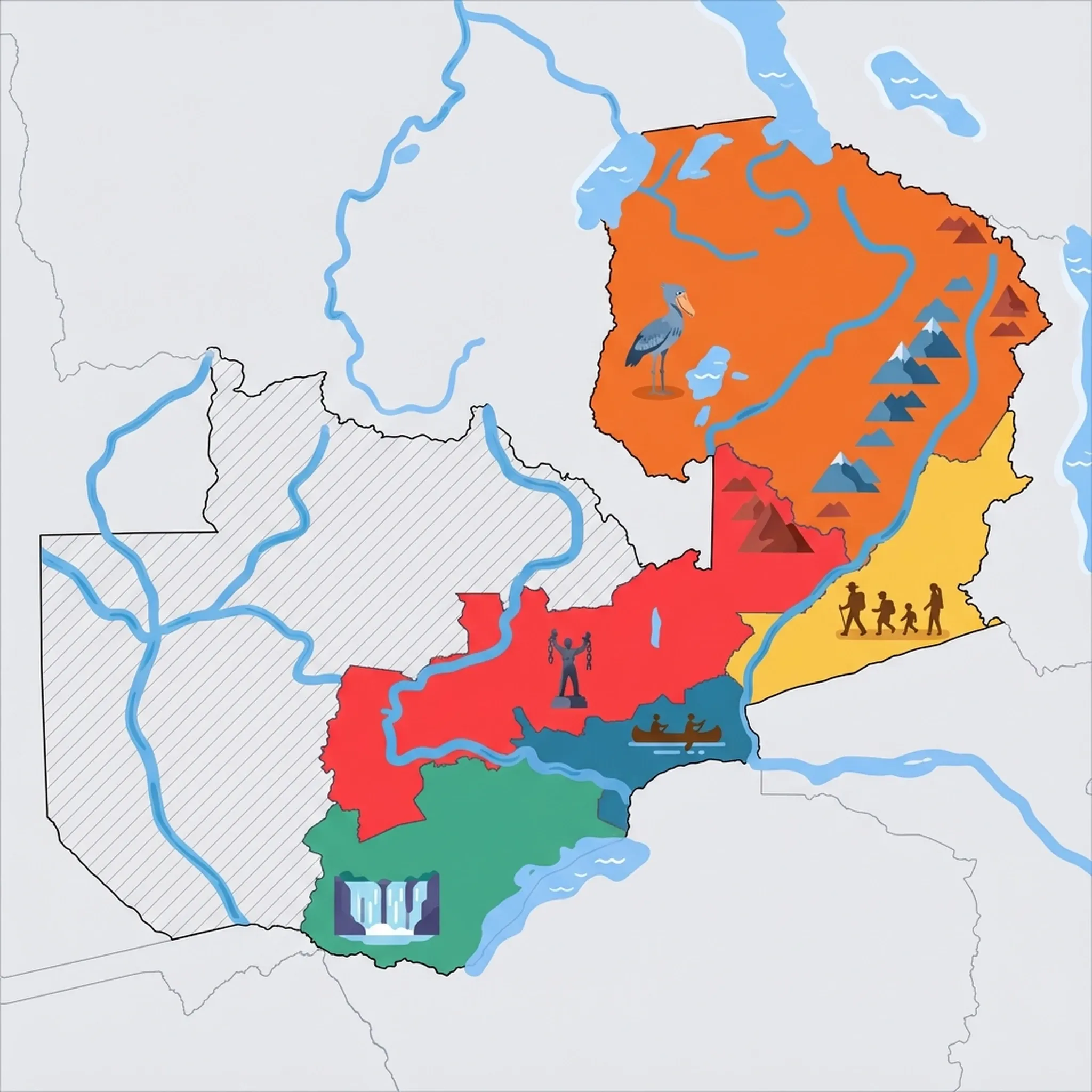
5 Regions
Livingstone & Victoria Falls
The smoke that thunders and the heart of African adventure 🌈🦁
Lower Zambezi NP
River adventures and elephants swimming in the sunset 🐘🛶
Lusaka & Central
Urban culture meets the open road 🏙️🛣️
Northern Zambia (Kasanka, Bangweulu)
Where waterfalls roar and millions of bats darken the sky 🦇💦
South Luangwa NP
The Valley of the Leopard and the birthplace of the walking safari 🐆🌿
Click on a region marker to explore details. Use the dropdown to color regions by activity suitability.

Getting There & Around
Getting There
- By Air – The main gateway is Kenneth Kaunda International Airport (LUN) in Lusaka. Harry Mwanga Nkumbula International Airport (LVI) in Livingstone is perfect for direct access to Livingstone & Victoria Falls. Major connections come via Johannesburg, Dubai, or Nairobi.
- By Land – Families often enter via the Victoria Falls Bridge from Zimbabwe or the Kazungula Bridge from Botswana. Border crossings can be chaotic; using a transfer agent is recommended.
- Entry Requirements – The KAZA Univisa allows unlimited travel between Zambia and Zimbabwe for 30 days ($50 USD). Check your government website for the latest visa requirements, or use the IATA Travel Centre entry-requirements checker.
Getting Around
- Domestic Flights – The easiest way to cover big distances. Proflight Zambia connects Lusaka & Central to key tourist hubs like Mfuwe (for South Luangwa) and Livingstone.
- Car Hire – Renting a 4x4 is essential for self-driving families. It offers freedom but requires confidence driving on potholed roads. Essential for reaching remote spots in Northern Zambia. Driving is on the left.
- Buses – Coach services like Shalom or Mazhandu Family Bus are affordable and connect major cities, but can be long, crowded, and loud-better suited for adventurous families with older teens.
- Taxis – Widely available in Lusaka and Livingstone. Negotiate the fare before getting in, as meters are rare.
Official Links

Packing List
Older dollar bills are frequently rejected by banks and lodges; bring only crisp, new notes with 'big heads'.
Bright white lights attract millions of bugs in the bush; amber/red settings keep the insects away at camp.
Strict luggage restrictions on small internal flights (Proflight) often ban hard-shell suitcases.
Power cuts (load shedding) are common; a solar backup ensures phones and cameras stay charged.
Open game drive vehicles are incredibly dusty in the dry season; protect your nose and mouth.

Activities & Best Times

Adventure & Nature
ExcellentHiking, wildlife, outdoor exploration, ecotourism
Home to a UNESCO World Heritage natural wonder and unique white rhino tracking, offering unparalleled proximity to the Zambezi's raw power. Peak dry months (May-Aug) provide optimal wildlife viewing and clear views of the Falls; shoulder months see the dramatic high-water spray or rising heat; the wet season (Nov-Feb) limits trail access and visibility.
A world-class destination for water-based safaris and wilderness immersion, specifically renowned for its high-quality guiding and unique canoeing opportunities along the Zambezi River. Peak game viewing occurs in the late dry season when wildlife congregates on the floodplains, while heavy summer rains from December to April cause seasonal closures of many luxury lodges.
Home to the unique Shoebill stork and the world's highest drop waterfall at Kalambo; this is a premier wilderness destination for experienced safari-goers. Peak wildlife viewing and road access coincide with the dry winter and spring months.

Sports & Active
ExcellentSport tourism, fitness activities, active recreation
A global capital for adrenaline sports, featuring world-class Grade 5 white-water rafting, bungee jumping, and gorge swings. The peak low-water season (Aug-Oct) is the only time the most technical rafting runs are open; high river levels from Jan-Apr often force the closure of these elite-level aquatic activities.
While Kalambo Falls trekking is noteworthy, the region lacks the infrastructure and international reputation for 'very_good' sports/active classification. 'Good' better reflects a developing but not yet world-class offering.
Insufficient evidence for 'very_good' rating on international scale. Mountain biking trails and adventure parks are claimed but not documented. Downgrade to 'good' unless more substantial evidence emerges.

City & Cultural
Very GoodUrban tourism, museums, historical sites, architecture
The region features the extraordinary Shiwa Ng'andu estate and numerous iconic waterfalls that serve as historical and cultural landmarks. May to August offers the best balance of high water flows for scenic beauty and dry weather for accessibility.
Lusaka is a cosmopolitan hub featuring world-class art galleries and museums that reflect Zambia's heritage and modern identity. The cool winter season is ideal for exploring outdoor monuments and vibrant urban markets comfortably.
Livingstone town offers a safe, authentic glimpse into Zambian history with colonial architecture and local markets, though it lacks the infrastructure of a global cultural metropole. Dry peak months are best for navigating the town on foot; shoulder months are viable for cultural immersion, but summer rains make urban exploration difficult.

Educational & Exploratory
Very GoodLearning experiences, scientific sites, historical education
Rich in colonial history and geological significance, with the Livingstone Museum providing sophisticated insights into David Livingstone's explorations. Peak months offer comfortable walking temperatures for historical tours; high rainfall in summer (Dec-Feb) makes outdoor archaeological and heritage sites difficult to navigate.
The Chipembele Wildlife Education Centre provides high-quality conservation learning for children, though it serves as a secondary activity rather than a standalone travel motivator. Facility access and logistical ease for families are highest during the primary dry-season tourism window.
The Wildlife Discovery Centre provides an internationally recognized conservation education experience focused on elephant rescue. Its operations are most effective during the dry season when outdoor learning and animal interactions are most consistent.

Relaxation & Wellness
GoodSpa retreats, wellness centers, peaceful getaways
Features ultra-luxury riverside lodges and high-end spas overlooking the Zambezi, providing a serene escape for discerning families. The dry winter (May-Aug) offers low humidity and bug-free relaxation; the wet season (Nov-Mar) brings oppressive humidity and high mosquito activity that detracts from the outdoor wellness experience.
Kapishya Hot Springs provides a high-quality, natural thermal experience in a lush, remote setting. The cooler winter months (June-August) are ideal for enjoying the thermal waters, while heavy summer rains can complicate travel.
Natural thermal baths at Chinyunyu offer a rustic wellness experience that appeals to adventurous families. The cool months of June through August make the hot springs particularly restorative and pleasant to visit.

Road Trips & Scenic
GoodScenic drives, countryside tours, route-based travel
Features spectacular and rugged scenic routes such as the Leopards Hill Escarpment Drive, providing authentic African landscapes for adventurous families. Travel is restricted to the dry months when unpaved valley roads are navigable, as the monsoon-like summer rains render tracks impassable for standard international tourism.
Features spectacular, rugged driving routes like the Riverside Drive that offer intimate wildlife viewing for self-drive visitors. These unpaved tracks are strictly seasonal and become impassable due to deep mud during the rainy season, restricting reliable touring to the mid-to-late dry months.
The Northern Circuit is a celebrated route for adventurous drivers, connecting spectacular waterfalls and historical sites. Roads are most reliable and scenery most accessible during the dry months when river crossings are safe.

Theme Park & Entertainment
GoodAmusement parks, family entertainment venues

Festivals & Seasonal
MarginalEvents, celebrations, seasonal attractions
Host to the Kasanka Fruit Bat Migration, the world's largest mammal migration, which is a bucket-list event for nature enthusiasts. This strictly seasonal phenomenon occurs only between late September and December.
The world-class Kasanka bat migration is a unique natural spectacle occurring strictly at the year's end, drawing global wildlife enthusiasts. This specific window is the only time to experience this internationally significant biological event.

Public Holidays & Calendar Next 12 months
Public holidays, festivals, cultural celebrations, and seasonal natural phenomena coming up in Zambia over the next 12 months.
Loading holidays and events...
Climate & Weather
Livingstone & Victoria Falls
Show Details
| Month | Temp °C | Rain | Humidity |
|---|
Lower Zambezi NP
Show Details
| Month | Temp °C | Rain | Humidity |
|---|
Lusaka & Central
Show Details
| Month | Temp °C | Rain | Humidity |
|---|
Northern Zambia (Kasanka, Bangweulu)
Show Details
| Month | Temp °C | Rain | Humidity |
|---|
South Luangwa NP
Show Details
| Month | Temp °C | Rain | Humidity |
|---|

Travel Advisory
The majority of major international agencies classify Zambia as a destination requiring standard safety awareness. While specific risks like crime in cities and landmines near borders exist, they do not currently warrant an elevated nationwide risk rating for most travellers.
Safety Topics
Traveller Advice (4 groups)

Be cautious in social settings like bars and nightclubs where reports of drink spiking have occurred. Avoid travelling solo after dark.
When travelling in rural or border areas, use a 4x4 vehicle and strictly remain on paved or well-marked roads to avoid the risk of landmines and unexploded explosives.

Homosexual activity is illegal and punishable by significant prison time, including life sentences. Travellers should exercise extreme discretion and avoid public displays of affection as social tolerance is low.

Maintain standard security awareness, avoid walking alone at night in urban centers, and stay clear of any political gatherings or demonstrations.
Agency Summaries
Australia advises a baseline of normal safety measures across the country. A higher level of vigilance is necessary near the border with the Democratic Republic of the Congo due to criminal activity and the threat of undetected landmines. Public demonstrations should be avoided as they can escalate quickly.
The United States suggests travellers follow standard safety procedures. While the security environment is generally stable, visitors are encouraged to stay away from political rallies and large crowds, which can occasionally lead to civil unrest or minor violence, particularly during election cycles.
New Zealand recommends a higher level of awareness than one would use at home due to the prevalence of violent crime in major cities and the risk of landmines in frontier zones. Moving through urban areas alone or after dark is discouraged.
Most visits to Zambia are trouble-free. Travellers should remain alert to common street crimes like pickpocketing in busy urban areas. There are specific health warnings regarding contaminated water in mining regions and periodic outbreaks of infectious diseases that require vigilance.
Ireland advises its citizens to maintain typical personal security awareness while visiting Zambia. It is important to confirm entry requirements and ensure travel documents meet the necessary validity standards before departure.
Zambia is considered a safe destination for travel using standard precautions. However, travellers should exercise a high degree of caution in border regions near Angola, Mozambique, and the DRC because of the residual risk of landmines and unexploded ordnance. Compliance with strict laws on mineral exports and the possession of precious stones is essential.
Information is provided for general guidance only and does not constitute travel, safety, medical, or legal advice. Conditions may change. Users are responsible for independently verifying information before travel.