
Overview
Zimbabwe is often described as the "Real Africa," a landlocked country defined by its dramatic landscapes, from the granite hills of the Matopos to the lush Zambezi Valley. For families, it offers a raw and exciting safari experience that feels far more exclusive than in busier safari destinations. The country is dominated by a high central plateau, giving it a generally temperate climate, although the low-lying Zambezi valley gets hot. The vibe here is one of resilience and warmth; despite economic challenges, Zimbabweans are famously friendly and eager to welcome families, with guides who are widely considered some of the best-trained in Africa.
Traveling here with children is an adventure into the wild. The primary draw is the wildlife, but the geography is equally stunning, featuring the world's largest sheet of falling water and the mystical stone ruins of ancient civilisations. While the cities can be chaotic, the tourist infrastructure in Victoria Falls & Western Zimbabwe is excellent, offering family-friendly hotels, safe transport, and activities ranging from sunset cruises to canopy tours. It is a destination that rewards curiosity, offering a profound connection to nature that kids will never forget.
Key Attractions
The undisputed jewel is Victoria Falls, one of the Seven Natural Wonders of the World. Families can walk the rainforest trails to see the main falls, cross the historic Victoria Falls Bridge, or take a helicopter flight for a "Flight of Angels" view. Just a short drive away, the Victoria Falls National Park offers easier game viewing for younger kids who might find full-day safaris tiring. For the ultimate wildlife experience, Hwange National Park is essential. It is famous for its massive elephant herds-sometimes numbering in the hundreds-that gather at waterholes, providing a spectacle that will leave children awe-struck.
For families interested in history, the Great Zimbabwe National Monument in the Great Zimbabwe & Masvingo region is a UNESCO World Heritage site comprising the largest ancient stone structures in sub-Saharan Africa. It’s a fascinating history lesson brought to life, where kids can explore the Great Enclosure and Hill Complex. In the north, the wild Mana Pools National Park offers a more remote adventure along the Zambezi River, famous for its walking safaris and canoe trips (best for older teens). Closer to the capital, the Chinhoyi Caves offer a magical stop with their cobalt-blue sleeping pool, a geological wonder hidden beneath the earth.
Practical Advice
The best time to visit for wildlife is the dry season (May to October), when animals congregate around waterholes. October is the hottest month but offers the best sightings. Malaria prophylaxis is essential for most of the country, including Victoria Falls and Hwange. Visas are required for many nationalities; the KAZA UniVisa is a great option, covering both Zimbabwe and Zambia for 30 days. Currency is critical: The US Dollar (USD) is the effective currency for tourists. Bring ample cash in small denominations ($1, $5, $10) as change is rarely available. Credit cards are accepted in major hotels but unreliable elsewhere due to network issues.
Food & Drink
Typical meal times: Lunch is usually served from 12:30 pm to 2:00 pm, while dinner tends to be early, especially in safari lodges, from 6:30 pm to 8:30 pm. City restaurants may stay open later, until around 9:30 pm.
Typical meal costs: $10–20 (approx. €9–18 EUR / £8–15 GBP) for a casual lunch; $20–40 (approx. €18–37 EUR / £15–30 GBP) for a nice dinner. Prices are almost exclusively quoted in USD for tourists.
Dietary requirements: Vegetarian options are generally available in hotels and lodges, though less common in local rural eateries. Gluten-free and vegan requests can be accommodated at safari camps if booked in advance, but variety may be limited. Peanut allergies require caution as groundnuts are a staple ingredient.
Family-friendly dining: Safari lodges are excellent at catering to kids, often offering early dinners and simplified "kiddie menus." In towns like Victoria Falls, restaurants are casual and welcoming, often featuring outdoor seating where kids can move around.
Signature dishes:
- Sadza – The national staple, a thick white maize porridge eaten with hands and dipped into stews or relishes. It is bland on its own but delicious with sauce.
- Huku ne Dovi – Chicken stewed in a rich, creamy peanut butter sauce with leafy greens. A mild, nutty flavour that children often love.
- Kapenta – Tiny freshwater sardines from Lake Kariba, usually dried and fried until crispy. They are eaten like crunchy snacks or with sadza.
- Mopane Worms (Madora) – A crunchy, fried caterpillar delicacy rich in protein. A fun "fear factor" challenge for brave adventurous teens!
- Game Meat – Warthog, kudu, or impala steaks are common in tourist restaurants, offering a lean, organic alternative to beef.

While Zimbabwe can be affordable, the dollarised tourist economy means prices are comparable to Western levels. A family of four should budget $150–250 (approx. €140–230 EUR / £120–195 GBP) per day for mid-range lodging and meals, excluding safari activities. Park fees and game drives significantly increase costs.
Age Suitability



Did you know? Zimbabwe welcomes approximately 2.1 million international visitors per year. Most visitors come from Africa.
Explore Regions
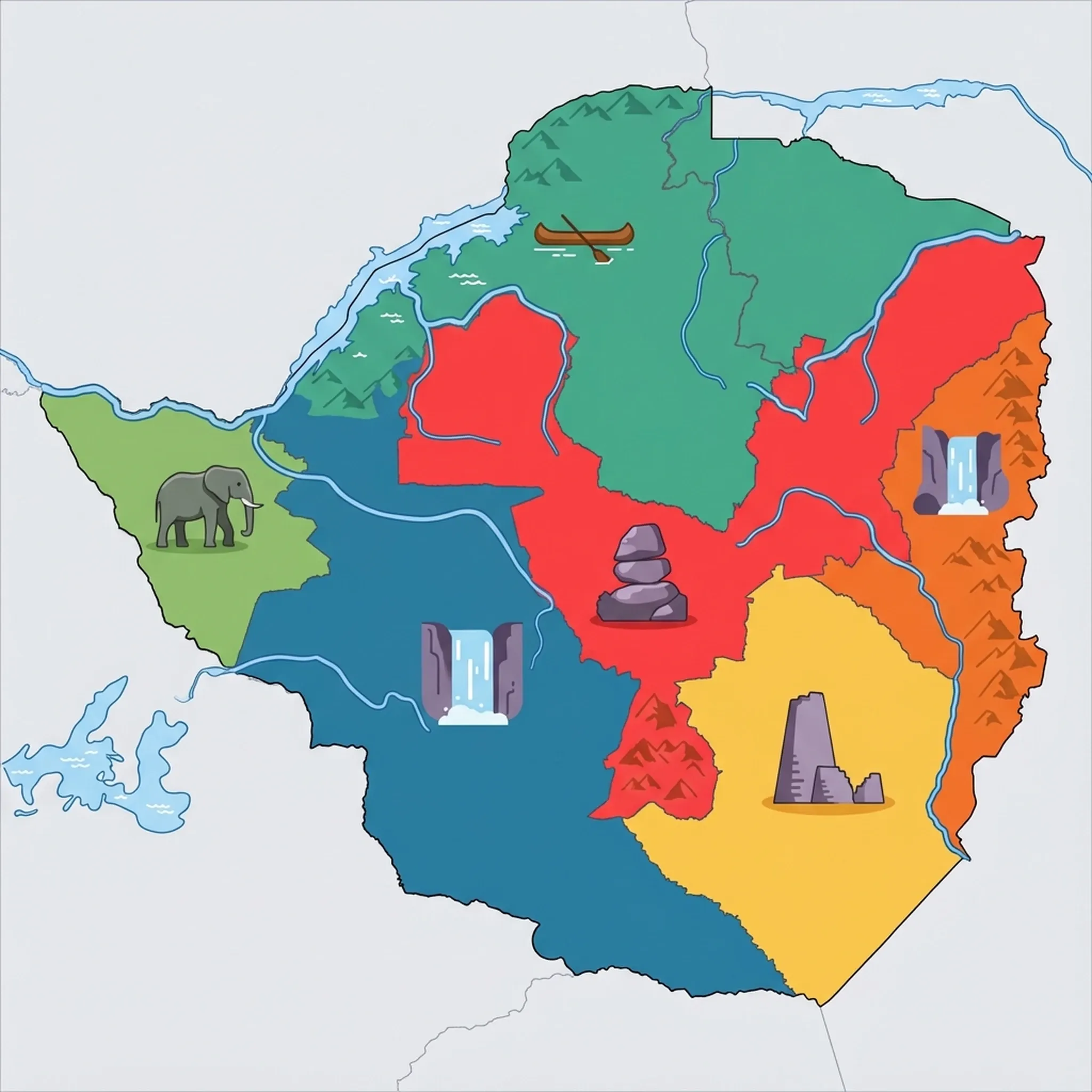
6 Regions
Eastern Highlands (Nyanga, Chimanimani)
Where mist-covered mountains meet family adventure 🏔️
Great Zimbabwe & Masvingo
Uncover the secrets of the ancient stone city 🏛️
Harare & Central
Art, culture, and nature on the city's edge 🎨
Hwange National Park
Home to the giants of Africa 🐘
Mana Pools & Zambezi Valley
The wildest walking safari on Earth 🦁
Victoria Falls & Western Zimbabwe
The Smoke that Thunders and the adventure capital 🌊
Click on a region marker to explore details. Use the dropdown to color regions by activity suitability.

Getting There & Around
Getting There
- By Air – Victoria Falls Airport (VFA) is the main tourist hub, with direct flights from Johannesburg, Cape Town, and Addis Ababa. Robert Gabriel Mugabe International (HRE) serves Harare & Central.
- By Land – The Victoria Falls Bridge connects to Zambia (Livingstone). The Kazungula border connects to Botswana, featuring a modern bridge over the Zambezi.
- Visa / Entry Requirements – The KAZA UniVisa ($50) allows travel between Zimbabwe and Zambia. Check your government website for the latest visa requirements, or use the IATA Travel Centre entry-requirements checker.
Getting Around
- Private Transfers – The safest and most common option for families. Operators like Wild Horizons run comfortable shuttle buses between Victoria Falls, Hwange, and nearby borders.
- Domestic Flights – Fastjet and local charters connect Harare, Victoria Falls, and Hwange. This is the quickest way to cover the large distances between the Eastern Highlands and the west.
- Elephant Express – A unique family favourite: a specialized railcar that runs along the edge of Hwange National Park. It transforms a transfer into a fun game-viewing train ride.
- Car Hire – Possible for adventurous families, but 4x4 is essential for parks. Police roadblocks are common; keep documents handy and remain polite.

Packing List
Change is almost never available; $1, $5, and $10 notes are essential for tips and small purchases.
Hotel sockets vary (Type G/D) and outlets are scarce; vital for charging multiple family devices.
Power cuts (load shedding) are frequent, and safari camps can be very dark at night.
Essential for protecting phones and cameras from the heavy spray at Victoria Falls.
Morning game drives and evenings are surprisingly cold, often dropping below 10°C (50°F).
Keeps children engaged on safari; sharing one pair among a family often leads to frustration.

Activities & Best Times

Adventure & Nature
ExcellentHiking, wildlife, outdoor exploration, ecotourism
A premier African safari destination famous for massive elephant herds and predator sightings around vital waterholes. Peak season occurs during the dry winter months when wildlife concentrates at pumped pans; the wet summer (Emerald Season) offers lush scenery but dispersed wildlife and difficult navigation.
Home to the world-renowned Victoria Falls and premier wildlife destinations like Hwange National Park, offering world-class safari and immersion. Peak months coincide with the dry season for optimal wildlife viewing and clear views of the Falls' spray.
Mana Pools is a UNESCO World Heritage site renowned for authentic walking safaris and canoe trails along the Zambezi River. The peak dry season (Jul-Oct) offers world-class wildlife viewing as animals congregate by the river, while many camps close during the wet months (Dec-Mar) due to impassable roads and flooding.

City & Cultural
Very GoodUrban tourism, museums, historical sites, architecture
Harare features sophisticated botanical gardens and the Museum of Human Sciences, which provides deep insights into the Great Zimbabwe civilization. Tourism peaks during the dry, sunny months and specifically in September/October when the city's famous Jacaranda trees are in full purple bloom.
Centred on the UNESCO-listed Great Zimbabwe National Monument, providing a world-class archaeological experience of immense historical depth. Dry, cool months are essential for safely navigating the extensive granite stone complexes and Hill Complex paths.
Features significant historical landmarks like the Victoria Falls Bridge and a thriving local art gallery scene centered in the town hub. The dry winter months offer comfortable walking temperatures for exploring heritage sites and markets.

Sports & Active
Very GoodSport tourism, fitness activities, active recreation
The granite domes of Domboshava and Ngomakurira offer world-class hiking and rock-scrambling routes that are highly regarded by active travelers. These activities are most safely performed in the dry season when the rock surfaces provide maximum grip and temperatures are cool.
Offers recognized hiking routes through ancient ruins and cycling trails along the Lake Mutirikwi shoreline. Peak conditions align with the cooler winter season to avoid the high heat and humidity of the tropical summer.
Highly regarded for authentic walking safaris and professional guide-led wilderness treks on trails like the Zambezi and Chamabonda. The cooler, dry months provide safe conditions and clear visibility for tracking wildlife on foot, whereas summer months are too hot and overgrown.

Road Trips & Scenic
GoodScenic drives, countryside tours, route-based travel
As the central hub, Harare provides access to celebrated scenic drives toward the Eastern Highlands and Lake Kariba. Driving conditions are safest and most scenic during the dry season; summer rains can lead to rapid road degradation and poor visibility on the highveld.
Offers iconic scenic drives like the Ten Mile Drive and routes between camps that provide immersive wilderness views. Driving is optimal during the dry months when tracks are firm; heavy summer rains make many remote park roads impassable for standard safari vehicles.
The Nyanga Scenic Loop and Vumba Mountain Drive are celebrated for their dramatic escarpment views and mist-shrouded forests. Travel is discouraged in the peak wet season (Dec-Feb) when heavy rain and dense fog can make mountain roads hazardous.

Educational & Exploratory
GoodLearning experiences, scientific sites, historical education
Provides high-quality learning experiences at the Painted Dog Conservation Visitor Centre and the historic Bridge Visitor Centre. These sites offer internationally significant insights into African biodiversity and engineering history.
The Painted Dog Conservation Visitor Centre is a world-class facility for families to learn about endangered species protection. While the center is open year-round, visitation is typically tied to the broader safari season when international travelers are in the park.

Festivals & Seasonal
MarginalEvents, celebrations, seasonal attractions
Harare hosts the internationally acclaimed HIFA (Harare International Festival of the Arts) traditionally in late April, while the spring Jacaranda bloom is a major seasonal draw. Outside of these specific windows, the region lacks the consistent major event calendar required for a higher rating.
Highlighted by the unique natural spectacle of the Lunar Rainbow during high-water months and the vibrant Victoria Falls Carnival in December. These events are date-specific and provide distinctive, authentic seasonal draws for international visitors.
Theme Park & Entertainment
MarginalAmusement parks, family entertainment venues
Local entertainment hubs like Longchen Plaza offer water and amusement parks that serve domestic families well but lack international scale. These outdoor facilities are best enjoyed during the warm, dry transition months, with heavy summer rains making them impractical.
The Mutarazi Falls Skywalk offers a world-class adrenaline experience, though it remains a single-attraction destination rather than a full theme park. Visibility and safety on the high-altitude skyline are significantly better during the dry, mist-free winter months.

Relaxation & Wellness
MarginalSpa retreats, wellness centers, peaceful getaways

Public Holidays & Calendar Next 12 months
Public holidays, festivals, cultural celebrations, and seasonal natural phenomena coming up in Zimbabwe over the next 12 months.
Loading holidays and events...
Climate & Weather
Eastern Highlands (Nyanga, Chimanimani)
Show Details
| Month | Temp °C | Rain | Humidity |
|---|
Great Zimbabwe & Masvingo
Show Details
| Month | Temp °C | Rain | Humidity |
|---|
Harare & Central
Show Details
| Month | Temp °C | Rain | Humidity |
|---|
Hwange National Park
Show Details
| Month | Temp °C | Rain | Humidity |
|---|
Mana Pools & Zambezi Valley
Show Details
| Month | Temp °C | Rain | Humidity |
|---|
Victoria Falls & Western Zimbabwe
Show Details
| Month | Temp °C | Rain | Humidity |
|---|

Travel Advisory
The strong majority of international agencies recommend exercising elevated caution in Zimbabwe. This consensus is driven by significant concerns regarding street crime, the potential for political demonstrations to turn violent, and an unstable economic environment that impacts the reliability of basic services.
Safety Topics
Traveller Advice (3 groups)
Foreign media workers and journalists may face increased scrutiny or official harassment. Ensure all accreditation is properly obtained before attempting to report or film.

Female travellers should avoid walking alone at night and remain vigilant in isolated areas or when using public transport. Dressing conservatively is recommended to respect local norms.

Same-sex sexual activity is criminalised and can lead to imprisonment. Social intolerance is common, and public displays of affection may attract negative attention or legal consequences.
Agency Summaries
A high level of care is necessary due to the threat of crime and civil unrest. The economic situation is volatile, and protests can emerge quickly and become violent.
Irish citizens are urged to maintain high personal security awareness. The risk of muggings and pickpocketing is elevated in cities, especially after dark.
Visitors should increase their safety awareness because of frequent opportunistic crime and the possibility of official harassment of foreign nationals. Violent crimes like carjackings and home invasions also occur.
Travellers are advised to be extremely vigilant due to a high rate of crime and the potential for sudden civil disturbances. The security environment remains unpredictable.
While most visits are incident-free, there is a persistent risk of street crime and political demonstrations. Travellers should avoid any political activity and remain alert in urban areas.
Travelers should be cautious due to safety concerns that exceed standard levels. Political tension is common, and basic infrastructure like power and water can be unreliable.
Information is provided for general guidance only and does not constitute travel, safety, medical, or legal advice. Conditions may change. Users are responsible for independently verifying information before travel.