
Click a region to explore
Overview
Santo Antão is the "green lung" of Cape Verde. The geography here is jaw-dropping: massive volcanic walls drop vertically into the ocean, and valleys are carpeted in sugar cane, bananas, and breadfruit trees. For active families who love nature, this is the highlight of Cape Verde. It is not a beach destination—the coast is rough and rocky—but a place for walking, breathing fresh mountain air, and exploring rural villages that seem untouched by time.
The island feels ancient and agricultural. Farmers still use donkeys to transport goods up steep cobblestone paths, and the smell of roasting coffee and distilling sugar cane (grogue) is often in the air. The famous Cova de Paúl crater is a highlight, where you can stand on the rim of a volcano that is now a patchwork of farm fields. The people are incredibly friendly, often waving at passersby on the winding mountain roads.
Key Attractions
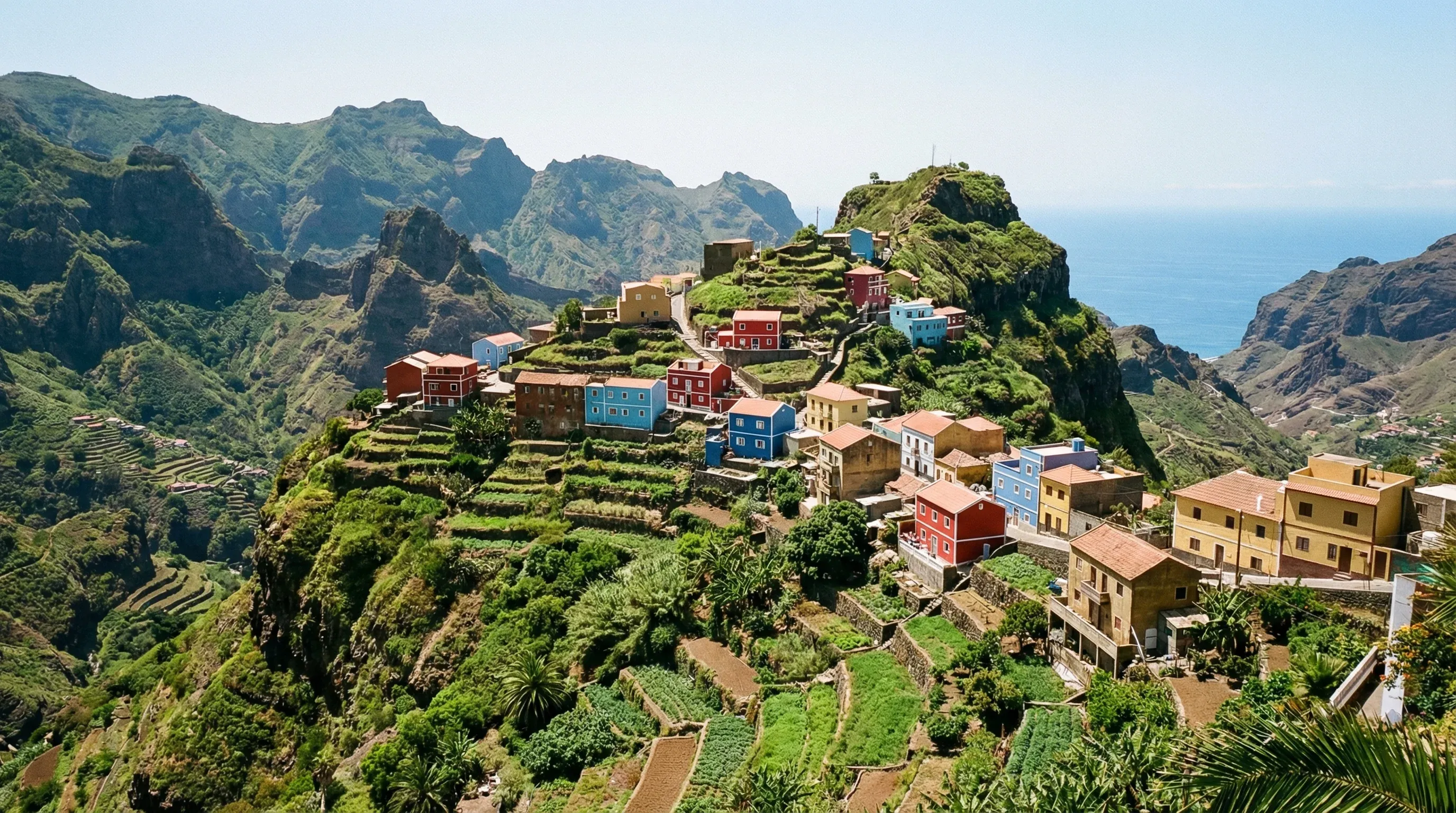
The visual highlight is Fontainhas Village. Often listed among the villages with the best views in the world, its colorful houses cling to the side of a deep ravine. It looks like a toy village and is a fantastic photo op. The drive there alone is an adventure. The Paúl Valley is the greenest part of the island; easy walks along the levadas (irrigation channels) are suitable for children and allow you to see exactly where tropical fruits grow. The Old Road (Estrada de Corda) that crosses the central mountain spine offers some of the most dramatic driving scenery in Africa.
Practical Advice
There is no airport; you must take a ferry (1 hour) from São Vicente. The sea can be rough, so prepare accordingly. The roads are steep and winding—not for those with vertigo. It is best to hire a driver so you can enjoy the views safely.
Food & Drink
Typical meal times: Lunch 12:30 pm to 2:30 pm; Dinner 7:00 pm to 9:00 pm.
Typical meal costs: Inexpensive. A meal is often 700–1,000 CVE (approx. $7–10 USD / €6.50–9 EUR).
Dietary requirements: Fresh fruit and vegetables are abundant here, more than any other island. Vegetarians will eat well (yams, manioc, beans).
Signature dishes:
- Caldo de Peixe – A clear, healthy fish soup with large chunks of vegetables, perfect for a light lunch.
- Grogue & Ponche – While Grogue is strong rum for adults, 'Ponche' (honey/molasses liqueur) is a local specialty. Kids can try the fresh sugar cane juice (calda) often sold at the same production sites (trapiches).
- Catchupa Refogada – Fried leftover stew served with egg, the standard hiker's breakfast.
Why this score?
The island is a premier adventure location characterized by dramatic vertical peaks, deep green valleys like the Paúl Valley, and the mist-filled Cova Crater. The terrain is physically demanding, featuring steep coastal trails and mountain paths that require significant effort to traverse.
Why this score?
Medical infrastructure is very basic and localized in small clinics in towns like Porto Novo and Ribeira Grande. In the event of a serious injury on a hiking trail, evacuation involves difficult terrain followed by a ferry crossing to the neighboring island for better care.
Why this score?
Santo Antão remains a niche destination for dedicated hikers and nature lovers due to its lack of a commercial airport. Visitors must arrive via ferry from São Vicente, which keeps international crowds low despite the island's growing reputation for spectacular mountain scenery.

Santo Antão offers a rural cost of living. Accommodation is mostly in family-run guesthouses (residencials) which cost 3,500–6,000 CVE (approx. $35–60 USD / €32–54 EUR). Food is cheap and locally sourced. Hiring a private driver for a full day tour is the biggest expense, approx. 7,000–9,000 CVE ($70–90 USD / €63–80 EUR).
Family Travel Notice
Families should take extra care with food and water hygiene due to recent spikes in Shigella and Salmonella infections reported in returning tourists.

Getting Here & Around
Getting Here
- Ferry – The only way to arrive. Ferries run twice daily from Mindelo (São Vicente) to Porto Novo. The crossing takes 60 minutes.
- Airports – You must fly to São Vicente (VXE) first, then take the taxi to the ferry terminal.
Getting Around
- Aluguer (Minibus) – They wait at the ferry terminal in Porto Novo. They fill up and drive to Ribeira Grande or Paúl. Very cheap but chaotic.
- Private Driver – Highly recommended for families. Drivers can take the scenic "Old Road" over the mountains (which buses often avoid) to reach places like Fontainhas Village.
- Walking – The best way to see the valleys, but bring a carrier for small kids as paths are cobbled and steep.
No airports in this region. See the country flight map for nearby connections.
Official Links

Packing List
The ferry channel between São Vicente and Santo Antão is notoriously choppy.
Strollers are completely useless on the steep, cobbled mountain paths.
You will go from hot coastal sun to cold mountain mist and back again in 40 minutes.
Cobblestones become incredibly slippery when the mountain mist rolls in.
Essential for protecting feet from sharp volcanic rocks and sea urchins common on many non-resort beaches.
Strong trade winds make evenings surprisingly chilly, and mountain areas like Fogo and Santo Antão are cold at altitude.
Inter-island ferry crossings can be very rough, and mountain roads are steep and winding.
Specific brands are hard to find and expensive; stock in local supermarkets is inconsistent.
Power cuts can occur on smaller islands; useful for keeping phones charged during long hiking days.

Activities & Best Times

Hiking, wildlife, outdoor exploration, ecotourism
As West Africa's premier trekking destination, the island offers dramatic volcanic landscapes and lush valleys like Paúl that provide a world-class, authentic wilderness experience. The dry peak season ensures optimal trail safety and clear vistas, while the late summer months are often too humid and rainy for comfortable exploration.

Urban tourism, museums, historical sites, architecture
The iconic cliffside village of Fontainhas and the historic center of Ponta do Sol offer sophisticated travelers a glimpse into a unique, preserved mountain culture. These cultural sites are best visited during the dry season to avoid the heavy mists and humidity that can obscure the island's famous architectural views in late summer.

Beach resorts, marine activities: diving, snorkelling, kite surfing, wind surfing, sailing
Remote volcanic beaches like Tarrafal de Monte Trigo offer an exclusive and rugged coastal experience far from mass tourism. Peak months align with the driest periods for reliable sun, whereas the rainy season can complicate travel logistics to these isolated coastal enclaves.

Scenic drives, countryside tours, route-based travel
The Estrada da Corda is a legendary scenic route featuring cobblestone engineering and breathtaking ridge-line views across volcanic craters. Driving conditions are most spectacular and safe when visibility is high during the dry season, avoiding the clouds and slippery surfaces common in August and September.

Sport tourism, fitness activities, active recreation
The island's internationally recognized trekking and mountain cycling routes provide significant vertical challenges for active families. These activities are best pursued during the cooler, drier months to ensure physical comfort and peak performance on the island's demanding terrain.




Public Holidays & Calendar Next 12 months
Public holidays, festivals, cultural celebrations, and seasonal natural phenomena coming up in Santo Antão over the next 12 months.
Loading holidays and events...

Travel Advisory
The majority of international agencies classify Cape Verde as a destination requiring only standard safety awareness. However, several agencies highlight elevated crime in Praia and specific health risks, suggesting travellers remain vigilant.
Safety Topics
Traveller Advice (3 groups)

Ensure you have comprehensive travel insurance that includes medical air evacuation, as healthcare facilities are limited and inter-island transport for emergencies can be difficult.

Female travellers should be cautious as sexual assaults have been reported. It is advised to avoid walking alone in isolated areas or on beaches after dark.

Families should take extra care with food and water hygiene due to recent spikes in Shigella and Salmonella infections reported in returning tourists.
Agency Summaries
Travellers should be extra vigilant due to high crime rates. Offences like theft and muggings are common in major urban centres and tourist spots across the islands of Santiago, Sal, and Boa Vista.
While crime levels are generally low, petty theft and muggings occur in Praia and on Sal and Boa Vista islands. Recent health alerts indicate an increase in gastrointestinal infections among visitors.
Cabo Verde is considered a safe destination for most visitors. However, increased caution is advised specifically in the capital city of Praia due to a higher prevalence of crime.
Vigilance is necessary due to specific health risks and crime. Health authorities have highlighted concerns regarding Zika virus transmission and high rates of Hepatitis C.
General safety conditions are stable, but travellers are encouraged to stay informed about local risks and maintain standard safety awareness throughout their stay.
No specific travel advisory is in effect for Cabo Verde. Visitors should follow standard safety routines and ensure they have robust travel insurance covering medical evacuations.
Information is provided for general guidance only and does not constitute travel, safety, medical, or legal advice. Conditions may change. Users are responsible for independently verifying information before travel.