
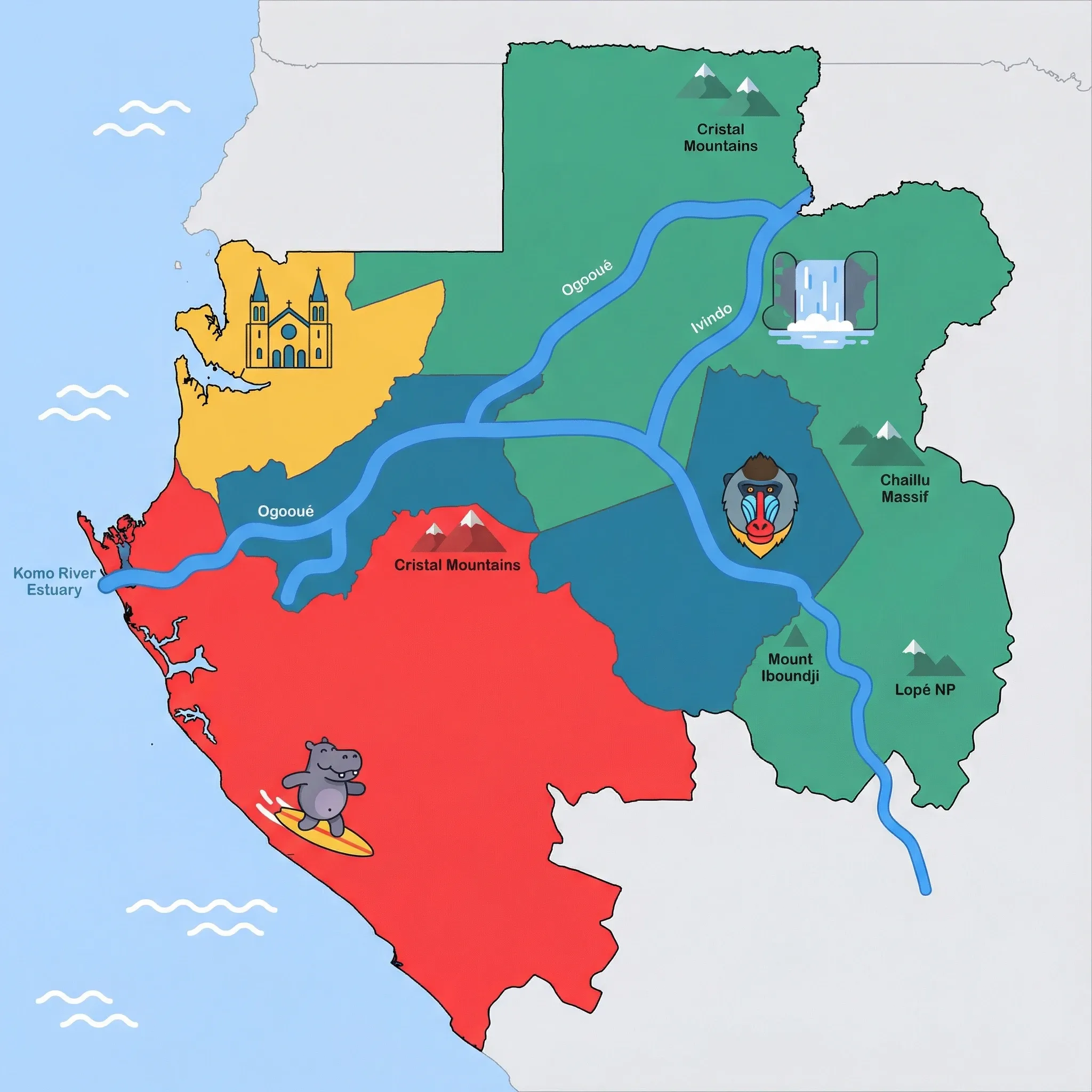
Click a region to explore
Overview
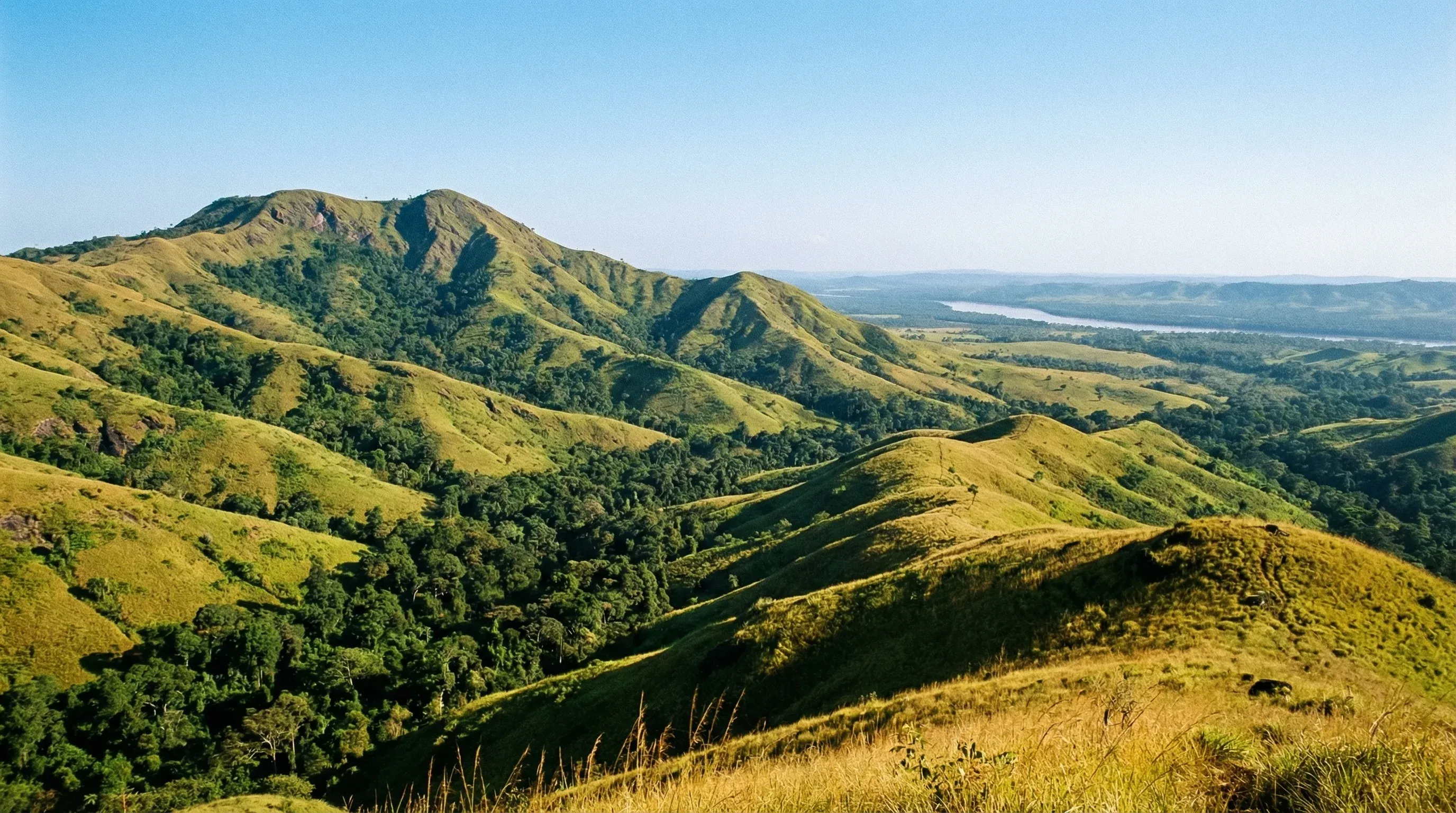
Lopé National Park is a UNESCO World Heritage site and a geological oddity that captivates visitors. It is a mosaic landscape where golden savannah grasses collide abruptly with dense tropical rainforests, a remnant of the last Ice Age. For families, Lopé is arguably the most user-friendly of Gabon's parks because it is accessible by the Trans-Gabon train, eliminating the need for expensive charter flights or grueling 4x4 drives. The open savannah areas make spotting wildlife—like forest elephants, buffalo, and red river hogs—easier than in the dense jungle parks.
Culturally, this region is ancient. The landscape is dotted with petroglyphs (rock carvings) dating back to the Iron Age, providing a fascinating history lesson for children. The real stars of the show, however, are the mandrills. Lopé hosts some of the largest gatherings of primates in the world, with herds sometimes numbering in the hundreds. Hearing the roar of a mandrill troop moving through the forest is a sound your family will never forget. The climate here is slightly drier than the coast, making it a bit more comfortable for hiking.
Key Attractions
The primary destination is Lopé National Park itself. Safari drives here offer a unique visual contrast of animals against the backdrop of Mount Brazza. Unlike typical African safaris, the animals here are forest-dwelling species that venture into the open, so the elephants are smaller and the buffalo are reddish-brown.
Within the park and its buffer zones, guided treks to see the Mandrills are a highlight. While sightings are never guaranteed, the radio-tracking programs increase your chances significantly. For a change of pace, families can hike to the ancient petroglyph sites in the savannah, where kids can see carvings made by humans nearly 400,000 years ago (Stone Age tools have been found here). The Ogooué River also offers boat safaris which are excellent for birdwatching and spotting hippos.
Practical Advice
The best time for mandrills is the dry season (July-August) when they gather in large groups. The train journey from Libreville is comfortable but often delayed; pack plenty of snacks and entertainment for the ride. Malaria is present, so nets and medication are required. The "burning season" (when savannah grass is burned to promote new growth) occurs in dry months—it can be smoky but attracts fresh grazing wildlife.
Food & Drink
Typical meal times: Hotel dining follows standard times: Breakfast 7:00 am to 9:00 am, Lunch 12:30 pm to 2:00 pm, Dinner 7:30 pm to 9:00 pm.
Typical meal costs: Dining is limited to the hotel/lodge you stay in. Expect to pay 15,000–20,000 XAF (approx. $25–33 USD / €23–30 EUR) for a buffet dinner. Local roadside stalls sell fruit and grilled maize for very low prices (500 XAF).
Dietary requirements: Lodges generally offer buffet styles with rice, pasta, and vegetables, making it easier for picky eaters. Gluten-free bread is virtually non-existent, so bring your own crackers/substitutes.
Signature dishes:
- Atanga (Bush Butter) – A purple fruit that is boiled and eaten with salt; it has the texture of butter and is a local favorite in season.
- Brazza Carp – Fresh fish from the Ogooué River, usually grilled or fried, named after the explorer Pierre Savorgnan de Brazza.
- Banane Plantain – Fried, boiled, or mashed plantains are the standard side dish for every meal.
Why this score?
Visiting Lopé involves an adventurous multi-hour train journey followed by savanna and forest trekking to spot wildlife. The environment is wild and requires guided expeditions, though the presence of established research stations and the Mikongo camp provides some structure.
Why this score?
Medical infrastructure in the Lopé area is minimal, consisting only of basic local dispensaries. Foreigners are advised to carry their own extensive medical kits, and any significant trauma would require a long train or road evacuation to the capital.
Why this score?
Lopé is a UNESCO World Heritage site known for its mandrill populations, but it remains a niche destination. It is slightly more accessible than the eastern rainforest thanks to the Trans-Gabon railway, but it still sees very few international families.

Compared to the coastal or deep jungle parks, Lopé offers better value, though still not "cheap." The train ticket (VIP) costs around 40,000 XAF (approx. $65 USD / €60 EUR) one way. Accommodation at the main park hotel costs roughly 60,000–100,000 XAF (approx. $100–165 USD / €90–150 EUR) per night. Safari drives are charged separately, approx. 25,000 XAF ($40 USD / €38 EUR) per person.

Getting Here & Around
Getting Here
- Train – The Trans-Gabon Railway is the best way to arrive. The train runs from Libreville (Owendo) to Lopé station (approx. 5–7 hours). VIP class is recommended for families for air-conditioning and space.
- Driving – The road from Libreville (La Route Économique) is partially paved but has long stretches of rough laterite. It takes 6–8 hours and requires a 4x4.
Getting Around
- 4x4 Safari Vehicle – Essential for entering Lopé National Park. These are provided by the park lodge (Lopé Hotel).
- Walking – Guided walking safaris are a specialty here, allowing you to track mandrills on foot. Age limits may apply for safety.
No airports in this region. See the country flight map for nearby connections.
Official Links

Packing List
Surprisingly, the savannah can get chilly in the early morning and late evening.
The savannah drives can be very dusty in the dry season; protects kids' lungs.
Mandrill tracking involves walking off-trail on uneven forest ground.
The train is often delayed by hours; onboard food is limited and outlets may not work.

Activities & Best Times

Hiking, wildlife, outdoor exploration, ecotourism
A unique forest-savannah mosaic offering world-class wildlife encounters, including mandrills and forest elephants. Dry seasons from June to August provide optimal visibility and trail access, while heavy rains in October and November make forest expeditions nearly impossible.

Urban tourism, museums, historical sites, architecture
Home to the UNESCO-listed Lopé-Okanda cultural landscape, featuring globally significant Iron Age petroglyphs and archaeological sites. Travel is best during dry periods when remote heritage sites are accessible and the interface between culture and nature is most visible.

Sport tourism, fitness activities, active recreation
Offers physically demanding trekking routes like the Mount Brazza Trail and Mikongo wildlife tracking paths. Peak conditions occur during the long dry season when trails are firm; rainy months create dangerous, slippery conditions and heavy mud.

Learning experiences, scientific sites, historical education
The Ecomusée de la Lopé provides significant insights into the region's unique biodiversity and human history, though it serves as a secondary destination. Visits are best aligned with the general dry season to ensure the facility is reachable via the Trans-Gabon Railway.



Public Holidays & Calendar Next 12 months
Public holidays, festivals, cultural celebrations, and seasonal natural phenomena coming up in Lopé NP (wildlife) over the next 12 months.
Loading holidays and events...

Travel Advisory
Gabon is generally stable, but multiple agencies recommend increased vigilance due to crime and potential political instability. While some agencies maintain a baseline level, half advise higher caution due to recent political transitions and urban crime risks.
Safety Topics
Traveller Advice (4 groups)

Stay informed via local news and avoid any political rallies or demonstrations. Adhere strictly to any nighttime curfews established by the government.

Review guidance on local attitudes and legal standing, as social sensitivities can vary and public displays of affection may attract negative attention.

Female travellers should consult gender-specific safety resources; there have been reports of physical assaults and risks associated with walking alone after dark.

Be aware that infrastructure for physical accessibility is limited throughout the country.
Agency Summaries
Travellers should be more vigilant due to concerns regarding crime, social unrest, and health issues. Increased crime rates are noted in Libreville and Port Gentil. A nighttime curfew is currently in effect.
There is a persistent risk of violent crime. Travellers should also be aware of health risks including various insect-borne diseases prevalent in the region.
While no specific warning is in place, travellers are encouraged to have comprehensive insurance and remain aware of potential health and safety risks in the region.
Irish citizens should exercise caution, stay informed of local developments, and avoid all large gatherings or protests. A curfew may be in effect and should be respected.
Travellers are advised to be cautious in crowded locations and near political gatherings, especially around election periods. Recent history includes heightened scrutiny of foreign visitors by local authorities.
Visitors should maintain heightened awareness due to a security environment that is currently stable but remains unpredictable and could change quickly.
Information is provided for general guidance only and does not constitute travel, safety, medical, or legal advice. Conditions may change. Users are responsible for independently verifying information before travel.