
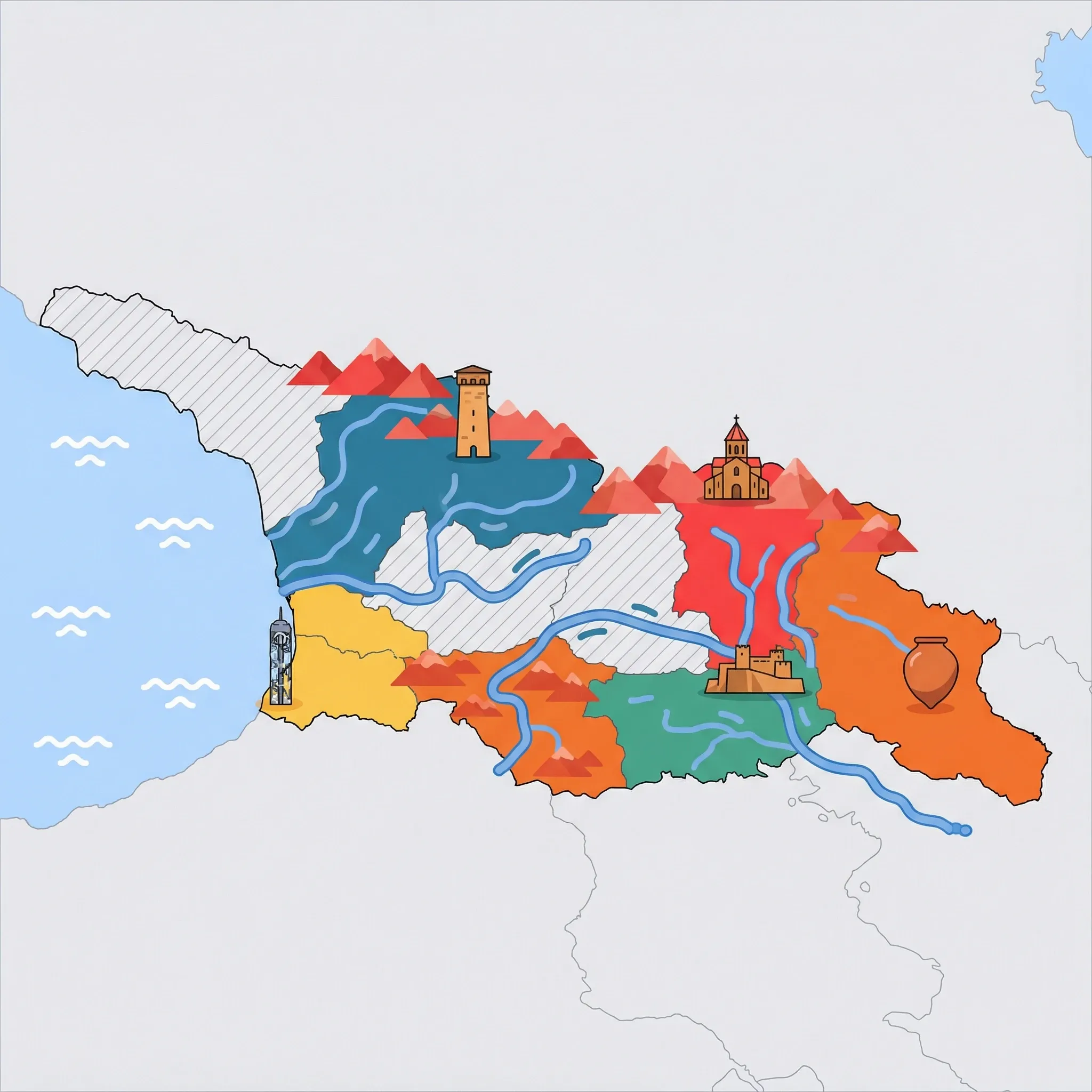
Click a region to explore
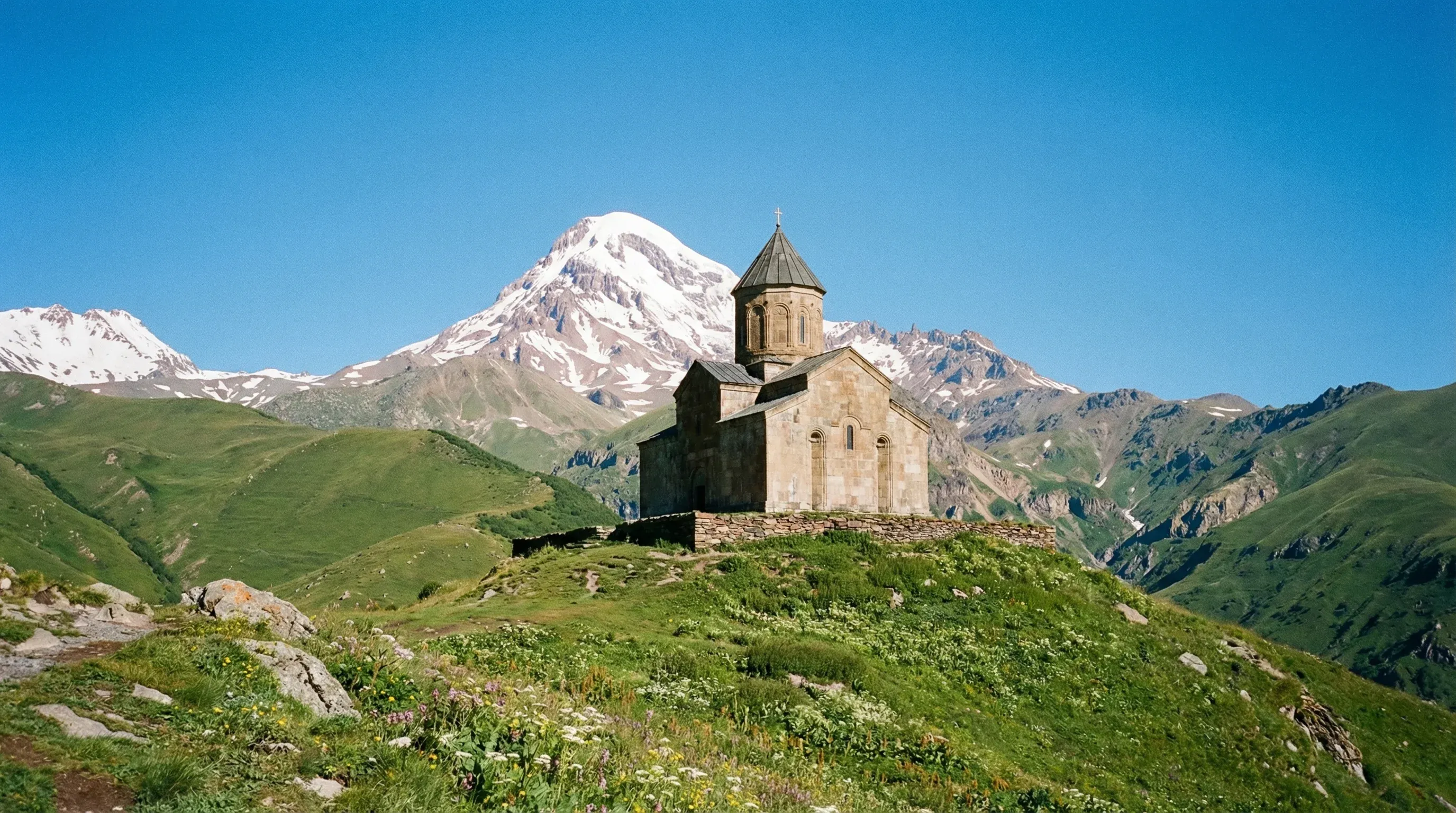
Kazbegi (Stepantsminda) is the gateway to the high Caucasus and offers arguably the most dramatic scenery-to-effort ratio in Georgia. For families, this is the place to see 5,000-meter peaks without needing to be professional mountaineers. The journey itself is the destination here; the region is connected to Tbilisi by the Georgian Military Highway, a historic route that winds through river valleys and high mountain passes, offering jaw-dropping views at every turn. The air is crisp, thin, and revitalizing. While the landscape looks rugged and unforgiving, the infrastructure has developed enough to make it comfortable for families, with good hotels and restaurants sitting right in the shadow of giants.
This region is all about scale. Children are often awestruck by the sheer size of the mountains. It serves as a fantastic outdoor classroom for geography, showcasing glaciers, river gorges, and alpine meadows. Unlike the remote Svaneti region, Kazbegi is accessible enough for a weekend trip from the capital, making it a low-stress option for experiencing the "real" mountains. The culture here is stoic and hardy, born of centuries living in harsh conditions, yet the hospitality remains warm. In winter, the southern part of the region (Gudauri) becomes a ski hub, but in summer, it's a paradise for hiking, horse riding, and paragliding watching.
Key Attractions
The journey usually begins with a stop at the Ananuri Fortress Complex. Sitting on the turquoise waters of the Zhinvali Reservoir, it is a perfect castle for kids to explore, with towers to climb and carvings of dragons and lions to find on the church walls. The ultimate destination is Mount Kazbek, a dormant volcano that dominates the horizon. At its foot lies the Gergeti Trinity Church, perhaps Georgia's most famous image. You can hike up (about 1.5–2 hours, steep but doable for active older kids) or take a local 4WD taxi directly to the top for an unforgettable view.
For a gentler nature experience, the Sno Valley leading to the village of Juta is spectacular. In summer, the area around the "Fifth Season" hotel in Juta offers relatively flat meadows surrounded by jagged peaks—perfect for a family picnic. Kazbegi National Park covers much of this area, protecting the unique alpine flora and fauna, including eagles which you can often spot circling overhead.
Practical Advice
Mountain weather is unpredictable. Even in July, it can be chilly at night or foggy in the mornings. Bring layers. The high altitude (Stepantsminda is at 1,740m) means the sun is stronger than you think—sunscreen is mandatory. July and August are the best months for hiking; May and June can still be wet and muddy.
Food & Drink
Typical meal times: 12:00 pm to 3:00 pm for lunch. Dinner is usually 7:00 pm to 9:00 pm.
Typical meal costs: Prices are higher here due to transport costs. A meal for four costs 100–150 GEL (approx. $37–55 USD / €34–51 EUR).
Dietary requirements: Mountain food is heavy on dough, cheese, and meat. Vegetarians will rely heavily on Khachapuri and vegetable sides. Gluten-free is difficult here as the signature dish is a dumpling.
Signature dishes:
- Khinkali – These famous soup dumplings originated in the mountains. Eating them is a skill: bite a hole, drink the broth, then eat the rest. Kids love the interactive "no cutlery allowed" rule.
- Pkhlovana – A version of Khachapuri stuffed with spinach and cheese, a great way to get greens into children.
- Dambalkhacho – A rare, aged cottage cheese that is usually melted in butter. It has a strong, pungent flavor like a French cheese.
Why this score?
The region offers significant high-altitude terrain, including Mount Kazbek and the rugged Sno Valley, attracting serious mountaineers and paragliders. While the main road is paved, many family activities involves 4x4 off-roading and steep mountain hiking in unpredictable weather conditions.
Why this score?
Healthcare is very limited in Stepantsminda, consisting of a basic medical center designed for stabilization and minor injuries. Given the risk of altitude sickness and hiking accidents, visitors must rely on the fact that Tbilisi's superior hospitals are approximately three hours away by car.
Why this score?
This region is a staple of almost every Georgian travel itinerary due to the iconic Gergeti Trinity Church and its proximity to Tbilisi. While it receives high volumes of day-trippers and hikers, the total overnight visitor capacity remains smaller than the urban centers.

Kazbegi has a "tourist premium" compared to other rural regions. Accommodation ranges from luxury design hotels costing 400+ GEL (approx. $148 USD / €136 EUR) to simple guesthouses for 80 GEL (approx. $30 USD / €27 EUR). A 4WD taxi to the church costs roughly 50–70 GEL (approx. $18–26 USD / €17–24 EUR) per vehicle.

Getting Here & Around
Getting Here
- Driving – The Georgian Military Highway is the only route. It takes about 3–3.5 hours from Tbilisi. The road is paved but winding.
- Private Driver – The best option for families. You can stop at Ananuri Fortress Complex and the Russia-Georgia Friendship Monument for photos.
- Minibus – Marshrutkas leave from Didube station in Tbilisi. They are cheap (15 GEL) but often crowded, fast, and not suitable for those prone to car sickness.
Getting Around
- 4WD Taxi – Essential for reaching Gergeti Trinity Church if you don't hike, and for getting to Juta or the Truso Valley. Regular sedans cannot handle the side roads.
- Walking – The town of Stepantsminda is small and walkable, though hilly.
No airports in this region. See the country flight map for nearby connections.

Packing List
The Military Highway is extremely winding; essential for kids sensitive to car sickness.
Even in August, temperatures can drop to 10°C (50°F) at night or when clouds roll in.
Great for spotting eagles, vultures, and climbers on the glacier of Mount Kazbek.
High altitude sun and wind will chap lips very quickly.
Women must cover their heads to enter Orthodox churches; useful to keep one in your bag.
Essential for cleaning sticky hands after eating Khinkali (dumplings) the traditional way.
Even 'light' walks in Kazbegi or paved streets in Old Tbilisi can be steep, uneven, or muddy.
Street lighting in rural guesthouses and some historic city streets can be dim or inconsistent.
Some stricter monasteries require women to wear skirts (not trousers); wraps are often provided but own is better.
The local diet is very heavy on dough, cheese, and meat, which can be tough on sensitive stomachs.

Activities & Best Times

Hiking, wildlife, outdoor exploration, ecotourism
Offers world-class mountain scenery and high-altitude trekking including the iconic Mount Kazbek and Juta valley. Best explored in summer when high passes are snow-free; winter conditions make most trails dangerous or inaccessible for families.

Urban tourism, museums, historical sites, architecture
Home to the culturally iconic Gergeti Trinity Church and Ananuri Fortress, representing the soul of Georgian highland heritage. Peak visitation occurs during warmer months when these historic sites are easiest to reach and enjoy on foot.

Scenic drives, countryside tours, route-based travel
The Georgian Military Highway is one of the world's most iconic mountain roads with exceptional historical and scenic significance. This elevation creates better differentiation from other Georgian road trip regions and aligns with international recognition of this route.

Sport tourism, fitness activities, active recreation
Features established mountain biking and hiking infrastructure, alongside seasonal adventure parks in Gudauri. Activity is concentrated in the summer window when facilities are operational and the mountain climate is favorable.

Learning experiences, scientific sites, historical education
The Kazbegi National Park Visitor Center offers localized insights into the region's unique biodiversity. It serves as a notable supplementary educational stop during the peak summer tourism season.

Winter sports, ski resorts, snow activities
Gudauri provides significant ski infrastructure with modern lifts and a long season. While a major regional hub, it is rated marginal for international families due to the limited number of distinct resorts in the immediate vicinity.




Public Holidays & Calendar Next 12 months
Public holidays, festivals, cultural celebrations, and seasonal natural phenomena coming up in Kazbegi & Greater Caucasus over the next 12 months.
Loading holidays and events...

Travel Advisory
Five out of six major agencies classify Georgia's overall risk as the lowest level, recommending standard safety awareness. While serious regional warnings exist for the breakaway territories of Abkhazia and South Ossetia, the country is generally considered stable for tourism.
Safety Topics
Traveller Advice (3 groups)

While same-sex acts are legal, social attitudes can be conservative. Members of the LGBTQ+ community may face discrimination or harassment in public settings.

As of early 2026, all visitors are required to have valid health and accident insurance with a minimum coverage of 33,000 GEL. Proof of insurance may be requested upon entry.

Female visitors should exercise caution, particularly when traveling alone at night. Instances of harassment and sexual assault have been reported; avoid isolated areas and use reputable taxi applications instead of hailing cabs on the street.
Agency Summaries
Most of Georgia is safe for travel with standard vigilance. Australian travelers are advised to completely avoid South Ossetia and Abkhazia because of high risks involving terrorism and unexploded ordnance.
While general travel is permitted, the authorities warn against visiting breakaway regions and areas near their administrative boundaries. Travelers are alerted to potential drink spiking in bars and the ongoing risk of political protests in the capital.
Standard safety measures are recommended for the majority of the country. A strict 'Do Not Travel' advisory is in effect for South Ossetia and Abkhazia due to the presence of Russian troops, landmines, and a lack of available emergency services.
Heightened vigilance is advised across the country due to civil unrest and the potential for crime targeting foreigners. Extreme danger exists in the separatist regions where the government has no control.
Visitors should maintain standard safety awareness throughout the country. However, travel is strongly discouraged to regions bordering Russia and the separatist territories of Abkhazia and South Ossetia due to military activity, landmines, and the risk of detention.
Travelers should observe standard safety protocols. It is important to avoid the occupied territories and be mindful of new mandatory health insurance requirements that came into effect recently.
Information is provided for general guidance only and does not constitute travel, safety, medical, or legal advice. Conditions may change. Users are responsible for independently verifying information before travel.